
Journalist

AJP
-
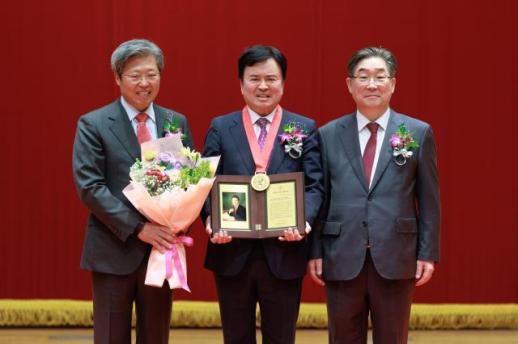 Aju News Corporation Chairman Kwak Young-kil receives Korea University Alumni Award SEOUL, May 05 (AJP) - Aju News Corporation Chairman Kwak Young-kil received the Proud Korea University Alumni Award on Tuesday, using the platform to advocate for a transition to spirit-centered artificial intelligence to ensure human control over technology. The award recognizes the contributions Kwak has made to South Korean media and his philosophical approach to the intersection of humanities and technology. His speech at the ceremony defined a new vision for artificial intelligence governance, emphasizing that spiritual values must guide technological advancement. Korea University President Kim Dong-won presented the award during a ceremony marking the 121st anniversary of the institution at the Inchon Memorial Hall in Seoul. Samyang International Chairman Huh Kwang-soo and Ace Bed Chief Executive Officer Ahn Sung-ho were also honored with the alumni award for their contributions to society and the university. University officials cited the career-long dedication of Kwak to reporting truth and his pioneering spirit. They noted his affection for his alma mater and his commitment to nurturing future scholars as key reasons for his selection. Kwak, who graduated from the Department of English Language and Literature in 1974, said the most important lesson he learned was a humanities mindset rather than just language. He described his academic background as a door to spirituality that transcends linguistic boundaries. The chairman emphasized that the core driving force of the current era must be spirituality. He noted that while he focused on human-centered artificial intelligence a decade ago, the rapid evolution of technology now necessitates a shift toward spirit-centered systems. If spirituality cannot govern artificial intelligence, humans will inevitably be dominated by technology, Kwak told the audience. He added that the essence of this spirituality aligns with the university's core values of liberty, justice, and truth. As a media executive, Kwak highlighted his efforts to promote South Korean industries, including the defense sector, through multilingual news systems. He expressed a desire for Korea University to serve as a lamp for humanity in the age of artificial intelligence. During the ceremony, KNet Investment Partners Chief Executive Officer Kim Dae-young and Eugene Investment and Securities Chief Executive Officer Yoo Chang-su also received the Social Service and Development Contribution Award. 2026-05-05 17:46:37
 -
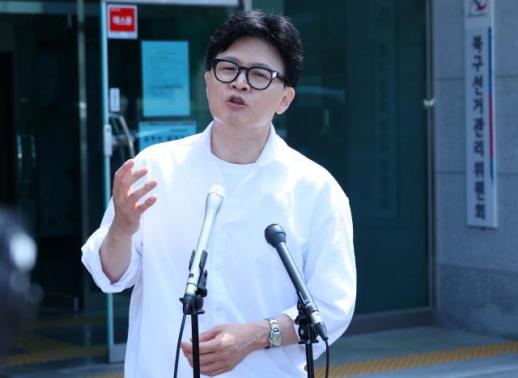 Special Prosecutor Bars Han Dong-hoon From Leaving South Korea in Probe of Alleged North Korea Remittance Case Manipulation A second comprehensive special prosecutor team led by Special Prosecutor Kwon Chang-young has barred Han Dong-hoon, former leader of the People Power Party, from leaving the country after he was accused in connection with allegations that an investigation into remittances to North Korea was manipulated. The team said on the 6th that it imposed a travel ban on Han. A special prosecutor official said the restriction followed the filing of a complaint naming Han as an accused party in a case alleging presidential office interference in a Suwon District Prosecutors Office investigation. According to the Justice Ministry’s Korea Immigration Service, Han has been under a travel ban from the 13th of last month through the 12th of this month due to the ongoing investigation. Han disclosed the travel ban on Facebook and said, “Last year, the Chae Sang-byeong special prosecutor imposed a travel ban on me for an absurd reason and then closed the case without even questioning me. This special prosecutor is repeating the same excessive move.” He added, “The Democratic Party couldn’t even call me as a witness for a parliamentary probe aimed at canceling Lee Jae-myung’s indictment, yet the party and political special prosecutors keep putting on a show. Again, I say, ‘Go ahead and try.’ But there must be no election interference.” Earlier, the civic group Judicial Justice Action filed a complaint with the special prosecutor team on the 7th of last month against seven people, including Han, former President Yoon Suk Yeol, former Prosecutor General Lee Won-seok, former Suwon District Prosecutors Office chief Hong Seung-wook, former second deputy chief prosecutor Kim Young-il, former Criminal Division 6 chief Kim Young-nam, and prosecutor Park Sang-yong. The group alleged abuse of authority and obstruction of rights, and inducing perjury, among other charges. The group said the complaint was based on claims that a “typical fabricated investigation aimed at eliminating a political rival” was carried out to tie Democratic Party leader Lee Jae-myung — described as a leading presidential contender who lost the 20th presidential election by 0.7 percentage points — to the case. The special prosecutor team received the Ssangbangwool remittances-to-North-Korea case from a human rights inspection task force at the Seoul High Prosecutors Office in early last month. It has since pursued the probe under the name “alleged presidential office interference in the Suwon District Prosecutors Office investigation.”* This article has been translated by AI. 2026-05-05 17:34:34
 -
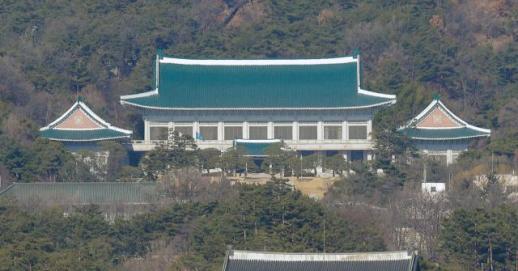 South Korea reviews Hormuz mission after Trump demands military support SEOUL, May 05 (AJP) - The South Korean presidential office Blue House announced Tuesday it is reviewing military participation in a United States-led maritime operation following an explosion on a South Korean cargo ship. The move indicates a shift in Seoul's policy as it evaluates international maritime security against its own domestic legal requirements and peninsula defense needs. The HMM NAMU, a vessel operated by the flagship carrier HMM, suffered an explosion and fire at 8:40 p.m. (1140 GMT) on Monday near the United Arab Emirates. All 24 crew members, including six South Korean nationals, are confirmed safe, but the ship remains inoperable and requires towing to a nearby port for a forensic inspection. The Blue House said that the government is considering the military proposal while accounting for the defense posture of the Korean Peninsula and domestic legal procedures. Officials emphasized that the safety of international shipping lanes and the freedom of navigation are core principles that must be protected under international law. Seoul is currently "noting" the recent public comments made by Donald Trump, who claimed on Truth Social that Iran was responsible for the blast and urged South Korea to join a mission called Project Freedom. The presidential office confirmed that it is maintaining close communication with Washington regarding the stable use of major sea lanes in the region. The government is also coordinating with relevant nations to conduct a thorough investigation into the cause of the explosion and fire. Officials stated that the safety of South Korean citizens and vessels remains the primary focus while the technical origins of the incident are determined. The Blue House stated it will implement corresponding follow-up measures as soon as the results of the investigation are confirmed. 2026-05-05 17:30:03
 -
 Samsung TV Unit Faces Cost Pressures as Panel Prices Jump Nearly 36% in Two Years Samsung Electronics is moving to reshape its TV business, with a sharper focus on improving its cost structure and streamlining operations as profitability remains under pressure from higher input and shipping costs. On May 5, Samsung said it expects it will be difficult to secure strong results and profitability in the TV market this year due to rising raw material prices. The company expects second-quarter demand to grow as major sports events such as the World Cup increase, but it sees overall TV demand remaining largely stagnant this year. A central challenge is the cost of display panels. As panel prices continue to rise, Samsung’s production costs have climbed. According to the company’s business report, Samsung’s spending on display panel purchases rose to 7.9606 trillion won in 2025 from 5.8624 trillion won in 2023, a 35.8% increase in two years. Logistics costs are also rising. With the war in the Middle East dragging on, ocean freight rates have increased, adding to global supply chain cost pressures. Because TVs are bulky and must be shipped worldwide, higher freight costs can directly squeeze margins. Organizational efficiency and cost cuts are expected to be key tasks under President Lee Won-jin. Samsung is seen pursuing a shift from a hardware-centered business toward platforms and services while reducing unnecessary expenses. On the product side, Samsung is pursuing a two-track strategy. In the mid- to low-priced segment, it aims to maintain market share while competing with Chinese brands. In the premium segment, it is expected to focus on advanced markets such as the United States and Europe, centered on organic light-emitting diode (OLED) TVs and ultra-large models. Samsung has recently strengthened its premium lineup by expanding its Micro RGB offerings and has also released new Mini LED models as it seeks to broaden choices and boost share in the mass market. However, Chinese companies such as TCL and Hisense are rapidly improving their technological capabilities, prompting concerns that hardware differentiation alone may not be enough. The key, analysts say, will be how much Samsung can widen gaps in platforms and artificial intelligence. If Samsung strengthens service competitiveness by combining its Tizen OS TV operating system with content and AI features, it could open a new path for growth in its TV business. Kim Won-woo, a vice president in Samsung’s Visual Display Business, said on a recent second-quarter earnings conference call that the company would further solidify its No. 1 position in the global TV market through differentiated product marketing and proactive business responses. He said Samsung will "successfully introduce new models that change the competitive landscape, centered on Micro RGB, OLED and Mini LED, and maximize the launch effect."* This article has been translated by AI. 2026-05-05 17:28:45
 -
 Samsung Taps Software Veteran Lee Won-jin to Lead TV Push on AI and Platforms Samsung Electronics has put software and content specialist Lee Won-jin in charge of its Visual Display (VD) Business, which oversees the company’s TV operations. It is the first time in about 20 years that the VD unit has been led by someone without a hardware development background, since former vice chairman Choi Gee-sung in 2007. The move is widely seen as a bid to counter low-priced competition from Chinese brands by shifting from a hardware-centered approach to a strategy built on platforms and artificial intelligence. Industry officials said Samsung on May 4 appointed Lee, who previously worked at Google, as head of the VD Business, signaling a broader shift in its TV strategy. The personnel change is being interpreted as more than a reshuffle, pointing to a restructuring toward software and services. Samsung has long held the No. 1 spot globally in TV revenue, but it has faced growing pressure on profitability and market share amid aggressive pricing by Chinese rivals. According to market researcher Omdia, Samsung’s share slipped from 30.1% in 2023 to 29.1% last year. TCL and Hisense posted shares of 13.1% and 10.9%, respectively, pushing their combined share into the mid-20% range and narrowing the gap with Samsung. Samsung is accelerating efforts to strengthen its platform business around its Tizen TV operating system. The company aims to generate recurring revenue beyond one-time TV sales through its ad-supported free streaming service, Samsung TV Plus. The service has expanded, with monthly active users topping 100 million worldwide as of January this year. Competition in the global TV market is also intensifying around platforms rather than hardware alone. Omdia forecast that Hisense’s V (formerly Vidaa) will surpass LG Electronics’ webOS in shipments in Europe this year. The Connected TV Marketing Association estimated that in 2024, Samsung’s Tizen OS led the smart TV OS market with a 12.8% share, followed by Hisense V at 7.8% and LG’s webOS at 7.4%. Samsung is also expanding its lineup of TVs with stronger AI features. It plans to apply AI functions to 99% of its new TV models this year as it pushes broader adoption of “AI TVs.” The company is positioning the strategy as a way to secure an edge through high quality and differentiated services, rather than competing primarily on low prices. * This article has been translated by AI. 2026-05-05 17:27:26
 -
 U.S. Raises Pressure on China Over Deportations and Iran Ahead of Trump’s Beijing Trip The United States is stepping up pressure on China over the return of Chinese nationals ordered deported from the U.S. and over Iran, ahead of President Donald Trump’s planned visit to Beijing. A senior Trump administration official told Reuters on Monday that China has been reluctant to accept the return of Chinese nationals in the U.S. illegally and that Washington is prepared to tighten travel restrictions if Beijing does not change course. The official said China accepted about 3,000 people for deportation in early 2025 via charter and commercial flights, but has sharply reduced cooperation over the past six months. “China is not cooperating sufficiently with the United States to repatriate its own citizens,” the official said, calling it a violation of China’s international obligations and its responsibility to its nationals. If China does not expand cooperation, the official said the U.S. could consider raising visa application bonds, widening limits on visa issuance and strengthening entry denials at the border. The official warned that China’s lack of cooperation could also affect future travel by Chinese people who follow the law. The U.S. government estimates more than 100,000 Chinese nationals are in the United States illegally. More than 30,000 have final deportation orders, and about 1,500 are detained awaiting removal, the report said. The warning comes as Trump is scheduled to visit Beijing on May 14-15 for a summit with President Xi Jinping. Trump is expected to raise deportations alongside trade issues. Since returning to office, Trump has made immigration enforcement and deportations a core policy and has raised the possibility of tariffs or sanctions against countries that do not cooperate in taking back their nationals. China has been described as responding cautiously to U.S. requests for years, saying it is willing to accept “verified Chinese nationals” while maintaining that identity checks take time. U.S. urges China to help pressure Iran The United States is also pressing China in connection with Iran. The New York Times reported that Treasury Secretary Scott Bessent said in a Fox News interview on Sunday that he urged China to join “this international operation” and said it remains to be seen whether China will use diplomacy to get Iran to reopen the strait. “Iran is the world’s largest state sponsor of terror, and China has been buying 90% of Iran’s energy, so it is effectively funding the world’s largest state sponsor of terror,” Bessent said. Bessent also said the United States has “complete control” of the strait, underscoring the U.S.-led maritime operation. “We are demanding that (Iran) release these ships for the benefit of the international community, and we expect our international partners to engage in the same way,” he said, adding that it is a good time for partners to step up pressure on Iran. He said the United States is returning fire only if attacked and “is not the provocateur,” but added that if Iran seeks to escalate, the U.S. is ready to respond. The United States has also tightened sanctions targeting China in recent weeks. The State and Treasury departments last month sanctioned China’s Hengli Group over imports of Iranian crude oil, and on May 1 added sanctions on operators tied to a “shadow fleet” linked to Iran’s petroleum exports. Treasury also sanctioned three Iranian exchange houses and related front companies that it said brokered foreign-exchange transactions worth billions of dollars, cutting them off from financial dealings. The groups are accused of converting yuan flowing in from China into other currencies that could be used for military funding. China has pushed back against U.S. sanctions on its companies, signaling discomfort and urging noncompliance, the report said.* This article has been translated by AI. 2026-05-05 17:15:22
 -
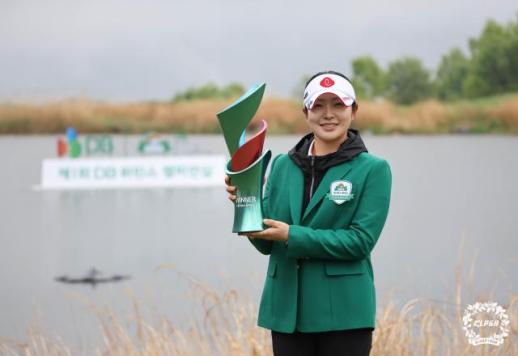 KLPGA Winner Yoo Hyun-jo Climbs to No. 45 in Women’s World Golf Ranking Yoo Hyun-jo, who captured her first win of the 2026 season on the Korea Ladies Professional Golf Association Tour at the DB Women’s Championship (total purse 1.2 billion won), moved back inside the top 50 in the women’s world golf rankings. In the rankings released May 5 (Korean time), Yoo rose eight spots from last week to No. 45. Her career-best ranking is No. 33, set after she finished tied for third at the Hana Financial Group Championship in September last year. Yoo won the DB Women’s Championship, which ended May 3 at Rainbow Hills Country Club (par 72) in Eumseong, North Chungcheong Province. She shot 7-under 281 over four rounds, finishing one stroke ahead of the players tied for second. The 2024 KLPGA rookie of the year, Yoo won last year’s player of the year and scoring titles. The victory was her third career KLPGA Tour win and her first in eight months since winning the KB Financial Star Championship in September. She also became the inaugural champion of the newly created event. Kim Min-sol, a KLPGA Tour “super rookie” who tied for second at the tournament, climbed to No. 39 from No. 44 last week. There was no change at the top of the world rankings. Nelly Korda of the United States, who won her third title of the season at the LPGA Tour’s Riviera Maya Open, which ended May 4, remained No. 1. She was followed by Jeeno Thitikul of Thailand, Kim Hyo-joo, Charley Hull of England, Hannah Green of Australia, Miyu Yamashita of Japan, Minjee Lee of Australia, Lydia Ko of New Zealand and Lottie Woad of England to round out the top 10. Kim Sei-young stayed at No. 11, Yoo Hae-ran at No. 13 and Choi Hye-jin at No. 17.* This article has been translated by AI. 2026-05-05 17:12:17
 -
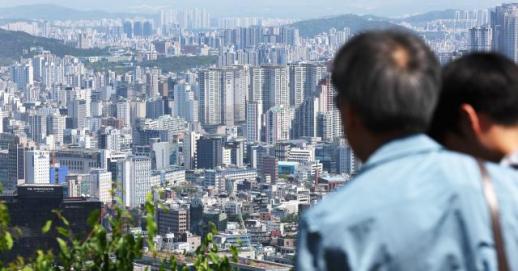 Seoul Jeonse Crunch Deepens as ‘Two-Tier’ Deposits Split Even Within Same Complex As Seoul’s jeonse market tightens, a “two-tier pricing” pattern is spreading, with large gaps in deposits even for the same complex and the same size unit. The split is most pronounced in high-priced complexes where home prices have surged and in complexes with a large share of public rental units that anchor cheaper jeonse deals. According to the Transport Ministry’s real-transaction disclosure system, a new jeonse contract for an 84-square-meter unit in Eunpyeong New Town’s Gupabal 10 Complex (Building 1019, 4th floor) was signed on May 1 for 680 million won. A comparable 84-square-meter lease in the same for-sale section of the complex, signed last month using a tenant’s right to request a renewal, was 580 million won — a gap of about 100 million won. The difference is sharper because the complex separates rental buildings from general-sale buildings. Of 100 jeonse transactions recorded in April for Buildings 1001 to 1028, only one new contract occurred in the general-sale buildings (1011 to 1019). In the rental buildings (1020 to 1028), 95 jeonse contracts were renewals, with 84-square-meter deposits around 25.117 million won, underscoring the internal split. A similar pattern has appeared in complexes with high rental shares. In Gangdong-gu, a new jeonse contract for an 84-square-meter unit in Gangil River Park 10 Complex was signed in February for 640 million won, while renewal contracts last month remained around 385.87 million won. Of the complex’s 694 households, rentals account for 67.7% (470 households), including 377 long-term jeonse units. The rental supply effectively sets a low-end price floor, widening the gap with new contracts. By district, the median deposit gap between new and renewed contracts in Gangdong-gu and Eunpyeong-gu was 100 million won each, well above the Seoul-wide gap of 55 million won. They ranked second in Seoul after Seocho-gu, which posted a 200 million won gap. The figures suggest the two-tier effect is intensifying in areas with expensive complexes or mixed public-rental developments. Yang Ji-young, a specialist at Shinhan Premier Pathfinder, analyzed 74,407 apartment lease transactions in Seoul from Jan. 5 to April 30. Among 38,246 jeonse deals, the median deposit for new contracts (17,825 cases) was 585 million won, 55 million won higher than the median for renewals (19,166 cases), at 530 million won. Gaps were also evident in key areas along the Han River where home prices rose sharply last year. Seocho-gu had the largest median difference at 200 million won, followed by Songpa-gu at 88 million won, Dongdaemun-gu at 75 million won, Seongbuk-gu at 60 million won, and Gangnam-gu and Seongdong-gu at about 50 million won each. In Songpa-gu’s Helio City, a new jeonse contract for a 110-square-meter unit (Building 110, 24th floor) was signed on April 22 for 1.7 billion won. A unit of the same size on the 21st floor in the same building was renewed the same month for 1.33 billion won. With renewal increases capped at 5% by law, the gap between market-priced new leases and capped renewals widened to as much as 370 million won even under similar conditions. Experts said volatility could increase as more tenants who have used up renewal rights are exposed to market prices. Yang warned, “From 2026 to 2027, when the first renewal cycle arrives for many newly built complexes, the market-price shock could begin in earnest.”* This article has been translated by AI. 2026-05-05 17:06:15
 -
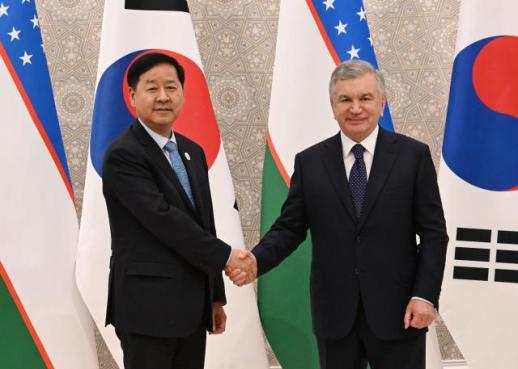 South Korea’s Koo Yun-cheol Meets Uzbek President, Seeks More Openings for Korean Firms Koo Yun-cheol, South Korea’s deputy prime minister and minister of economy and finance, met with Uzbekistan’s president and agreed to strengthen cooperation in emerging industries, including biotech, as Seoul seeks to broaden opportunities for Korean companies in Central Asia. South Korea’s Ministry of Economy and Finance said Tuesday that Koo met President Shavkat Mirziyoyev on May 3 (local time) in Samarkand to discuss the planned Korea-Central Asia summit in September and the direction of bilateral economic cooperation. According to the Korea Trade-Investment Promotion Agency, Uzbekistan imports $1.79 billion worth of Korean products. Exports are led by manufactured goods such as auto parts, passenger cars, engines and synthetic resins, while demand continues to rise for consumer goods and higher value-added items including cosmetics and medical electronic devices. Mirziyoyev cited the Afrasiyab murals in Samarkand as an example of long-standing friendly exchanges between the two countries. “Based on this, I hope trade and investment cooperation between Korea and Uzbekistan will expand further,” he said, adding that he hoped for broad discussions to identify cooperation projects and produce tangible results. Koo praised Uzbekistan’s recent reform and opening policies and the economic gains that followed. He said the two sides should strengthen cooperation in biotech, infrastructure such as railways and airports, supply chains and regional cooperation. Koo said he understood Uzbekistan is prioritizing industrial diversification and infrastructure modernization under its 2030 development strategy, and asked that opportunities be opened for Korean companies “given their strong capabilities.” Before meeting the president, Koo held talks with Uzbek officials overseeing economic cooperation with South Korea, including Deputy Prime Minister Jamshid Khodjaev and Deputy Prime Minister and Minister of Economy and Finance Jamshid Kuchkarov, as well as vice ministers from the ministries of investment, industry and trade; economy and finance; transport; and health, to review the status of bilateral cooperation. The deputy prime ministers agreed that cooperation should shift from a focus on infrastructure to more forward-looking areas such as biotech and critical minerals. Khodjaev said he hoped cooperation with South Korea would deepen in projects Uzbekistan is pushing, including the creation of medical and pharmaceutical clusters and the construction and operation of a new airport. The Export-Import Bank of Korea and Uzbekistan’s Ministry of Investment, Industry and Trade signed a strategic cooperation memorandum of understanding to expand exchanges in areas such as supply chains and digital and green cooperation. The ministry said the bank will support companies in both countries through policy financing to help broaden cooperation outcomes. Earlier, on May 2 (local time), Koo visited a medical cluster site in Tashkent with Khodjaev and Health Minister Khudayarov Anvarovich. The cluster, which is to include a national children’s hospital and a Tashkent general hospital, is being developed with support from South Korea’s Economic Development Cooperation Fund. Koo said the cluster could help Uzbekistan position itself as a medical hub in Central Asia. Khodjaev said, “With Korea’s EDCF support, we have been able to provide high-quality medical services to the people of Uzbekistan,” and expressed gratitude. Koo visited Uzbekistan on the sidelines of the Asian Development Bank’s annual meeting and met senior officials, including the president and two deputy prime ministers, the ministry said.* This article has been translated by AI. 2026-05-05 17:04:29
 -
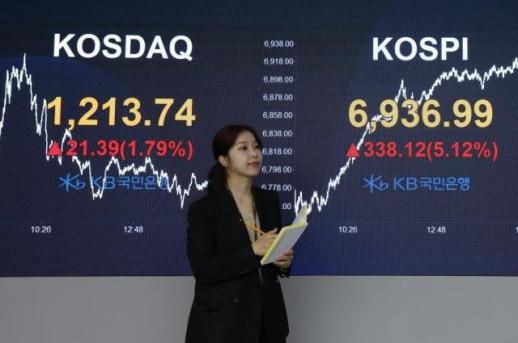 Bank Deposits Shift to Stocks as KOSPI Rally Fuels 'Money Move' Expectations that the KOSPI will break above 7,000, along with forecasts of a rally in large-cap technology shares, are accelerating the shift of money from bank deposits into the stock market. Analysts say the trend reflects a clearer move away from deposit-centered asset management as investors chase higher returns. According to the Bank of Korea’s Economic Statistics System, the number of time-deposit accounts at commercial banks with balances of 100 million won ($72,000) or less totaled 21,629,000 at the end of last year. That was the lowest since the end of the first half of 2019 (20.7 million). The figure fell 3.2% from the end of the first half of last year (22,334,000) and 3.1% from the end of 2024 (22,330,000). The total amount held in those sub-100 million won time deposits also slipped. The balance stood at 299.709 trillion won at the end of last year, down 2.2% from a year earlier (306.528 trillion won). After rising for three years and six months and hitting a record at the end of the first half of last year (308.333 trillion won), the uptrend reversed. Most time deposits under 100 million won are believed to be held by individuals. Banks say the decline reflects a recent personal-finance trend in which retail investors are moving beyond deposits and taking a more active approach to investing. For similar reasons, demand deposits—often treated as cash waiting to be invested—have been swinging sharply. At the five major banks (KB Kookmin, Shinhan, Hana, Woori and NH Nonghyup), demand-deposit balances were 699.9081 trillion won at the end of March, fell to 680.9236 trillion won on April 16, then rebounded to 700.6712 trillion won at the end of April, showing nearly 20 trillion won moving out and back in within about two weeks. Analysts attribute the pattern to money flowing heavily into stocks as the KOSPI repeatedly set new highs, then returning to banks at month-end as investors rebuilt cash positions. A key gauge of leveraged stock buying in Korea—outstanding margin loans—has also set fresh records. Margin loans refer to money investors borrow from brokerages for stock purchases that has not yet been repaid. The balance first topped 35 trillion won on April 23, then hit another high five days later on April 28 (35.6895 trillion won). It has risen for 13 straight trading sessions since April 10 and is up 2.7 trillion won so far this month. The shift is expected to persist for now, with bank deposit rates stuck in the 2% range and the KOSPI pushing higher day after day, lifting expected returns. Global investment banks have raised their KOSPI forecasts sharply, to as high as 8,500, adding to the flow of funds. A commercial bank official said that in the past, people tended to park lump sums in time deposits, but now they are increasingly moving money frequently based on market conditions. The official added that the pace of transfers has quickened alongside the recent stock-market rise.* This article has been translated by AI. 2026-05-05 17:03:15