
Journalist

AJP
-
 S. Korean researchers capture electricity-switching moment in next-gen memory materials SEOUL, February 08 (AJP) - Researchers at the Korea Advanced Institute of Science and Technology and Kyungpook National University have developed a technique to observe the real-time electrical switching process within nano-devices. By rapidly melting and freezing tellurium at cryogenic temperatures, the team successfully created and stabilized amorphous tellurium, a material essential for high-speed, low-power memory. This research provides a foundational understanding of how and when electrical switching occurs, offering a new blueprint for designing efficient semiconductor materials. As artificial intelligence applications expand, computers require faster and more energy-efficient memory. The performance of these semiconductors depends on the switching principle, the mechanism by which memory materials turn electricity on and off. Tellurium has gained attention as a candidate for next-generation memory due to its ability to transition between high and low resistance states. However, tellurium is highly sensitive to heat, making it difficult to maintain its amorphous state—a disordered atomic structure similar to glass—under normal operating conditions. The research team, led by Professor Seo Jun-gi of the Department of Chemical and Biomolecular Engineering at the Korea Advanced Institute of Science and Technology (KAIST) and Professor Lee Tae-hoon of Kyungpook National University (KNU), addressed this instability by lowering the surrounding temperature to cryogenic levels. In this environment, they applied electrical current to momentarily melt tellurium and then cooled it rapidly to lock it into an amorphous state. This method allowed the researchers to compare the electrical flow of disordered amorphous tellurium with that of regularly arranged crystalline tellurium within the same device. Through this comparative analysis, the team identified that microscopic defects within the amorphous tellurium play a critical role in electrical conduction. The study revealed that switching occurs in two distinct stages: first, current increases sharply along these defects when a specific voltage is reached, and second, heat accumulates until the material melts. Previously, it was believed that the sudden increase in current was caused primarily by the melting process itself, but this research clarifies the specific roles of defects and thermal energy. The researchers also successfully demonstrated a self-oscillation phenomenon, where voltage repeatedly rises and falls while maintaining the amorphous state without excessive current. This finding indicates that stable electrical switching can be achieved using only tellurium, a single-element material, without the need for complex chemical compositions. Professor Seo Jun-gi stated that this is the first study to implement amorphous tellurium in an actual device environment and clarify the switching principle. He noted that the research sets a new standard for the study of next-generation memory and switching materials. Heo Nam-uk, a student in the integrated master's and doctoral program at KAIST, served as the lead author. The study was published online in Nature Communications on January 13. (Paper information) Journal: Nature Communications Title: On-device cryogenic quenching enables robust amorphous tellurium for threshold switching DOI: https://bit.ly/4knBqqs 2026-02-08 12:00:00
 -
 South Korea’s Cha Jun-hwan, Shin Jia gain team-event experience, eye Olympic singles medals South Korea’s figure skating standouts Cha Jun-hwan and Shin Jia used the team event as a tune-up, getting a feel for the Olympic ice and atmosphere ahead of the singles competition. South Korea finished seventh with 14 points in the figure skating team event at the 2026 Milan-Cortina d’Ampezzo Winter Olympics on Saturday (Korea time) at the Ice Skating Arena in Milan, Italy. The top five advanced to the final segment (free skating and free dance), and South Korea did not qualify. Cha placed eighth in the men’s short program. His key mistake came on the final jump element, a triple axel, when he lost rotation on takeoff and turned it into a single axel (one and a half rotations). Under short program rules, skaters must attempt a double axel or triple axel for the element to count, so it was scored as zero. Afterward, Cha told reporters in the mixed zone, “It’s disappointing that I made a mistake on the third jump (the triple axel). I want to think of it as a vaccine shot ahead of the individual event.” He added, “It’s frustrating because it’s not something I usually do, but I’m satisfied because the other elements were about as good as in practice. I’ll make up for it in the individual event.” Cha will skate the men’s short program on Feb. 11, with medals decided in the free skate on Feb. 14. Shin, competing in her first Olympics, boosted expectations with a steady performance in the women’s short program on Feb. 6, finishing fourth. After a clean skate, she clenched her fist in celebration. In a broadcaster interview, Shin said she tried not to dwell on the Olympic stage. “I thought I’d get nervous if I kept thinking it was the Olympics, so I controlled my mindset and told myself it was a competition I always do,” she said. “That helped me skate like I usually do.” She added, “The team event helped me find my rhythm. I’ll carry that momentum into the individual event and show everything I can do.” Shin is scheduled to skate the women’s short program on Feb. 18, aiming for South Korea’s first Olympic figure skating medal in 16 years since Kim Yu-na. The free skate is set for Feb. 20. 2026-02-08 11:36:00
 -
 Ryu Seung-wan’s ‘Humint’ Tops Advance Ticket Sales Ahead of Release The film ‘Humint’ has climbed to No. 1 in overall advance ticket sales ahead of its theatrical release. According to the Korean Film Council’s integrated box office system, ‘Humint’ ranked first as of 10:24 a.m. on Saturday, with 142,151 tickets reserved. The surge followed the first preview screening, with moviegoers calling it “pure catharsis experienced in a theater.” ‘Humint’ is a term for intelligence work that relies on human networks, meaning an informant. The story is set in Vladivostok, where secrets and truth are buried in an icy sea, and people with different goals collide. Directed by Ryu Seung-wan, the film stars Jo In Sung, Park Jung Min, Shin Se Kyung and Park Hae Joon. It opens in theaters Feb. 11. * This article has been translated by AI. 2026-02-08 11:24:00
 -
 Pyongyang highlights military role in national development on army anniversary SEOUL, February 08 (AJP) - North Korea has marked the 78th anniversary of the founding of its armed forces on February 8, with state media calling for the military to guarantee national prosperity ahead of a major political gathering. The Workers' Party of Korea is scheduled to hold its ninth congress in Pyongyang later this month. The event, held every five years, is the highest decision-making body of the state and is expected to outline new development goals while reinforcing the country’s security posture. An editorial in the Rodong Sinmun, the official newspaper of the Workers' Party, stated that the Korean People's Army must maintain its political and military power to match the status of the state. The publication urged the military to provide a strong defense for the party and people as they move toward what it described as a new stage of socialist development. "The struggle of our party and people to raise the phase of national prosperity to a new high level must be firmly guaranteed by powerful arms," the editorial said. It added that the military has successfully suppressed challenges and threats from hostile forces to ensure the safety and rights of the people. The state also emphasized the military's involvement in domestic economic projects, particularly the Regional Development 20x10 Policy. This initiative involves the military in the construction of local factories across the country. North Korea has newly organized 20 units known as the 124th Regiments, with each regiment assigned to a specific construction site. The editorial called on the personnel of the 124th Regiments to act as the vanguard of the new year's struggle and to fulfill their duties in expanding the regional revolution. February 8 commemorates the date in 1948 when the Korean People's Army held its official founding ceremony in Pyongyang. North Korea recognized this date as its Army Day until 1977, after which it moved the anniversary to April 25 to mark the 1932 formation of anti-Japanese guerrillas by Kim Il-sung. The country returned to observing the February 8 anniversary in 2018. 2026-02-08 10:06:33
 -
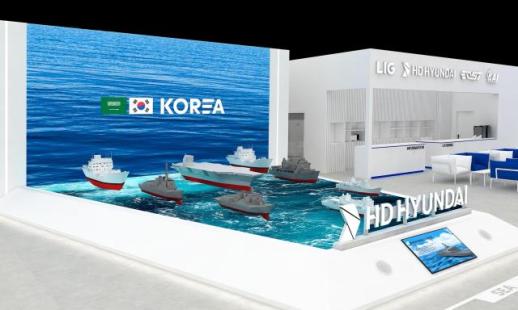 HD Hyundai Heavy Industries to Showcase Advanced Warship Technology at Saudi Defense Expo HD Hyundai Heavy Industries is taking part in the Middle East’s largest defense exhibition in Saudi Arabia as it steps up efforts to win the kingdom’s next frigate program. The company said it will attend the 2026 World Defense Show, or WDS, in Riyadh from Feb. 8 through Feb. 12. It plans to run a joint exhibition area with LIG Nex1, Korea Aerospace Industries (KAI) and EOST to present advanced shipbuilding technology and maritime defense capabilities. Held every two years, WDS is expected to draw about 770 defense companies from 76 countries and more than 100,000 visitors this year, bringing together key decision-makers from the Middle East and the global defense market. Saudi Arabia is pursuing a naval modernization program that includes large-scale procurement of new frigates. HD Hyundai Heavy Industries said it will display eight types of vessels, including the 6,000-ton export frigate HDF-6000, designed to meet Saudi requirements. The company said it developed the HDF-6000 as an “Aegis destroyer-class frigate,” expanding its size and significantly upgrading onboard systems and performance based on experience building the Sejong the Great-class and Jeongjo the Great-class Aegis destroyers. At the show, HD Hyundai Heavy Industries plans to highlight a package approach for the Saudi naval modernization effort to officials from the Saudi Defense Ministry and navy. It said it will emphasize its design, construction and project-management capabilities, along with experience in local construction and maintenance, repair and overhaul, citing successful results at Peru’s SIMA shipyard. The company also said it will propose a phased localization plan tailored for shipbuilding in Saudi Arabia. If it wins a frigate order, it is considering gradually increasing the share of local construction for the HDF-6000 centered on the Saudi IMI shipyard, established through joint investment by HD Korea Shipbuilding & Offshore Engineering and Saudi state-owned company Aramco, among others. Separately, HD Hyundai Heavy Industries said it will sign a joint memorandum of understanding with Saudi Arabia’s Ministry of Investment and 12 South Korean companies, including LIG Nex1 and STX Engine, to build a local supply chain. The MOU aims to set cooperation measures under Saudi Arabia’s Industrial Participation Program, or IPP, and pursue joint entry into the Saudi market. Joo Won-ho, president of HD Hyundai Heavy Industries, said the company added strategic weight by presenting the HDF-6000, optimized for Saudi requirements, at the region’s largest defense exhibition. He said the company will do its best to win the next frigate program through local construction and industrial cooperation using IMI, the largest shipyard in the Middle East and North Africa. * This article has been translated by AI. 2026-02-08 09:33:00
 -
 LGES buys battery JV in Canada as Ottawa weighs industrial offsets in submarine bid SEOUL, February 08 (AJP) -LG Energy Solution (LGES) has agreed to acquire its partner’s entire stake in a major Canadian battery plant for a symbolic $100, underscoring how slowing electric vehicle demand, shifting industrial policy and geopolitics are reshaping North America’s manufacturing landscape. In a regulatory filing on Friday, the South Korean battery maker said it would purchase the 49 percent stake held by Stellantis in their joint venture, NextStar Energy Inc., ending the partnership formed in 2022 to build Canada’s first large-scale EV battery plant in Windsor, Ontario. Stellantis however will remain as a customer. Under the agreement, LGES will take full ownership of the venture by June 30, 2026, acquiring shares for $100 that Stellantis had originally bought for $980 million. LG has committed $1.46 billion to the project and said its investment will continue as planned. The price reflects the deteriorating outlook for EV demand in North America, where automakers have scaled back expansion plans amid weaker sales and the rollback of U.S. consumer tax incentives. LGES said the ownership change would allow it to realign the facility toward a broader customer base, including energy storage systems (ESS), as automakers cut battery orders. Company officials in Seoul said the move reflects a strategic shift away from reliance on a single carmaker and toward fast-growing demand from data centers and renewable energy projects. One production line at the Windsor plant has already been converted for ESS manufacturing, with LG targeting utilization of more than 70 percent by year-end. The facility’s full capacity stands at about 49.5 gigawatt-hours annually. The pivot follows the cancellation of a $6.5 billion EV-related supply deal with Ford Motor late last year and mirrors similar conversions at LGES’ U.S. plants in Michigan. The restructuring comes as Canada intensifies efforts to protect its auto sector and attract non-U.S. investment, amid trade tensions with Washington and uncertainty over the future of North American supply chains. Prime Minister Mark Carney’s government has rolled out incentives tied to domestic production and revived EV purchase subsidies to stabilize the industry after major cutbacks by automakers. Last year, U.S. President Donald Trump imposed 25 percent tariffs on Canadian vehicles and parts, dealing a major blow to exports and accelerating streamlining of Canadian operations by carmakers including Stellantis which has moved production of its Jeep Compass model from Ontario to Illinois. Canadian officials now say the ability of foreign partners to deliver broader industrial benefits — beyond a single project — is becoming central to Ottawa’s investment strategy. The battery plant deal is also being watched closely in Seoul and Berlin, as Canada evaluates bids for its multibillion-dollar Canadian Patrol Submarine Project (CPSP). Stephen Fuhr, Canada’s special envoy for defense procurement, said during a recent visit to South Korea that automotive and advanced manufacturing cooperation would weigh heavily in the final decision. “If there are areas where we can cooperate in sectors like automobiles, we are looking to pursue broader partnerships that go beyond defense,” Fuhr said after touring facilities operated by Hanwha Ocean. Analysts observe LGES' deeper commitment to Canadian manufacturing may strengthen South Korea’s case by reinforcing long-term industrial ties at a time when Ottawa is seeking to reduce dependence on U.S.-based supply chains. For LGES, full control of NextStar offers operational freedom and access to generous Canadian production subsidies. For Ottawa, it preserves a flagship manufacturing asset while reinforcing its pitch for foreign partners willing to invest across multiple sectors. 2026-02-08 08:02:18
 -
 Snowboarder Lee Sang-ho Targets Medal at Milan-Cortina Olympics, Eyes South Korea’s 400th South Korea’s top alpine snowboarder, Lee Sang-ho (Nexen Wingard), will try to add a milestone to the nation’s Olympic history at the 2026 Milan-Cortina Winter Olympics. Lee is scheduled to compete Sunday (Korea time) in the men’s parallel giant slalom at Livigno Snow Park in Italy’s Sondrio province. Qualifying begins at 5 p.m., and if he finishes in the top 16, he will advance to the head-to-head finals starting at 9 p.m. to decide the medals. Lee won silver in the men’s parallel giant slalom at the 2018 Pyeongchang Olympics, delivering South Korea’s first-ever Olympic medal in skiing or snowboarding. He is seeking another Olympic medal for the first time in eight years after falling in the quarterfinals at the 2022 Beijing Games. He has dealt with multiple injuries and had an uneven start to the season while continuing equipment tests. But he surged just before the Olympics, winning a International Ski and Snowboard Federation (FIS) World Cup race on Jan. 31 in Rogla, Slovenia. Lee, the captain of South Korea’s men’s team at these Games, is also aiming for what would be the nation’s first Olympic gold medal in skiing or snowboarding. His result is drawing added attention because it could also mark South Korea’s 400th Olympic medal overall. South Korea have won 320 medals at the Summer Olympics (109 gold, 100 silver, 111 bronze) and 79 at the Winter Olympics (33 gold, 30 silver, 16 bronze), for a total of 399. The first South Korean medalist at the Milan Winter Olympics would become the 400th. Also competing in the men’s parallel giant slalom are Kim Sang-gyeom (High1) and Cho Wan-hee (Jeonbuk Ski Association). In the women’s event, Jung Hae-rim (High1) is set to race.* This article has been translated by AI. 2026-02-08 07:45:00
 -

A long war, fading certainties *Editor’s Note: As Russia’s invasion of Ukraine nears its fifth year, AJP reviews how the war began, how it has evolved, and where it is heading — and asks the most urgent question of all: will it end? This first installment examines the toll on Ukraine, Russia, and the world. SEOUL, February 07 (AJP) - As Russia’s full-scale invasion of Ukraine approaches its fifth year, the war shows signs of diplomatic motion without political resolution — inching toward talks, yet anchored by irreconcilable claims over land, security and identity. According to a recent report by Reuters, Washington is pressing Moscow and Kyiv to explore a tentative peace framework, with March floated as an ambitious target for progress. U.S. and Ukrainian negotiators, led by Special Envoy Steve Witkoff and former presidential adviser Jared Kushner, have discussed proposals that could eventually be put to a Ukrainian referendum. Yet diplomats on both sides acknowledge that the timeline is fragile. Russia remains adamant about retaining occupied territories, while Ukraine refuses to legitimize territorial loss. For now, the war grinds on — suspended between battlefield exhaustion and diplomatic paralysis. A Goliath Wounded What began on Feb. 24, 2022, as a rapid campaign envisioned by President Vladimir Putin has hardened into a prolonged war of attrition. Russia failed to seize Kyiv, lost tens of thousands of elite troops, and settled into incremental advances measured in meters rather than kilometers. An analysis by the Center for Strategic and International Studies (CSIS) estimates that Russian forces have suffered roughly 1.2 million casualties, including more than 325,000 killed since 2022 — the highest toll for a major power since World War II. At current rates, CSIS warns, combined casualties on both sides could approach two million by 2026. Ukrainian losses are estimated at 500,000 to 600,000, according to CNN, while Britain’s UK Ministry of Defence said Russia crossed the threshold of one million killed or wounded by mid-2024. Despite sustained offensives, Russian units in some sectors have advanced by no more than 70 meters per day — slower than the pace of trench warfare at the Somme in 1916. The result is a modern paradox: a militarized giant bleeding manpower, capital and credibility, yet still capable of sustaining war. The Logic of Attrition Unable to secure a decisive breakthrough, the Kremlin has embraced a strategy of exhaustion — wearing down Ukraine’s infrastructure, economy and manpower through steady artillery fire, drone strikes and missile barrages. Russia now controls about one-fifth of Ukrainian territory. Most of those gains, however, have come at extraordinary human cost. Economically, Moscow’s war footing rests on narrow foundations. Manufacturing output weakened through much of 2025, consumer demand softened, and growth slowed to around 0.6 percent. Demographic decline and labor shortages have deepened structural fragilities. Russia, once eager to present itself as a technology power, no longer hosts a single firm among the world’s top 100 by market value. Yet the war machine persists, sustained in part by external lifelines. Western intelligence agencies say Chinese exports of dual-use goods have enabled Russian factories to expand missile production, while North Korea supplies ammunition in exchange for economic and technological support. Iran, too, remains a critical drone supplier. These networks have allowed Moscow to absorb losses that would have crippled most economies — but at the price of deeper strategic dependence. A Fraying Western Consensus The war has also tested Western cohesion. “The West is showing fatigue,” said Berthold Rittberger of LMU Munich. “Without the U.S., Europe still lacks the capability to contain Putin. Populists and pro-Russian forces are exploiting this to deepen polarization.” Across the Atlantic, Joseph Parent of the University of Notre Dame offers a bleaker assessment. “The war was effectively over in its first six months,” he said. “Both sides lost. Ukraine won’t get its old borders back, and Russia won’t keep Ukraine out of the West. The longer it drags on, the weaker both societies become.” In Washington, election politics further complicate strategy. Uncertainty over future U.S. commitment has already influenced European calculations — and emboldened Moscow. Europe’s Strategic Dilemma For Europe, the war has been both a geopolitical awakening and a fiscal burden. In the early months of the invasion, European leaders moved with unusual unity, imposing sanctions, expanding defense budgets and funneling military aid to Kyiv. Nearly five years on, that consensus has thinned. Energy prices have stabilized, but political cohesion has not. Far-right and Eurosceptic parties — many openly sympathetic to Moscow — are gaining ground from Paris to Prague. Governments face rising defense bills at a time of slowing growth and voter fatigue. “Europe has done more than it ever imagined it would,” said Berthold Rittberger of LMU Munich. “But it is reaching the limits of what it can sustain politically and economically.” While European Union members have pledged tens of billions of euros in military and financial assistance, much of their security architecture still depends on American power. Without U.S. leadership, Europe struggles to translate resources into credible deterrence. “Without the United States,” Rittberger added, “Europe still lacks the military capacity and institutional coordination to contain Russia on its own.” This dependency has sharpened anxieties about Washington’s future reliability. A shift in U.S. policy, European officials fear, would leave the continent exposed — diplomatically, militarily and psychologically. Privately, European diplomats now speak less about “victory” and more about “managing decline”: preventing Ukraine’s collapse, limiting escalation, and preserving NATO’s credibility. The change in tone reflects hard arithmetic. Ammunition stocks are depleted. Defense industries are struggling to scale up production. And public patience is eroding. “Support for Ukraine remains strong in principle,” one senior EU official said, “but weaker in practice. Every budget cycle becomes harder.” For Moscow, this erosion is strategic. Russia’s war planners have long calculated that Western unity would fray before Ukrainian resistance. Europe’s growing ambivalence — amplified by domestic politics — suggests that calculation may yet prove correct. Seoul’s Strategic Lens In South Korea, the war is increasingly viewed not only as a European crisis, but as a rehearsal for geopolitical realignment in Asia and feels too closely at home with the same global superpowers deeply involved in the war including North Korea. Kwon Young-se, a senior lawmaker of the People Power Party and former ambassador to China, observed Trump’s return to had reshaped the conflict. “Trump is unlikely to invest large sums of money in a war he considers unrelated to U.S. interests. That is why Washington is now pushing ceasefire ideas that Kyiv can hardly accept.” For Seoul, the war’s most troubling byproduct lies farther east. “North Korea has gained leverage,” Kwon said. “With Russian technology transfers, its missile and nuclear programs are advancing. That changes the threat environment.” Another former ambassador and lawmaker Kim Gunn traced the conflict to deeper historical anxieties, invoking British geographer Halford Mackinder’s theory of Eurasian power. “Russia believes that without controlling its neighbors, it is vulnerable,” he said. “But recognizing spheres of influence is dangerous. That logic justified past imperialism. It invites endless expansion.” “After the war, Russia will seek new partners,” Kim said. “Its Far East development could become central. Korea may emerge as an important economic partner.” Between War and Peace The current diplomatic push reflects exhaustion more than reconciliation. Russia seeks recognition of its territorial gains. Ukraine seeks security guarantees and sovereignty. The United States wants stability before electoral uncertainty intensifies. None of these goals align easily. For now, negotiations resemble parallel monologues rather than genuine compromise. The front lines barely shift. Casualties accumulate. Reconstruction plans outpace peace prospects. For South Korea, the lesson is strategic duality: maintain solidarity with Western allies while preserving diplomatic channels across Eurasia. “Korea must strengthen its military and work with value-sharing partners,” Kwon said. “But we must also remain pragmatic.” He suggests Seoul must have eyes on post-war order. “It may sound cold,” he said, “but once reconstruction begins, there will be a huge economic stage. Korea should position itself early.” Kim echoed that view: “Our diplomacy must be multidimensional. If major powers tolerate revisionist aggression, global instability will deepen.” Nearly five years in, Russia’s war has become more than a territorial dispute. It is a test of endurance, governance and global resolve. It has exposed the limits of military power, the fragility of alliances, and the costs of strategic ambiguity. Whether March produces a ceasefire or another missed deadline, the deeper reckoning will persist. The conflict has already reshaped Europe’s security order and Asia’s strategic calculations. As one empire’s ambitions erode under the weight of reality, the fault lines of the next global contest are taking shape — slowly, relentlessly, and at immense human cost. 2026-02-08 07:30:53 -
 South Korea’s Internet Banks Step Up Lending to Sole Proprietors South Korea’s internet-only banks are accelerating efforts to grow lending to sole proprietors as they look for new revenue sources. With major commercial banks taking a more cautious approach to such loans to manage asset quality, online lenders are moving to capture niche demand and diversify their portfolios. According to the financial industry on Saturday, KakaoBank since Feb. 2 has added a new three-year maturity option to its real estate-backed loan for sole proprietors, which has a maximum limit of 1 billion won. The bank previously offered only 5-, 10-, 15- and 20-year terms, but expanded choices as demand for short-term funding has grown. It also added a bullet repayment option alongside installment repayment, allowing borrowers to reduce monthly payments. Toss Bank, which has not yet launched a collateralized loan, is strengthening its lineup with unsecured products aimed at specific sole proprietors. On Feb. 5, it introduced a “professional sole proprietor loan” for nine licensed professions, including doctors, lawyers and accountants. The bank said it can automatically verify license and certification information through a non-face-to-face process. K Bank moved first among internet-only banks by launching a real estate-backed loan for sole proprietors and has sought to add customers by expanding refinancing so borrowers can switch from loans at most regulated financial institutions. It is promoting competitive terms, including an average interest rate about 1 percentage point lower than major commercial banks. The push reflects the need to sustain growth as financial regulators continue to tighten oversight of household lending, limiting asset growth for internet-only banks that have relied heavily on consumer loans. Loans to sole proprietors are seen as a new growth area because they are relatively less affected by those rules. Demand is also shifting as South Korea’s five largest banks — KB Kookmin, Shinhan, Hana, Woori and NH NongHyup — have raised rates or tightened screening for sole proprietor loans amid concerns about weakening asset-quality indicators. As of the end of last year, the five banks’ outstanding sole proprietor loans totaled 324.4325 trillion won, down 0.4% from a year earlier. Over the same period, KakaoBank’s outstanding sole proprietor loans, including real estate-backed and unsecured loans, rose 61.3% to 3.0550 trillion won. K Bank’s total outstanding sole proprietor loans also doubled. “Because growth strategies centered on household lending are becoming difficult, we have no choice but to expand corporate credit, especially financing for sole proprietors,” an internet-only bank official said. “Non-face-to-face financial services that improve convenience for sole proprietors will continue to be introduced.” 2026-02-08 07:03:00
 -
 Cha Jun-hwan’s jump error leaves South Korea out of Olympic figure skating team final South Korea’s top men’s figure skater, Cha Jun-hwan of Seoul City Hall, stumbled in his first appearance at his third Olympics, finishing eighth in the men’s short program of the figure skating team event. Cha scored 83.53 points on Saturday (Korea time) at the Milan Ice Skating Arena in Milan, Italy, at the 2026 Milan-Cortina d’Ampezzo Winter Olympics. He earned 41.78 points in technical elements and 41.75 in program components, placing eighth among 10 skaters. The team event is a nation-based competition across four disciplines — men’s and women’s singles, pairs and ice dance. Points are awarded by placement in each segment (10 to 1), and the top five teams advance to the final (free skating and free dance). South Korea returned to the Olympic team event for the first time since the 2018 Pyeongchang Games. South Korea had 11 points after Friday’s segments: ice dancers Lim Hae-na and Kwon Ye placed seventh (four points), and women’s singles skater Shin Ji-a placed fourth (seven). South Korea did not enter a pairs team and received zero points; it was the only team-event nation without an entry in one discipline. To reach the top five, South Korea needed Cha to finish in the top two in men’s singles to add nine or 10 points. His eighth-place result ended South Korea’s chances. The team finished seventh overall. Skating fifth, Cha performed his short program to “Rain in Your Black Eyes.” He opened with a clean quadruple Salchow, then landed a triple Lutz-triple loop combination. His flying camel spin earned Level 4. But he made a costly mistake on his final jump, the triple Axel. He lost rotation on takeoff and completed only a single Axel. The men’s short program requires either a double Axel or triple Axel; Cha’s single Axel was scored zero. He finished with a change-foot combination spin and a step sequence, both graded Level 4. Yuma Kagiyama of Japan won the segment with 108.67 points. Ilia Malinin of the United States was second with 98.00. The five teams advancing to the free programs were the United States (34 points), Japan (33), Italy (28), Canada (27) and Georgia (25).* This article has been translated by AI. 2026-02-08 05:42:22