
Journalist

AJP
-
 OIMU’s “San 239” Wins Bronze in 2026 World’s Most Beautiful Book Contest <San 239> (publisher OIMU, designer Shin Sohyeon) won a Bronze Medal in the 2026 World’s Most Beautiful Book competition, the Korean Publishers Association said on the 13th. The Bronze Medal ranks fourth, after the top Golden Letter award and the gold and silver medals. The “World’s Most Beautiful Book” competition is jointly run by Germany’s Stiftung Buchkunst and the Leipzig Book Fair. <San 239> is a small book measuring 50 millimeters wide, 68 millimeters tall and 20 millimeters thick. It is fitted with a carabiner and a compass so it can be clipped to a bag or belt. Each page introduces one of 239 mountains on the Korean Peninsula, listing practical information for hikers such as location and elevation, whether it is among Korea’s “100 famous mountains,” guidance on what to do when encountering wild animals, and first-aid tips. German organizers said the book “goes beyond something to read” and can serve as a companion on the trail, noting that it packs a sweeping subject — 239 Korean mountains — into a format small and light enough to carry anywhere. They also cited the balance of text, images and illustrations in conveying extensive information clearly within limited space, calling it an object in which every element is precisely designed. Designer Shin Sohyeon of OIMU said, “More than half of Korea is made up of mountains, and most mountains are open to everyone,” adding, “If you enjoy hiking, I hope you’ll clip this book to your bag and we’ll meet on the mountain.” Judging for the 2026 competition was held Feb. 19-21 at the German National Library by an international design jury of five designers. A total of 14 books from nine countries were selected as final winners. The awards ceremony will be held at 4 p.m. local time March 20 at the Leipzig Book Fair. * This article has been translated by AI. 2026-03-13 08:30:38
 -
 BTS-Linked Museum Projects Spotlight Silla Bell and Korean Painting Catalog With BTS set to return on the 21st, the group is drawing fresh attention to Korea’s traditional culture, including museum projects tied to the band. After a National Museum product line known as “Muetts” linked BTS with the famed King Seongdeok bell, a new catalog of Korean paintings produced with a donation from BTS leader RM has also put cultural heritage in the spotlight. According to the cultural sector on the 13th, visitors to Gyeongju National Museum can experience the bell’s sound in a way that is otherwise difficult to hear. The National Museum Foundation of Korea and HYBE produced the Muetts items to mark the release of BTS’ fifth full-length album, “ARIRANG,” drawing motifs from patterns on the King Seongdeok bell. The Unified Silla-era bronze bell is known not only for its decoration but also for its clear, solemn tone, often described as an “echo of a thousand years.” But regular bell-ringing at the museum stopped in 1992 to protect the artifact, making the sound hard to hear in person. The museum disclosed a sound-testing session in September last year for the first time in 22 years, but outdoor speakers have made it difficult to fully convey the bell’s distinctive beat effect. The bell’s sound alternates in intensity. That pattern fueled a legend that a baby was sacrificed during casting because the ringing resembled an infant’s cry, giving rise to the nickname “Emille Bell.” The museum offers an indirect way to experience the sound. A digital immersive video now screening in the digital theater on the first floor of the Silla Art Gallery uses projection mapping and 9.1-channel audio to recreate the bell’s resonance and form. Kim Yun-i, a curator at Gyeongju National Museum, said the team “put a lot of effort into the sound,” adding that it reproduces even the beat effect that is hard to feel through outdoor speakers and has drawn a strong response from visitors. She said the video uses the bell’s actual sound recorded during the sound test, making the resonance more vivid. The video is part of the permanent exhibition and can be viewed during museum hours without a reservation. Interest in Korean painting is also growing. The Overseas Korean Cultural Heritage Foundation, under the Korea Heritage Service, recently published a catalog titled “IT’S ______ HERE: Korean Old Paintings Shining Abroad,” bringing together Korean paintings held by major museums and art institutions overseas. It spans about 400 years of Korean painting, from the early 16th century to the 20th century. The catalog was produced with funds donated by RM in 2022. It includes “Pyeongan-gamsa-do-gwa-geupjeja-hwanyeong-do (平安監司道科及第者歡迎圖),” held by the Peabody Essex Museum in the United States and highlighted last year after conservation work by the Leeum Museum of Art. The 19th-century work depicts a series of events hosted by a provincial governor to celebrate two people who passed a provincial exam in Pyeongan Province. It shows a large procession, an outdoor banquet and an elaborate feast, portraying Pyongyang’s prosperity, goods and the people watching the festivities. The catalog will be distributed to national and public libraries and major research institutions in and outside South Korea for public access. Kwak Chang-yong, secretary-general of the foundation, said the works in the catalog “carry meaning as a cultural bridge connecting Korea and the world,” adding that RM’s support for traditional culture “further raised the value of this catalog.” * This article has been translated by AI. 2026-03-13 08:12:33
 -
 Seoul places rare price cap on gasoline prices on outlook on lengthier crisis SEOUL, March 13 (AJP) -South Korea will impose a rarely-used fuel price cap starting midnight Friday in an emergency attempt to contain surging domestic fuel costs driven by escalating tensions in the Middle East and renewed volatility in global oil markets. The Ministry of Trade, Industry and Energy said Thursday the measure will set a ceiling on the wholesale prices oil refiners charge gas stations and distributors for key petroleum products, though retail prices at individual gas stations will not be directly regulated. The initial ceiling, effective from March 13 to March 26, is set at 1,724 won ($1.16) per liter for gasoline, 1,713 won for diesel and 1,320 won for kerosene. The levels are 109 won, 218 won and 408 won lower, respectively, than the average supply prices refiners reported on March 11. Authorities said the caps will be reviewed every two weeks depending on global oil price movements. The ceiling will be calculated based on refiners’ weekly average supply prices before the Middle East crisis, adjusted by fluctuations in the Mean of Platts Singapore (MOPS) benchmark and then adding taxes. The government invoked a rarely visited clause in the Petroleum Business Act that allows authorities to designate maximum prices when oil market volatility threatens economic stability. It marks the first enforcement of the system since South Korea liberalized petroleum pricing in 1997. Industry Minister Kim Jung-kwan said the move aims to stabilize fuel costs while preventing excessive price hikes that could distort the market. “The government decided to introduce the petroleum price cap system to stabilize oil prices, respond to unreasonable price increases and ensure that the burden of rising fuel costs is shared among the government, businesses and the public,” Kim said during a ministerial task force meeting on consumer prices. Officials also warned they will closely monitor market behavior, including possible hoarding or excessive price hikes at gas stations not directly covered by the cap. Under the program, exports of petroleum products subject to the ceiling may also be restricted to prevent domestic supply shortages caused by price gaps with overseas markets. The government said any financial losses incurred by refiners will be reviewed and compensated after the program ends, subject to strict verification. The emergency measure comes as domestic fuel prices have surged sharply since the outbreak of the latest Middle East conflict on Feb. 28, when the United States and Israel launched airstrikes on Iran. According to the Korea National Oil Corp., the nationwide average retail gasoline price climbed to 1,904.3 won per liter, up from 1,692.6 won before the conflict. Diesel prices rose even faster, reaching 1,927.5 won per liter from 1,597.2 won over the same period. Global oil markets have also swung sharply higher as the war threatens shipping through the Strait of Hormuz, a chokepoint for about 20 percent of global seaborne crude flows. Brent crude surged 9.2 percent to $100.46 per barrel Thursday — its largest one-day jump since 2020 — while U.S. benchmark West Texas Intermediate (WTI) rose 9.7 percent to $95.73. The spike followed warnings from Iran’s newly appointed supreme leader Ayatollah Seyed Mojtaba Khamenei, who said Tehran would consider expanding the conflict and continue using the possibility of blocking the Strait of Hormuz as leverage against the United States and Israel. The threat of prolonged disruption to global oil shipments has heightened concerns of a sustained energy price shock, prompting governments across Asia to prepare emergency stabilization measures. Seoul said it will lift the price cap once domestic fuel markets stabilize, while continuing efforts to secure additional crude supplies outside the Middle East and prepare potential releases from strategic petroleum reserves. 2026-03-13 07:48:50
 -
 Global Air Defense Market Grows as Hanwha, Other South Korean Firms Expand Production Demand for air defense weapons is rising in the Middle East and Europe, rapidly expanding the global market and prompting South Korean defense companies to intensify sales efforts and expand production bases. With regional instability persisting in the Middle East, countries are moving more aggressively to strengthen air defense capabilities. According to the defense industry on March 12, Hanwha took part in a defense exhibition opening that day in Brussels, Belgium, promoting systems including the long-range surface-to-air missile, or L-SAM, and the Chunmoo multiple rocket launcher. L-SAM is designed to intercept ballistic missiles at high altitude and is often described as a “Korean-style THAAD.” Chunmoo is a weapons system capable of firing various guided munitions. By joining the exhibition in Belgium, home to NATO headquarters, Hanwha aims to accelerate its push into Western Europe. Hanwha Aerospace has secured contracts to supply Romania with K9 self-propelled howitzers and K10 armored ammunition resupply vehicles worth $1 billion, and to supply Poland with Chunmoo multiple rocket launchers in deals valued at $3.6 billion for the first phase and $2.2 billion for the second. Lim Kyung-wook, head of Hanwha Aerospace’s Romania unit, said at an international security and defense conference in Bucharest on March 10 (local time) that the company would expand in Europe based on a local factory. The sales push comes as demand for South Korean air defense weapons grows quickly in Europe and the Middle East. Cheongung-II, deployed earlier this month in the United Arab Emirates, has drawn attention for its performance, spreading by word of mouth to neighboring countries. Industry observers have also suggested announcements of additional purchase agreements with multiple Middle Eastern countries could be imminent. As production demand increases, South Korean defense firms are expanding their footprints. Hanwha Aerospace began construction last month on a production plant in Romania aimed at broadening its European supply chain. In South Korea, affiliate Hanwha Systems relocated its Gumi production plant last year, increasing output capacity by about 30%. The facility expanded from 45,000 square meters to 89,000 square meters, roughly doubling in size. LIG Nex1, the lead contractor for South Korea’s missile systems, completed a guided-missile assembly and inspection facility this month in Gumi, North Gyeongsang Province, for the Fleet-to-Air Guided Missile-II. Korea Aerospace Industries said it built a second hangar near its Sacheon plant in South Gyeongsang Province in line with planned KF-21 deliveries in the second half of this year. “Production lines tied to export contracts are already running at full capacity,” a defense industry official said. “If additional new weapons exports are secured, expanding the workforce will be unavoidable.” Industry officials say shifting security conditions in Europe and the Middle East are creating opportunities for South Korean defense companies. As countries in those regions seek to reduce reliance on U.S.-made weapons and strengthen their own defense industries, analysts say South Korea has emerged as a niche supplier. Choi Ki-il, a professor of military studies at Sangji University, said Europe’s expanding “buy European” approach is changing defense exports from simple weapons sales to deals that also build production facilities. For Middle Eastern countries, he said, difficulties importing weapons from adversary states are combining with a growing tendency to seek South Korea, which he described as having strong ground-weapons production capabilities among NATO countries.* This article has been translated by AI. 2026-03-13 05:04:57
 -
 LIG Nex1 to Rename as LIG Defense & Aerospace, Expanding Into Space LIG Nex1, marking its 50th anniversary this year, will change its name to LIG Defense & Aerospace (LIG D&A) as it seeks to broaden its business beyond missiles into space and aviation and position itself as a global defense contractor. The company said it aims to expand exports of a Korean-style integrated air defense system, led by its flagship Cheongung-II interceptor, as part of its push to become a 100-year company. According to the defense industry on March 12, LIG Nex1 will hold a shareholders meeting on March 31 to discuss agenda items including the name change, an increase in the scale of bond issuance, reflecting revisions to the Commercial Act, and approval of dividend payments. The company had signaled in January that it would adopt the LIG D&A name. A company official said the change is intended to clarify its defense-industry identity while expanding into global markets and the space sector, adding that it would make a fresh start under a new banner meaning “to the world, to space, to the future.” Tracing its roots to Geumseong Precision, LIG Nex1 began in 1976 as a U.S. missile maintenance company working on systems such as Hawk and Nike. After separating from the LG Group, it acquired LG Innotek’s defense business division in 2004 and adopted its current name in 2007. Its core technologies include precision strike, surveillance and reconnaissance, avionics, command and control, and communications. Key products include the Shingung short-range surface-to-air missile, the Cheongung medium-range surface-to-air guided weapon, and the Bigung guided multiple-launch weapon. The company has drawn attention in global markets after Cheongung-II deployed in the United Arab Emirates during the recent U.S.-Israel and Iran war posted a 96% interception success rate. LIG Nex1 said the rebranding reflects its goal of becoming a comprehensive defense company spanning guided weapons, aircraft armaments, electronic warfare and space. As modern warfare shifts toward reconnaissance, target identification, precision strike and layered air defense networks, space-based technology is increasingly central, driving defense firms to secure space infrastructure. The company says it already has capabilities in rocket propulsion, guidance, radar, communications, sensors and satellite data, making expansion into space more feasible. It also pointed to the example of RTX, created through the merger of missile maker Raytheon and aerospace-focused UTC. An industry official said missiles and satellites share many underlying technologies, and that the space sector faces simpler export controls than weapons, making it easier to attract investment, pursue technical cooperation and join global projects. LIG Nex1 is also posting results in related areas. A key project is a 1.6 trillion won program signed with South Korea’s Defense Acquisition Program Administration to develop a Korean electronic warfare aircraft system. The company has also begun business cooperation with global space defense firm L3Harris on future space and satellite development. It plans to expand bond issuance to support new business growth. Industry observers said the new LIG D&A name and the Cheongung-II showcase are expected to lift the company’s global profile. CEO Shin Ik-hyun said, “This year, our 50th anniversary, will be the first year of a new start toward the next 100 years,” adding that the company will aim to become a true defense leader by building a global foundation, accelerating research and development and strengthening a culture of communication.* This article has been translated by AI. 2026-03-13 05:03:29
 -
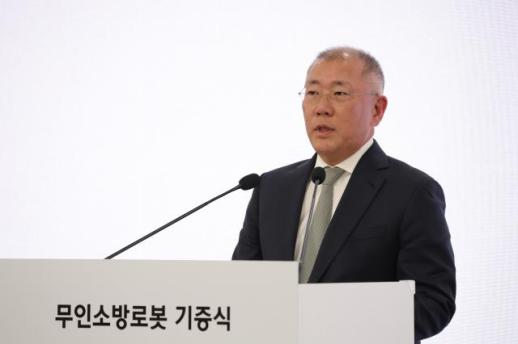 Hyundai Motor Group Chairman Chung Euisun Earns $3.9 Million in First Kia Pay Hyundai Motor Group Chairman Chung Euisun received 5.4 billion won ($3.9 million) in compensation from Kia last year, the automaker said. In its 2025 annual business report filed Thursday, Kia said Chung was paid 2.7 billion won in salary and 2.7 billion won in bonuses, for a total of 5.4 billion won. Chung, who became chairman of Hyundai Motor Group in 2020, had run Kia without pay through 2024 and received compensation from the company for the first time last year. Through 2024, he received salary from two companies, Hyundai Motor and Hyundai Mobis. Excluding Hyundai Motor, whose business report has not yet been filed, Chung’s total compensation last year from Kia and Hyundai Mobis was 8.46 billion won, the report said. Kia said Chung has contributed to record results since being appointed an inside director in March 2019, citing efforts to strengthen competitiveness and recruit global talent. It said it began paying him last year to reinforce accountable management as global trade conditions and geopolitical uncertainty worsen and competition in future mobility intensifies. Kia CEO Song Ho-sung received 3.042 billion won in compensation last year, including 1.516 billion won in salary and 1.526 billion won in bonuses and other pay, up 5.7% from a year earlier. Kia posted 114.1409 trillion won in revenue last year and 9.0781 trillion won in operating profit. Revenue rose 6.5% from the previous year to a record, while operating profit fell 28.6% due to the impact of U.S. tariffs. Total production was 2,851,092 vehicles, with plant utilization at 91.6%. 2026-03-12 19:03:15
 -
 Hanmi Pharm Names Hwang Sang-yeon as CEO Candidate, Signaling Possible First Outside Hire Hanmi Science, the holding company of the Hanmi Group, is moving to replace the CEO of Hanmi Pharmaceutical and reshape the company’s board. It has nominated Hwang Sang-yeon, head of the private equity division at HB Investment, as a new inside director to succeed CEO Park Jae-hyun, in a bid to stabilize management. If Hwang’s appointment is confirmed after a shareholders meeting scheduled for later this month, Hanmi Pharmaceutical would be led by an externally recruited CEO for the first time since its founding. Hanmi Science and Hanmi Pharmaceutical said they each held board meetings on March 12 and approved an agenda item for Hanmi Pharmaceutical’s shareholders meeting later this month to nominate Hwang as a new director candidate. Hwang is expected to be selected as CEO after the regular shareholders meeting and a subsequent board meeting. Born in 1970, Hwang earned bachelor’s and master’s degrees in chemistry from Seoul National University. He previously served as head of the research center at Mirae Asset Securities and as chief investment officer at Allianz Global Investors, and later became CEO of Chong Kun Dang Holdings. In 2025, he joined venture capital firm HB Investment as head (vice president) of its newly established private equity fund unit. The market expects that, with experience in both the biotech industry and capital markets, he will help coordinate complex interests between major shareholders and management and strengthen the company’s competitiveness. Hanmi Pharmaceutical’s current and former CEOs — Lee Kwan-soon, Woo Jong-soo, Kwon Se-chang and Park — were professional managers promoted internally who led the company’s growth over decades. Hanmi Pharmaceutical’s board currently has 10 members: four inside directors — Park Jae-hyun, Lim Jong-hoon, Park Myung-hee and Choi In-young; four outside directors — Yoon Do-heum, Kim Tae-yoon, Lee Young-gu and Yoon Young-kak; and two other non-executive directors — Shin Dong-kuk and Kim Jae-kyo. The terms of five members — Park Jae-hyun, Park Myung-hee, Yoon Young-kak, Yoon Do-heum and Kim Tae-yoon — expire this month. At its meeting, Hanmi Science approved an agenda item to reappoint audit committee member Kim Tae-yoon (outside director) and to nominate Hwang, Kim Na-young, head of Hanmi Pharmaceutical’s new product development division, former lawmaker Chae Yi-bae, and Han Tae-joon, president of Ghent University Global Campus, as new directors. * This article has been translated by AI. 2026-03-12 18:18:00
 -
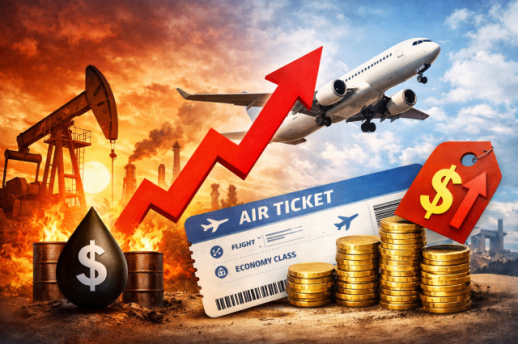 Korea’s Big 3 Budget Airlines Lack Fuel Hedges as Fares Set to Rise in April-May Geopolitical risks tied to the Middle East have increased airlines’ exposure to oil-price swings, and the burden is expected to be heavier for low-cost carriers that do not have fuel hedging contracts. Airfares are also expected to rise from April and May. According to industry officials on Wednesday, the so-called LCC Big 3 — Jeju Air, Jin Air and T’way Air — do not currently have separate fuel hedging contracts. Other low-cost carriers also do not have such contracts. A fuel hedging contract is a type of derivative used when buying jet fuel on a relatively mid- to long-term basis. It sets both upper and lower price limits to reduce management risk from later price fluctuations, helping airlines cushion costs when oil prices are volatile. With international oil prices rising in the wake of the Middle East war, low-cost carriers without hedges face higher costs. The global average jet fuel price in the first week of March was $157.41 a barrel, up about 58.4% from the previous week. In the last week of February, it was $99.40 a barrel, up 3.6% from the prior week, before the increase accelerated. The rise is expected to feed into higher ticket prices. Korean airlines have already announced they will raise domestic-route fuel surcharges in April to 7,700 won from 6,600 won in March. That calculation included only a single day — Feb. 28, the first day of U.S. and Israeli airstrikes on Iran — and oil prices have surged since then, raising expectations that May surcharges will jump sharply. April fuel surcharges for international routes are also expected to be announced soon, with a larger increase anticipated than for domestic routes because longer flights make fuel a bigger share of ticket prices. The April international surcharge is calculated using average jet fuel prices from Feb. 16 to March 15, meaning it is more likely to reflect the impact of the Middle East war. The exchange rate is another variable because fuel is paid for in U.S. dollars. As the dollar strengthened on concerns that high oil prices could persist due to the war, the won-dollar exchange rate rose to 1,495.5 won on March 9, nearing the 1,500-won level. With high oil prices and a weak won overlapping, losses at low-cost carriers already struggling with weak results are expected to widen. An airline official said low-cost carriers are believed to be unable to buy derivatives given the amount of jet fuel they consume annually. The official said they are instead responding by ordering slightly more fuel than needed when placing orders with fueling companies. * This article has been translated by AI. 2026-03-12 18:03:16
 -
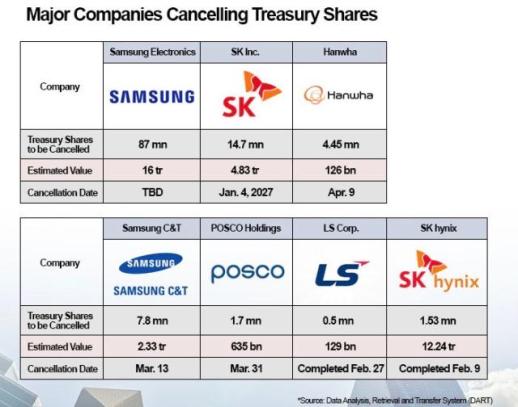 Korean Inc. in a rush to retire shares but risks losing key management tool SEOUL, March 12 (AJP) — South Korea’s largest companies have rushed to retire 36.3 trillion won ($25 billion) worth of treasury shares in the first quarter of 2026 under a new Commercial Act amendment, but analysts warn the mandatory move may do little to improve corporate value while stripping management of a key strategic tool. A string of blue-chip firms including Samsung Electronics, SK hynix and Samsung C&T have unveiled large-scale treasury share cancellations since the revised law took effect, putting share buybacks and retirements at the center of Korea’s market reform drive. Supporters say broader cancellations could help narrow the longstanding “Korea discount” by lifting per-share metrics and strengthening shareholder returns. Critics, however, say the law forces companies to give up assets long used to support management control, fund acquisitions and compensate employees. The third amendment to the Commercial Act, passed by the National Assembly on Feb. 25 and effective from March 6, requires listed companies in principle to cancel treasury shares within a year of acquiring them. Exceptions, including stock-based compensation and employee stock ownership plans, are allowed only with shareholder approval at a general meeting. According to regulatory filings, Samsung Electronics plans to cancel about 87 million treasury shares worth roughly 16 trillion won. SK hynix will retire 15.3 million shares valued at about 12.24 trillion won. Other major firms are following suit. Samsung C&T plans to cancel 7.81 million shares worth about 2.33 trillion won, while SK Inc. will retire 14.69 million shares worth around 4.83 trillion won. POSCO Holdings and LS Corp. have also canceled treasury shares worth about 635.1 billion won and 129.3 billion won, respectively. Canceling treasury shares reduces the number of shares outstanding, which typically boosts earnings per share and book value per share. For that reason, it has long been regarded as a straightforward way to return value to shareholders. But analysts say the effect on corporate value is not automatic. “The idea that fewer shares automatically raise corporate value is too simplistic. Markets have already priced in such factors,” said Shin Hyun-han, a professor at Yonsei University. Kim Dae-jong, a professor at Sejong University, said treasury share retirements can be a more equitable form of shareholder return than dividends because they benefit all shareholders proportionately. Even so, he cautioned that making cancellations mandatory could come at a high cost for companies. “The biggest loss from mandatory cancellations is reduced capital flexibility,” Kim said. “Companies can sell treasury shares to raise cash or use them in M&A deals. Mandatory cancellations remove that option.” Treasury shares have long served as strategic assets for Korean companies, despite being treated as a deduction from equity in accounting terms. In practice, they have functioned as a reserve of capital that can be mobilized for financing, strategic partnerships or management defense. That matters especially in Korea, where treasury shares have at times played a role in reinforcing control structures during corporate restructuring or spin-offs. With forced retirements becoming the norm, those options could narrow, making it harder for controlling shareholders to defend management rights. Shin argued that the broader risk is a decline in management stability. “If management control can be easily challenged, companies may struggle to make long-term plans,” he said. He also warned the rule could backfire by discouraging future buybacks altogether. “If buybacks must ultimately be canceled, companies may avoid them and choose dividends instead,” Shin said, calling the policy “penny wise, pound foolish.” For policymakers, the measure is meant to push listed firms toward stronger shareholder returns and more transparent governance. But for corporate Korea, the new mandate is fast turning treasury shares from a flexible strategic resource into a disappearing one. 2026-03-12 17:50:20
 -
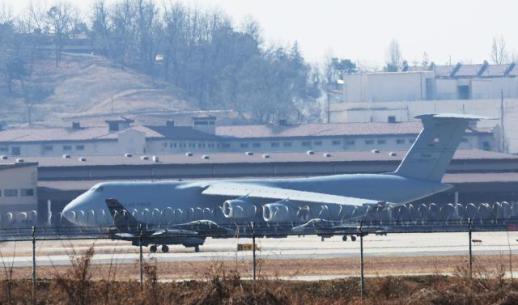 Iran war may feel closer at home for South Korea and Japan if conflict stretches SEOUL, March 12 (AJP) - The war with Iran may be unfolding thousands of kilometers away, but for U.S. allies in Northeast Asia it could begin to feel much closer if the conflict drags on. Questions are emerging in Seoul and Tokyo over whether Washington could eventually ask its key regional allies — South Korea and Japan — to support operations tied to the conflict, particularly given their reliance on energy shipments passing through the Strait of Hormuz and the presence of major U.S. military assets in both countries. Japan’s Yomiuri Shimbun reported Wednesday that the United States could press Tokyo to provide tangible support when U.S. President Donald Trump meets Japanese Prime Minister Sanae Takaichi later this month. Possible requests could include dispatching Japan’s Self-Defense Forces to escort oil tankers through the Strait of Hormuz or assisting with mine-clearing operations. The discussion reflects a broader concern in the region that a distant war could gradually draw U.S. allies into supporting roles even if they initially seek to remain on the sidelines. Signs of the conflict’s ripple effects are already visible. Parts of the U.S. military posture in East Asia appear to be shifting as Washington reallocates resources to the Middle East. U.S. media outlets have reported that the Pentagon is moving elements of a Terminal High Altitude Area Defense (THAAD) system from South Korea to the Middle East. Some Patriot missile batteries stationed with U.S. Forces Korea may also be redeployed. South Korean President Lee Jae Myung acknowledged that Seoul had voiced concerns about the removal of certain air-defense systems, but emphasized that the move would not significantly weaken the country’s deterrence posture against North Korea. “If asked whether that would seriously hinder our deterrence strategy against North Korea, I can say with certainty that it would not,” Lee said during a cabinet meeting Tuesday. Still, the redeployment has sparked debate about the durability of the U.S. security commitment to East Asia at a time when Washington is engaged in a major conflict elsewhere. Tokyo faces a particularly delicate dilemma. Japan hosts roughly 50,000 U.S. troops and provides critical bases for American operations across the Indo-Pacific. At the same time, the Japanese government has been cautious about becoming entangled in the Iran conflict. Under Japan’s postwar constitutional framework, military participation abroad is tightly constrained. Any direct support for U.S. combat operations would likely require legal justification under Japan’s doctrine of collective self-defense — allowing force to protect an ally if Japan’s own survival is at stake. Government spokesperson Minoru Kihara recently said the current situation does not constitute an “existential crisis” that would trigger collective self-defense. Yet pressure could grow if the war disrupts global energy routes. The Strait of Hormuz — through which a large share of Japan’s oil imports passes — remains one of the world’s most vulnerable maritime chokepoints. If Iran threatens shipping there, Japan could face calls to contribute maritime escorts or logistical support to ensure safe passage for energy supplies. Despite these concerns, many analysts believe direct military involvement by U.S. allies remains unlikely — for now. Yasuyuki Matsunaga, a professor at Tokyo University of Foreign Studies, said the strategic logic of the alliance system makes such participation improbable. “The possibility of South Korea and Japan becoming involved in the Iran war is rather low,” Matsunaga told AJP. “The U.S. does not need our military participation in the active war theater in the Middle East, and more importantly it does not want to create vulnerabilities in East Asia that could open a second war front.” That logic reflects Washington’s broader strategic dilemma: while concentrating forces against Iran, the United States must also deter potential adversaries in Asia, including North Korea and China. Still, even limited logistical or maritime support could mark a shift in the role U.S. allies play in conflicts beyond their immediate region. South Korea has long faced concerns about “entrapment” — the risk that alliance commitments could draw it into distant conflicts initiated by Washington. Brandon Ives, a professor at Seoul National University, said the likelihood of such entrapment depends largely on how the war evolves. “If the conflict becomes a prolonged, low-intensity struggle, Iran may rely more on asymmetric tactics and attacks against actors perceived to support the U.S. or Israel,” he said. “But overall, Iran would likely avoid directly targeting third-party countries.” For both Tokyo and Seoul, the Iran war is quickly becoming a test of alliance politics in an era of globalized security risks. Neither government appears eager to play an active military role in the conflict. Yet as the war expands and U.S. forces reposition across the globe, the political pressure on allies to contribute — even indirectly — may continue to grow. For now, both governments hope the conflict remains distant enough to avoid a difficult choice. 2026-03-12 17:23:00