
Journalist

AJP
-
 North Korea 'conducts drill involving hypersonic missiles' SEOUL, January 5 (AJP) - North Korea has tested "hypersonic missiles" with its leader Kim Jong-un in attendance, state media reported on Monday. According to the state-run Korean Central News Agency (KCNA), the hypersonic missiles were fired the previous day from a site near Pyongyang as part of a missile-launching drill and "hit targets" in the East Sea as Kim "oversaw" the drill along with senior military officials. The KCNA said, "Important achievements have been recently made in putting our nuclear forces on a practical basis and preparing them for an actual war." "It is a very important strategic task to maintain and expand a powerful and reliable nuclear deterrent through the sustained verification of key components of war deterrence and the improvement of its performance and the mastering of operational capabilities," it quoted Kim as saying. "To be honest, our such activity is clearly aimed at gradually putting the nuclear war deterrent on a high-developed basis. Why it is necessary is exemplified by the recent geopolitical crisis and complicated international events," it added, apparently referring to the capture of Venezuela's authoritarian leader Nicolás Maduro in a lightning military operation by U.S. forces. Specific details of the missiles were not disclosed, but based on their range and trajectories, they are believed to be from the country's Hwasong series of ballistic missiles. 2026-01-05 09:55:11
 -
![[CES 2026] Hyundai Motor wins Best of Innovation Award for autonomous mobility robotics](https://image.ajunews.com//content/image/2026/01/05/20260105075035317980_518_323.jpeg) [[CES 2026]] Hyundai Motor wins Best of Innovation Award for autonomous mobility robotics LAS VEGAS, January 05 (AJP) - Hyundai Motor said Monday it won a top honor at CES 2026 for its next-generation autonomous mobility robot platform, MobED, and plans to begin mass production in the first quarter as it targets the future mobility market. The automaker said MobED received the Best of Innovation award in the robotics category. The Consumer Technology Association, which organizes CES, awards Innovation Awards annually after evaluating entries for innovation, design and technology, with Best of Innovation granted to the highest-scoring honorees in each category. Hyundai said it was the first time the company had received a CES Innovation Award since it began participating in the event, adding that the recognition underscored the competitiveness of its robotics technology and products. The company first unveiled a concept version of MobED at CES 2022 and introduced the production model in December at Japan’s International Robot Exhibition (iREX). After about three years of development, Hyundai said the platform was designed for practical use in both business environments and daily life. MobED’s core feature is its ability to maintain stable movement across challenging terrain, Hyundai said. Using an eccentric-wheel-based Drive-and-Lift module, the robot can adjust its body tilt on uneven surfaces or slopes to improve stability. The platform features a simplified design focused on core functions and can be equipped with interchangeable top modules for applications such as delivery, logistics and filming. It also includes a user-friendly interface, including a separate controller with a 3D-graphics touchscreen. MobED measures 74 centimeters in width and 115 centimeters in length, with a top speed of 10 kilometers per hour. Hyundai said it can operate for more than four hours on a single charge and carry a payload of about 47 to 57 kilograms, depending on the model. The platform comes in two versions: a Basic model for research and development in autonomous robotics, and a Pro version that incorporates autonomous-driving technology. Hyundai said the MobED Pro uses AI-based algorithms combined with lidar and camera sensors to enable safe and efficient operation in complex indoor and outdoor environments. Hyundai said it plans to begin mass production of MobED in the first quarter and sell the platform to customers. “The award shows that Hyundai Motor Group’s robotics technology is evolving in ways that enhance everyday life,” Hyun Dong-jin, executive director and head of Hyundai’s Robotics Lab, said in a statement. “We will continue to advance AI-based autonomous robot-driving technology so it can become an innovative solution that brings us closer to customers.” 2026-01-05 09:49:58
[[CES 2026]] Hyundai Motor wins Best of Innovation Award for autonomous mobility robotics LAS VEGAS, January 05 (AJP) - Hyundai Motor said Monday it won a top honor at CES 2026 for its next-generation autonomous mobility robot platform, MobED, and plans to begin mass production in the first quarter as it targets the future mobility market. The automaker said MobED received the Best of Innovation award in the robotics category. The Consumer Technology Association, which organizes CES, awards Innovation Awards annually after evaluating entries for innovation, design and technology, with Best of Innovation granted to the highest-scoring honorees in each category. Hyundai said it was the first time the company had received a CES Innovation Award since it began participating in the event, adding that the recognition underscored the competitiveness of its robotics technology and products. The company first unveiled a concept version of MobED at CES 2022 and introduced the production model in December at Japan’s International Robot Exhibition (iREX). After about three years of development, Hyundai said the platform was designed for practical use in both business environments and daily life. MobED’s core feature is its ability to maintain stable movement across challenging terrain, Hyundai said. Using an eccentric-wheel-based Drive-and-Lift module, the robot can adjust its body tilt on uneven surfaces or slopes to improve stability. The platform features a simplified design focused on core functions and can be equipped with interchangeable top modules for applications such as delivery, logistics and filming. It also includes a user-friendly interface, including a separate controller with a 3D-graphics touchscreen. MobED measures 74 centimeters in width and 115 centimeters in length, with a top speed of 10 kilometers per hour. Hyundai said it can operate for more than four hours on a single charge and carry a payload of about 47 to 57 kilograms, depending on the model. The platform comes in two versions: a Basic model for research and development in autonomous robotics, and a Pro version that incorporates autonomous-driving technology. Hyundai said the MobED Pro uses AI-based algorithms combined with lidar and camera sensors to enable safe and efficient operation in complex indoor and outdoor environments. Hyundai said it plans to begin mass production of MobED in the first quarter and sell the platform to customers. “The award shows that Hyundai Motor Group’s robotics technology is evolving in ways that enhance everyday life,” Hyun Dong-jin, executive director and head of Hyundai’s Robotics Lab, said in a statement. “We will continue to advance AI-based autonomous robot-driving technology so it can become an innovative solution that brings us closer to customers.” 2026-01-05 09:49:58 -
 Veteran actor Ahn Sung-ki loses battle with cancer SEOUL, January 5 (AJP) - Veteran actor Ahn Sung-ki died at a hospital in Seoul on Monday with his family by his side. He was 74. Ahn had been unconscious in the intensive care unit at Soonchunhyang University Hospital for about a week after collapsing at home last Wednesday due to choking on food and being taken to the hospital in cardiac arrest. He had been receiving treatment for blood cancer since 2019. Ahn made his debut in 1957 with director Kim Ki-young's "Twilight Train" when he was just a five-year-old boy and went on to appear in more than 150 films over a career spanning roughly 60 years, becoming one of the country's most beloved stars. The actor won numerous film awards for his work, with many of his hits including road film "Whale Hunting" (1984), buddy action comedy "Two Cops" (1993), historical epic "The Taebaek Mountains" (1994), action thriller "Nowhere to Hide" (1999), "Silmido" (2003), the country's first film to draw over 10 million moviegoers and drama "Radio Star" (2006). The diligent actor earned widespread admiration for his dedication and versatility across various genres, achieving both critical acclaim and commercial success throughout his career. Despite his battle with the illness, the seasoned star never abandoned his passion for acting, vowing on several occasions to return to the screen. His magement agency Artist Company said in a statement later in the day, "Ahn, who had a deep sense of sincerity and dedication, had been part of the history of South Korean cinema and popular culture," adding that he gave comfort and resonated with audiences across generations. His memorial altar was set up at Seoul St. Mary's Hospital in southern Seoul with a funeral service scheduled for Friday, before he will be laid to rest at a cemetery in Yangpyeong, Gyeonggi Province. He is survived by his wife and two sons. 2026-01-05 09:42:23
 -
 South Korea says financial markets stable despite Venezuela risks SEOUL, January 05 (AJP) - South Korea said on Monday that spillover effects on its financial markets and broader economy from recent U.S. airstrikes on Venezuela and North Korea’s ballistic missile launch have so far been limited. The assessment came after an emergency joint economic meeting convened to evaluate the potential impact of heightened geopolitical risks. The meeting was chaired by Kang Gi-ryong, assistant vice minister at the Ministry of Economy and Finance, and included officials from the foreign, trade and finance ministries, as well as the Financial Services Commission, the Bank of Korea, the Financial Supervisory Service and the Korea Center for International Finance. Officials said volatility in global markets, as well as in South Korea’s financial and foreign-exchange markets, remained manageable despite the recent developments. They added that any fallout for the real economy and overall trade conditions was unlikely to be significant in the near term. "Still, the government would maintain heightened vigilance," an official said, warning that geopolitical uncertainty could escalate. Authorities plan to step up monitoring of global oil prices, exchange rates, movements in international financial markets and shifts in export and import conditions. 2026-01-05 09:34:26
 -
 OPINION: Higher long-term rates in Japan, what it means for the economy Japan’s long-term interest rates have returned to levels unseen in decades, marking a structural shift for an economy long defined by near-zero borrowing costs. Yields on newly issued 10-year Japanese government bonds (JGBs) climbed into the 2% range in December 2025, the highest level in 26 years and 10 months, extending a steady rise that began in 2023. The move has been broad-based. Two-year yields reached 1.12%, the highest since 1996; five-year yields hit 1.52%, the highest since 2008; and 20-year yields climbed to 3.02%, the highest since 1999. In an economy conditioned to ultra-low rates, interest is once again a price. Why rates are rising Monetary normalization is the first driver. Since 2024, the Bank of Japan has dismantled the pillars of its ultra-easy stance. It ended negative interest rates and yield-curve control in March 2024, began tapering bond purchases in July, and raised its policy rate in stages to 0.75% by December 2025. As the BOJ steps back from bond buying, market forces are reasserting themselves, and investors are demanding a term premium to compensate for uncertainty and fiscal risk. Fiscal expansion is the second. The Takaichi government has leaned on stimulus rather than austerity, approving a large supplementary budget and a broader stimulus package funded heavily through new bond issuance. With the BOJ no longer acting as a dominant buyer, heavier supply is adding upward pressure on yields, while markets question whether cash-based support and utility subsidies address Japan’s longer-term growth constraints. What it means Rising long-term rates carry two messages. First, they suggest Japan may finally be moving beyond deflation. Inflation has stayed above 2%, and wage gains are increasingly cited by policymakers as evidence of a nascent price-wage cycle. In that sense, higher yields reflect a healthier — if unfamiliar — macro environment. Second, they introduce new risks. Higher yields raise debt-servicing costs for a heavily indebted government, lift corporate financing costs, and create valuation losses for financial institutions holding large JGB portfolios. For households, higher mortgage rates threaten to weigh on consumption and housing demand. The policy dilemma ahead The key argument is that Japan is no longer a demand-starved economy. With labor shortages and capacity constraints emerging, demand-heavy fiscal stimulus risks fueling prices rather than growth. The priority, the author argues, should shift toward supply-side reform — easing labor bottlenecks, lifting productivity, and fostering new industries — while financial institutions, companies, and households adapt to a world where interest rates once again matter. Whether Japan can complete its transition to a “normal” interest-rate economy will depend on how effectively each sector adjusts to this long-awaited return of price signals. About the author ▷Economics, Seoul National University ▷Ph.D. in economics, Hitotsubashi University ▷Vice president, Korea Institute for International Economic Policy * This article, published by Aju Business Daily, was translated by AI and edited by AJP. 2026-01-05 07:21:48
 -
 Fatal taxi crash reignites debate over elderly drivers SEOUL, January 4 (AJP) - A deadly traffic accident in central Seoul last Friday has reignited debates about elderly taxi drivers after a man in his late 70s rammed his taxi into two vehicles near Jonggak subway station during the evening rush hour, killing one pedestrian and injuring about a dozen others. According to police, the man showed no signs of drunk driving but tested positive for morphine in an initial test. Authorities said morphine can also be found after taking certain cold medications. The fatal accident has raised concern over the growing number of elderly taxi drivers in South Korea, as the country officially became a "super-aged society" last month, with those aged 65 and older accounting for more than 20 percent of the population for the first time, according to demographic data released by the Ministry of the Interior and Safety. The taxi industry starkly reflects this aging demographic trend, with drivers in their 20s and 30s now a rarity and elderly drivers dominating the workforce. Data from the state-run Korea Transportation Safety Authority showed that more than 55 percent or 91,000 of 164,000 self-employed cab drivers were aged 65 or older as of October last year. The figure rose to 76 percent when including those over 60, while drivers under 30 accounted for just 0.04 percent. Those in their 30s made up 0.71 percent, drivers in their 40s 4.9 percent, and those in their 50s 18.1 percent. The situation is similar among drivers employed by corporate taxi companies. Industry insiders cite low wages compared with heavy workloads as the main reason young workers are staying away. Corporate-employed cab drivers earn less than 3 million won ($2,200) per month on average, while self-employed drivers in Seoul typically make around 4 million won, often after working long hours. "Taxi drivers can make over 5 million won a month if they push themselves by extending shifts, but it often comes at the cost of their health," one industry insider said. He also cited additional risks such as frequent abuse from passengers, which has led many young workers to opt instead for platform jobs like delivery, where earnings are higher. Many experts say luring younger workers requires concrete incentives, while restricting elderly drivers without alternative measures would face strong resistance. "There are many stull-healthy drivers in their 60s and 70s," a taxi industry representative said. "South Korea is aging as a whole. You can't single out taxi drivers without addressing the broader structural problem." Meanwhile, traffic accidents involving elderly drivers rose from around 4,100 in 2015 to about 7,200 in 2024, jumping from 9.9 percent to 21.7 percent of all accidents, according to a report by the Seoul Metropolitan Government. To encourage the elderly to voluntarily turn in their driving license, the city government has been offering incentives since 2019, as they are more prone to traffic accidents than young drivers due to slower reactions and declining driving skills. 2026-01-04 16:40:27
 -
 Lee begins four-day trip to China SEOUL, January 4 (AJP) - President Lee Jae Myung arrived in Beijing on Sunday for a summit with Chinese President Xi Jinping. His four-day trip marks Lee's first visit to China since taking office in June last year. It is also the first visit to China by a South Korean president since former President Moon Jae-in traveled there in December 2019, and the first state visit in about nine years. Lee is set to start his itinerary with a dinner with South Korean expats there. After attending a business forum on Tuesday, he will hold a summit with Xi later in the day, which will include a welcoming ceremony and a banquet. The two leaders are expected to discuss ways to strengthen bilateral relations and economic cooperation, as well as various issues including China's veiled restrictions on South Korean films and dramas, and the installation of dubious structures on the submerged shelf of Ieodo in the West Sea, which overlaps with maritime zones of both South Korea and China. Attention is now focused on whether Lee's first overseas trip of the new year would bring momentum in efforts to further ease strained ties with China, after the two leaders met about two months ago on the sidelines of the Asia-Pacific Economic Cooperation (APEC) summit in the southeastern city of Gyeongju in November last year. On Tuesday, he is also scheduled to have lunch with Premier Li Qiang before traveling to Shanghai. Lee will return home on Wednesday. 2026-01-04 14:11:31
 -
 Hyundai's luxury Genesis brand reaches 1.5 million sales milestone SEOUL, January 4 (AJP) - Automaker Hyundai's premium brand Genesis has sold over 1.5 million vehicles in cumulative global sales a decade after its launch. According to industry sources on Sunday, the automaker reached the milestone in November last year, about 10 years after it rolled out its luxury G90 sedan in 2015. Genesis was especially popular among customers in Europe and the U.S. It sold over 500,000 units globally by May 2021 and surpassed 1 million in August 2023. Annual global sales grew from about 201,000 vehicles in 2021 to roughly 230,000 in 2024. The G80 midsize sedan is Genesis' best-selling model, with 501,517 units sold through November last year, making it the brand's first vehicle to exceed 500,000 in cumulative sales. It is followed by the GV70 with 337,457 units and the GV80 with 322,214. Together, the three models accounted for 77 percent of Genesis' total sales. Genesis plans to expand its lineup with extended-range electric vehicles and hybrids, aiming for annual global sales of 350,000 by 2030. 2026-01-04 13:42:37
 -
 Hyundai Motor and Chung family diplomacy under focus ahead of Lee's Shanghai visit SEOUL, January 04 (AJP) -As Lee Jae Myung embarked on the first state visit by a South Korean president to China in nine years, attention is turning to a little-known episode of corporate diplomacy that helped preserve one of Korea’s most important overseas historical sites — the former headquarters of the Republic of Korea Provisional Government in Shanghai. At the center of that effort was the late Hyundai Motor Group chair Chung Mong-koo, whose direct engagement with Shanghai leaders two decades ago proved decisive in safeguarding the building amid a sweeping urban redevelopment drive. In 2004, Shanghai was pressing ahead with a major redevelopment of the Luwan district ahead of the 2010 World Expo, planning to transform more than 46,000 square meters of aging neighborhoods into a commercial and entertainment hub. The provisional government building — a cornerstone of Korea’s modern statehood narrative — stood within the redevelopment zone. Concerns mounted in South Korea that if the project were led by foreign developers, the historic site might not be fully protected. While Seoul requested preservation of the specific addresses housing the building, Shanghai officials maintained that excluding a small section from a large-scale redevelopment was impractical. According to Hyundai Motor Group materials and government accounts, Chung met senior Shanghai officials at City Hall in May 2004, urging the city to allow South Korean companies to participate in the redevelopment so the site’s preservation could be guaranteed. Chung described Shanghai as “an international city where a cutting-edge future and China’s former golden age coexist,” while stressing that the provisional government building was “a symbol of Korea’s spirit of independence and legitimacy,” carrying profound historical significance for South Koreans. His outreach extended beyond a single meeting. Follow-up discussions with Shanghai’s urban development leadership linked economic cooperation with historical preservation, elevating the issue to intergovernmental consultations between Seoul and Shanghai. The result was highly unusual. Despite an international open bid already having taken place, Shanghai put the redevelopment plan on hold, allowing the provisional government building to be preserved intact. Seoul officials at the time described the decision as a rare case of effective public–private coordination that conveyed the importance of the site to Chinese authorities. The episode has since been cited as an early example of how South Korean companies, operating beyond formal diplomacy, helped protect national heritage abroad through long-term trust and engagement.President Lee Jae Myung’s China itinerary spans Beijing and Shanghai, combining political diplomacy with economic and innovation-focused engagements. In Shanghai, the president is scheduled to meet city leaders, attend a Korea–China venture and startup summit, and visit the former provisional government building — a symbolic stop that links contemporary diplomacy with shared historical memory. The timing has drawn renewed attention to Chung’s role, particularly as Lee is accompanied by a 200-strong business delegation, the largest to travel with the president. Among the delegates is Chung Euisun, the son of the late Chung Mong-koo and now chairman of Hyundai Motor Group. His participation underscores the continuity of Hyundai’s engagement with China across generations — from his father’s quiet intervention to preserve a historic site to the group’s current focus on electric vehicles, hydrogen and next-generation mobility cooperation. Hyundai plans to uphold the legacy of the late Chung by stepping up preservation of overseas independence movement sites by assessing conditions and, when repairs are needed, pursuing preservation work in consultation with the veterans ministry and other agencies. A Hyundai Motor Group official said remembering the sacrifice and dedication of independence patriots and passing those values to the next generation is meaningful, adding the group will continue to work closely with the veterans ministry using its people, resources and technology. The company’s social contribution work in China has also drawn attention, including the “Hyundai Green Zone” project to combat desertification in Inner Mongolia, the “Dream Classroom” program supporting elementary schools in underserved areas, and hydrogen education through HTWO Guangzhou. Hyundai said the Inner Mongolia project has run for 17 years in line with China’s 2060 carbon neutrality policy and local anti-desertification efforts. Launched in 2008 under Chung and continued under Chairman Chung Euisun, it is one of the group’s flagship initiatives in China. Across three phases in Ulanqab, Inner Mongolia, Hyundai said it built an eco-friendly guesthouse village, created about 31,000 square meters of forest (including reed beds and waterside flower gardens), and carried out a 300-square-meter grassland restoration project. In August 2019, Chung visited Zhenglan Banner in Inner Mongolia, where the project was underway. Since 2011, Hyundai said it has supported education at 96 elementary schools across 30 provinces in China through Dream Classroom, providing a cumulative 10.5 million yuan in equipment and scholarships. Since 2023, it has offered hydrogen-related education and science museum experience programs through HTWO Guangzhou, its local hydrogen fuel cell system production unit. Hyundai said these efforts helped it rank No. 1 for 10 consecutive years among automakers in the Chinese Academy of Social Sciences’ corporate social responsibility development index. As of 2025, it ranked third among all companies in China for the fifth straight year and second among foreign companies. * This article, published by Aju Business Daily, was translated by AI and edited by AJP. 2026-01-04 13:17:22
 -
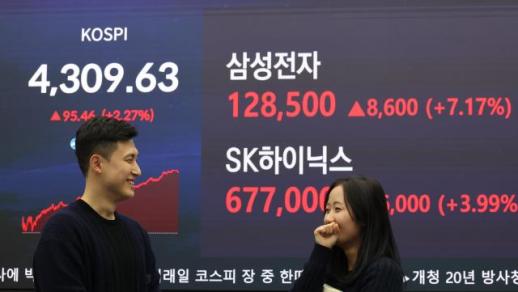 Foreign stock ownership in Korean stocks highest in nearly 6 years SEOUL, January 04 (AJP) -Foreign ownership of South Korean stocks climbed to its highest level in nearly six years by the end of December 2025, as global investors doubled down on an AI-driven memory-chip boom led by Samsung Electronics and SK hynix, while bond inflows accelerated ahead of South Korea’s inclusion in a major global sovereign bond index. According to the Korea Center for International Finance (KCIF) on Sunday, foreign ownership accounted for 32.9 percent of Korea’s total stock-market capitalization at the end of December, the highest level since April 2020. The Financial Supervisory Service previously reported foreign ownership at 31.5 percent in April 2020 and 29.6 percent at the end of November last year. The official end-December figure has yet to be released. Foreign investors’ net buying in the electrical and electronics sector reached 4.5 trillion won in December, exceeding overall foreign net buying of 3.5 trillion won, the KCIF said. By stock, SK hynix attracted 2.2 trillion won in net foreign inflows, while Samsung Electronics drew 1.4 trillion won. Foreign ownership of SK hynix rose to 53.8 percent at the end of December, up from 53.2 percent a month earlier, while Samsung Electronics edged up to 52.3 percent from 52.2 percent. The KCIF attributed the surge in equity inflows primarily to tight memory-chip supply and rising prices, which are lifting earnings expectations for Korean chipmakers amid the global AI investment cycle. Nomura recently forecast that commodity memory prices could rise another 20 to 30 percent this year, raising its estimates for annual operating profit by 21.5 percent for Samsung Electronics and 9.7 percent for SK hynix. The center also pointed to valuation differentials as a key driver of foreign inflows. While foreign investors were net sellers of Taiwanese stocks by $1.6 billion in December, they were net buyers of South Korean equities. Taiwan’s 12-month forward price-to-earnings ratio stands at around 17, above its 10-year average of 14.7, while the Kospi trades near 10, broadly in line with its long-term average, the KCIF said. Expectations for policies aimed at boosting corporate value, including a third revision to the Commercial Act and potential changes to dividend taxation, also supported investor sentiment. Foreign money flowed strongly into bonds as well. In December, foreigners made net investments of 8.8 trillion won in Korean bonds, lifting total foreign bond holdings to 339.3 trillion won, up from 329.5 trillion won at the end of November. Korea’s long-anticipated inclusion in the FTSE World Government Bond Index is set to begin in April 2026 and conclude in November 2026, with the weighting added in eight equal monthly steps. The inclusion had originally been scheduled to start in November 2025, but FTSE Russell postponed the timeline to 2026. The WGBI, compiled by FTSE Russell, is regarded as a benchmark “developed-market” sovereign bond index, with stringent criteria covering outstanding issuance, credit ratings and market accessibility. The Korean government expects WGBI inclusion to help attract advanced-economy capital, stabilize fiscal management, reduce government borrowing costs, and enhance financial-market stability and external credibility. The National Pension Service, the country’s largest institutional investor, has previously estimated that WGBI membership could draw at least $56 billion into South Korea’s financial markets. * This article, published by Aju Business Daily, was translated by AI and edited by AJP. 2026-01-04 12:53:47