
Journalist

AJP
-
 Roster unveiled ahead of football matches later this month SEOUL, November 3 (AJP) - South Korea will have this year's final friendlies with Bolivia and Ghana later this month. The Korea Football Association on Monday unveiled the roster for the national team ahead of upcoming matches against Bolivia in Daejeon on Nov. 14 and Ghana in Seoul on Nov. 18. The roster includes regular call-ups who play for overseas clubs such as Son Heung-min of Los Angeles FC in Major League Soccer (MLS), Lee Jae-sung and Kim Min-jae of Bundesliga clubs Mainz 05 and Bayern Munich, and Lee Kang-in of Paris Saint-Germain Among the notable inclusions is striker Cho Gue-sung of Danish Superliga club Midtjylland, who is returning about 20 months after his last appearance in March 2024 due to knee surgery and related complications. Head coach Hong Myung-bo, who recently met him in Denmark, said, "The coaching staff assessed his condition several times and concluded he is fit for the matches." Yang Min-hyeok, a forward for Portsmouth on loan from Premier League club Tottenham Hotspur, is rejoining the national team after eight months, while Kwon Hyuk-kyu of FC Nantes earned his first call-up under Hong's leadership. The squad will gather next week to prepare for the matches at a new facility for national football players in Cheonan, South Chungcheong Province, marking the first time it will be used since opening last month. * This article, published by Aju Business Daily, was translated by AI and edited by AJP. 2025-11-03 17:40:23
 -
 PHOTOS: 2025 Small Business Convention opens with craftsmanship and passion on display SEOUL, October 31 (AJP) - The 2025 Korea Small Business Convention opened on October 31 at KINTEX in Goyang, Gyeonggi Province. Now in its 20th year, the convention is South Korea’s largest annual event dedicated to small business owners, aimed at elevating their social and economic standing while fostering communication and unity within the community. Held under the theme "Small Businesses Opening Today, Connecting Tomorrow’s Korea," this year’s event celebrates the achievements of entrepreneurs across the country and explores new drivers for growth. Over two days, the convention features an opening ceremony, skills competitions, exhibitions, and seminars. From October 31 to November 1, more than 1,540 small business owners from across the country are showcasing their skills and creativity in the 2025 Small Business Skills Championship. Organized by associations including the Korea Outdoor Advertising Association, the Korea Bakers Association, the Korea Makeup Artists Association, the Korea Florists Association, and the Korea Culinary Masters Association, the competition spans categories such as advertising design, baking, makeup, floral arrangements, and culinary arts. Contestants approached their craft with remarkable focus and sincerity. In an age when artificial intelligence is transforming industries, the passion expressed through their hands filled the venue with energy. Machines may evolve, but human touch and sincerity remain irreplaceable. The skill and dedication on display illuminated this year’s championship, reminding visitors that the beauty of human craftsmanship endures beyond time. 2025-11-03 17:30:07
 -
 Kazakhstan goes all-in on AI in bid to emerge as regional leader ASTANA, November 03 (AJP) - Soviet-era government buildings in Kazakhstan’s capital now hum with modern servers and fiber-optic cables as the Central Asian nation pushes to reposition itself as the region’s leading digital economy. The country of 20 million has already emerged as a GovTech leader, ranking 24th globally in the UN’s e-Government Development Index and 10th in online services. It is now doubling down with an expansive AI strategy built on supercomputing infrastructure, hyperscale datacenters and an unusual pitch to global investors: partnership without geopolitical complications. “We’re not just building infrastructure. We’re building a national AI platform that gives every government agency access to the same tools, from large language models to 120 government databases,” Dmitriy Mun, Vice Minister of AI and Digital Development, told AJP in an exclusive interview. Kazakhstan’s digital overhaul has been decades in the making. Mun noted that the country has more than 25 years of experience in GovTech, beginning with physical service centers, then digitization, then mobile platforms. By the time COVID hit, the foundation was in place for a major shift toward digital public services. A key breakthrough came with the Smart Bridge platform, a marketplace for government APIs that allows private banks and companies to tap directly into state databases. Its people can access government services through private banking apps, with cashless payments accounting for 85 percent of transactions. The eGov mobile app has 11 million users — 96 percent of the adult population — accessing more than 1,000 services without visiting an office. Kazakhstan launched its National AI Platform in December 2024. The platform has signed 43 use cases across government, with 10 already implemented and a roadmap for 50 AI agents. An AI assistant called eGov AI has handled more than 800,000 user requests in four months. Another agent, e-Otinish AI, processes 160,000 of the country’s 4 million annual citizen appeals across 15 agencies. Qazaq Law answers legal questions with 86 percent accuracy, and a reengineering assistant helps civil servants identify regulatory changes needed to streamline procedures. The Smart Data Ukimet platform aggregates data from over 120 state databases, powering the Digital Family Card, which tracks 6 million families and delivers 4 million proactive public services automatically. Kazakhstan’s AI ambitions depend heavily on access to compute. The country operates a supercomputer built on 63 NVIDIA H200 GPUs under the ALEM.AI initiative. Securing the hardware required extended conversations with the United States beginning in 2023, Mun said, given Kazakhstan’s proximity to China and Russia. The country initially considered working with Groq but pivoted when the startup moved to an API-only model. A second NVIDIA-based system with 62 GPUs now serves Samruk-Kazyna, the state holding company, and a third supercomputer is planned for universities. Kazakhstan treats high-grade compute as a strategic asset, offering tax exemptions and preferential customs treatment. Mun said the resource-rich country's biggest constraint is not capital but talent. “We really need new talents who understand both AI and the processes in their field. I need experts in AI in oil, AI in logistics. I need to mix knowledge with AI.” Kazakhstan plans to train one million people in AI over the next three to four years. Nineteen universities are establishing AI faculties that combine technology with sector-specific majors, with students paired with industry partners. Primary schools are also introducing AI curricula. Datacenter capacity is expanding rapidly. Kazakhstan plans to build 200 megawatts of capacity with $1.5 billion in investment between 2025 and 2030, with more than four projects already underway. Special Economic Zones offer zero VAT, corporate tax exemptions and customs-duty waivers to attract hyperscale operators. The cloud services market has grown to $110 million as of late 2024. South Korea has emerged as a key partner in Kazakhstan’s digital push. Officials say the two countries already have five years of experience in data management cooperation, with ongoing projects ranging from speech detection tools to the Maui City smart-city initiative. Mun said he hopes to strengthen partnerships in datacenter construction, smart-city pilots in Astana and Almaty, and joint education programs. “What I would like to learn more about is smart cities in Korea — flying taxis, air taxis,” he said. Asked which sectors stand to gain the fastest from AI adoption, Mun cited agriculture, oil, mining and logistics. Samruk-Kazyna has already developed an AI agent roadmap across these areas. “We are in the top ten in the OECD online services index. We have the most powerful supercomputer in Central Asia. We have strong AI talent — Higgsfield AI, a Kazakh startup, recently became a unicorn. We have special economic zones with tax benefits,” he said. “Kazakhstan offers opportunity and stability. We are strategically located between Europe, China and South Asia. Major hyperscale projects are underway.” The scale of activity reflects that ambition: hyperscale datacenters under construction, AI agents processing millions of citizen queries, universities rolling out AI programs and the government treating compute capacity as a national strategic priority. Whether Kazakhstan successfully establishes itself as Central Asia’s digital hub remains uncertain, but with $1.5 billion committed to datacenter infrastructure and NVIDIA-powered supercomputers already in operation, the country is placing a determined bet on AI-driven transformation. 2025-11-03 17:24:42
 -
 Seoul expects details on nuke submarine and wartime command in SCM week SEOUL, November 03 (AJP) - Seoul and Washington are expected to discuss detailed plans for the transition of wartime operational control (OPCON) and South Korea’s nuclear-powered submarine initiative — two agenda items that could reshape the country’s self-defense posture — during this week’s high-level bilateral security talks. The 57th annual Security Consultative Meeting (SCM), set for Tuesday in Seoul, is expected to focus on adjustments to the combined defense strategy and the future direction of alliance cooperation. U.S. Defense Secretary Pete Hegseth arrived in Seoul on Monday and is scheduled to tour the Joint Security Area (JSA) with South Korean Defense Minister Ahn Kyu-baek later in the day. It marks the first time in eight years that the defense chiefs of both nations have jointly visited the inter-Korean border, following the 2017 trip by Song Young-moo and James Mattis. In line with President Donald Trump’s recent declaration of a “stronger-than-ever” alliance during his visit to Korea, the two ministers will meet South Korean and U.S. service members stationed in the JSA and reaffirm the importance of their combined defense posture. On Tuesday, Hegseth and Ahn will hold formal talks in Seoul as part of the SCM — the first since both governments launched new administrations. The meeting is widely seen as a key juncture to recalibrate alliance roles and adapt them to evolving regional security challenges. Two of the most closely watched topics will be the OPCON transfer and Seoul’s nuclear-powered submarine plan. During his flight to Kuala Lumpur last week for the ASEAN Defense Ministers’ Meeting Plus, Hegseth called Korea’s OPCON transition efforts “a commendable step forward.” Ahn has said Seoul “welcomes U.S. support for the transition” and aims to complete it within the current administration’s term. The nuclear-powered submarine issue is also expected to receive detailed treatment. The discussion follows an agreement reached by Presidents Lee Jae-myung and Donald Trump during last week’s APEC Summit in Gyeongju. Both governments are preparing a three-page “joint fact sheet” summarizing the agreement, reportedly stating that “the United States and South Korea will work together toward the construction of South Korea’s nuclear-powered submarines.” Separately, Seoul has been moving rapidly to build up autonomous defense functions. On Sunday, the Defense Ministry announced that South Korea’s fifth military reconnaissance satellite had been successfully launched from Cape Canaveral Space Force Station in Florida aboard a SpaceX Falcon 9 rocket. The satellite reached its designated orbit 14 minutes after liftoff and established contact with a ground station an hour later. With this launch, South Korea now has a complete fleet of five reconnaissance satellites, enabling around-the-clock monitoring of North Korea with an observation interval of roughly two hours. The ministry said the satellite network allows “independent, all-weather surveillance across the entire Korean Peninsula” and marks a “milestone in strengthening South Korea’s defense autonomy.” The latest satellite is equipped with a Synthetic Aperture Radar (SAR) sensor capable of detecting objects as small as 30 centimeters — even at night or through clouds and rain. The capability enables near real-time tracking of North Korean missile launches and troop movements, enhancing the precision of Seoul’s Kill Chain preemptive strike system. The ministry called the launch “a significant step toward self-reliant defense,” noting that it reduces Korea’s dependence on U.S. intelligence assets. The Defense Acquisition Program Administration (DAPA) plans to deploy about 40 small satellites over the next several years, with the first launch slated for late next year. This week’s SCM comes at a pivotal moment as Seoul’s expanding defense capabilities converge with Washington’s efforts to update alliance structures. Following Tuesday’s meeting, the two governments are expected to release a joint statement outlining agreements on OPCON transfer, submarine cooperation, defense cost-sharing, and long-term alliance priorities. 2025-11-03 17:07:27
 -
 HS Hyosung acquires Belgium's battery materials company for $145 million SEOUL, November 03 (AJP) - South Korea's HS Hyosung Group said Monday it has entered the next-generation battery materials market with the acquisition of EMM, the battery anode subsidiary of Belgium’s Umicore, for about 200 billion won, or roughly $145 million. The deal also includes the creation of a joint venture between the two companies to advance silicon anode technology. Umicore, specialized in materials science, has long been known for its expertise in battery components, catalysts, and semiconductor materials, as well as its historic role in early nuclear research — its facilities once hosted Marie Curie’s experiments on radon and uranium, according to HS Hyosung. The acquisition positions HS Hyosung at the forefront of efforts to commercialize silicon anodes, a technology widely regarded as the next leap in electric vehicle batteries. Silicon anodes can store more than 10 times the energy density of traditional graphite anodes, potentially slashing charging times and boosting vehicle range and efficiency. The investment reflects Vice Chairman Cho Hyun-sang’s push to strengthen Hyosung’s portfolio through core technologies and intellectual property, while integrating artificial intelligence into the company’s manufacturing and materials businesses. Cho reportedly led negotiations with Umicore, visiting Belgium several times to finalize the deal. HS Hyosung said it plans to invest 1.5 trillion won over the next five years to scale up production, beginning at its Ulsan facility. The expansion is expected to create high-value jobs and enhance South Korea’s competitiveness in the global battery supply chain. “Our goal is to build a foundation for the next generation of energy materials,” the company said in a press release. “This partnership will allow us to accelerate innovation in silicon anodes and strengthen our global position.” * This article, published by Aju Business Daily, was translated by AI and edited by AJP. 2025-11-03 16:54:52
 -
 Actor Yeo Jin-goo to join KATUSA next month SEOUL, November 3 (AJP) - Actor Yeo Jin-goo will begin his mandatory military service with the Korean Augmentation to the United States Army (KATUSA) next month. "Recruited as a member of KATUSA, Yeo will fulfill his 18-month military duty starting Dec. 15," his management agency said on Monday. "We ask for your continued support and encouragement until he returns healthy and more mature after completing his military duty," it added. But the exact time and location of his enlistment have not been revealed. Since his debut with a minor role in "Sad Movie" (2005), Yeo has appeared in various dramas and films including "A Frozen Flower" (2008), "Moon Embracing the Sun" (2012), "The Crowned Clown" (2019) and "Hijack 1971" (2024). * This article, published by Aju Business Daily, was translated by AI and edited by AJP. 2025-11-03 16:13:44
 -
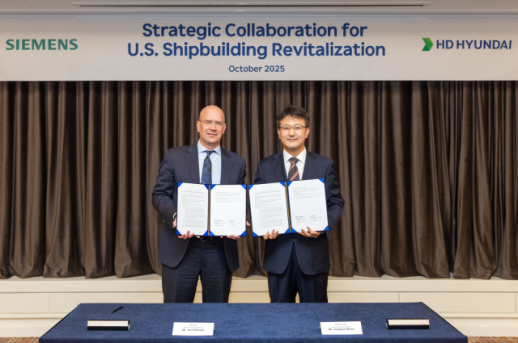 HD Hyundai joins hands with Siemens to spur digital transformation in shipbuilding SEOUL, November 03 (AJP) - South Korea's HD Hyundai has signed a partnership with Siemens of Germany to bring digital transformation and automation technologies to the United States shipbuilding industry. The companies signed a memorandum of understanding on Monday at the Lahan Select Hotel in Gyeongju, the venue for the Asia-Pacific Economic Cooperation summit. The agreement calls for collaboration in digital ship design, process automation, and data-driven quality management aimed at improving efficiency and cutting costs in U.S. shipyards. Under the partnership, HD Hyundai will combine its global shipbuilding expertise with Siemens’ digital twin and business platform technologies, which allow virtual modeling of vessels and production lines before physical construction begins. The collaboration will focus on automating assembly and installation processes — core steps in ship construction — and reducing errors through predictive analytics. The initiative also includes a workforce development program. HD Hyundai plans to use Siemens’ 30 training facilities across the United States to provide hands-on instruction for shipbuilding specialists. The two companies will also work with universities, including the University of Michigan and the Massachusetts Institute of Technology, to design curricula on digital engineering, advanced manufacturing, and process automation. “Maximizing production efficiency through digital and automation technologies is crucial for rebuilding the U.S. shipbuilding industry,” HD Hyundai said in a press release. “Our shipbuilding expertise, combined with Siemens’ digital capabilities, will create new opportunities in the U.S. market.” * This article, published by Economic Daily, was translated by AI and edited by AJP. 2025-11-03 16:10:04
 -
 POST-APEC: Seoul plays wise and practical in balancing role among global powers SEOUL, November 03 (AJP) -South Korea emerged from the Asia-Pacific Economic Cooperation summit with more than ceremonial optics, securing substantive outcomes from both Washington and Beijing while helping revive multilateral cooperation on shared challenges ranging from artificial intelligence to demographic headwinds. The two-day summit of 21 economies adopted the Gyeongju Declaration, reaffirming APEC’s pillars of trade and investment liberalization, business facilitation, and economic and technical cooperation. The statement also reflected Seoul’s priorities as host, highlighting artificial intelligence, demographic transition, and cultural industries as areas for expanded regional collaboration. President Lee Jae Myung, in his first major test as host of a multinational gathering, moved swiftly to lock in key gains from the United States. During U.S. President Donald Trump’s brief stop in Gyeongju ahead of the formal APEC agenda, the two leaders reached a long-sought settlement on a $350 billion investment and trade package that will lower U.S. tariffs on Korean automobiles from 25 percent to 15 percent. The framework consists of $200 billion in cash investments and $150 billion in shipbuilding projects linked to the Make America Shipbuilding Great Again initiative. Unlike Japan’s agreement signed a day earlier in Tokyo, which front-loads government-led financing, Seoul’s package spreads out spending over several years with a cap of $20 billion annually to prevent currency-market volatility. According to a presidential aide, the structure ensures “commercial rationality” through an equal sharing of returns until the principal is fully recovered, with adjustments possible if the investment is not recouped within 20 years. In one of the most unexpected gestures of the week, Trump endorsed Seoul’s ambition to develop a nuclear-powered submarine, calling it a symbol of “stronger-than-ever” ties. The vessel is slated to be built at Philly Shipyard, acquired last year by South Korea’s Hanwha Group. The U.S. has previously shared nuclear submarine technology only with Britain and Australia, making the concession particularly significant. The concessions came with their share of political theatre. Trump received a replica of an ancient Silla gold crown and the Grand Order of Mugunghwa, South Korea’s highest honor—gestures some U.S. media mocked as ill-timed amid domestic criticism of “king-like” symbolism surrounding Trump. Still, the pageantry helped secure tangible gains for Seoul and a comparatively more flexible deal than Japan’s $550 billion agreement. With Trump’s departure, Seoul shifted quickly to its other high-stakes guest: Chinese President Xi Jinping, making his first visit to South Korea in 11 years. President Lee pressed Xi to play a more active role in urging North Korea back to dialogue, arguing that stability on the peninsula is foundational for regional prosperity. Xi said China would continue efforts to “promote peace and stability,” though Pyongyang dismissed Seoul’s appeal as a “daydream,” according to Vice Foreign Minister Pak Myong Ho. The two countries signed agreements to expand their free trade pact, cooperate on combating online scams, and renew a 70-trillion-won ($49 billion) currency swap that had recently lapsed. Xi also reiterated China’s call for “genuine multilateralism” and proposed establishing a World Artificial Intelligence Cooperation Organization to coordinate global AI governance. On the sidelines, Lee held his first meeting with Japan’s new Prime Minister Takaichi Sanae. The leaders agreed to strengthen cooperation in trade, supply-chain resilience, and emerging technologies, while expanding dialogue on artificial intelligence and demographic challenges—core themes of this year’s APEC agenda. Both reaffirmed the importance of trilateral coordination with the United States in maintaining regional stability, even as Seoul and Tokyo pursue separate investment frameworks with Washington. The Gyeongju Declaration reaffirmed member economies’ commitment to the Putrajaya Vision 2040, a roadmap for open, predictable, and rules-based trade. While acknowledging “significant challenges” to the global system, the statement omitted the phrase “free and open trade” at Washington’s request. Leaders agreed to deepen cooperation on demographic risks and responsible AI development, noting the technology’s potential as both a growth engine and a source of social disruption. 2025-11-03 16:08:29
 -
 South Korea urges North Korea to come forward for talks SEOUL, November 3 (AJP) - The Ministry of Unification on Monday urged North Korea to break its silence and return to dialogue, stressing that opportunities for peace on the Korean Peninsula including talks with the U.S. remain open. "South Korea will continue to work toward restoring inter-Korean relations," said Ministry spokesperson Koo Byung-sam during a regular briefing, offering another conciliatory gesture to the isolated country. But the ministry refrained from commenting on why North Korea remained unresponsive to U.S. President Donald Trump's repeated proposals for talks during his visit to South Korea for the Asia-Pacific Economic Cooperation (APEC) summit in the country's southeastern city of Gyeongju last week. Despite Trump's eagerness to meet North Korean leader Kim Jong-un, talks between the two did not materialize, with the North launching a couple of ship-to-surface cruise missiles on the day of his arrival in South Korea, widely interpreted as a signal of rejection. Regarding North Korea's criticism of South Korea's pursuit of denuclearization on the Korean Peninsula, which came just ahead of President Lee Jae Myung's summit with Chinese President Xi Jinping last Saturday, Koo said denuclearization is a shared goal of the international community and that South Korea remains committed to it in cooperation with key allies and other relevant countries. * This article, published by Aju Business Daily, was translated by AI and edited by AJP. 2025-11-03 15:42:23
 -
 Korean Economy/Business Calendar SEOUL, November 03 (AJP) - Nov. 4, Tue Consumer Price Index, October 2025 (Ministry of Data and Statistics) Q3 Results (EcoPro BM) Q3 Results (Krafton) Q3 Results (GS E&C) Nov. 5, Wed Economically Active Population Survey, August 2025 (Ministry of Data and Statistics) Q3 Results (Naver) Q3 Results (EcoPro and its subsidiaries) Q3 Results (Kakao Bank) Q3 Results (Doosan Enerbility) Q3 Results (Hanwha Solutions) Nov. 6, Thu Multicultural Population Dynamics Statistics, 2024 (Ministry of Data and Statistics) Balance of Payments in September 2025 - preliminary (Bank of Korea) Q3 Results (CJ ENM) Q3 Results (StudioDragon) Nov. 7, Fri Q3 Results (Kakao) Q3 Results (KT) Q3 Results (Doosan) Q3 Results (YG Entertainment) Nov. 10, Mon Trade Statistics by Business Characteristics, Q3 2025 - Preliminary (Ministry of Data and Statistics) Q3 Results (NHN) Q3 Results (HYBE) Nov. 11, Tue Social Survey Results 2025 (Ministry of Data and Statistics) Q3 Results (CJ Cheiljedang) Q3 Results (NCSOFT) Nov. 12, Wed Employment Trends, October 2025 (Ministry of Data and Statistics) Monetary and Liquidity Aggregates, September 2025 (Bank of Korea) Q3 Results (Pearl Abyss) Q3 Results (JYP Entertainment) Nov. 14, Fri Export/Import Price + Trade Indexes, October 2025 - preliminary (Bank of Korea) Nov. 18, Tue Household Credit, Q3 2025 - preliminary (Bank of Korea) Nov. 19, Wed International Investment Position, Q3 2025 - preliminary (Bank of Korea) Nov. 21, Fri PPI, October 2025 - preliminary (Bank of Korea) Nov. 25, Tue CSI, November 2025 (Bank of Korea) Nov. 26, Wed Population Trends, September 2025 (Ministry of Data and Statistics) BSI and ESI, November 2025 (Bank of Korea) Nov. 27, Thu Household Income and Expenditure Survey Results, Q3 2025 (Ministry of Data and Statistics) Nov. 28, Fri Industrial Activity Trends, October 2025 (Ministry of Data and Statistics) 2025-11-03 15:32:24