
Journalist

Avidan Kent
-
 Golfzon Cultural Foundation Opens 13th 'Daejeon: Draw and Dream' Exhibition Golfzon Cultural Foundation is hosting the 13th 'Daejeon: Draw and Dream' exhibition through April 22 at Art Center Koo on the sixth floor of Golfzon Joymaru in Daejeon, showcasing works by emerging artists. Launched in 2012, the annual exhibition marks its 13th edition this year. The foundation said the program is a signature social contribution effort aimed at highlighting talented young artists, encouraging their creative work and helping energize the local arts scene. It provides broad support, including exhibition operations and production of promotional materials. This year's show features five artists — Kim Man-seop, Kim An-seon, Ryu Jae-seong, Won Daniel and Yoon Seung-won — presenting works that explore the theme of 'the search for identity' from their own perspectives. Admission is free. The exhibition is open daily from 10:30 a.m. to 5:30 p.m. during the run. About 100 guests, including foundation Chairman Kim Young-chan, attended the opening ceremony on April 9. The program included congratulatory performances by the Daejeon-based string ensemble 'Hwal' and tenor Jang Kyung-hwan, followed by remarks and introductions to the artists and their works. "Through support for cultural artists, the Golfzon Cultural Foundation is cheering on artists' dreams while giving local residents a chance to encounter new worlds of art," Kim said. "We will continue sustained support and efforts so more people can enjoy art in their daily lives." Participating artist Kim Man-seop said, "I'm grateful to the foundation for giving me the opportunity to share my valued work with the public," adding, "I hope the emotions and interpretations each person feels will connect in many different ways." Founded in 2010, the Golfzon Cultural Foundation said it has worked to strengthen artists' creative energy and expand cultural experiences for local residents. Beyond this exhibition, it runs a charity golf tournament to support artists and promotes traditional culture through activities to advance cheolhwa buncheong ceramics, among other initiatives.* This article has been translated by AI. 2026-04-12 14:54:00
 -
 South Korea Medical AI Approvals Jump 2.5-Fold in Three Years, Reaching 157 in 2025 South Korea’s medical artificial intelligence market is expanding rapidly, with government approvals rising more than 2.5 times over the past three years, according to the Ministry of Food and Drug Safety. The technology is also evolving beyond diagnostic support to systems that can generate preliminary findings for imaging readers, industry officials say. The ministry said approvals, certifications and filings for AI-based software medical devices climbed from 62 cases in 2023 to 108 in 2024 and 157 in 2025. Another 55 cases were added in the first quarter of this year, it said. That compares with 4 cases in 2018, 13 in 2019 and 50 in 2020, underscoring how quickly the market has grown in less than a decade. The industry attributes the broader uptake to results from early leaders such as Lunit and VUNO, along with progress by newer entrants. Lunit said it received domestic approval last year for its 3D breast tomosynthesis AI image analysis solution, “Lunit INSIGHT DBT.” The product received U.S. Food and Drug Administration premarket approval in November 2023 and is being supplied through major U.S. imaging centers including SimonMed Imaging and Resolute, the company said. Lunit reported consolidated revenue of 83.1 billion won last year, up 53% from 54.2 billion won a year earlier, its highest annual total. Overseas revenue was 76.8 billion won, or 92% of the total, up 61% from 47.8 billion won. Fourth-quarter revenue rose 32% to 26.5 billion won from 20.0 billion won a year earlier. VUNO said it expanded its lineup after receiving ministry approval for “VUNO Med-DeepECG Kidney,” an AI-based electrocardiogram analysis software designed to screen for declining kidney function. The company said the deep-learning algorithm analyzes 12-lead ECG data to provide noninvasive, rapid and accurate screening. VUNO posted revenue of 34.8 billion won last year, up 34.4% from the previous year, a record. Sales of its flagship AI-based cardiac arrest prediction device, “VUNO Med-DeepCARS,” rose 18% to 25.7 billion won. Revenue from its AI-based ECG measurement device “Hativ” also increased to 1.9 billion won, the company said. Other companies, including Noeul and 3billion, are also contributing to market growth by targeting areas not dominated by the leading firms, such as AI-based blood and cancer diagnostics and AI-based rare disease diagnosis, the report said. In contrast, the number of approvals for medical AI clinical trial plans has declined, the ministry said, falling from 59 in 2023 to 56 in 2024 and 38 in 2025. Seven plans were approved in the first quarter of this year. A ministry official said the drop reflects the Digital Medical Products Act, under which data-based clinical trials are exempt from plan approval. “Because AI software often relies on data-based clinical studies, there are likely many trials conducted without ministry approval,” the official said. 2026-04-12 14:27:00
 -
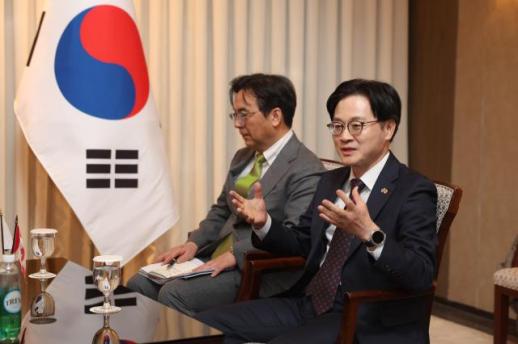 S. Korea secures 80 pct of May crude needs without tapping reserves, minister says SEOUL, April 12 (AJP) - South Korea has secured about 80 percent of its crude oil import needs for May and expects to weather the ongoing supply disruptions triggered by the Middle East conflict, Minister of Trade, Industry and Resources Kim Jung-kwan said. Kim said the volume of crude oil locked in for May had risen by 10 percentage points from the previous week, bolstered by private-sector stockpiles held by domestic refiners. "We believe we can get through April and May without releasing government reserves, unlike during the Russia-Ukraine war when such a release was necessary," Kim said. The minister, who returned Friday from a four-nation envoy trip, struck a guarded tone on the fate of seven South Korean-linked oil tankers stranded near the Strait of Hormuz. He said Seoul was working to secure their passage but cautioned that the outcome remained unpredictable. As an alternative to the choked strait, Kim said the government was preparing to route South Korean vessels through the Red Sea via Saudi Arabia's Yanbu port, with escort support from a destroyer. He added that Riyadh had pledged to give South Korean shipments top priority in allocating Yanbu port capacity. To diversify away from its heavy reliance on Middle Eastern crude, Seoul is pursuing imports from the United States and Kazakhstan. Kim said negotiations with Astana had made considerable headway and that specifics on volumes and terms could be announced early next week. Naphtha supply, a critical petrochemical feedstock often called the lifeblood of South Korea's manufacturing sector, is also stabilizing. Kim said procurement is projected to recover to about 80 percent of normal levels in April and May, with daily monitoring in place alongside industry partners to prevent further disruption. The government has earmarked 869.1 billion won (about $585.4 million) in a recently enacted supplementary budget for supply chain stabilization, including subsidies covering half the cost increase on naphtha imports for domestic petrochemical producers. Kim said the intervention was urgent because soaring feedstock prices had made it more economical for some firms to idle their plants entirely. On helium — a gas essential to semiconductor fabrication — Kim said supplies from U.S. sources had been secured through the end of June, ensuring that no chip production facility would face a shutdown over the interim. 2026-04-12 14:11:48
 -
 KATSEYE Brings Surprise HUNTRIX Collaboration to Coachella, Crowd Sings Along KATSEYE delivered a surprise collaboration at the Coachella Valley Music and Arts Festival, sharing the stage with vocalists from HUNTRIX, the fictional girl group from “K-Pop Demon Hunters.” The group performed on the Sahara stage in Indio, California, on April 11 (Korea time). Opening with its newly released single “PINKY UP,” KATSEYE ran through 11 songs and dance breaks in a roughly 45-minute set. “We can’t believe we finally made it to Coachella. So many emotions are swirling,” the members said. “You’re making our dream a reality.” The set drew loud sing-alongs from the crowd on songs spanning multiple styles, including “Debut,” “Gameboy,” “Internet Girl,” “Gabriela” and “Gnarly,” as fans followed the lyrics and moved to the beat. Introducing “My Way,” the members offered a message of support: “We’re cheering for all of you who have the courage to do things your own way, not just what others tell you to do.” The night’s centerpiece was a surprise joint stage with HUNTRIX vocalists Rei Ami, Audrey Nuna and Leejae, who joined KATSEYE for “GOLDEN.” The song was rearranged at a slightly slower tempo to highlight the melody, with the performers trading eye contact and building harmonies. KATSEYE’s “PINKY UP,” released April 11, ranked No. 10 on Spotify’s “Daily Top Songs USA” chart dated April 10 and No. 18 on the “Daily Top Songs Global” chart. The track pairs hard-hitting percussion and bass with glossy synth textures, delivering an energetic sound and a message about living fully in the moment.* This article has been translated by AI. 2026-04-12 10:55:13
 -
 South Korea Culture Ministry Sets 461.4 Billion Won Supplementary Budget for Tourism Loans, Ticket Discounts The Ministry of Culture, Sports and Tourism said Friday that its first supplementary budget for 2026 was finalized at 461.4 billion won. The ministry said the package was designed to limit damage to the culture, sports and tourism industries amid economic pressures such as high oil prices and inflation, while providing early support for livelihoods including those of grassroots artists. It also aims to spur domestic spending through discounts for movies and performances and support for lodging and travel, linking that demand to a rebound in regional tourism and the domestic economy. To ease financing strains on tourism businesses facing rising costs, including from a weaker currency, the ministry will increase tourism-sector loans by 200 billion won, expanding the program to 837.5 billion won. It will also invest 28.1 billion won in overseas marketing to encourage foreign visitors to enter and stay in regional areas, boosting local consumption and economies. Additional funding includes 8.6 billion won for tourism startups and ventures and 3.1 billion won to expand the Youth Tourism Dure program. To support a recovery in household spending, the ministry will issue 4.5 million movie discount coupons, budgeted at 27.1 billion won, worth 6,000 won each. It will also issue 400,000 performing-arts discount coupons, budgeted at 4.1 billion won, worth 10,000 won each, to help theaters and performance venues rebuild audiences. For non-capital regions designated as areas with population decline, the ministry will provide an additional 300,000 lodging discount coupons, budgeted at 11.2 billion won. It will also expand eligibility for a worker vacation support program to include employees at mid-sized companies, allocating 4.2 billion won. A half-price travel support program for population-decline areas will expand to 30 locations from 20, with 4 billion won, to boost domestic demand and help restore sales. The ministry also set aside funding to help artists and the content industry sustain activity amid a downturn. It added 2 billion won each for operating private visual and performing arts creation spaces and supporting creators, and for supporting touring exhibitions in regional areas. It will expand support for performances by young artists with 2.4 billion won, increase loans for artists’ livelihood stability to 32.78 billion won, and expand financial support for the arts industry by 30 billion won. It also allocated 700 million won to add staff for administering the artist activity certification system. To counter a slowdown in the content industry, the ministry will invest a total of 38.5 billion won, including 26 billion won to support production of mid-budget films, 8 billion won for advanced production support, and 4.5 billion won for independent and art films. It will also increase support, by 6.3 billion won, for creation and production through regional Content Korea Labs and business support centers. The ministry said it will newly establish a 25 billion won youth content fund-of-funds to encourage investment in young “K-content” companies that are vulnerable during economic shocks. To expand youth employment in the field, the ministry will increase support for internship positions at cultural and arts institutions, allocating 3.4 billion won. It will also launch new programs: a youth internship at literature museums (750 million won), training tourism personnel linked to industrial sites (850 million won), and an internship matching program for top talent in the content industry (1.9 billion won). In sports, the ministry will add 4 billion won to its sports activity incentive program, known as Ttunteun Money, to cover an additional 80,000 beneficiaries. It will also increase funding for vouchers for sports classes for people with disabilities by 6.2 billion won, supporting 20,000 people with monthly tuition of 110,000 won. It will spend 9.5 billion won to roll out nationwide youth sports programs that use retired athletes and sports instructors as coaches. Culture Minister Choi Hwi-young said high oil prices and inflation driven by the war in the Middle East were compounding difficulties across the culture, sports and tourism sectors. “This supplementary budget is an investment to respond proactively to the crisis,” Choi said. He said he expects it to achieve two goals at once: stabilizing livelihoods for artists and the tourism and culture industries, and reviving domestic demand to help energize regional economies.* This article has been translated by AI. 2026-04-12 10:54:17
 -
 EcoPro secures C$6 mln from Canada to develop all-solid-state battery materials SEOUL, April 12 (AJP) - South Korean battery materials maker EcoPro said it has secured 6 million Canadian dollars (about $4.3 million) in research funding from Canada's federal government to develop lithium metal anode technology for next-generation all-solid-state batteries. The grant, awarded to EcoPro Lithium — a unit of subsidiary EcoPro Innovation — falls under Ottawa's Energy Innovation Program, which aims to bolster domestic battery supply chains. EcoPro Innovation signed a joint development agreement with Quebec state utility Hydro-Quebec in March last year to co-develop lithium metal anodes. The funding will bankroll efforts to build and demonstrate a full lithium metal anode value chain on Canadian soil by March 2027, spanning lithium metal production, high-purity refining, ultra-thin foil fabrication and performance validation. The company also plans to accelerate construction of a semi-mass-production pilot line for the material. Lithium metal anodes offer about 10 times the energy density of conventional graphite-based anodes, a leap that could dramatically extend electric vehicle driving range and position the technology as a linchpin of the all-solid-state battery era. Beyond anodes, the EcoPro group is developing solid electrolytes, solid-state cathode materials and lithium sulfide. Its solid electrolyte program, targeting commercialization next year, has a pilot facility at the company's Ochang headquarters in North Chungcheong Province producing samples at a rate of 40 tons per year. "We are advancing lithium metal anode technology in collaboration with the Canadian government and local partners to lead the all-solid-state battery market," an EcoPro Innovation spokesperson said. "This government funding is expected to significantly accelerate the pace of development." 2026-04-12 10:27:15
 -
 UPDATE: U.S.-Iran talks collapse in Islamabad over nuclear, Hormuz disputes SEOUL, April 12 (AJP) - The United States and Iran failed to reach an agreement after 21 hours of grueling negotiations in the Pakistani capital, plunging the fragile two-week ceasefire into uncertainty with its April 21 expiration now looming. The marathon session, mediated by Pakistan, stretched across multiple rounds from Saturday evening through Sunday morning but ultimately foundered over deep divisions on Iran's nuclear program and the reopening of the Strait of Hormuz. U.S. Vice President JD Vance, who led the American delegation, told reporters after the talks that Washington had yet to see a fundamental commitment from Tehran. "We leave here with a very simple proposal: a method of understanding that is our final and best offer," Vance said. "We'll see if the Iranians accept it." Iran's semi-official Tasnim news agency struck a defiant tone, reporting that the Iranian delegation had rebuffed what it characterized as Washington's attempt to extract through negotiation concessions it could not win on the battlefield, including the dismantling of Iran's uranium enrichment program and the immediate opening of the strait. The United States sought not only the surrender of Iran's existing stockpile of highly enriched uranium but also curbs on its enrichment capabilities — an effort to eliminate both Tehran's present nuclear capacity and its future weapons potential. Iran, for its part, refused to relinquish what it called its right to peaceful nuclear energy. The Strait of Hormuz emerged as an equally intractable flashpoint. Washington demanded the immediate reopening of the vital waterway, whose blockade has driven up global oil prices and rattled international markets. Tehran, however, views the strait as its most powerful bargaining chip and insisted it would lift the blockade only after a comprehensive deal is sealed, senior Iranian officials cited. Tensions along the waterway underscored the stakes. U.S. Central Command said it had begun preparations for mine clearance in the strait, with two Navy guided-missile destroyers transiting the passage. Iran's Islamic Revolutionary Guard Corps warned that any warships attempting to pass would face a forceful response. The breakdown of the first face-to-face encounter between the two adversaries casts a shadow over the ceasefire brokered on April 8. With the truce set to expire in nine days, concerns are mounting that Israel could intensify its military operations against Hezbollah in Lebanon, further complicating any return to the negotiating table. Experts note that Iran appears to believe time is on its side, calculating that the economic pain inflicted by the Hormuz blockade gives Washington greater incentive to make concessions. The United States and Israel, meanwhile, have signaled they reserve the right to strike Iran's nuclear facilities at any time. 2026-04-12 09:33:28
 -
 BTS Launches 'Arirang' World Tour in Goyang, Drawing 132,000 Fans Over Three Shows BTS returned to solo touring with a stadium-scale production that paired mass choreography and fireworks with distinctly Korean imagery, using its new album, "Arirang," to signal what the group called a new chapter, "BTS 2.0." The group held "BTS World Tour Arirang in Goyang" on April 9 and April 11-12 at the main stadium of Goyang Sports Complex in Goyang, south of Seoul. It marked BTS’ first standalone tour in about four years since "BTS Permission to Dance on Stage" ended in April 2022. About 132,000 people attended across the three shows. BTS opened with "Hooligan," "Aliens" and "Run BTS," driving the pace from the start. A mega crew of dozens joined the group for synchronized choreography that filled the stadium and quickly lifted the crowd’s energy. After the opening, Jung Kook told fans the weather was better than the day before and promised to "heat up" the venue even if it felt chilly. V said it had been a long time since BTS performed on a 360-degree stage and that being surrounded by ARMY, the group’s fan base, felt good. Jimin said the audience response seemed even hotter and that ARMY’s voices were especially clear. He added that BTS released "Arirang" after four years and resumed a concert tour after six and a half years, saying the group tried many new approaches in both the album and the stage production. Suga said BTS also made new attempts in songs and staging and asked fans to stay with the show even if some elements felt unfamiliar. The concert framed "BTS 2.0" as a step forward while revisiting the group’s roots. Fans saw new songs from the fifth full-length album, "Arirang," alongside established hits, arranged to trace BTS’ musical path and point to its next direction. The setlist was organized into three themes. In the "BTS" section, the group performed "they don’t know ‘bout us" with large screens showing modernized images of traditional Korean masks, followed by "Like Animals," "FAKE LOVE," "Swim" and "Merry Go Round." In the "2.0" section, BTS centered on "Normal," inspired by ink-wash painting, and ran through performance-heavy tracks including "Not Today," "MIC Drop," "FYA" and "FIRE." "Body To Body" featured choreography evoking the traditional circle dance ganggangsullae and was paired with fireworks. "IDOL" included a march along the stadium track. The final "Arirang" section pushed the crowd into a festival mood with "Come Over," "Butter," "Dynamite," "Fleet" and "Into the Sun." Korean aesthetics ran through the production, reflecting themes BTS said it explored on "Arirang" about origins, roots and identity. Traditional symbols were presented with a modern sensibility and tied closely to the music. The stage design placed a pavilion-like structure inspired by Gyeonghoeru at the center of an open 360-degree stage, reimagining a shared banquet space. The floor was designed after the South Korean flag: the taegeuk circle anchored the center, while four protruding stages extended outward, drawing on the trigrams. The layout also brought the group closer to fans around the venue. With the world tour resuming after six and a half years, the show emphasized the full seven-member lineup rather than individual stages, leaning on large-scale group choreography and a setlist packed with fan-favorite hits while presenting the message of cohesion and evolution tied to "BTS 2.0." RM thanked fans for coming after what he called a long wait, saying, "You’re the best." He said many things were changing, but the most important points had not: that the seven members chose to do this work together and that they genuinely think of their fans. He added that BTS would not take filling the venue lightly and asked fans to trust the group and watch its changes with patience, noting he first met Jung Kook when he was 15 and that they are now all over 30. Suga said the good weather seemed to match the crowd’s energy and asked fans to tell those attending the next day to come ready to shout and blow off stress. "Thanks to you, I’m taking home good memories. Thank you, and I love you," he said. Jimin said it had been six and a half years since the group toured and four years since the album release, adding he missed fans and wanted to thank them for waiting. He said BTS would keep working to deliver strong stages and music and asked fans to stay by the group’s side. V said he used his voice so much during the first show that the back of his neck hurt afterward, but that seeing ARMY made the pain "disappear like magic." Jung Kook said he was relieved the show ended safely and said the weather and cheers made him feel good. He told fans he hoped they understood that his actions and feelings toward them were sincere in any situation, adding he would keep giving everything for them and would repay their waiting with strong performances. J-Hope said he is always curious about fans’ thoughts and reactions and that the members talked extensively while preparing the concert, considering in detail how to deliver good feelings and create memories. He said the seven members’ commitment to the stage is genuine and that they want to keep showing their best performances. BTS is set to continue the tour with shows April 17-18 at Tokyo Dome, followed by dates across North America, Europe, South America and Asia. The plan calls for 85 concerts in 34 cities, described as the highest number of shows for a single tour by a Korean artist, with additional dates in Japan and the Middle East also announced.* This article has been translated by AI. 2026-04-11 21:39:17
 -
 Kang Gye-yeol, 102, Featured in ‘My Love, Don’t Cross That River,’ Dies Kang Gye-yeol, who appeared in the documentary film “My Love, Don’t Cross That River,” has died. She was 102. Director Jin Mo-young announced her death on social media on the 10th. Jin said he visited Kang on March 31 to say goodbye. Though her memory had faded, she recognized the group, greeted them and offered kind words, he said. “Even when I first met her in September 2012, she was like a young girl,” Jin wrote, mourning her death after she lived past 100. Released in 2014, “My Love, Don’t Cross That River” follows the lives of Kang and her husband, Cho Byeong-man. The film drew about 4.8 million viewers, an unusually strong box-office showing for an independent movie. Cho died in 2013 while the film was being shot.* This article has been translated by AI. 2026-04-11 19:33:14
 -
 Police intensify search as escaped wolf remains at large for fourth day SEOUL, April 11 (AJP) - Authorities in the central city of Daejeon have deployed drones and specialized tracking teams on Saturday to locate an escaped wolf that fled a zoo safari as the search enters its fourth day without a confirmed sighting. The two-year-old male wolf was last detected by a thermal imaging camera at 1:30 a.m. on Thursday, but it has since vanished into the rugged terrain surrounding the facility. Recent heavy rainfall and deteriorating weather conditions hindered initial aerial efforts, leading officials to believe the wolf may be taking cover in burrows or dense brush that obscured its heat signature from recovery teams. The search operation involves approximately 90 personnel and 10 drones focused on the mountainous areas of the Jung District. To prevent the animal from fleeing further into inhabited zones, ground teams have been minimized in favor of high-altitude surveillance. Officials expect that as temperatures drop after sunset, the wolf’s body heat will provide a sharper contrast against the cooling ground, allowing thermal sensors to pinpoint its exact location. Once spotted, the strategy will shift from observation to containment, with experts planning to herd the animal toward a designated capture zone without causing undue stress that could provoke a flight response. The prolonged disappearance has placed local authorities on high alert, as the window for a controlled recovery narrows. City officials emphasized that night operations remain the most viable path to a resolution, given the increased visibility of moving targets under infrared light. A spokesperson for the city of Daejeon stated, "It is much easier to find moving individuals by checking with drones equipped with thermal imaging cameras at night than during the day. It is important to find the wolf quickly by focusing on night searches from tonight until dawn." 2026-04-11 17:54:19