
Journalist

Elizabeth Englezos
-
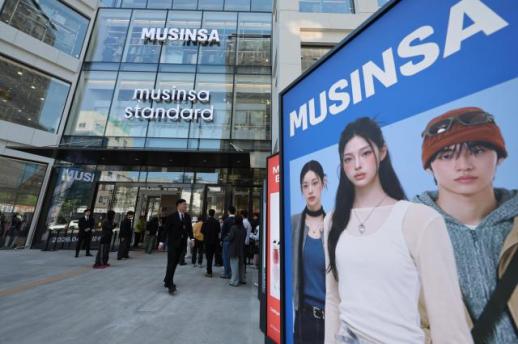 K-shopping wonderland lands in Seongsu as Musinsa scales offline push SEOUL, April 24 (AJP) - Gone are the days when group tourists shuffled through duty-free shops and the Dongdaemun marketplace. K-shopping today is about hip, affordability and fun — and sharing the experience with friends, on or off camera. To amplify that shift, a shopping-themed amusement park has arrived in Seoul’s trendiest district, Seongsu-dong. "I wish there was a store like this in the U.S.," said Maddie, a tourist from the United States, as she explored the newly opened Musinsa Megastore Seongsu on Friday. Alongside her friend Hannah, she was among the thousands who flocked to the 6,600-square-meter facility for its official grand opening. As South Korea’s leading fashion and beauty enterprise, Musinsa is pivotally expanding its domestic physical presence. While already a dominant force online and a growing name in Japan and China, this megastore—South Korea’s largest single-brand offline retail space—signals a major strategic evolution. By blending over 1,000 brands with experiential entertainment, Musinsa aims to broaden its appeal from its core Gen Z demographic to include families and shoppers in their 40s. Spanning five floors from the basement to the fourth floor, the store utilizes a "shop-in-shop" concept to present brands in a multidimensional way. Dedicated concept zones include "Girls" — featuring brands like Glowny, Low Classic Lc, and The Barnnet — as well as "Young," "Sports," and "Next Outdoor" sections featuring global names like Nike and Adidas. For international visitors, the curated selection is a primary draw. "I realized that I didn't know many of the brands, but they look cool," Maddie noted. "I feel like Musinsa has curated that for us... It’s less cumbersome. Shopping time is valuable". Hannah added that for their age group, "uniqueness" and "style" outweigh brand names, describing the quality as significantly better than "Walmart quality". The Americans compared the experience favorably to major international retailers. "We basically have things like Muji and Uniqlo, but it’s only clothes and basics," they said. "Here, you have more edgy clothes, you have Musinsa Standard on one floor, beauty on another... it’s like a department store in one". The second floor houses a massive 150-pyeong (approximately 500-square-meter) "Musinsa Beauty" section, stocking approximately 7,500 items from 700 brands. This includes several brands exclusive to Musinsa's offline channel, such as Glif, Tense, Snidel Beauty, Sensle, and Ares. The sheer scale of this offline beauty section signals Musinsa's bold expansion into a category long dominated by established offline health and beauty (H&B) giants. The move represents a direct challenge to the existing market hierarchy, sparking fierce behind-the-scenes competition for brand curation as Musinsa aggressively disrupts the traditional H&B retail landscape. Anne, a visitor from the Philippines who came specifically for skincare, praised the store’s spaciousness. "The store is massive, but it’s not too crowded that it’s uncomfortable for shopping," she said. However, some Western shoppers noted a difference in organization, observing that the beauty section is arranged by product type rather than brand, a departure from typical U.S. store layouts. Musinsa has packed the facility with "experiential content" to keep shoppers engaged. Features include the "Musing-sa" coin karaoke booth in the basement, an NCT WISH idol pop-up zone, and a custom soccer jersey marking service on the fourth floor. The top floor features a "Food Garden" with popular eateries like Tteoksan and Fuglen coffee. Musinsa officials described the F&B zone as a convenience facility designed for customer retention rather than direct profit. "You have to eat and get energy to shop again," a representative noted. The megastore is part of Musinsa's broader "O4O" (Online-for-Offline) strategy. The company now operates 75 offline locations and recently secured naming rights to Seongsu Station to solidify its presence in the district. For international visitors, the Seongsu location serves as a highly calculated business hub rather than a simple tourist attraction. The facility is equipped with multilingual self-checkout kiosks and in-store tax refund machines to streamline purchasing for foreign tourists. Furthermore, Musinsa integrates this physical experience with its "Global Store" app, allowing tourists to seamlessly continue shopping and receive direct shipments to 13 different countries after returning to their home countries. To celebrate the opening, Musinsa is holding the "ON & OFF FESTIVAL" through May 3 across 11 offline stores and its online platform, offering discounts up to 80 percent. Opening day specials include the "Mega Bag," a 49,900-won bundle containing merchandise and vouchers worth up to 400,000 won. "Musinsa Megastore Seongsu will be the pinnacle of offline retail that captures the essence of the fashion and beauty we pursue," a company official said. 2026-04-24 15:44:34
 -
 Myanmar Fishery Exports Top 326,300 Tons in FY2025 Myanmar exported more than 326,300 tons of fishery products in fiscal 2025 (April 2025 to March 2026), with export earnings topping $404 million (about 64.4 billion yen), the state-run Global New Light of Myanmar reported on the 23rd, citing the Fisheries Department under the Ministry of Agriculture, Livestock and Irrigation. By transport route, seaborne shipments exceeded 150,000 tons worth $240.48 million, while overland exports totaled 176,000 tons valued at $163.5 million. Myanmar continues to export seafood to more than 40 countries, including South Korea, Japan, China, Thailand and Bangladesh. The Myanmar Fisheries Federation said key export items include hilsa, rohu, catfish, seabass, eel, shrimp and crab. It also said more than 140 upgraded frozen and refrigerated storage facilities nationwide must renew annual permits through the Fisheries Department. In fiscal 2024, Myanmar exported about 400,000 tons of fishery products worth $421 million.* This article has been translated by AI. 2026-04-24 15:39:38
 -
 Kia Says Robotics America Investment Under Review; SDV Test Car on Track Kim Seung-jun, Kia’s head of finance (executive director), said during the company’s first-quarter earnings conference call on April 24 that Kia has previously indicated it intends to take part in an investment in Robotics America. “However, details such as the size, the method of contribution and the investing entity are under review,” Kim said. “If we are ready in the second half of this year, we will be able to share more.” Kim said the SDV “pace car,” or test vehicle, is expected to be ready near the end of this year, with development to be completed in 2027 and a possible launch around early 2028. He said there is no major change to the overall schedule to mass-produce SDVs at an L2++ level that can gradually expand to autonomous driving in urban areas. * This article has been translated by AI. 2026-04-24 15:39:13
 -
 Blue House: No Decision Yet on Long-Term Capital Gains Deduction for Nonresident Single-Homeowners The Blue House said Thursday that the government is discussing whether to apply a long-term capital gains deduction to nonresident single-homeowners, but that nothing has been decided. A Blue House official told reporters at the Chunchugwan press briefing room that officials are hearing a range of views and that more discussion is needed. The long-term holding special deduction reduces capital gains tax by up to 40% based on how long a property is held and up to 40% based on how long the owner has lived in it, for a combined maximum deduction of 80%. Earlier Thursday, Lee wrote on X, formerly Twitter, that to protect single-homeowners, tax relief tied to actual residence is necessary. But he argued that cutting capital gains taxes on expensive homes simply because they were held for a long time as investments, without the owner living there, is not a housing protection policy but a policy that encourages speculation. His remarks were widely read as signaling an intent to overhaul the tax system by reducing breaks for nonresident single-homeowners while expanding deductions tied to holding periods for those who live in their homes. The Blue House official said the president’s message was “at the level of principles,” stressing that one-home households should be treated more favorably than multi-homeowners, and that even among one-home households, investment-driven nonresidence should be distinguished from owner-occupied housing. 2026-04-24 15:37:18
 -
 Prosecutors Seek 30 Years for Yoon Suk Yeol Over Alleged Pyongyang Drone Operation A special prosecutor on Thursday sought a 30-year prison term for Yoon Suk Yeol, accused of ordering drones sent into Pyongyang to create a pretext for declaring martial law on Dec. 3. Prosecutors argued the operation aimed to manufacture wartime conditions and was linked to the broader martial law case. The special counsel team investigating the alleged insurrection, led by Special Prosecutor Cho Eun-seok, asked the Seoul Central District Court to sentence Yoon to 30 years and former Defense Minister Kim Yong-hyeon to 25 years. The request came during closing arguments before the court’s Criminal Division 36, presided over by Judge Lee Jeong-yeop. Prosecutors described the case as an “anti-state, anti-people crime” in which the commander in chief and the defense minister allegedly tried to create wartime conditions on the Korean Peninsula to meet the requirements for declaring martial law. They said the actions caused real harm to national security, severely undermined military interests, and led to national confusion and a breakdown in discipline. They said Yoon’s role as commander in chief and alleged leadership of the acts was reflected in the sentencing request, while Kim’s involvement from planning through execution was also considered. Prosecutors said they also weighed the defendants’ conduct during the investigation and trial. A central issue is whether the “Pyongyang drone deployment” went beyond a military operation and amounted to an attempt to provoke a “North wind” incident to justify martial law. Prosecutors allege Yoon and others ordered multiple drone flights into Pyongyang around October 2024 to raise military tensions. They also argued that a drone crash led to the disclosure of operational and force-related military secrets, supporting an “aiding the enemy” charge. Under that offense, prosecutors said, a crime can be established even without collusion with an adversary if military interests are harmed or benefits are provided to an enemy state. Prosecutors said the case was a “preliminary-stage” offense connected to the martial law declaration. They said they set the requested terms in light of earlier sentencing requests in related cases, including the death penalty sought for Yoon on charges of leading an insurrection and life imprisonment sought for Kim on charges of playing a key role in an insurrection. In related cases, prosecutors have also sought heavy sentences, including 20 years for former Defense Security Command chief Yeo In-hyeong and five years for former Drone Operations Command chief Kim Yong-dae, requested on April 10. Thursday’s hearing was closed to the public due to military secrets, but the sentencing hearing is expected to be open under the Constitution. With closing arguments complete, attention is turning to the court’s judgment on whether the alleged pretext-building for martial law is established and whether the “aiding the enemy” charge applies.* This article has been translated by AI. 2026-04-24 15:36:21
 -
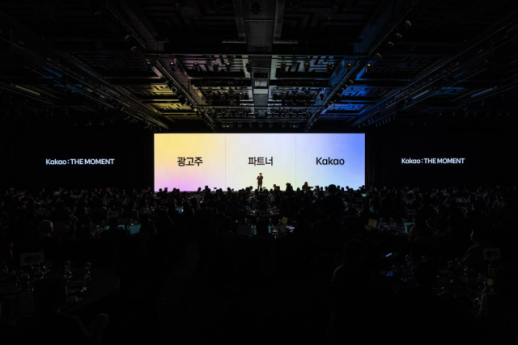 Kakao Wraps Ad Conference, Unveils AI-Driven Integrated Advertising Strategy Kakao said it successfully wrapped up its “Kakao The Moment” advertising conference and outlined plans to expand an artificial intelligence-based ad platform. The company said about 1,000 people — including advertisers, agencies and media representatives — attended the April 23 event, where Kakao shared its advertising vision and strategy. Kakao said the conference was designed to review the present and future of its ad business and strengthen partnerships. Kakao presented a plan to expand into an integrated advertising platform that links messaging, display, commerce and AI. Centered on KakaoTalk, the company said it aims to improve both efficiency and performance by offering ad models that blend naturally into users’ daily experiences. Kakao highlighted examples of purchase conversions driven by message ads and user behavior-based targeting that connects display and commerce ads, saying the approach can improve campaign results. AI-driven ad operations were also a key topic. Kakao said it plans to automate and optimize the full process — from campaign planning and audience targeting to creative operations — to boost efficiency and help advertisers run more precise marketing strategies. The company also emphasized building an ad environment based on user consent, including principles for data use and protection. Kakao said it will deliver messages based on consent to receive promotional information and use ad exposure methods that reflect user choice to strengthen trust. Beyond presentations, the event included an AI experience zone, on-site Q&A and a lucky draw. Kakao also linked KakaoTalk-based reservation, notification and open chat features to extend the experience before and after the event and let participants see how ads can be used in real business settings. Jeon Hyeon-su, a performance leader at Kakao, said the conference shared the company’s expansion direction and technology-based competitiveness. “We will continue to build an environment where we can grow with advertisers by advancing AI-based advertising technology and earning user trust,” he said. * This article has been translated by AI. 2026-04-24 15:31:03
 -
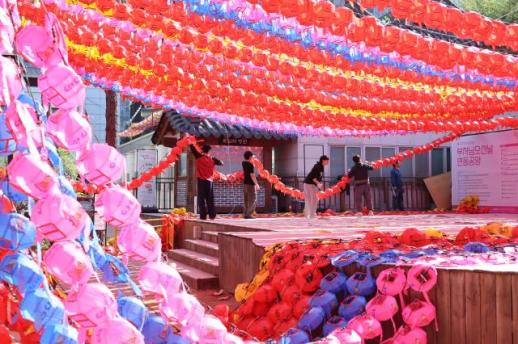 A ceiling of wishes: Jogyesa fills with lantern light ahead of Buddha's Birthday SEOUL, April 24 (AJP) -At Jogyesa Temple in downtown Seoul, the sky has begun to lower — not with clouds, but with color. A month ahead of Buddha's Birthday on May 24, preparations are in full swing. Lanterns gather overhead in long, patient rows, stretching across the temple grounds like a suspended tapestry. From a distance, they resemble a soft ceiling; up close, each one carries a name, a wish, a quiet intention. Near the entrance, a modest registration booth hums with steady activity. Believers and visitors stop to sponsor lanterns, their handwritten tags accumulating one by one — small slips of paper that will soon rise into the canopy above. The act is simple, almost routine, yet deliberate: a wish written, a string tied, a place secured among thousands. Elsewhere, the work continues in quiet coordination. Workers move methodically beneath the lines, lifting, fastening, adjusting. Long strings of lanterns are raised overhead, inch by inch, transforming open air into something more intimate. In some sections, the installation is complete — lanterns already catching sunlight, their reds, yellows and blues softly glowing against the spring sky. In others, hands remain busy, carefully attaching name tags to rows of white lanterns waiting to be filled with meaning. In the center of Seoul, amid traffic and routine, Jogyesa Temple becomes a place where tradition and faith briefly take visible form — not in grand gestures, but in repetition: lantern after lantern, wish after wish, rising together to fill the air. 2026-04-24 15:26:18
 -
 Kia Says Raw Material Costs Rose From March, Keeps 10.2 Trillion Won Operating Profit Target Kim Seung-jun, an executive vice president and head of Kia’s finance division, said on an earnings conference call for the company’s first-quarter results that rising raw material prices, including aluminum, began affecting costs in March. He said oil prices could stay around $100 this year even if the war ends, adding that the company faces a clear risk of higher costs. Kim said Kia ships about 260,000 vehicles a year to the Asia and Middle East region, but he believes the company has enough capacity to offset that volume in other markets such as South Korea, Europe and India. He said Kia expects to maintain its annual targets of 3.35 million vehicles sold and 10.2 trillion won in operating profit.* This article has been translated by AI. 2026-04-24 15:24:14
 -
 Coupang Denies Reports It Lobbied U.S. to Pressure South Korea Coupang on Thursday denied recent reports that it was pressuring the South Korean government through lobbying of the U.S. administration and Congress, calling the claims untrue. In a reference note, the company said assertions that there were discussions related to security were "clearly false." It said its lobbying has covered economic cooperation between the two countries, including expanding investment and trade involving South Korea, Taiwan and Japan, and broadening professional visa opportunities for South Koreans, and that it did not include any security-related issues. Coupang added that it is focused on communication with the United States and other countries to promote AI innovation, investment and job creation, and to expand cross-border commerce. Separately, a filing under the U.S. Lobbying Disclosure Act showed Coupang Inc. spent $1.09 million on lobbying in the first quarter (January to March) this year. Coupang said companies in the United States and major South Korean firms conduct legal lobbying, adding that major U.S. companies spend three to four times more than Coupang and that its spending is also lower than that of major South Korean conglomerates. * This article has been translated by AI. 2026-04-24 15:22:46
 -
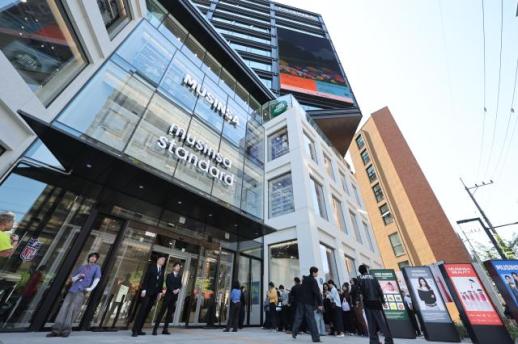 Forget SPA, enter experience: new K-fashion megastore lands in Seongsu SEOUL, April 24 (AJP) -For a shop lover, the ambience matters. This warehouse-like space hums with a hip energy that makes you feel instantly on trend. Musinsa's massive 66,000-square-foot offline store in Seongsu-dong that opened on Friday brings together about 1,000 brands across fashion, beauty and F&B under one roof to showcase the company’s retail essence. Musinsa Mega Store Seongsu, spanning one basement level and four above-ground floors, is the largest multi-brand shop in Korea housed within a single store. The space unfolds by theme rather than function. The basement floor houses Musinsa Young, work and formal wear, as well as casual and leather shoes. The first and second floors feature girls’ fashion, bags and caps club, eyewear and beauty. The third floor brings together Musinsa Standard Men, Women, Home and Beauty, while the fourth floor is dedicated to sports, running, next outdoor and a food garden. The beauty hall opens wide — a dense yet airy field of color and glass where shoppers test, compare, and consult. Products are grouped by function, not brand, encouraging discovery over familiarity. It feels less transactional, more exploratory. Ah, then there are the shoes. Neatly lined rows give way to bursts of color and texture — sneakers, loafers, leather classics — each pair waiting to be picked up, tried on, and walked out into the city. A “Girls” zone bursts in soft tones and textured fabrics, while just steps away, a “Sports” section shifts the mood with bold silhouettes and global labels. There is no single path. Visitors drift, double back, linger — browsing as if navigating an exhibition rather than a store. 2026-04-24 15:22:19