
Journalist

James Mehigan
-
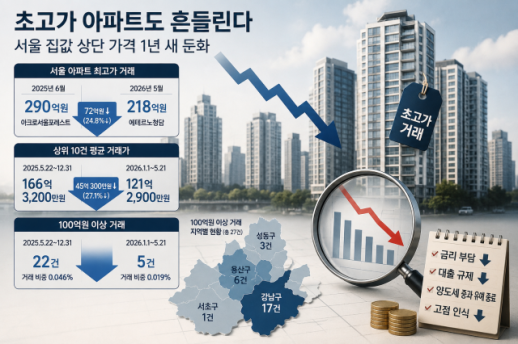 High-End Apartment Transactions in Seoul Slow Down The high-end apartment market in Seoul has seen a decline in transaction values compared to a year ago. While transactions in key areas like Gangnam and Yongsan continue in the 10 billion won range, the trend of large transactions in the 20 billion to 30 billion won range has noticeably slowed down. An analysis of real transaction data from the Ministry of Land, Infrastructure and Transport revealed that the highest apartment transaction this year was for a 231.2798 square meter unit at 'Aeterno Cheongdam' in Gangnam, which sold for 2.18 billion won. In contrast, the highest transaction recorded in the past year was a 273.928 square meter unit at 'Acro Seoul Forest' in Seongdong-gu, which sold for 2.9 billion won last June. The average price of the top 10 transactions has also decreased. This year, the average price for the top 10 apartment transactions in Seoul was 1.2129 billion won, down from 1.6632 billion won from May to December last year. This represents a decrease of 450.3 million won, or 27.1%. The frequency of transactions exceeding 10 billion won has also declined. From May 22 to the end of last year, there were 22 transactions over 10 billion won, but only five have occurred by May 21 this year. The proportion of transactions over 10 billion won has dropped from 0.046% to 0.019% during the same period. However, some analysts suggest that the high-end market is not experiencing a complete downturn. Transactions in the 10 billion won range continue in core areas of Gangnam and Yongsan. Notable transactions this year include 'Nine One Hannam' in Yongsan, selling for between 14 billion and 15.7 billion won, 'Shinhyundai 11th' in Gangnam at 11 billion won, and 'Raemian One Pentas' in Seocho at 10 billion won. Regionally, Gangnam has shown a significant concentration of high-value transactions. Of the 27 transactions over 10 billion won in the past year, 17 occurred in Gangnam, followed by six in Yongsan, three in Seongdong, and one in Seocho. Expanding the scope to transactions over 5 billion won, Gangnam accounted for 253 transactions, while Seocho had 150, with Yongsan and Seongdong recording 30 and 29 transactions, respectively. In terms of specific complexes, 'Nine One Hannam' and 'Shinhyundai 11th' each had the highest number of transactions at five. 'Acro Seoul Forest' and 'Apgujeong Hyundai 6th and 2nd' each recorded three transactions. This indicates that the high-end market is primarily driven by emerging luxury complexes in the Hannam and Seongsu areas, as well as redevelopment projects in Apgujeong. Additionally, the expiration of the temporary suspension on capital gains tax for multiple homeowners is seen as a variable affecting the market. With increased tax burdens and land transaction regulations, buyers are becoming more selective in their pricing within the high-end market. A real estate industry official stated, "The high-end apartment market is experiencing a slowdown in transaction values rather than a complete halt. While high-value transactions continue in prime locations, the atmosphere of consecutive large transactions around 20 billion won, as seen last year, has weakened somewhat."* This article has been translated by AI. 2026-05-21 17:36:14
 -
 AJP Focus: Samsung strike on hold, but shareholders see a new battle beginning SEOUL, May 21 (AJP) - The chip lines at Samsung Electronics ran uninterrupted Thursday morning. What had been dreaded as the opening day of an unprecedented 18-day walkout instead turned into relief rally on the market after labor and management reached a last-minute settlement shortly before midnight. Samsung shares surged as much as 7 percent during trading and closed at a fresh record high as markets priced out the immediate risk of production disruption at the world’s largest memory-chip maker. But not all existing shareholders were pleased. Two separate shareholder advocacy groups staged demonstrations in Seoul on Thursday, arguing that the tentative wage agreement could severely undermine future shareholder returns and destabilize Samsung’s long-term financial structure if institutionalized. At the center of the controversy is the newly agreed compensation framework for semiconductor employees. Under the tentative deal, the union secured a structure that effectively allocates bonuses equivalent to 12 percent of operating profit — consisting of a 1.5 percent Overall Performance Incentive (OPI) and a 10.5 percent special management bonus for chipmaking divisions. According to consensus estimates compiled by FnGuide, Samsung Electronics is projected to post operating profit of around 348 trillion won ($252 billion) in 2026 amid the continuing global AI semiconductor boom. If the company executes the agreed formula in full, more than 41 trillion won could be recognized as labor compensation in a single year. For shareholders, the issue is not simply the size of the payout but its collision with Samsung’s existing capital return framework. Samsung previously pledged to return 50 percent of free cash flow generated between 2024 and 2026 to shareholders through dividends and share buybacks. But if tens of trillions of won are absorbed into operating expenses before profits flow into free cash generation, shareholder distributions could shrink sharply. Activist groups estimate the reduction in shareholder return capacity could exceed 15 trillion won. Industry experts note that while such a payout structuralizes financial risks, management faced an unavoidable dilemma regarding human capital. "From a financial perspective, 41 trillion won is an astronomical sum, equivalent to the capital required to build a massive, state-of-the-art semiconductor fabrication line," said Lee Jong-hwan, a professor of system semiconductor engineering at Sangmyung University. "However, Samsung's biggest fear right now is a 'domino-effect' drain of its core talent to SK Hynix or foreign competitors. From management's perspective, securing talent retention was likely deemed a safer, more urgent path for long-term survival than immediate infrastructure expansion." A small delegation from the “Korea Shareholder Movement Headquarters” gathered near the residence of Lee Jae-yong on Thursday, condemning what they described as an excessive inward transfer of corporate profits. Min Kyung-kwon, head of the organization, argued that the structure may violate Article 462 of South Korea’s Commercial Act governing dividend calculations. The group contends that distributing large-scale bonuses directly tied to pre-tax operating profit without shareholder approval amounts to what it called a “disguised illegal dividend.” The activists also questioned the sustainability of the formula during the semiconductor industry’s notoriously volatile downcycles. “Semiconductors are not a permanently booming industry,” one protester said during the rally. “If operating profit collapses during the next downturn, how can the company survive while structurally locked into massive payouts?” The group further criticized what it described as a widening disconnect between management, labor and shareholders, arguing that top executives themselves could indirectly benefit from profit-linked compensation structures while ordinary shareholders absorb the dilution in corporate value. Using ACT, an online minority shareholder platform reportedly containing around 13,000 verified Samsung shareholders, the activists are now preparing a potential nationwide class-action campaign. If Samsung’s board formally approves the tentative agreement, they say they plan to pursue breach-of-trust complaints against consenting directors and seek legal action to invalidate the board resolution. Elsewhere in Seoul, another shareholder organization calling itself the “Samsung Electronics Shareholder Action Practice Headquarters” held a parallel rally near Hangangjin Station in Yongsan District. That group framed the dispute less as a legal issue than a broader social and economic imbalance. Its members argued that highly paid workers in the semiconductor sector were demanding disproportionate rewards while many ordinary workers across South Korea continue to earn annual salaries below 30 million to 40 million won. The organization also renewed calls for the government to invoke emergency adjustment powers — a rarely used legal mechanism allowing authorities to suspend strikes temporarily in industries deemed vital to the national economy. The group argued that semiconductors should effectively be treated as strategic national infrastructure similar to police, electricity or transportation systems because of their central role in exports, employment and supply chains. Some members called for permanent legal restrictions on strikes within the semiconductor industry altogether, warning that prolonged labor instability could damage South Korea’s global competitiveness during a critical phase of the AI race. Furthermore, observers warn that the settlement could set a precedent that fundamentally alters the labor landscape across South Korean industries. "This deal could open the floodgates," Professor Lee warned. "Not only will non-memory units and other Samsung affiliates demand identical transparent, profit-linked bonus structures, but major automotive giants and their supply chain networks will face immense pressure from unions to replicate this formula. It triggers a nationwide structural shift in corporate profit distribution." For now, the immediate crisis has passed. Production remains stable. Markets have calmed. The feared supply-chain disruption that had alarmed investors, policymakers and global technology customers alike has been avoided. Yet the settlement appears to have exposed a deeper structural fault line inside corporate South Korea. The conflict is no longer confined to labor versus management. It is increasingly evolving into a three-way confrontation between labor, capital and shareholders over who ultimately owns the gains generated by the AI-era semiconductor boom. 2026-05-21 17:33:10
 -
 Seoul Mayoral Candidates Launch Campaigns Ahead of June 3 Election Jung Won-o of the Democratic Party and Oh Se-hoon of the People Power Party officially launched their campaigns for the Seoul mayoral election on May 21. The two candidates began a 13-day campaign across the city, engaging in a fierce contest for votes. On the first day of the official campaign, both candidates visited key locations at midnight. Jung went to the Dongseoul Postal Center in Gwangjin-gu, while Oh visited the Garak Agricultural and Marine Products Wholesale Market in Songpa-gu. Jung encouraged workers on the night shift and personally moved packages in the sorting area, while Oh greeted wholesalers and assisted with the auction of cabbage and radishes. Later, they traveled throughout Seoul to appeal for voter support. Jung held his official launch event at Wangsimni Station in Seongdong-gu, which he considers his political hometown, having served as the district's mayor for three terms. He emphasized that this election is about changing the capabilities of local government, urging citizens to vote for a revitalized local economy and a safer Seongdong. Following the launch, Jung continued campaigning near Konkuk University, at a bus terminal, and around Gangnam Station. He criticized Oh's safety awareness regarding the construction site of the GTX-A line at Samsung Station, where missing rebar was discovered. Jung claimed it was a clear case of poor construction, stating, "If Oh had been concerned about safety, this issue would have been reported to the mayor." Oh, after the sun rose, expressed his aspirations for the election in Samyang-dong, where he spent his childhood. He stated, "This election should call for a shift in the government's livelihood policies and serve as a warning to the Blue House against the path of dictatorship." Former lawmaker Yoo Seung-min, known for his centrist stance, joined Oh to lend support. Yoo remarked, "The candidate who prioritizes housing welfare for Seoul citizens should become the mayor, and I will actively assist Oh, who shares this vision." Oh then visited several districts, including Seodaemun, Yeongdeungpo, Guro, Seongbuk, and Dongdaemun, highlighting the government's failures in real estate policy that have led to a shortage of rental properties and skyrocketing rents. He urged voters to hold the government accountable for its real estate missteps. Oh concluded the first day of campaigning with a rally in Cheonggye Plaza during rush hour, before moving to Gangnam Station to wrap up the day's events. The official campaign period for the 9th nationwide simultaneous local elections, scheduled for June 3, lasts for 13 days until the day before voting on June 2. Early voting will take place over two days, on May 29 and 30. 2026-05-21 17:27:42
 -
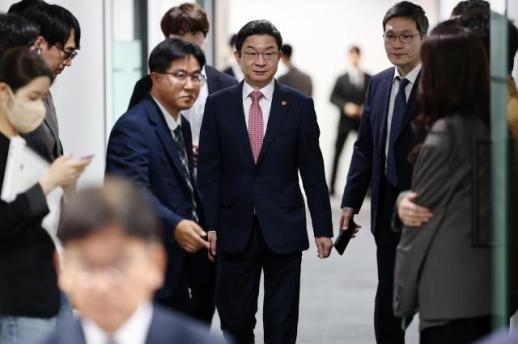 FSC to offer low-rate insurance for 10 Korean ships near Hormuz SEOUL, May 21 (AJP) - Financial Services Commission Chairman Lee Eok-won said Thursday the government will provide low-rate marine insurance for 10 vessels operated by small and midsized Korean shipping companies currently waiting near the Strait of Hormuz. Lee made the remarks during a meeting with shipping companies, policy lenders and insurers in Seoul, the fourth in a series of industry-finance meetings aimed at supporting sectors hit by the Middle East conflict. “The high and prolonged waves triggered by the Middle East war are increasing the management burden on shipping companies through higher operating costs, including fuel expenses, and opportunity costs from route restrictions,” Lee said. He said smaller shipping firms could face difficulties securing insurance for their vessels’ safe return, as marine insurance for large and special risks depends heavily on overseas reinsurers. Under the support plan, 10 domestic nonlife insurers will jointly underwrite war-risk insurance for the vessels without relying on overseas reinsurance. The participating insurers include Hyundai Marine & Fire Insurance, Samsung Fire & Marine Insurance, Meritz Fire & Marine Insurance, KB Insurance and Hanwha General Insurance. The coverage is expected to total about 300 billion won ($200 million) based on the value of the vessels subject to the insurance. The FSC said the insurance will be offered at the lowest rate available among domestic shipping companies, including large carriers. If a lower rate is later applied to another Korean vessel after the contracts are signed, the same rate will be applied retroactively through measures such as premium refunds. The support measure takes effect immediately. Lee also said the FSC will review, in consultation with relevant ministries, ways to establish a standing reinsurance program to expand coverage to major vessels with significant impact on the national economy. Regarding Namu, a midsized bulk carrier operated by HMM that caught fire after an external attack, Lee urged insurers to swiftly proceed with related procedures so that reasonable compensation can be provided. 2026-05-21 17:26:20
 -
 Concerns Grow Over Wage Gap After Samsung's Labor Agreement The small business sector expressed concerns that the recent wage agreement between Samsung Electronics and its labor union will exacerbate the wage and benefits gap between large and small enterprises. In a statement released on May 21, the Korea Federation of Small and Medium Businesses noted, "The conclusion of this negotiation is significant as it alleviates concerns over production disruptions at a major company that has a substantial impact on our economy amid intensifying global semiconductor competition." However, the federation added, "Small business workers and employers feel heavy-hearted watching the negotiations, and there are lingering doubts about whether fair compensation and rewards have been provided to partner small businesses amid discussions of performance bonuses amounting to hundreds of millions of won." On the night of May 20, Samsung Electronics and its labor union signed a tentative agreement on the 2026 wage negotiations at the Gyeonggi Provincial Labor Office in Suwon. The agreement maintains the existing Excess Profit Performance Incentive (OPI) and introduces a special management performance bonus system for the semiconductor (DS) division. The OPI will be paid based on business performance selected by mutual agreement, while the special management performance bonus for the DS division will be set at 10.5% of the agreed business performance. The Korea Federation of Small and Medium Businesses pointed out, "The deepening polarization between large and small enterprises is one of the most serious issues in our society," emphasizing that small business workers earn only half of what their counterparts in large companies make, with even larger gaps in bonuses and benefits. It further stated, "The competitiveness of our country's semiconductor industry, recognized as a global leader, is the result of thousands of partner companies and small businesses in materials and components working together as one team, and the contributions and roles of these partner small businesses must be fairly evaluated." The federation expressed hope that Samsung's promised co-growth measures would lead to effective strategies that promote research and development, facility investment, and wage increases for partner companies.* This article has been translated by AI. 2026-05-21 17:23:54
 -
 KOSPI outperforms Asian peers with record point gain on Nvidia boost, Samsung labor deal SEOUL, May 21 (AJP) - South Korean stocks sharply outperformed regional peers Thursday, as Nvidia’s upbeat earnings and Samsung Electronics’ tentative labor deal triggered a powerful rally in Seoul’s chip-heavy market despite mixed trading across Asia. The KOSPI jumped 606.64 points, or 8.42 percent, to finish at 7,815.59, dwarfing other gains across Asia. Japan’s Nikkei 225 rose more than 3 percent, while Chinese and Taiwanese shares lost ground, underscoring the strength of Korea’s rebound. The daily point gain marked the largest on record, surpassing the previous record increase of 490.36 points set on March 5. It was also the first time since May 14 that the index closed above the 7,800 mark. The index opened 3.85 percent higher at 7,486.37 and extended gains throughout the session, touching an intraday high of 7,819.23. The rapid rally triggered buy-side sidecar curbs in both the KOSPI and KOSDAQ markets in early trading, the first simultaneous activation in both markets since April 8. The rebound was also supported by easing geopolitical concerns and a pullback in oil prices, after U.S. President Donald Trump said negotiations with Iran were in the “final stages,” raising hopes for a potential easing of Middle East tensions. U.S. Treasury yields also retreated overnight, helping restore risk appetite across global markets. Investor sentiment was also supported by stronger-than-expected earnings from Nvidia, widely seen as a bellwether for global artificial intelligence demand. Nvidia reported its 12th consecutive quarter of record revenue, while adjusted earnings per share came in at $1.87, above Wall Street’s estimate of $1.76. The results reinforced expectations that global AI infrastructure spending remains strong, lifting demand for Korean semiconductor shares tied to high-bandwidth memory and advanced AI chip supply chains. Samsung Electronics’ tentative wage agreement with its labor union further fueled the rally, easing concerns over a possible strike at the country’s largest chipmaker. The deal came late Wednesday, shortly before a planned walkout was set to begin. Institutional investors led the rally, buying 2.883 trillion won ($1.91 billion) worth of shares on the main bourse. Retail investors sold 2.647 trillion won, while foreign investors offloaded 233 billion won. Most large-cap shares ended sharply higher. Samsung Electronics jumped 8.51 percent to close at 299,500 won after the tentative labor deal eased concerns over production disruptions. SK hynix surged more than 11 percent to 1,940,000 won, reflecting renewed optimism over AI memory demand. SK Square also rallied, while Samsung Electronics preferred shares, Samsung Life Insurance and Samsung C&T gained strongly. Samsung Electro-Mechanics rose 13.48 percent, Samsung Life Insurance climbed 13.78 percent and Samsung C&T advanced 12.96 percent. LG Electronics hit the daily upper limit, soaring 29.83 percent to 235,000 won, as investors priced in expectations for growth in its robotics and physical AI businesses. Automakers also posted strong gains. Hyundai Motor jumped 12.50 percent to 666,600 won, while Hyundai Mobis surged 25.2 percent to 670,000 won on expectations that it could benefit from Hyundai Motor Group’s expansion into humanoid robots and physical AI. The tech-heavy KOSDAQ also rebounded after four consecutive sessions of losses, rising 49.90 points, or 4.73 percent, to close at 1,105.97. Foreign investors and institutions bought 137 billion won and 139 billion won, respectively, while retail investors sold 258 billion won. Semiconductor equipment and robotics shares led gains on the secondary market. Wonik IPS rose 11.97 percent, EO Technics climbed 18.8 percent and Rainbow Robotics advanced 16.5 percent. By sector, electronics products led the gains with a 29.1 percent rise, followed by auto parts with 17 percent and display panels with 16.1 percent. Among themes, major IT shares climbed 14.6 percent, major automakers rose 13.7 percent and electric wire-related stocks gained 13.1 percent. The dollar remained strong at 1,506.1 won after briefly retreating to the 1,490-won range earlier in the session. 2026-05-21 17:21:17
 -
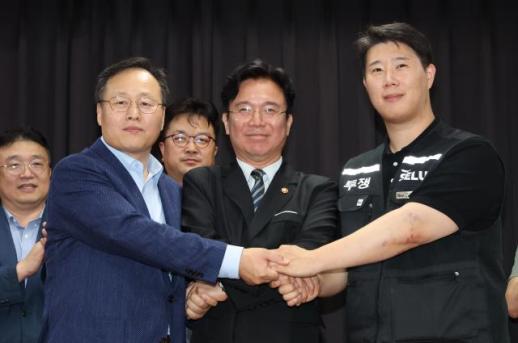 Labor Minister Facilitates Dialogue, Mediator Helps Resolve Samsung Wage Negotiations Samsung Electronics and its labor union reached a dramatic agreement just a day before a planned strike, with the involvement of labor authorities playing a significant role. Minister of Employment and Labor Kim Young-hwan facilitated dialogue between the two sides, while Park Soo-geun, chair of the Central Labor Relations Commission, focused on bridging their differences. Observers noted that the situation could have escalated into a crisis if emergency mediation powers had been activated, but the worst was averted. On May 21, relevant departments reported that Minister Kim began mediating the negotiations between Samsung Electronics and its labor union at 4 p.m. the previous day. Following the failure of the second post-adjustment meeting earlier that morning, the likelihood of an unprecedented strike at Samsung Electronics increased, prompting Kim to lead both parties back to the negotiation table, ultimately resulting in a tentative agreement. During the first post-adjustment meeting, which took place from May 11 to 13, the union declared a breakdown in negotiations. However, Kim persuaded both sides to resume talks during meetings on May 15 and 16, where he reportedly shared his past experiences in labor movements to build rapport with the union. Throughout the two rounds of post-adjustment meetings, Kim remained at the government complex in Sejong, engaging in behind-the-scenes discussions with both parties. After the second post-adjustment meeting failed, Park Soo-geun remarked, "There were many opposing views, but Minister Kim helped us, and many people contributed to making progress." After the breakdown of the post-adjustment talks, Kim facilitated further negotiations. While en route to the Gyeonggi Employment and Labor Office, he posted on social media, "Hope blooms in despair. It’s not over until it’s over." Following six hours of negotiations, he successfully mediated a tentative agreement, preventing a potential 0.5 percentage point drop in the country's GDP due to a strike. While Kim supported the negotiations behind the scenes, Park took an active role as a mediator, working to narrow the gap between the two sides during marathon meetings that lasted three days and included various proposals. This collaborative effort allowed both parties to find common ground, leading to the creation of a tentative agreement. After the agreement was reached, Minister Kim stated, "Chairman Park played a significant role in narrowing the gaps, and I believe he contributed greatly to resolving the remaining issues." The mediation by labor authorities is seen as having prevented a deterioration in labor-management relations. The business community expressed concerns that, given Samsung Electronics' significant role in the economy, a strike could have necessitated the activation of emergency mediation powers. Conversely, labor representatives maintained that discussions about activating emergency mediation powers, which limit fundamental rights, were inappropriate. As the government hinted at the possibility of invoking these powers, the labor-management relationship was on the brink of crisis, but mediation successfully averted this outcome.* This article has been translated by AI. 2026-05-21 17:21:00
 -
 Jang Dong-hyuk Meets Jeong Cheong-rae in Gongju, Urges Clean Candidates Jang Dong-hyuk, the leader of the People Power Party, visited Gongju in South Chungcheong Province on May 21, following a stop in Daejeon, where he criticized President Lee Jae-myung and called for accountability from the Democratic Party. At the same time, Jeong Cheong-rae, the leader of the Democratic Party, was also campaigning in Gongju, heightening the political atmosphere. As the head of the party's election campaign committee, Jang urged support for Yoon Yong-geun, the candidate for the National Assembly by-election in Gongju, Buyeo, and Cheongyang, and for Choi Won-cheol, the candidate for Gongju mayor, during his visit to Gongju Sanseong Market. "Lee Jae-myung has become president but is trying to dismiss his own trial while ignoring the public," Jang said. He emphasized the need for Yoon, who could help bring Lee back to trial, to be elected to the National Assembly. At the same time, Jeong passed by Jang's rally at the market, further intensifying the atmosphere. Jang, seemingly aware of Jeong's presence, called out the names of gubernatorial candidate Kim Tae-heum, Choi, and Yoon with increasing fervor. He appealed to voters, saying, "Please choose clean and competent candidates to create a better Gongju." Some supporters of the People Power Party shouted, "Oppose the dismissal of the indictment" at Jeong, who maintained a smile as he walked by. After his speech, Jang urged the crowd to unite for an overwhelming victory for the People Power Party in South Chungcheong Province, which he believes will lead to national success. Yoon also called for support, stating, "Please create a crucial seat in the National Assembly to revive the People Power Party and conservatism in Gongju," while Choi asked for the opportunity to correct the imbalanced political landscape. Following the rally, Jang, along with the two candidates, bowed deeply to their supporters and then engaged with local merchants to connect with the community.* This article has been translated by AI. 2026-05-21 17:13:34
 -
 HD Korea Shipbuilding wins $1.2 bln order for 6 ammonia carriers SEOUL, May 21 (AJP) - HD Korea Shipbuilding & Offshore Engineering said Thursday it has signed a contract with a European shipowner to build six very large ammonia carriers. The deal is worth 1.08 trillion won ($1.2 billion), the intermediate shipbuilding holding company of HD Hyundai said in a regulatory filing. The vessels will be built by HD Hyundai Samho and delivered by the second half of 2029. With the latest order, HD Korea Shipbuilding has secured orders for 104 vessels worth $12.54 billion so far this year, achieving 53.8 percent of its annual target of $23.31 billion. By vessel type, the company has won orders for 16 liquefied natural gas carriers, 26 container ships, 26 liquefied petroleum gas and ammonia carriers, seven crude oil carriers, 26 product carriers, two pure car and truck carriers and one other vessel. The order comes as HD Hyundai is also expanding its presence in next-generation energy sectors beyond shipbuilding. The company and Hyundai Engineering & Construction said Thursday they were selected as preferred bidders to manufacture and supply key equipment for TerraPower’s fourth-generation Natrium reactor, a sodium-cooled fast reactor being developed by the U.S. SMR company founded by Bill Gates. HD Hyundai Heavy Industries signed a basic agreement with TerraPower on the reactor supply, while Hyundai E&C plans to discuss participation in engineering, procurement and construction work for follow-up commercial units. 2026-05-21 17:12:13
 -
 President Lee Advocates for Open Criticism and Advice in Government Advisory Meetings President Lee Jae-myung emphasized the importance of open criticism and advice during a meeting with the presidential advisory council on May 21. He stated, "I believe that while you should feel free to criticize and advise, it is essential to understand that the principles of an organized government must also function."The meeting, held at the Blue House, focused on the slogan "Envisioning the Future of Korea Together" and included reports on the status, achievements, and future plans of three advisory councils and 16 presidential committees tasked with national priorities.President Lee noted, "In two weeks, it will be the one-year anniversary of our government. While the past year was primarily focused on normalizing a disordered domestic system, it is now time to achieve tangible improvements in the lives of our citizens with a new vision."He urged the committees to actively gather opinions, create policy alternatives, and provide advice to the president, stating, "Each committee has its essential functions. Please ensure that your activities are smooth and vigorous."Lee also encouraged direct communication, saying, "If you have something to say to me directly, please feel free to share your thoughts through the chat room."He remarked on the changing landscape of understanding public sentiment, saying, "In the past, those in power would visit neighborhoods to gauge the situation, but nowadays, simply engaging with various communities and social media can provide a clear picture of public opinion."Regarding the treatment of advisory council members, he expressed concern, stating, "I sometimes feel that the treatment of chairs and members is inadequate. These individuals bring valuable expertise and dedicate their time, yet the practical compensation is insufficient."During the subsequent closed-door discussion, committee chairs reported on their work and shared opinions. They requested enhanced feedback from the presidential office and increased administrative support and budget allocations.Kim Seong-sik, vice chair of the National Economic Advisory Council, noted that the budget execution rate during the previous administration was low, leading to automatic reductions, and requested that the budget allocation criteria be updated to reflect 2022 standards.Kim Won-jung, chair of the Asian Cultural Center Establishment Committee, stated, "Due to regional limitations in Gwangju, we have not yet achieved the status of a competitive Asian cultural center. We aim to build a new city that embodies the spirit of Gwangju, committing to this mission with the resolve of independence fighters."President Lee addressed the Future Defense Strategy Committee, highlighting the differing military responses during the Gwangju Uprising and the December 2021 insurrection, attributing these differences to the democratic awareness of soldiers and citizens. He stressed the importance of democratization and culture within the military.To Baek Jong-woo, chair of the National Life Safety Committee, he stated, "One of our government's key tasks is to reduce our alarmingly high suicide rate. Please conduct thorough research on this issue and prepare effective measures, particularly regarding depression."He also expressed disappointment over the lack of traditional architectural designs in the recent presidential office design competition, urging the National Architecture Policy Committee, led by Kim Jin-ae, to propose freely without being constrained by regulations and procedures.Additionally, Lee Seok-yeon, chair of the National Integration Committee, who raised concerns about misconduct within the Blue House the previous day, attended the meeting. The Blue House responded to his allegations by stating that an internal review and investigation would take place.In his remarks, Lee emphasized that true national unity begins with those in power reaching out and creating pathways for collaboration, pledging to play a role in fostering unity and making it a celebration for all citizens. 2026-05-21 17:07:37