
Journalist

Lim, Kwu Jin
-
 Democratic Party’s Ha Jung-woo Launches Campaign at Busan Market, Meets Han Dong-hoon and Lee Jun-seok Ha Jung-woo, a former senior presidential secretary for AI future planning, began full-scale political activity on April 29 by joining the Democratic Party and making his first field visit to Gupo Market in Busan, where he had brief encounters with Han Dong-hoon and Lee Jun-seok. Ha visited the market starting at 5:20 p.m. to hear from voters. He is widely expected to win the party’s nomination for the June 3 parliamentary by-election in Busan’s Buk-gu Gap district. The seat was held by Jeon Jae-soo, the Democratic Party’s Busan mayoral candidate; Ha and Jeon are alumni of the same high school, with Jeon six years ahead. If Ha wins, he would become the Democratic Party’s only lawmaker from Busan. Explaining why he chose the market for his first stop, Ha said he saw it as “the most symbolic place” and that it was only right to greet local residents first, saying, in effect, that “the son of Buk-gu has returned.” While touring the market, Ha met Han, who has declared his candidacy in Buk-gu Gap as an independent. In an encounter lasting about 10 seconds, Han told Ha, “It’s been a while. Let’s do well.” Ha later said they exchanged greetings and told each other to stay healthy because campaigning “takes a lot of stamina.” Ha also ran into Lee, the leader of the New Reform Party, who was touring the market with the party’s Busan mayoral candidate Jeong Yi-han. Lee asked Ha whether he was entering politics, and after Ha replied in the affirmative, Lee offered encouragement, saying, “If you’re here, you should win.” After finishing his market visit, Ha told reporters he wished he had arrived earlier to meet more merchants and voters. “Today I couldn’t meet many because of time constraints, including time with reporters,” he said, adding that he would return repeatedly to hear merchants’ concerns and help address them.* This article has been translated by AI. 2026-04-29 21:06:23
 -
 Fire Breaks Out at Insulation Factory in Namyangju; Level 1 Response Issued A fire broke out at an insulation manufacturing plant in Namyangju, south of Seoul, prompting fire authorities to issue a Level 1 response and begin firefighting operations. The Gyeonggi Northern Fire and Disaster Headquarters said the fire was reported at about 7:27 p.m. Tuesday at a factory in Yeonpyeong-ri, Jinjeop-eup, Namyangju. Authorities deployed equipment and personnel and issued a Level 1 response at about 7:49 p.m. A Level 1 response mobilizes crews and gear from up to four nearby fire stations. The fire has spread to two or three factory buildings, and crews are focusing on preventing it from expanding further. Earlier, Namyangju City sent an emergency text alert saying a fire had occurred at a factory near 390 Yeonpyeong-ri, Jinjeop-eup, and urging nearby residents to use caution because of heavy smoke. Fire authorities and police said they plan to investigate the cause and the extent of damage after the blaze is fully extinguished. 2026-04-29 20:33:15
 -
 Unification Minister Jeong Dong-young Slams Ruling Party’s Push to Oust Him Unification Minister Jeong Dong-young on Tuesday criticized the People Power Party for filing a motion calling for his dismissal, saying its “pro-American stance has gone too far.” Jeong made the remarks after attending the launch ceremony for the third 2030 Youth Advisory Group and a minister-youth dialogue at the Odusan Unification Observatory in Paju, Gyeonggi Province. He told reporters the opposition party should act as South Korean lawmakers, not U.S. lawmakers, and represent the national interest. The People Power Party filed the motion the previous day, citing Jeong’s remarks last month during a National Assembly Foreign Affairs and Unification Committee meeting in which he mentioned Kusong City. Jeong said he had also referred to Kusong City as the location of a uranium enrichment facility during a confirmation hearing last year, but People Power Party members on the committee raised no objection at the time. He said they only began reacting strongly after the United States took issue with his comments. The United States has reportedly argued that Jeong’s remarks disclosed classified information shared by Washington and has moved to restrict the sharing of satellite intelligence on North Korea. Jeong and the Unification Ministry have rejected the claim, saying the information about Kusong City’s uranium enrichment facility is based on publicly available sources, including overseas think tank reports. Jeong criticized the People Power Party’s move, saying it is in South Korea’s national interest to press the United States to quickly lift what he called an unreasonable restriction on intelligence sharing about North Korea. 2026-04-29 19:57:21
 -
 S&P Affirms South Korea’s AA Sovereign Credit Rating, Citing Electronics Strength Standard & Poor’s on Tuesday affirmed South Korea’s long-term sovereign credit rating at AA. Yonhap News Agency reported that S&P also kept the country’s short-term rating unchanged at A-1+ and maintained its outlook at “stable.” S&P said volatility in global energy markets had posed a risk to the South Korean economy, but that the country’s strong competitiveness in the electronics sector and supportive fiscal policy helped cushion the headwinds. The agency said South Korea is expected to post a higher average growth rate than most high-income countries over the next three to four years. It added that trust in political stability was somewhat damaged by the 2024 declaration of martial law, but that the swift lifting of the measure, the response that followed and the launch of a new government through elections helped limit the negative impact. After the assessment, the Ministry of Economy and Finance said that despite elevated domestic and external uncertainty, including the situation in the Middle East, positive overseas assessments of the South Korean economy remain firmly in place. It said it would do its best to keep the country’s credit standing stable. 2026-04-29 19:36:16
 -
 Trump Says Iran 'Hasn't Come to Its Senses,' Presses for End-of-War Talks President Donald Trump pressed Iran over end-of-war negotiations, saying the country "hasn't come to its senses." Trump posted the remarks on Truth Social at about 4 a.m. Eastern on April 29 (local time). "They'd better figure it out fast," he wrote, adding, "They (Iran) don't even know how to make a denuclearization deal." He also posted an image titled "No More Mr. Nice Guy." The picture shows Trump wearing sunglasses with bombing in the background. AFP said it believed Trump posted the message as end-of-war talks between the United States and Iran stalled. Separately, The Wall Street Journal reported the previous day that Trump told aides to prepare to extend a maritime blockade on Iran. The United States has limited military action since a ceasefire with Iran on April 7, but has increased economic pressure through steps including the maritime blockade. A senior U.S. official said Iran is suffering major economic damage because of the blockade.* This article has been translated by AI. 2026-04-29 19:24:18
 -
 Hyundai Motor Group Chairman Chung Euisun Returns to Beijing Auto Show After 8 Years Hyundai Motor Group Chairman Chung Euisun visited the Beijing motor show, the world’s largest auto exhibition, for the first time in eight years, a move seen as reinforcing the group’s push in China. According to industry officials on Tuesday, Chung visited Auto China 2026 at the Beijing International Exhibition Center and checked the show floor. He toured booths of major Chinese electric-vehicle makers, including BYD, and was said to have reviewed their growing competitiveness in EVs, batteries and autonomous driving. It was Chung’s first visit to the Beijing motor show since 2018. Following his attendance at last year’s Shanghai motor show, it marked a second straight year he has visited a major auto show in China. The Beijing motor show, which opened April 24, spans 380,000 square meters — about the size of 50 soccer fields — making it the largest auto exhibition in the world. Hyundai used the show to unveil the Ioniq V for the first time globally and signal its intent to regain momentum in China. Starting with the Ioniq V, Hyundai aims to launch 20 new models over the next five years and lift annual sales to about 500,000 vehicles.* This article has been translated by AI. 2026-04-29 18:32:15
 -
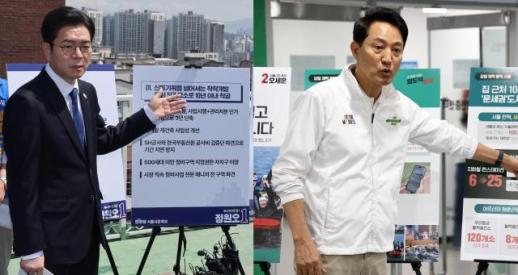 Seoul mayoral rivals trade barbs over redevelopment speed and housing pledges With the Seoul mayoral election set for June 3, Democratic Party candidate Jeong Won-oh and People Power Party candidate Oh Se-hoon have escalated a daily war of words over real estate. After Jeong on April 29 unveiled a housing platform centered on shortening redevelopment timelines, Oh’s camp countered that Jeong was repackaging policies already underway. Jeong announced what he called the “Chakchak Development” real estate plan from the rooftop of Sinjangwi Apartment in Seongbuk-gu, Seoul, outlining steps to improve the profitability of redevelopment and reconstruction projects. The announcement came as Oh’s side pressed Jeong to state his position on President Lee Jae-myung’s remarks about abolishing the long-term holding special deduction; Jeong responded by emphasizing housing supply. Jeong’s plan includes expanding areas eligible for floor-area-ratio incentives to semi-industrial zones and raising the standard used to calculate the price of rental housing purchased by redevelopment associations — from standard construction costs to about 80% of the “basic-type” construction cost. He also pledged to revitalize public-led redevelopment projects and to supply large volumes of “practical housing” priced at levels residents can afford. “Chakchak Development is centered on revising laws and operating our own system so each redevelopment stage can move quickly and safely,” Jeong said. Jeong also sharply criticized Oh’s redevelopment initiative known as “Shintong Planning.” Jeong said that during Oh’s tenure as mayor and under the Yoon Suk Yeol government, the supply of apartments and villas in Seoul fell sharply, with the number of permits and approvals in 2022–2024 amounting to only 62% of the previous 10-year level. He pledged to supply large amounts of public housing with affordable sale prices and rents so that middle-class and working-class residents without homes can buy in Seoul. Oh, who on the same day announced “Steel Fitness, Energetic Seoul” as his first campaign pledge, avoided direct comment on Jeong’s housing plan. His aides, however, issued pointed criticism. Kim Byung-min, spokesperson for Oh’s election committee, said Jeong was “disguising” existing programs as new pledges. Kim said the Yoon government’s August 2024 “8·8 measures” already set a plan to raise the purchase price for rental housing to 80% of the basic-type construction cost, and that related bills introduced by both ruling and opposition parties passed the National Assembly this month. He also said expanding floor-area-ratio incentive zones to semi-industrial areas is already being implemented by the Seoul city government. “In short, Jeong is pledging to start a train that’s already running,” Kim said. “Can Seoul’s real estate problems be solved with this kind of amateur administration?” Oh’s camp also criticized Jeong for staying silent on the Lee government’s real estate policies. Park Yong-chan, another spokesperson for Oh’s campaign, said in a statement that “wrong real estate policies” by the Lee administration — including last year’s “10·15 measures” and a plan to abolish the long-term holding special deduction — had triggered a rental crunch. Park said forecasts suggest that if the policy direction continues, Seoul’s rental shortage and surging lease prices could become entrenched. He urged Jeong to press the president to change course “quickly and strongly” before the rental crisis “falls into ‘rental hell.’"* This article has been translated by AI. 2026-04-29 18:27:59
 -
 Korea’s ETF Copycat Problem Persists as New-Product Protections Go Unused Exchange-traded fund (ETF) protections designed to curb a flood of look-alike products are effectively not working, with usage either extremely limited or nonexistent for years, according to the financial investment industry. Critics say the lack of effective safeguards has helped fuel the spread of so-called “copycat” products in the ETF market. <Related article, Page 4> As of Tuesday, South Korea operates three index and product protection programs, but their use is virtually nil, industry officials said. The Korea Exchange’s “ETP New Product Protection Program” and the Korea Financial Investment Association’s “exclusive right to use a new product” have not been applied even once since 2020. Both are intended to give a financial investment firm that develops an innovative new product the right to sell it exclusively for a set period. Applications for the Korea Exchange program stopped after the “Samsung KRX Gold Spot ETN,” listed in November 2019. The association’s exclusive-use right has not been applied since October 2019, when Mirae Asset Daewoo (now Mirae Asset Securities) was granted five months of exclusivity for a “structured range equity-linked bond (ELB).” The Korea Exchange’s “index priority use right” (formerly an exclusive-use right) is used more often, but the industry says its impact is limited. The program allows exclusive use for three or six months based on factors such as index differentiation, but once the period ends there is no way to prevent similar indexes from entering the market. With multiple safeguards operating in name only, the ETF market’s copycat problem is worsening. South Korea now has 1,099 ETF products with total net assets of 431 trillion won. But products tracking the same index or using similar strategies continue to proliferate, repeatedly driving overheated competition. In many cases, an ETF is treated as distinct even if it changes only a small part of its portfolio holdings or weights. Operators of the programs say it has become harder to judge the “originality” required for protection. A Korea Exchange official said theme-based ETFs are often prepared by multiple asset managers around the same time to reflect investor demand and market issues, adding that it is difficult to find a clear reason to prevent only one firm from offering a given theme product. Asset managers, however, argue the structure ultimately favors large firms. Even if a small or midsize manager opens a niche with a distinctive ETF, a bigger competitor can launch a similar product and dominate using greater financial resources and distribution networks. “When smaller firms target a niche and launch a product, the pattern repeats: once it looks promising, a large firm follows and pushes it with scale,” an asset management industry official said. * This article has been translated by AI. 2026-04-29 18:26:44
 -
 IBS Identifies Collagen Barrier Mechanism in Stroke, Proposes Drug Candidate South Korea’s Institute for Basic Science said it has identified what it called a root mechanism of brain damage in stroke and outlined a potential treatment approach, showing that blocking a “hydrogen peroxide–collagen production pathway” could suppress neuronal death. The research team led by IBS Center Director Lee Changjoon, working with Eulji University, said on April 28 that it found a mechanism in which rising hydrogen peroxide during stroke activates astrocytes, and type I collagen produced in the process triggers the death of nerve cells. Astrocytes typically help protect the brain and, during stroke, are known to form a glial barrier around damaged tissue to limit the spread of lesions. The team said it confirmed that this barrier can instead contribute to neuronal death, challenging the prevailing view. Based on the mechanism, the researchers developed a drug candidate, KDS12025, designed to both remove hydrogen peroxide and inhibit collagen production. In a mouse stroke model, the team said, the drug sharply reduced glial barrier formation and neuronal death, and impaired motor function returned to normal levels within a week. The team also reported effects even when the drug was given two days after onset, suggesting the possibility of extending the “golden time” window often cited as a limitation in stroke treatment. Similar results were reported in a primate model. Three days after KDS12025 was administered, lesion size decreased, and within a week, function returned in a hand that had been paralyzed, the researchers said. In a fruit-grasping test, the treated group succeeded in all 10 attempts, while the untreated group struggled because of motor impairment. The team said the primate findings support the potential for clinical application because of primates’ biological similarity to humans. Lee Boyoung, an IBS research fellow, said the team identified at the molecular level a collagen-synthesis mechanism in astrocytes driven by reactive oxygen species. “It will provide an important clue not only for stroke but also for research on degenerative brain diseases such as dementia and Parkinson’s disease,” Lee said. Yoo Seungjun, a professor at Eulji University, said that demonstrating efficacy in a primate model could help speed the transition to clinical stages. Lee Changjoon said the team succeeded in identifying a root cause and proposing a treatment strategy through a “one-stop research system” integrating basic research, drug development and preclinical work. The findings were published online April 28 in the international journal Cell Metabolism.* This article has been translated by AI. 2026-04-29 18:25:30
 -
 Foreign Buying Lifts Korea ETFs as Asset Managers Push Global Expansion As the Kospi extends its gains, overseas investors are increasing demand for South Korea-listed exchange-traded funds. According to the Korea Exchange on April 29, foreign investors bought about 510.1 billion won of the TIGER MSCI KOREA TR from March 27 through that day. They also posted net purchases of 91.2 billion won in the similarly structured KODEX MSCI KOREA TR. Korean asset managers are moving beyond basic product management and accelerating efforts to tap overseas ETF markets through local listings, equity investments and strategic partnerships. The U.S., the Middle East and India are key targets. Hanwha Asset Management is seeking to become the first Korean manager to list an ETF in the Middle East, aiming to capture new demand. It is preparing products for local investors, focusing on Gulf markets such as Saudi Arabia and the United Arab Emirates. Mirae Asset Management operates ETFs in major markets including the United States, Canada, Australia and Japan under its Global X brand. Its overseas ETF net assets account for more than half of its total, reflecting progress in its global business. Samsung Asset Management has taken a 20% stake in U.S. ETF manager Amplify, seeking to broaden its reach by listing ETF strategies proven in Korea in the local market. KB Asset Management launched what it said was the first Korea-listed ETF focused on India’s digital industry, while NH-Amundi Asset Management is expanding ETF distribution in Europe through cooperation with global manager Amundi. Korea Investment Trust Management has also listed an ETF in Vietnam and has posted strong profitability, the report said. Industry officials say the rapid growth of Korea’s ETF market has built management capabilities that are now aligning with overseas demand. “As competition in domestic ETFs intensifies, global markets are emerging as a new growth breakthrough,” an asset management industry official said. “Overseas expansion that combines local listings and strategic partnerships will expand further.” Analysts also link the trend to changes in how global money flows into Korea. As overseas investors increasingly access the Korean market through index products rather than individual stocks, ETFs are effectively becoming a gateway for investing in Korea. In response, managers are stepping up strategies to improve access by pursuing local exchange listings and building global brands, rather than relying only on products listed in Korea.* This article has been translated by AI. 2026-04-29 18:24:15