
Journalist

Lim, Kwu Jin
-
 Science Ministry Checks Deployment of Homegrown AI Chips as Commercial Use Expands South Korea’s Ministry of Science and ICT has begun on-site checks at major AI companies as it moves to speed adoption of Korean-made neural processing units, or NPUs. The ministry said it visited SK Telecom’s Incheon data center and LG AI Research on the 29th to review how domestic AI semiconductors are being used in real services and to hear feedback from companies. The visit was arranged to assess the rollout of Korean-made NPUs. At SK Telecom’s Incheon data center, Lee Do-gyu, director general for ICT Policy at the ministry, toured the site with Park Byeong-gwan, head of SKT’s core platform, and Park Seong-hyeon, CEO of Rebellions. Servers installed there use Rebellions’ data center NPUs, ATOM and ATOM MAX. Park said SKT is applying servers based on ATOM and ATOM MAX to A.Dot’s phone-call summary service and to X Caliber, a companion-animal video diagnostic support service. He said the company plans to keep expanding commercial services based on ATOM MAX. SKT said A.Dot’s call-summary service, built on its in-house large language model A.Dot X (A.X), handles up to 50 million API calls a day. At LG AI Research, the ministry was briefed on AI service development that combines the institute’s in-house large language model EXAONE with FuriosaAI’s NPU, Renegade (RNGD). Renegade is a Korean-made AI chip that uses high-bandwidth memory, or HBM, and is designed to deliver the data-processing performance needed to run large AI models. The ministry described it as a case of building an “AI full stack” by pairing a domestic LLM with a domestic semiconductor. Lee said the ministry confirmed on the ground that Korean-made AI semiconductors are being applied to real services. He said the government will continue policy support so AI chips that have entered full-scale mass production can spread quickly in the market.* This article has been translated by AI. 2026-04-29 16:37:43
 -
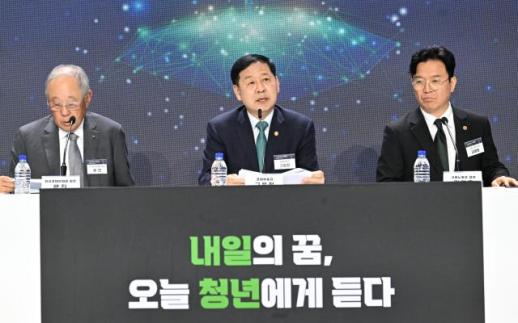 South Korea Unveils Youth New Deal to Expand Training and Help 100,000 Find Jobs Unemployed young people total 171, and the youth employment rate stood at 43.5% in the first quarter, underscoring a prolonged hiring slump for people in their 20s and 30s. The government said it drew on feedback from young people to craft a “Youth New Deal implementation plan” built around three tracks — advancement, experience and recovery — to support entry into the workforce. The government announced the plan on the 29th at a public-private Youth New Deal briefing chaired by Deputy Prime Minister and Minister of Economy and Finance Koo Yun-cheol, in a joint release with related ministries. Under the advancement track, the government will provide job training and education programs to 19,000 young people through private companies and universities. It will also launch the “K-New Deal Academy,” a 10,000-person program designed and run directly by private companies that hire, offering training for jobs in areas such as artificial intelligence and semiconductors, as well as youth-preferred fields including finance and content. Companies will also run voluntary programs such as psychological and career counseling and workplace adjustment support. Young people facing barriers to employment, including long-term unemployment, will be given priority in selection. Companies and participants outside the Seoul metropolitan area will receive preferential support for training costs and participation allowances. Short, intensive university courses previously limited to enrolled students will be linked to a “Youth Advancement Talent Boot Camp” and opened to 4,000 job-seeking young people who are not currently students. Two tracks — advanced-talent and practical-talent — will offer level-based curricula tailored from non-majors to majors. The experience track will expand work-experience programs by 22,000 slots and centrally manage participation records to support practical, job-relevant career building. In the public sector, the government will newly hire 9,500 staff to verify the status of delinquent national taxes and non-tax revenues and pursue tailored collection by debtor type. It will also hire 4,000 workers for a comprehensive farmland survey, including building databases to curb farmland speculation and track ownership and use. New programs will allow 2,500 young people to gain experience in social solidarity economy organizations — including social enterprises, village enterprises and cooperatives — in areas such as care, culture and the environment. The government also plans to expand public-institution youth internships by 3,000 from last year. In the private sector, the government will create or expand job-linked courses in youth-preferred fields such as tourism, content, culture and arts, and digital. It will also increase existing private work-experience programs by 1,500, focusing on in-demand internship-type placements and environmental, social and governance support roles. Participation records in Youth New Deal programs will be integrated and issued through an online platform, Employment 24, so they can be recognized as official experience in the job market. Under the recovery track, the government will run a close-support program covering the full cycle from counseling and daily-life recovery to job training and employment. It will expand Youth Future Centers that provide tailored services from four to 17 locations, and increase by 1,000 the Youth Challenge Support Program for young people who have given up job searching. Additional recovery programs — including parent and family relationship education and economic camps — will be offered to a total of 11,000 participants. To support job searches and hiring, the government will also redesign and upgrade youth employment support infrastructure. It will create a youth-focused track within the National Employment Support System and expand support, including job-search promotion allowances, to 30,000 more people. The government will broaden eligibility for the Youth Job Leap Subsidy — which pays up to 7.2 million won each to youth-hiring companies and to young workers who stay long term — from mid-sized firms in non-metropolitan industrial complexes to all mid-sized firms outside the Seoul metropolitan area. It will also expand low-interest loan support for young small business owners or small business owners who hire young people. A ministry official said the plan is expected to provide employment-related services to about 100,000 young people. “The government will prepare the programs without disruption so young people can quickly benefit from these measures,” the official said.* This article has been translated by AI. 2026-04-29 16:36:47
 -
 South Korea Lawmakers Push Strategic Export Finance Fund to Boost Arms Sales South Korea’s National Assembly began accelerating debate on legislation aimed at closing a financing gap that has hindered defense exports, as competition in large export projects increasingly hinges on bundled financial support. The Assembly’s Fiscal and Economic Planning Committee held a public hearing April 29 at the main Assembly building to discuss the need for the proposed Strategic Export Finance Support Act. The bill, introduced by Democratic Party lawmakers Han Jeong-ae and Ahn Do-geol and others, would establish a Strategic Export Finance Fund to build a system for timely financing in export projects where competition between countries is intense. Speakers said the global defense market has shifted beyond price competition to “financial package” competition, with buyers often demanding technology transfer, offset deals and investment as part of contract terms — burdens difficult for companies to shoulder alone. Korea’s defense firms, despite favorable conditions tied to the Middle East and the Russia-Ukraine war, have struggled to secure policy financing. Data released from the Export-Import Bank of Korea showed defense industry lending accounted for just 4.7% last year, compared with ships at 19.3%, construction plants at 11.1%, autos at 9.9% and electronics at 9.9%. To supplement limited lending, the bill calls for creating the fund through contributions from exporters that receive support such as buyer’s credit. Companies would pay about 1% of the disbursed amount, or up to 5% if linked to export industry cooperation, to help backfill financing shortfalls. Kwon Heon-cheol, a professor of defense economics at Korea National Defense University, said fast-growing defense exports face heavy burdens including offset deals. “Large-scale exports require buyer’s credit and guarantees to be combined, so national-level financial support is needed,” he said. Park Chang-gyun, a research fellow at the Korea Capital Market Institute, said existing policy finance has limits in spreading risk across individual firms, making a separate fund necessary for a stable supply of support. The hearing also cited recent defense exports to Poland as an example of constraints. In a $44 billion project, the Export-Import Bank of Korea and the Korea Trade Insurance Corp. provided about $15 billion, but later faced limited additional capacity, affecting the bidding competitiveness of major Korean defense companies. Some participants urged revisions to avoid overlap with a separate bill introduced by the National Defense Committee to create a defense industry development and export promotion fund. Attorney Park In-yong of law firm Yulchon said he agreed with the purpose of the export finance bill but called for clarifying the relationship and scope of the bills to prevent double charges. Industry representatives also warned that contributions of up to 5% could be burdensome. Ahn Sang-nam, head of the defense promotion division at the Korea Defense Industry Association, said requiring an additional 5% payment on supported amounts could create a double cost burden that small and partner firms may struggle to bear. He urged lowering the contribution rate from 5% to 1% to strengthen competitiveness across the defense supply chain. The Fiscal and Economic Planning Committee is set to hold a full meeting April 30 to decide whether to send the bill to a plenary session. If passed, officials plan to pursue institutional steps with a goal of establishing the fund in September. Committee Chair Lim I-ja said there are concerns that exporters’ burdens could be excessive during the fund-raising process and said the bill needs improvements, including addressing potential overlap with policy finance and fairness issues in profit distribution.* This article has been translated by AI. 2026-04-29 16:34:55
 -
 Samsung C&T Construction Q1 Operating Profit Falls 30% to 111 Billion Won Samsung C&T Corp.’s construction division said April 29 that its first-quarter operating profit fell 30.1% from a year earlier to 111 billion won. Revenue for the quarter slipped 5.7% to 3.413 trillion won, it said. A company official cited one-time costs and the completion of major projects as reasons revenue and operating profit declined from a year earlier. The official said results are expected to improve gradually as key businesses continue to move forward steadily. For Samsung C&T overall, the company reported revenue of 10.466 trillion won and operating profit of 720 billion won. Another company official said the firm maintained solid results despite an uncertain business environment, including geopolitical risks, and the impact of one-time costs, citing a diversified business portfolio and competitiveness.* This article has been translated by AI. 2026-04-29 16:34:00
 -
 Ador seeks property seizure as Danielle and Min Hee-jin face deepening legal rift SEOUL, April 29 (AJP) - Ador has secured a provisional attachment on the real estate assets of former NewJeans member Danielle, her mother, and former chief executive Min Hee-jin as the legal fallout from the K-pop industry’s most high-profile corporate schism intensifies. According to Legal sources, the court filing was confirmed on Wednesday, ahead of a full-scale trial scheduled for May, and would represent a tactical shift by the Hybe-owned label to freeze the financial resources of its former star artist and executive leadership. The move underscores the volatile transition of NewJeans from a unified global chart-topper to a fractured group caught in a precedent-setting battle over corporate control and creative independence. At its core, the dispute tests the durability of the multi-label model pioneered by Hybe, demonstrating how the intense loyalty between artists and their creative directors can destabilize the financial foundations of billion-dollar entertainment conglomerates. The conflict traces back to April 2024, when Hybe launched an unexpected audit of Ador, its subsidiary label founded by Min. Hybe accused the former executive of orchestrating a plan to seize independent control of the label and its primary asset, NewJeans, by seeking outside investment and leaking confidential business data. Min denied the allegations, characterizing the audit as a retaliatory strike after she raised concerns that another Hybe-managed group had plagiarized the artistic concept of NewJeans. The ensuing months were marked by a series of public press conferences and court injunctions that divided the K-pop industry and its global fanbase. While a Seoul court initially blocked Hybe’s attempt to fire Min as chief executive, citing a lack of evidence for actual implementation of a takeover, the corporate relationship remained untenable. By late 2024, Min was replaced as chief executive, leading to a direct confrontation between the members of NewJeans and the new Ador management. The members of the group, known for their distinct Y2K-inspired aesthetic and massive streaming success, took the unprecedented step of airing their grievances in a live broadcast, demanding the reinstatement of their former Ador chief. This internal friction eventually led to the departure of Danielle, also known as Mo Ji-hye, who has since aligned herself with Min’s newly established venture, OK Records. The upcoming May proceedings are expected to address the broader financial claims leveled by Ador, which has sought damages for what it describes as catastrophic disruption to the group’s activities. The real estate attachment serves as a legal guarantee to ensure that any potential financial penalties can be collected if the court rules in favor of the label. Lawyers representing Min and Danielle have not issued a formal statement regarding the specific property filings. The Seoul Central District Court is expected to begin hearing oral arguments on the merit of the underlying damages claim within the next month. 2026-04-29 16:33:49
 -
 LG Electronics Cites Uncertainty, Plans B2B, Subscription and Online Push LG Electronics said on April 29 that external uncertainty, including the war in the Middle East and concerns about U.S. inflation, has delayed a recovery in consumer sentiment and weighed on revenue. The company said operating profit faced pressure from some higher raw material prices and the impact of tariffs that intensified in the second half of last year, but it is maintaining solid profitability by expanding higher-margin businesses. LG Electronics said uncertainty will remain high in the second quarter, citing volatility in U.S. tariff policy and the possibility that interest-rate cuts could be delayed. It added that the war in the Middle East and rising prices make it difficult to expect a demand rebound. As a response, the company said it will strengthen its product lineup and expand its B2B, subscription and online businesses. LG Electronics said it will continue revenue growth by stepping up its push into Global South markets, focusing on the fast-growing B2B, subscription and online segments. On its vehicle components business, LG Electronics said a clear recovery in global automaker demand is likely to remain limited for the time being. It said it will respond to market volatility by expanding mass production for new projects and reshaping its portfolio toward higher value-added products. The company added that it plans to sustain profit-based growth by focusing on strategic customer collaboration and cost efficiency.* This article has been translated by AI. 2026-04-29 16:33:15
 -
 LG Electronics pivots to subscriptions, auto as profit engine strengthens SEOUL, April 29 (AJP) - LG Electronics is weathering a global spending slowdown by rapidly expanding subscription-based rentals for premium home appliances and scaling its vehicle solutions business, as demand grows for smarter mobility and recurring revenue models, its quarterly breakdown showed Wednesday. The first-quarter results underscored a structural shift in earnings quality, with high-margin recurring income from appliance subscriptions and a solid order backlog in the vehicle component solutions (VS) unit helping buffer the company against macro headwinds and rising raw material costs. Headline figures were unchanged from earlier guidance, with record quarterly revenue of 23.73 trillion won and operating profit of 1.67 trillion won. Beneath the surface, however, the VS division emerged as a key driver, with operating margin climbing above 6 percent — reinforcing its role as a core profit pillar alongside the home appliance business. The shift, analysts say, reduces LG’s traditional exposure to cyclical swings in consumer electronics. Business-to-business operations are gaining weight, now accounting for 36 percent of total revenue. B2B sales rose 19 percent on-quarter to 6.5 trillion won, supported by expansion into industrial cooling systems for AI data centers and electric vehicle components. The Home Appliance & Air Solution (HS) unit also showed resilience, maintaining an 8.2 percent operating margin despite U.S. tariff pressure and a weaker Korean won. Growth was driven by subscription-based sales, which rose 15 percent on-year and 8 percent on-quarter, as LG accelerates the model across emerging markets to secure steadier cash flow. Looking ahead, the company is positioning for the AI infrastructure cycle by expanding its Eco Solution (ES) portfolio, particularly advanced liquid cooling systems for global data centers. “The first-quarter results have effectively confirmed a recovery in profitability across core businesses,” said Jeong Min-gyu, an analyst at Sangsangin Investment & Securities. “Expectations are rising as commercialization of robot actuators and chiller orders for AI data centers gains visibility.” 2026-04-29 16:31:33
 -
 Iran War Nears 60-Day War Powers Deadline as Congress Weighs Role The U.S.-Israeli war against Iran is nearing a 60-day deadline, raising uncertainty over whether Congress will step in and how President Donald Trump may proceed. CNN and Al Jazeera reported that the conflict will reach its 60th day on May 1, counted from when Trump formally notified the start of the war. Under the 1973 War Powers Act, a president must obtain congressional approval to continue military operations beyond 60 days. How Congress responds is expected to be pivotal. Analysts have also pointed to past cases — including the Clinton administration’s Kosovo air campaign and the Obama administration’s Libya strikes — in which administrations continued operations without approval by narrowly interpreting what qualifies as “hostilities.” So far, Congress has shown little momentum. Republicans, who hold narrow control of both chambers, have repeatedly blocked resolutions aimed at limiting Trump’s military authority, and open opposition to the war has remained limited. Political risks are growing ahead of November’s midterm elections, with concerns that the war and its economic costs could hurt Republicans. U.S. public opinion has also soured. In a Reuters-Ipsos poll, 26% said the operation was worth its cost, and 25% said it made the United States safer. Some observers say a Republican-led Congress may avoid forcing the issue and allow the war to drag on. Henry Olsen, a senior fellow at the Ethics and Public Policy Center in Washington, told Al Jazeera, “They (Republican lawmakers) will want to avoid this vote by any means possible.” White House spokesperson Anna Kelly rejected that criticism, telling Military.com that Trump had briefed Congress transparently even before “Operation Epic Fury” began and that administration officials have provided more than 30 bipartisan briefings for lawmakers. Trump’s next steps remain unclear. Reuters, citing U.S. government officials, reported that intelligence agencies are analyzing how Iran might respond if Trump unilaterally declares victory after about two months of war. The report said the work is meant to gauge the fallout if Trump pulls back, as some officials and advisers worry the conflict could lead to a major Republican defeat in the midterms. No specific decision has been announced, but Trump could still resume or expand military operations if he deems it necessary. A rapid easing of tensions could reduce political pressure, while critics warn it could allow Iran to rebuild nuclear and missile capabilities and expand regional influence. Maintaining a maritime blockade is also being discussed as a pressure tool. The Wall Street Journal, citing sources, reported that Trump has instructed aides to prepare to extend the blockade, describing it as a lower-risk option than restarting airstrikes or declaring an early end to the war. The prolonged conflict is also battering Iran’s economy. The U.N. Development Programme projected that up to 4.1 million more people could fall into poverty. Hadi Kahalzadeh of the Quincy Institute said “50% of all jobs in Iran are at risk,” and that an additional 5% of the population could fall into poverty. Trump wrote on his social media platform Truth Social that Iran had just told the United States it was in a “State of Collapse,” adding that Iran wanted the Strait of Hormuz opened “as soon as possible” as it tried to resolve leadership issues. As U.S.-Iran talks on ending the war struggle to gain traction, CNN reported that Pakistani mediators expect to receive Iran’s revised negotiating proposal within days. 2026-04-29 16:28:29
 -
 Doosan to Invest 180 Billion Won to Build CCL Production Base in Thailand for AI Demand Doosan Corp. is setting up a new production base in Thailand to get ahead of rising demand for copper-clad laminate, or CCL, driven by the expansion of artificial intelligence data centers. The company said Tuesday it will establish a new local entity and build a CCL plant at the Araya Industrial Park in the Bang Bo area of Samut Prakan province. Total investment will be about 180 billion won. The site will cover about 73,000 square meters. Doosan plans to break ground within this year and aims to begin mass production in the second half of 2028. It said it will consider phased capacity expansions in line with demand to improve investment efficiency. The Thailand plant will mainly produce high-performance CCL for AI infrastructure and network equipment, the company said, adding it expects strong growth as global demand expands. Doosan cited logistics and operational stability as key reasons for choosing the site. The industrial park is about a 30-minute drive from Suvarnabhumi International Airport and about an hour from Laem Chabang port. The company also said the newer complex has operating infrastructure and disaster-response systems that support stable production. CCL is a sheet made by laminating copper foil onto both sides of an insulating material and is a core base material for printed circuit boards, or PCBs. Doosan said AI accelerators, which must process massive amounts of data at very high speeds, require high-performance CCL that minimizes signal loss and resists deformation in high-temperature operating environments. As investment in AI data centers grows worldwide, demand for high-performance CCL is rising rapidly, it said. Doosan said it has built competitiveness in CCL on materials technology accumulated over the past 50 years, including an edge in designing the “optimal composition ratio” among materials that determines CCL quality. “We decided to expand production capacity to respond in a timely way to growing CCL demand,” a Doosan official said. “We will monitor market conditions and flexibly review whether additional investment is needed.”* This article has been translated by AI. 2026-04-29 16:23:20
 -
 Finance Ministry Holds 4th Strategic Economy Advisory Panel Meeting on AI Shift The Ministry of Finance and Economy said it held the fourth meeting of the Strategic Economy Advisory Panel’s steering committee on the 28th at the Government Complex Seoul, chaired by Park Young-sun, head of the panel. Launched on the 13th, the panel has been identifying field-focused policy tasks tied to strategic industries. Over about two weeks, it convened both the steering committee and subcommittees to continue work on selecting key assignments. At the meeting, members discussed priority projects to respond to what the ministry called a major shift driven by artificial intelligence. Advisers said that amid changes in the external environment and a technology paradigm shift, the government should expand cross-ministry coordination and broaden private-sector participation to strengthen the competitiveness of domestic industries. Earlier, the panel added a new “AI agent commerce” subcommittee to its existing six, citing the growing importance of commerce applications using AI agents. Min Kyung-seol, head of the Office for Innovative Growth, asked advisers to “propose specific tasks so that strategic industries can grow into industries that will drive growth for the next 50 years.” The ministry said it will consult with relevant ministries on projects proposed by the panel and continue holding meetings to identify policy tasks.* This article has been translated by AI. 2026-04-29 16:22:39