
Journalist

MIN JAE YONG
-
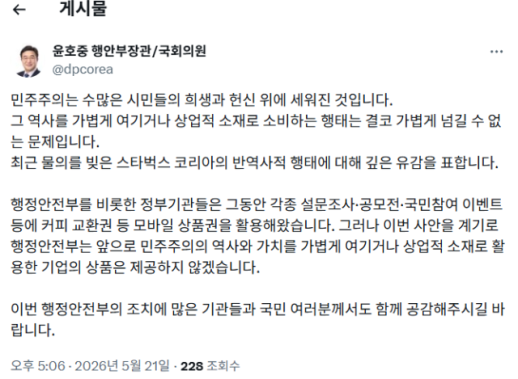 Yoon Ho-jung: Government to Halt Starbucks Promotions Over Controversy Yoon Ho-jung, the Minister of the Ministry of Interior and Safety, announced that the government will cease providing promotional items from Starbucks Korea following controversy surrounding the company's planned 'Tank Day' event coinciding with the May 18 Democratic Uprising memorial. On May 21, Yoon stated on X, "Democracy is built on the sacrifices and dedication of citizens," adding, "Disregarding that history or commodifying it is not something we can take lightly." He expressed deep regret over Starbucks Korea's "anti-historical behavior" that sparked recent outrage. Yoon explained that government agencies, including the Ministry of Interior and Safety, have previously utilized mobile gift cards, such as coffee vouchers, for surveys, contests, and public participation events. He emphasized that, moving forward, they will not provide products from companies that undermine the history of democracy or exploit social values for commercial gain. He also expressed hope for understanding and participation from other institutions and the public. Earlier, President Lee Jae-myung also criticized the matter strongly, calling it an act that "insults the sacrifices and struggles of citizens" and labeling it an inhumane behavior that denies democratic values. He stated that there must be moral, administrative, legal, and political accountability, questioning whether an apology would be forthcoming. The controversy erupted when Starbucks Korea used phrases like 'Tank Day' and 'Bang on the Desk' in a tumbler promotion set to begin on May 15. As criticism grew that these expressions trivialized the May 18 Democratic Uprising and the torture and death of Park Jong-cheol, the company decided to halt the event. Following this, Chairman Jeong Yong-jin issued a public apology, stating, "I take full responsibility for this matter."* This article has been translated by AI. 2026-05-21 21:52:16
 -
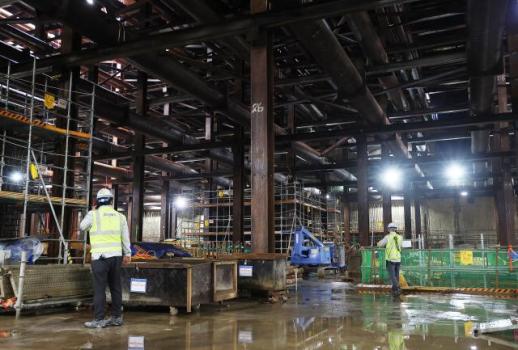 Lee Criticizes President Yoon for Interfering in Elections Over GTX-A Issues Jang Dong-hyuk, leader of the People Power Party, criticized President Lee Jae-myung on May 21 for allegedly interfering in the upcoming elections by directing an investigation into the missing rebar issue at the GTX-A Samsung Station construction site. Jang shared an article on his Facebook page detailing President Lee's instructions to the Ministry of Land, Infrastructure and Transport regarding the rebar situation, stating, "Jung Won-o (the Democratic Party's candidate for Seoul mayor) is struggling, so Lee Jae-myung is in a hurry." He linked the government's push for a special investigation into incidents involving President Lee to the current situation, questioning, "Is the Ministry of Land, Infrastructure and Transport, which is responsible for the incident, being told to cover up its mistakes?" Jang added, "Seoul citizens already know the truth about Jung Won-o, so it won't matter," and challenged, "If you're innocent, let's have a debate about Samsung Station." Earlier, Jung Won-o called for a halt to the GTX-A Samsung Station construction, suggesting that it should be paused until safety concerns are addressed. The Democratic Party announced plans to hold a task force meeting on May 22 to investigate the allegations surrounding the missing rebar. In response, Oh Se-hoon, the People Power Party's candidate for Seoul mayor, criticized Jung, saying, "He is only focused on amplifying public anxiety to gain an electoral advantage. The Ministry of Land and the Korea Railroad Corporation concluded after 17 days of test operations that there are no safety issues, yet he wants to stop it for political reasons." Lee Jun-seok, leader of the Reformist Party, remarked, "Saying that the GTX-A Samsung Station construction should be stopped is essentially declaring that you want to disrupt the commuting routes for residents of Hwaseong. Using safety as an excuse to halt the GTX project is merely a political maneuver against candidate Oh." He emphasized, "I will not stand by while the Democratic Party sacrifices the commuting routes of Hwaseong residents for their electoral calculations. We cannot allow the already delayed full opening of GTX-A to be postponed further due to the political logic of candidate Jung and the Democratic Party."* This article has been translated by AI. 2026-05-21 21:51:00
 -
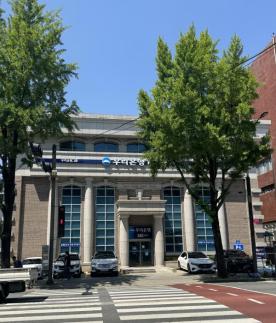 Woori Bank's 106-Year Legacy: A Visit to the Jeonju Financial Center On May 18, I arrived at Wansan-gu Paldal-ro after a 20-minute bus ride from Jeonju Station. Amidst ordinary buildings, one structure stood out, reminiscent of European architecture. Inside, employees were bustling about, and visitors filled the space at the Woori Bank Jeonju Financial Center, which has been a fixture for 106 years.The Jeonju Financial Center, which opened in 1920 as the Jeonju branch of Hanil Bank, has played a crucial role in supporting the local economy. It has evolved into a regional financial hub, serving not just as an old branch but as a central player in the Jeonbuk area. The center is particularly focused on supporting small and medium-sized enterprises and self-employed individuals, reflecting the unique characteristics of its location near Jeonju Hanok Village and a high-tech industrial complex.In an interview, Lee Seung-hwa, the center's director, stated, "The Jeonju Financial Center has been a representative branch of Woori Bank, accompanying the growth of local customers and the regional economy for over 100 years. We have consistently supported the financial needs of local businesses and residents, and we continue to serve as a key financial hub in the area."The Jeonju Financial Center has gained increased attention recently due to its pivotal role in Woori Financial Group's plan to enhance financial infrastructure in Jeonbuk Province.Woori Financial is actively building financial infrastructure in Jeonbuk, which is emerging as a key area for balanced development under the '5 poles and 3 specialties' initiative.The focus is on providing corporate financing to stimulate the local economy. Woori Bank plans to establish the 'Jeonbuk BIZ Prime Center,' a specialized corporate finance branch, to concentrate its corporate financing capabilities. This initiative aims to enhance synergy among local branches centered around the Jeonju area and expand business attraction and transaction bases.Additionally, Woori Bank is promoting a venture startup support program called 'Dino Lab Jeonbuk Center' to foster small and medium-sized enterprises and startups, with plans to supply approximately 1.6 trillion won in funding over five years to local small businesses and self-employed individuals. The number of employees in the Jeonbuk region is also set to increase from 200 to 300, contributing to job creation through local talent recruitment.Lee emphasized, "Jeonbuk is a region where the capital market and advanced industries are growing together, and I believe the interest and role of the financial sector will continue to expand. We will further enhance on-site financial support to contribute practically to revitalizing the local economy and establishing a financial hub."* This article has been translated by AI. 2026-05-21 21:48:00
 -
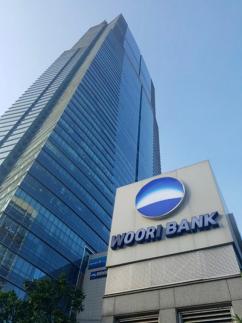 Woori Bank Expands Global Reach with 100 Years of Expertise Woori Financial Group is leveraging its 100 years of expertise to expand its global footprint. The company is establishing a financial network to support South Korean firms in overseas semiconductor and defense sectors, creating new growth opportunities and productive finance.According to the financial sector on May 21, Woori Financial has established a new base in Austin, Texas, to enhance its corporate banking operations.As Texas emerges as a new "land of opportunity" that rivals Silicon Valley, global companies are flocking to the area. Samsung Electronics, a key client of Woori Bank, is expanding its semiconductor operations by constructing additional foundry facilities. Woori Bank has been a partner of Samsung since the 1960s, and as Samsung grows its local business, Woori is actively securing a new network of branches. This aligns with the group's management goal of "co-prosperity," extending its reach internationally. Woori Bank aims to manage employee accounts while also catering to demands for facility investment and trade finance. Domestic suppliers accompanying Samsung's expansion are also potential clients for Woori Bank. Nearby, major corporations like Tesla, Apple, and Oracle are establishing their presence, further enhancing revenue opportunities.In Europe, Woori Bank is seeing increased corporate finance activity in Poland, with expectations for significant results starting this year. As defense, electric vehicle, and secondary battery companies enter the Polish market, Woori Bank has become the first domestic bank to establish a local sales network. Securing business licenses from local financial authorities is notoriously challenging, but Woori's century-long expertise has earned the trust of these regulators.Woori Bank is also increasing its presence in retail finance in overseas markets, particularly in Vietnam. Despite some domestic companies withdrawing from Vietnam, Woori Bank has gained traction among expatriates and locals, leading to growth in retail finance. The demand for services like non-face-to-face loans is rising, and Woori's digital and IT systems have successfully localized to meet this demand. Consequently, the total comprehensive income of the Vietnam branch quadrupled in the first quarter compared to the previous quarter.Experts attribute Woori Financial's global capabilities to its century-long history. A financial industry insider noted, "By establishing the first overseas branch of a commercial bank in Tokyo, Woori has quickly identified local demand. The strategy of establishing branches whenever domestic companies expand abroad has recently yielded positive results."Woori Financial plans to utilize its 458 networks across 24 countries to support domestic companies in their international ventures through productive finance. The company is also set to provide 3 trillion won in productive finance support for export and import businesses, aligning with this strategy.A financial industry source remarked, "As domestic lending regulations tighten, overseas operations have shifted from being a supplement to becoming a core source of revenue. Financial institutions are likely to accelerate their expansion into adjacent regions based on existing footholds."* This article has been translated by AI. 2026-05-21 21:46:01
 -
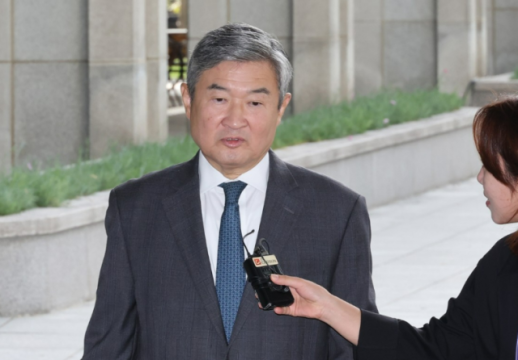 Court Sentences Former National Intelligence Service Chief Cho Tae-yong to 18 Months in Prison Cho Tae-yong, the former chief of South Korea's National Intelligence Service (NIS), was sentenced to 18 months in prison for failing to fulfill his reporting obligations to the National Assembly during the declaration of martial law on December 3, 2024, and for submitting false responses to conceal his involvement. However, the court found him not guilty of the key charges of negligence and political involvement. The Seoul Central District Court's Criminal Division 32, presided over by Judge Ryu Kyung-jin, delivered the verdict on May 21. Cho was convicted on charges including negligence, violations of the National Intelligence Service Act, violations of the National Assembly Testimony and Evidence Act, evidence destruction, preparation and use of false documents, and perjury. The sentence is significantly lower than the seven years sought by the special prosecutor's team led by Cho Eun-seok. The court acquitted Cho of the negligence charge, stating that while he received documents related to martial law from former President Yoon Suk Yeol on the day of the declaration, it could not be definitively concluded that he clearly understood the instructions regarding the arrest of politicians from former NIS Deputy Director Hong Jang-won. The court noted, "It cannot be ruled out that the defendant may have perceived the information received from Hong as mere rumors arising during the martial law process. Therefore, it cannot be concluded that the obligation to report to the National Assembly under the NIS Act arose." The court also ruled that there was insufficient evidence to support the claim that Cho selectively provided CCTV footage of Hong's movements to the ruling party, thus finding him not guilty of political involvement. Additionally, allegations that Cho participated in the deletion of electronic information from secure phones used by Yoon and Hong after the martial law declaration were also dismissed, as the court acknowledged the possibility of security measures being in place at that time. However, the court did find Cho guilty of making false statements regarding his receipt of martial law documents during the Constitutional Court impeachment trial and the National Assembly's investigation. The court stated, "As the NIS chief, the defendant should have sincerely addressed public concerns and taken responsibility for any wrongdoing. Nevertheless, he prepared false responses to minimize and conceal his responsibility and even committed perjury in the Constitutional Court." The court emphasized that such actions deceive the public and significantly undermine trust in the National Intelligence Service, warranting a serious penalty. Following the verdict, the special prosecutor's team announced plans to appeal the acquittal, expressing disappointment over the rejection of Hong's testimony. * This article has been translated by AI. 2026-05-21 21:43:33
 -
 Kyochon Donates 150 Million Won to Red Cross, Distributes 5,000 Chickens Kyochon Chicken is continuing its commitment to community support through its annual chicken distribution initiative. On May 15, Kyochon F&B held a donation ceremony at the Korean Red Cross in Jung-gu, Seoul, where it contributed 150 million won (approximately $130,000). Key figures at the event included Jang Young-jin, a senior official at Kyochon F&B, and Park Jong-soo, Secretary General of the Korean Red Cross. The donated funds will be used entirely to support university RCY 'Chonslover' activities and chicken distribution efforts. The Chonslover Project is Kyochon’s flagship social contribution campaign, which has been ongoing since 2021. The initiative aims to promote a culture of support and sharing within local communities, with university RCY members acting as Chonslovers who directly engage with those in need. This year, university RCY members across the country will distribute 5,000 chickens to local residents. Kyochon employees and franchise owners will also participate in the outreach efforts. The theme for this year's project is 'Sincere Gratitude and Support.' Stories highlighting individuals who quietly support society, such as sanitation workers, cafeteria staff, police officers, the elderly, and children, will be collected. Chonslovers will visit these individuals to express their appreciation with Kyochon chicken. Videos showcasing the volunteers' activities will be featured on Kyochon’s social contribution social media channels. Each month, five outstanding teams will be selected based on Instagram likes and views, receiving additional chicken support to expand the initiative's reach. As the project enters its sixth year, its cumulative achievements are noteworthy. Since its inception, Kyochon F&B has donated approximately 2.277 billion won (about $2 million) in cash and goods to the Korean Red Cross. Last year, 2,482 university RCY members participated, distributing 5,555 chickens and promoting the value of mutual support. A Kyochon F&B representative stated, “We will continue to spread the values of gratitude and support, and we will persist in our social contribution efforts for our community.” In addition, Kyochon F&B has recently initiated a project to provide chicken to children in childcare facilities, following its support for local children's centers. This initiative, valued at 230 million won (approximately $200,000), will benefit 2,400 children across 37 childcare facilities in six regions, including Busan and Incheon, by providing chicken and experiential programs.* This article has been translated by AI. 2026-05-21 21:40:43
 -
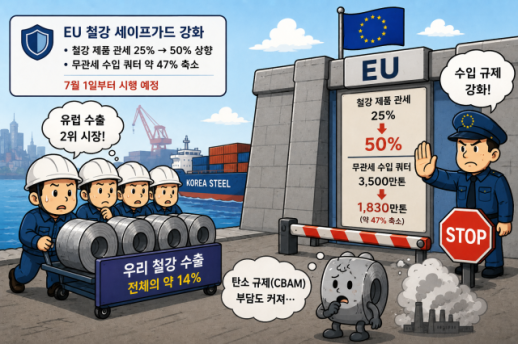 EU Follows U.S. in Strengthening Steel Tariffs, Limited Immediate Impact on South Korea As the European Union (EU) joins the United States in tightening steel import regulations, experts suggest that the immediate impact on South Korea may be limited. This is largely due to the absence of finalized country-specific regulations and the focus of these measures on curbing the influx of low-cost steel from China. According to industry sources on May 21, South Korean steel companies are closely monitoring the EU's moves to strengthen steel import regulations. On May 19, the European Parliament approved a plan to raise tariffs on steel products from 25% to 50% and reduce the duty-free import quota to about half of its previous level. This measure is set to take effect on July 1, following approval from member states. While the specific application methods and detailed regulations by product category have yet to be disclosed, the reduction of the duty-free quota from the previous annual level of 35 million tons to 18.3 million tons—approximately a 47% decrease—is expected to impose significant burdens on domestic companies. The EU is the second-largest market for South Korean steel exports. According to the Korea Iron and Steel Association, South Korea exported 1.386 million tons of steel to the EU from January to April this year, accounting for about 14% of total exports of 9.644 million tons. High-value-added products, such as hot-rolled, cold-rolled, and galvanized steel sheets, make up a significant portion of these exports, raising concerns that increased regulations could further strain the price competitiveness of South Korean steelmakers. Additionally, with the implementation of the EU's Carbon Border Adjustment Mechanism (CBAM) gaining momentum, South Korean steel companies are facing growing export burdens. CBAM imposes costs based on the carbon emissions generated during the production of carbon-intensive products, such as steel, exported to the EU. Industry analysts warn that if both tariff barriers and carbon regulations are strengthened simultaneously, the export cost burden on South Korean steelmakers could increase significantly. Among domestic steel companies, POSCO has the highest export share to the European market, with European exports accounting for 15% to 17% of its total overseas sales. Hyundai Steel, Dongkuk Steel, and SeAH Steel follow in this regard. However, some industry insiders believe that the actual impact may be limited, as specific implementation plans have not yet been disclosed. Given that the measures primarily target low-cost steel from China, there is a possibility that the quota for South Korean steel products will remain at current levels. A representative from the steel industry stated, "The EU's regulatory tightening is primarily aimed at preventing the influx of low-cost steel from China, so the likelihood of direct regulations affecting South Korean steel products remains low. However, the overall trend of increasing global protectionism may necessitate changes in export strategies in the long term."* This article has been translated by AI. 2026-05-21 21:39:00
 -
 Coway Launches Virex Suite Hotel Frame to Target Premium Sleep Market Recent trends show an increasing demand for bedrooms that serve not just as sleep spaces but as premium areas for relaxation and recovery. As interest in sleep quality rises, more consumers are looking to create a hotel-like atmosphere in their homes. In response to this trend, Coway announced on May 21 the launch of its 'Virex Suite Hotel Frame' aimed at the premium sleep market. The new product features hotel-style wall panels and a dual mattress structure designed for stability and support. The Virex Suite Hotel Frame is designed with a box spring foundation that supports the top mattress. This structure distributes weight more evenly than using a mattress alone, providing a more stable sleep environment. The design elements have also been enhanced. The wall panels can be combined in single, dual, or triple configurations, allowing for customization based on bedroom layout and personal taste. Arranging them beside the bed or between twin beds can create an ambiance reminiscent of a hotel suite. The multi-panel system includes shelving and lighting features. The wooden panels offer drawer storage, and both panels are equipped with adjustable three-level brightness lighting and a lower charging port for convenient use of electronic devices like smartphones. The product also reflects the trend of couples valuing their individual sleep patterns. By placing two super single frames side by side and unifying them with wall panels, users can achieve both personalized sleep experiences and cohesive interior design. A Coway representative stated, "The Virex Suite Hotel Frame offers a combination of hotel-inspired decor and a comfortable sleep environment. We will continue to introduce sleep care solutions tailored to our customers' lifestyles."* This article has been translated by AI. 2026-05-21 21:36:19
 -
 Automakers Compete in Software-Defined Vehicle OS Race with Upcoming Models Automakers are intensifying their competition for dominance in the Software-Defined Vehicle (SDV) sector, evolving into a race for proprietary operating systems (OS). With the launch of the first models featuring in-house platforms expected in the second half of this year, the scalability of software has become increasingly critical. As the transition to SDVs accelerates, the level of vehicle control implementation is anticipated to be a key factor in determining market position.According to industry sources, automakers have begun to expedite the integration of proprietary platforms for the transition to SDVs. SDVs operate and control vehicles based on software, allowing for wireless functionality updates. The key features include an integrated OS that consolidates major vehicle functions and an infotainment system that enhances convenience.The competition for SDV transition is expected to intensify starting this fall, as major brands are poised to launch their first models equipped with proprietary OS systems, aiming to secure early market leadership.Mercedes-Benz plans to introduce several models in the Korean market this year, including the new Mercedes-Benz S-Class and the new Mercedes-Maybach S-Class, both equipped with the proprietary 'MB.OS'. The all-new CLA will also make its debut. The fourth-generation infotainment system, 'MBUX', which incorporates artificial intelligence, is also drawing attention.BMW is similarly positioning its proprietary OS as a core element of its new vehicle competitiveness. The new BMW iX3, set to launch in the third quarter of this year, will feature the 'BMW Operating System X'. Additionally, the 'BMW Panoramic iDrive' aims to enhance the driver-centric infotainment experience.However, disparities in the level of development among companies are becoming more pronounced. While brands like Mercedes-Benz and BMW are integrating vehicle control into their proprietary OS, some companies have only just begun implementing next-generation infotainment systems or have yet to establish a concrete roadmap for SDV transition.Hyundai Motor Company recently launched its first model featuring the next-generation infotainment system 'Pleos Connect', the new Grandeur, on May 14. However, the vehicle control operating system 'Pleos Vehicle OS', which was also announced at the developer conference last March, does not yet have a specific deployment schedule.Most domestic small and medium-sized automakers are relatively behind in the SDV transition. Renault Korea plans to release a fully functional SDV by 2027, while KG Mobility has yet to announce detailed plans for its SDV transition.Given the varying speeds of SDV transition among companies, there is currently no clear standard for defining a 'complete SDV' in the market. The focus is shifting from whether a proprietary OS is implemented to how far vehicle control and update capabilities can be expanded. An industry insider noted, "We are currently at the initial stage of the SDV transition. Moving forward, the key will be how well we can integrate vehicle control."* This article has been translated by AI. 2026-05-21 21:34:05
 -
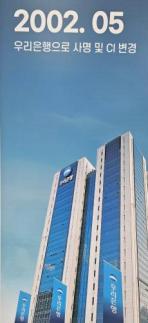 Woori Bank: A 127-Year Legacy in South Korean Finance Woori Bank, which began as Daehan Cheonil Bank 127 years ago, has played a significant role in the evolution of South Korea's financial landscape through industrialization, economic crises, digital transformation, and global expansion. More than just the oldest bank, it represents a living financial heritage intertwined with the growth of the South Korean financial industry. According to the financial sector, Woori Bank recently designated 15 branches that have been operational for over a century as "century-old branches." The oldest branch is the Incheon branch, which opened in 1899. Other notable branches include the Pyeongtaek Financial Center (1907), Seoul Station Financial Center (1908), Gupo branch (1912), Jinhae branch (1913), Seoul City Hall Financial Center (1915), and Jongno 4-ga Financial Center (1916). The Jongno Financial Center, Yongsan Financial Center, Cheongju Financial Center, and Iksan branch have also maintained their presence since their openings in 1924. While the banking industry is rapidly consolidating branches and shifting towards non-face-to-face services, Woori Bank emphasizes its "accumulation of time" as a competitive advantage. The bank positions itself not merely as a service point but as a space that has supported customers' livelihoods and the regional economy, reflecting the trajectory of South Korea's industrialization. Woori Bank's history is closely linked to the history of South Korea's financial industry. It began with the establishment of Daehan Cheonil Bank in 1899, the first bank founded with domestic capital during the Korean Empire, symbolizing a shift from foreign capital dominance in the financial market. In 1911, it changed its name to Chosun Commercial Bank, helping to establish a modern financial system. The main building, constructed in 1909, is now the Jongno Financial Center, symbolizing the bank's historical significance. After Korea's liberation, Woori Bank continued to lead changes in the domestic financial industry. It was listed among the first companies on the stock exchange in 1956 and opened the country's first female-only safe deposit box in 1959. In 1961, it became the first financial institution to establish a service center, expanding its role beyond simple deposits and loans to provide comprehensive financial services including finance, investment, real estate, and legal consultations. The bank also quickly embraced digital transformation. In 1977, it became the first commercial bank to start online operations between Seoul and Busan, and in 1980, it introduced the country's first bank loan system. In 1989, in collaboration with Samsung Electronics, it launched the first corporate banking system, allowing businesses to handle import letters of credit without visiting the bank, essentially laying the groundwork for modern corporate internet banking and digital finance. Since the 1990s, Woori Bank has introduced a series of innovations in non-face-to-face banking. It started ATM services in 1993 as the first Korean bank and launched home banking-based overseas remittance services in 1996, enabling customers to send money abroad from home or the office during the early spread of the internet and PC communication. In 1997, it implemented an image system that allowed exporters to be notified on the same day of opening a letter of credit, accelerating the digitization of trade finance. The restructuring of the financial sector following the 1997 Asian financial crisis marked another turning point in Woori Bank's history. In 1999, Korea Commercial Bank and Hanil Bank merged to form Hanbit Bank, and in 2001, the first financial holding company system was established in the country. In 2002, the bank changed its name to Woori Bank, establishing the brand that exists today. Recently, Woori Bank has been transforming from a traditional financial institution into a digital platform company. In 2022, it launched the first digital supply chain platform in the financial sector, "WonBiz Plaza," and in 2024, it introduced an AI-based service called "AI Banker." This evolution underscores Woori Bank's position as a symbolic financial institution that showcases the past, present, and future of South Korean finance, built on 127 years of accumulated financial DNA.* This article has been translated by AI. 2026-05-21 21:28:32