
Journalist

Park Heewon
-
 President Lee: Excessive Collection of Management Fees is Illegal President Lee Jae-myung stated on May 23 that the excessive collection of management fees in shared buildings such as apartments, officetels, and commercial properties is now illegal. In a post shared early that day on X (formerly Twitter), President Lee emphasized that "everyone has the right to request details of management fees." He added, "From now on, all irregularities in South Korea will be normalized." Earlier, on May 21, the Ministry of Land, Infrastructure and Transport announced measures to eradicate corruption related to management fees. The proposed reforms include increasing criminal penalties and abolishing exceptions that allowed audits to be waived with tenant consent. During a Cabinet meeting in February, President Lee criticized the practice of raising management fees to evade rent regulations, stating that concealing management fee details is akin to fraud and embezzlement.* This article has been translated by AI. 2026-05-23 20:37:00
 -
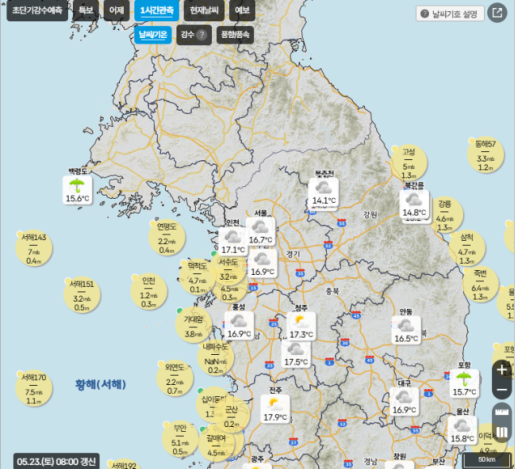 Weather Forecast: Cloudy Saturday with Light Rain Expected On Saturday, May 23, the weather across the country is expected to be mostly cloudy, with light rain in some areas during the day. Temperatures are forecasted to return to seasonal averages, easing the early summer heat. According to the Korea Meteorological Administration, light rain of less than 5mm is anticipated in most regions from morning into the afternoon. While the rainfall is not expected to be significant, it may temporarily make roads slippery in some areas, necessitating caution for drivers. After the rain, skies will gradually clear, leading to generally sunny weather across the country starting Sunday morning, May 24. However, Jeju Island is expected to remain mostly cloudy. The highest temperatures on May 23 are predicted to range from 17 to 24 degrees Celsius. Major cities are forecasted to see temperatures of 23 degrees in Seoul, Incheon, and Daejeon, 24 degrees in Gwangju, 22 degrees in Daegu, and 20 degrees in Busan and Ulsan. On May 24, morning lows are expected to be between 11 and 16 degrees, with daytime highs ranging from 21 to 28 degrees. While it may feel warm during the day, temperatures are expected to be cooler in the mornings and evenings, leading to a temperature difference of around 15 degrees in inland areas. On May 25, a public holiday for Buddha's Birthday, the weather is expected to start off mostly clear but will gradually become cloudy by the morning. Temperatures are projected to rise slightly compared to the weekend, with daytime highs reaching between 22 and 29 degrees, slightly above seasonal averages. Rain is expected to begin in Jeju on the afternoon of May 25, spreading to the Jeolla region and western South Gyeongsang Province by night. Rainfall is anticipated to continue across most of the country on May 26. * This article has been translated by AI. 2026-05-23 20:36:00
 -
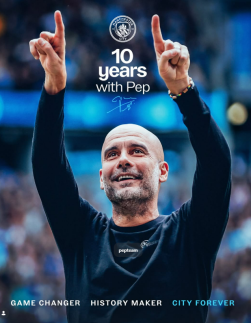 Pep Guardiola Steps Down as Manchester City Manager After 10 Years Pep Guardiola has announced his departure from Manchester City after a decade at the helm. Leading the team through a golden era, he cited "exhaustion" as the reason for his decision to part ways. On May 23, Manchester City confirmed that Guardiola's final match will be against Aston Villa on May 25, marking the end of the 2025-2026 season. The game will take place at the Etihad Stadium. This announcement comes as a surprise, especially since Guardiola had signed a contract extension with the club last November, committing to the 2026-2027 season. However, it is reported that he has expressed a need for a long break. Guardiola joined Manchester City in 2016, succeeding Manuel Pellegrini, and has since rewritten the club's history. He achieved a record 100 points in the Premier League during the 2017-2018 season and completed a historic treble in the 2022-2023 season by winning the Premier League, FA Cup, and UEFA Champions League. Notably, he led the team to four consecutive league titles in the 2023-2024 season, a first in English top-flight history. During his tenure, Guardiola secured six Premier League titles, three FA Cups, five League Cups, and one UEFA Champions League title, totaling 17 major trophies. This season, however, the team finished as runners-up to Arsenal in the league.To honor his achievements, Manchester City plans to name a stand after Guardiola and erect a statue in his likeness. Enzo Maresca, a former Chelsea manager and past City coach, is considered a leading candidate to succeed him. Guardiola will take a break from coaching before assuming the role of global ambassador for City Football Group (CFG), where he will assist with the operations and technical advice of its affiliated clubs. According to the BBC, Guardiola stated at a press conference, "Ten years is a very long time," and emphasized that the team needs a new manager and fresh energy. He added, "I felt I could no longer maintain the drive to stand in front of the players and compete for victory in every match."* This article has been translated by AI. 2026-05-23 20:33:28
 -
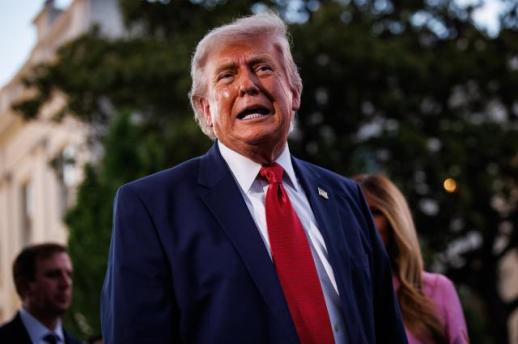 U.S. and Israel Prepare for Possible Strikes on Iran Amid Stalled Negotiations Reports indicate that the United States and Israel are preparing to resume strikes on Iran within days if negotiations show no progress. In response, mediating countries such as Qatar and Pakistan are reportedly intensifying efforts to extend a ceasefire and establish a framework for further negotiations. According to a report by Yonhap News on May 23, citing the Wall Street Journal, the current goal of the negotiations is to extend the unstable ceasefire that has been in place since May 8, rather than to reach a formal peace agreement. The aim is to sign a Letter of Intent (LOI) or a Memorandum of Understanding (MOU) to facilitate future discussions. The Trump administration insists that any agreement must include restrictions on Iran's nuclear program. Conversely, Iran argues that the focus should first be on ending the war, lifting restrictions in the Strait of Hormuz, and easing financial sanctions. The two sides have reportedly been unable to narrow their differences on which issues should be included in an immediate agreement and which should be deferred to future negotiations. If even a limited agreement fails, there is a possibility that the U.S. and Israel will conduct short-term strikes targeting Iran's energy infrastructure and other economic facilities. This would be a measure to increase pressure on the Iranian regime, but Iran has warned that it would respond with extensive retaliation if new attacks occur. Mediators are also acting swiftly. General Asim Munir, Chief of Army Staff of Pakistan, visited Tehran on May 22, and a Qatari negotiating team is reportedly staying in the region to continue mediation efforts. Saudi Arabia has also warned Iran that failing to reach an agreement could escalate the situation further. The U.S. maintains that Iran must agree to a long-term halt of its uranium enrichment program and the transfer of nuclear materials close to weapons-grade levels. Secretary of State Marco Rubio stated on May 22 in Brussels that while there has been “some progress,” the U.S. position remains unchanged: it cannot accept Iran possessing nuclear weapons. Reports suggest that President Trump has repeatedly warned of the possibility of resuming attacks on Iran if negotiations break down, and if military action is taken, Israel is likely to join. Concerns have also been raised within Israel that President Trump might agree to a deal that does not sufficiently curb Iran's nuclear program and missile capabilities.* This article has been translated by AI. 2026-05-23 20:31:13
 -
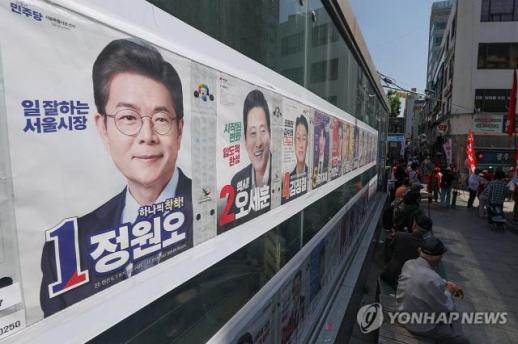 Voter Common Sense Needed Amid AI Misinformation in Local Elections The local elections on June 3 are approaching their final stages. However, the dominant issues in the election are not visions for regional development or livelihood policies. Instead, AI-generated misinformation, extreme political attacks, historical controversies, and smear campaigns are only increasing voter fatigue. Concerns are growing that the local elections are becoming a battleground for central politics, rather than a forum for discussing the future of the region. This election marks a significant entry into the 'AI political era' for South Korea. Authorities have recently launched investigations into AI-manipulated posts and false articles that distort and demean the May 18 Democratic Uprising. Fake articles, misleading images, and distorted videos generated by AI are spreading through social media and YouTube, exacerbating social confusion. This is not merely a case of misinformation; it undermines the very foundation of democracy, which relies on a 'shared reality.' More concerning is that this phenomenon is increasingly being used as a tool for political mobilization. Past elections relied on organization, funding, broadcasting, and street campaigning. Now, the competition has shifted to algorithms and view counts. YouTube Shorts, sensational videos, extreme claims, and conspiracy theories spread much faster than policy discussions. This is due to the profit structure of platform companies, which favors anger and sensationalism. Short, emotionally charged content generates more clicks and increases advertising revenue. From an economic perspective, this is a typical example of 'attention economy.' The core asset of platform companies is not factories but human time. The problem is that the content that captures human attention the longest is not always truthful or balanced. Ultimately, democracy is being pushed out of the deliberative process and into a race fueled by emotions. Similar phenomena are occurring globally. In the United States, ahead of last year's elections, AI robocalls mimicking President Joe Biden's voice spread messages urging people not to vote. Early in the Ukraine war, deepfake videos circulated showing Ukrainian President Volodymyr Zelensky declaring surrender. In India and the Philippines, AI avatars and voice replication of politicians have been used in campaigns. While technological advancements can make democracy more open, they can also serve as far more dangerous tools for incitement. The safety debates surrounding this local election also prompt a reflection on the essence of politics. Democratic Party candidate Jeong Won-oh visited the site of the 10th anniversary of the Guui Station disaster and criticized his opponent, Oh Se-hoon, for creating a "structural problem born from safety indifference." He connected this to the controversy over missing rebar in the GTX-A Samsung Station project, placing safety issues at the forefront. In contrast, Oh's camp has countered that this is a political attack. Safety should not be a tool for political conflict but a fundamental responsibility of administration. South Korean society has repeatedly paid the price for a safety indifference that assumes, "It will be fine." Yet, during election seasons, accidents are consumed as political fodder for attacks against one another. What matters is not who can criticize the other more forcefully, but what systems can be put in place to prevent accidents and improve conditions. The moral issues within politics are also fueling voter disappointment. TV Chosun reported allegations that Democratic Party candidate Kim Yong-nam operated a loan business under a proxy name. While Kim's camp has categorically denied these allegations, it is hard to deny that this incident highlights a broader crisis of trust in politics. A politician discussing the economy and high interest rates while embroiled in a high-yield loan controversy leaves voters feeling deeply cynical. The greatest crisis in South Korean politics today is not the ideological divide itself but the collapse of 'trust capital.' Citizens are increasingly finding it difficult to discern what is true and whom to trust. Politicians attack each other with accusations of falsehood, YouTube thrives on sensational videos for clicks, and AI endlessly produces fake images and false articles. In such a structure, only extremes and hatred survive. Democracy was originally a system that trusted human reason and common sense. However, in the age of AI and platforms, instincts are stimulated faster than human emotions. When politics shifts from policy competition to a competition of anger, the ultimate victims are the citizens. Real issues such as local economies, jobs, transportation, safety, housing, and welfare are pushed aside. Therefore, what is most needed in this local election is ultimately voter common sense. Voters must calmly assess what policies benefit the region without being swept away by AI misinformation, conspiracy theories, and extreme political attacks. The political sphere must also move away from election strategies that rely on clicks and sensational messages. Local elections should not be proxy battles for central politics but a stage for civic life that determines the lives of citizens. Technology will continue to advance. AI is likely to become more sophisticated, and the influence of platforms will grow. The issue is not the technology itself but what rules, ethics, and democratic principles will be established on top of it. This local election is not merely about who will be elected. It serves as a test of whether South Korean democracy will follow a path of common sense and deliberation or sink deeper into algorithm-driven and anger-fueled politics.* This article has been translated by AI. 2026-05-23 20:28:52
 -
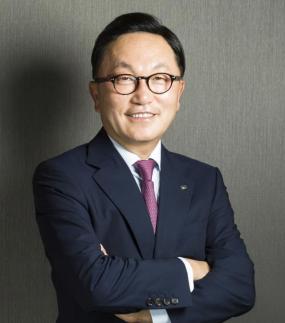 Park Hyun-joo Transforms Mirae Asset into a Global Investment Platform Park Hyun-joo, chairman of Mirae Asset Group, has a clear vision for financial leadership: to expand finance beyond the domestic market and direct capital globally. While the Korean securities industry has remained focused on a brokerage-centered revenue model, he recognized its limitations early on and sought to change the structure. The phrase "global investment platform" encapsulates his strategy. His network spans the United States, India, and Hong Kong, with expansions in global ETFs and alternative investments, all aimed at shifting finance from trading to investment and from domestic to global. Investments in SpaceX and the success of global ETFs validate his approach. However, this strategy raises questions about how to manage aggressive investments and volatility risks. Park's leadership is ongoing, as he continues to broaden the boundaries of finance. Overcoming Brokerage Limitations with a Global Investment Platform Park does not view securities firms merely as trading entities; he sees them as platforms designed for capital movement. The Korean securities industry has long relied on a brokerage-centered revenue model, which fluctuates based on commissions and trading volumes. Park believes this structure is not sustainable in the long term, prompting a shift in direction. He argues that the domestic market is small, competition is excessive, and performance is heavily influenced by interest rates and stock market fluctuations, limiting financial companies' growth potential. Thus, he reframed the question from "How can we increase trading?" to "Where should capital be directed?" This question is the starting point for his global investment platform strategy. Expanding overseas networks centered on the U.S., India, and Hong Kong, enhancing global ETF operations, and strengthening alternative investments are interconnected initiatives. Investment targets are broadening globally, and the means of investment are diversifying, creating a cohesive platform. In this process, Mirae Asset is transforming from a domestic securities firm into a global investment infrastructure. This is not merely an expansion; it is a redefinition of finance's role. Park is shifting finance from merely facilitating transactions to designing investment opportunities, and while this change is gradual, the direction is clear. Ultimately, overcoming the limitations of securities firms means not just expanding business areas but redefining finance itself, and Park's strategy is at that intersection. Risky Choices and Embracing Uncertainty Park's decision-making often sparks debate, yet a consistent pattern emerges: he moves when the majority is uncertain rather than when they are confident. His acquisition of Daewoo Securities was deemed an excessive gamble at the time, and the purchase of Global X was seen as a puzzling choice by the market. Similarly, his investment in SpaceX faced criticism for being overly risky for a financial company. However, over time, these choices have revealed a pattern. He does not shy away from risk; instead, he alters its nature, converting short-term risks into long-term structural advantages. The valuation gains from the SpaceX investment and the rapid growth of the global ETF business demonstrate that his decisions are based on structural insights rather than mere speculation. His investment philosophy is clear: the market always reacts late, and opportunities favor those who act first. This philosophy aligns closely with the essence of financial entrepreneurship: embracing uncertainty and taking responsibility for the outcomes. He performs both simultaneously. Of course, not every choice succeeds; there have been instances of volatility and losses in some overseas real estate and alternative investments. However, the crucial factor is direction. He does not stop due to the possibility of failure; instead, he creates structural performance across the entire portfolio, making his leadership more about judgment than management. This judgment stems not from personal intuition but from accumulated experience and understanding of global markets. Capital Movement as a Catalyst for Change Park's approach to finance does not conclude within the financial sector. He believes that capital creates industries, positioning finance at the forefront rather than behind. A look at his investment portfolio reveals a clear direction: internet, biotechnology, electric vehicles, space, and recently, digital assets—all aligned with future industries. This is not merely about seeking profits; it is about reading industrial structures and proactively allocating capital. Finance plays a role beyond supplying capital; it determines the pace of industries. The direction of growth and the competitive gap widen based on where capital flows. He understands this mechanism better than anyone, especially as global investment expansion seeks to overcome the structural limitations of Korean finance. Remaining in the domestic market restricts the scope of capital utilization and growth. Therefore, capital must venture abroad, necessitating the integration of global networks and investment platforms. He is making this structure a reality, not just by investing overseas but by creating a financial structure connected to international markets. In this sense, his strategy is about connection rather than mere expansion, linking finance and industry, domestic and international, capital and technology into a unified flow, with Mirae Asset at the center. This is not just a corporate strategy; it exemplifies the evolutionary direction of Korean finance. Redefining the Future of Finance in the Platform Era The competitive landscape of finance is already changing. It is no longer about products but platforms; the focus has shifted from individual services to interconnected structures. Park is among the first to recognize this shift. He aims to integrate investment, asset management, global investment, and digital assets into a single platform. With a foundation built on global ETFs, asset management, and overseas networks, the structure is already in place, and the integration of AI and data enhances the platform's sophistication. Data-driven investment analysis, automated asset management, and personalized portfolio construction are transforming financial services into entirely new forms. Customers no longer choose products; they select systems. And that system is the platform. He aims to seize this structure, which is not merely a digital transformation but a dismantling of financial boundaries. The distinctions between securities and asset management, investment and technology are disappearing, creating a unified investment infrastructure. In this process, Mirae Asset evolves from a financial company into a platform enterprise. Of course, this strategy carries risks, including global market volatility, regulatory changes, and intensified technological competition. However, the direction is clear: finance is no longer a domestic industry; it is a global platform industry, and Park is at the forefront of this transition. SWOT Analysis Strength: Park's strengths lie in his global investment judgment and execution. His strategic choices, such as the global ETF business and SpaceX investment, were ahead of the market. Additionally, his ability to transition into an investment platform is a key competitive advantage that differentiates him from traditional securities firms.Weakness: Aggressive investment strategies come with volatility. Instances of losses in overseas real estate and alternative investments highlight the importance of risk management. Furthermore, high dependence on global markets makes him vulnerable to external variables.Opportunity: The expansion of the global investment market, growth of ETFs, AI in finance, and the transition to asset platforms present favorable conditions for Mirae Asset. Particularly, the increase in individual investors provides a long-term growth foundation.Threat: Global financial market volatility, regulatory tightening, and competition from big tech companies pose significant threats. Additionally, major investment failures could lead to trust risks.* This article has been translated by AI. 2026-05-23 20:27:00
 -
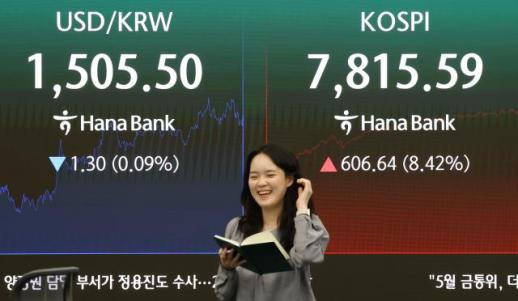 Single-Stock Leveraged ETFs Set to Launch, Potential for 60% Daily Loss As exchange-traded funds (ETFs) become a popular investment tool in South Korea, interest is growing in the upcoming launch of single-stock leveraged ETFs. While the introduction of various investment options centered around major semiconductor stocks like Samsung Electronics and SK Hynix is welcomed, investors should be cautious of the potential for daily losses of up to 60%. According to financial industry sources, leveraged and inverse products based on single stocks will be listed on the domestic stock market starting May 27. This includes ETFs that aim to double the returns of stocks like Samsung Electronics and SK Hynix. Some asset management firms are also set to introduce inverse products that bet on stock price declines. Single-stock leveraged products follow the daily returns of individual stocks, meaning if the ETF rises, the returns are doubled. However, if the stock moves contrary to investor expectations, significant losses can occur in a short period. Given that domestic stock prices can fluctuate by ±30%, losses of up to 60% in a single day are possible. Investors should also be aware that even if a single stock's price fluctuates without a net change, the value of leveraged products can steadily decline. For instance, if stock A drops from 100 won to 80 won (-20%) and then recovers to 100 won (+25%), a leveraged product starting at 100 won could fall to 60 won (-40%) and then rise to 90 won (+50%), resulting in a loss of 10 won. In fact, a comparison of specific stocks in the U.S. market last year showed that while individual stocks yielded an 18% return, a double-leveraged product recorded a 20% loss instead of the expected double return. Unlike general ETFs that track indices, single-stock leveraged ETFs expose investors directly to risks associated with individual companies, such as poor performance or negative news. Due to the high-risk nature of these products, investors must deposit a minimum of 10 million won and complete two hours of training through the Financial Investment Association's learning system—one hour of general education and one hour of advanced education. Previously, only one hour of training was required to invest in overseas leveraged ETFs. Yoon Jae-hong, a researcher at Mirae Asset Securities, noted, "Considering the size of the domestic ETF market and the trading patterns of individual investors, the inflow of funds into the 14 leveraged ETFs is estimated to be around 1.7 trillion won conservatively, and up to 5.3 trillion won aggressively. Given that initial capital tends to concentrate in the first five trading days, investors should be cautious of potential spikes in short-term volatility during this period."* This article has been translated by AI. 2026-05-23 20:20:16
 -
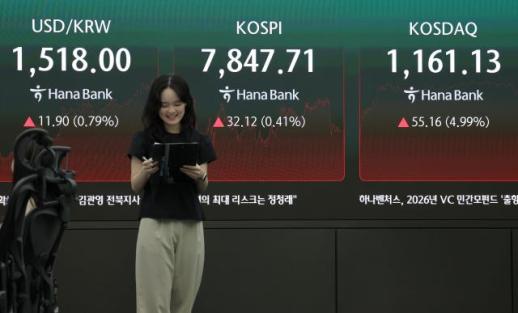 Korean Stock Market Stabilizes After Samsung Electronics Strike, Inflation and Rate Decisions Ahead Domestic stock markets have entered a period of stabilization following a sharp increase in volatility after the KOSPI index first surpassed the 8000 mark on May 15. While expectations for AI-driven investments in semiconductors continue to support the market, rising international oil prices, uncertainty over U.S. interest rates, and geopolitical risks in the Middle East are contributing to market fluctuations. Next week, the domestic market is expected to navigate significant events, including the U.S. Personal Consumption Expenditures (PCE) price index and the Bank of Korea's monetary policy committee meeting. According to the Korea Exchange, the KOSPI index rose by 32.12 points (0.41%) to close at 7847.71 on May 22. Over the week from May 11 to 15, the KOSPI and KOSDAQ indices increased by 4.73% and 2.77%, respectively. This week, the domestic market experienced sharp fluctuations due to profit-taking following the KOSPI's breach of the 8000 mark and concerns over interest rates. Negotiations between the U.S. and Iran have stalled, leading to a surge in international oil prices, while expectations for a rate cut by the U.S. Federal Reserve have diminished, dampening investor sentiment. Particularly, U.S. inflation data came in higher than expected, prompting the market to begin factoring in the possibility of interest rate hikes later this year. Concerns over a potential strike due to labor disputes at Samsung Electronics have also been cited as a factor increasing market volatility. However, by the end of the week, Samsung's management and labor reached a tentative agreement, and NVIDIA reported results and guidance that exceeded market expectations, helping to restore investor confidence in semiconductor stocks. In terms of supply and demand, retail and institutional investors net purchased 8.335 trillion won and 5.694 trillion won, respectively, while foreign investors net sold 14.307 trillion won. Analysts suggest that the outflow of foreign capital is more indicative of profit-taking following the semiconductor surge rather than a structural sell-off. Next week, several major macro events are scheduled. On May 25, stock markets in Korea, Hong Kong, the UK, and the U.S. will be closed. On May 27, single-stock leveraged ETFs for Samsung Electronics and SK Hynix will be listed in Korea for the first time. The U.S. PCE price index for April and the Bank of Korea's monetary policy committee meeting are set for May 28, followed by the MSCI quarterly rebalancing on May 29. The American Society of Clinical Oncology (ASCO) 2026 conference will also take place from May 29 to June 2. The U.S. PCE price index is viewed as a key variable that could influence short-term market direction, especially given the recent rise in international oil prices and concerns over inflationary pressures, which have increased uncertainty regarding Federal Reserve policy. According to Bloomberg consensus, the U.S. April headline PCE is expected to rise by 3.9% year-on-year, while core PCE is projected to increase by 3.3%. Jung Ye-kyung, a researcher at NH Investment & Securities, noted, "The recent rise in core Consumer Price Index (CPI) was significantly influenced by noise in rental statistics, so changes in housing costs may be limited in the PCE price index. However, market volatility could persist depending on oil prices and interest rate trends." Market attention is also focused on the outcome of the Bank of Korea's monetary policy committee meeting. While many expect the benchmark interest rate to remain unchanged, there are forecasts that a hawkish stance could strengthen due to recent trends in exports and domestic demand recovery, as well as inflationary pressures from high oil prices. Analysts believe that while short-term volatility is likely to continue, the attractiveness of earnings and valuations remains intact. They emphasize that the ongoing AI investment cycle and upward revisions in semiconductor profit estimates suggest limited risk to leading stocks. Na Jeong-hwan, a researcher at NH Investment & Securities, stated, "In a volatile market, the key factors are ultimately earnings and valuations. The current KOSPI forward price-to-earnings ratio (PER) is significantly below the average of the past decade, indicating that valuation attractiveness remains high. With the robustness of the AI infrastructure investment cycle reaffirmed, the investment appeal of sectors related to memory semiconductors and AI infrastructure is expected to stand out." * This article has been translated by AI. 2026-05-23 20:15:57
 -
 Chinese Film 'Dear You' Explores the History of Overseas Chinese “An audiovisual letter to hometowns and overseas compatriots.” On May 22, the Chinese state media outlet Global Times described the film 'Dear You' (original title: 給阿嬤的情書) as a recent box office sensation. Set in the Chao Shan region of Guangdong Province, which is home to many overseas Chinese in Southeast Asia, the film tells the story of Chinese immigrants who left for Southeast Asia in search of a better life and the families who awaited their return. The film follows Ye Su-lou, a grandmother living a quiet life in Chao Shan. Her husband, Zheng Wu-sheng, left for Southeast Asia long ago to earn money but has not returned, leaving only rumors of his success. Meanwhile, her grandson, Xiao Wei, burdened by debt, secretly travels to Thailand in search of the grandfather he has only heard about in stories. However, the truth he uncovers is unexpected. Zheng Wu-sheng has been deceased for many years, and the person who has been sending letters and money to Ye Su-lou for the past two decades is actually a friend of her late husband, Xie Nan-zi. The film delicately unravels themes of love, sacrifice, and the passage of time that have been hidden for over half a century. At the heart of the film is 'Chao Pi' (僑批), letters sent by overseas Chinese along with their remittances to family back home. In an era when communication was challenging, Chao Pi served not only as a means of sending money but also as the only link to families thousands of kilometers away. Today, Chao Pi is recognized as a UNESCO Memory of the World Register. The Global Times noted, “A single Chao Pi sent by overseas Chinese is not just a letter but a piece of Chinese history.” It added, “During times of turmoil and poverty, many residents of the Chao Shan region relied on remittances from overseas Chinese for their livelihoods,” emphasizing that the film captures the collective memory of the overseas Chinese community beyond individual stories. Initially, the film did not attract much attention. Released on April 30, just before the Labor Day holiday, it had a modest production budget of 14 million yuan (approximately $2.7 million) and earned only 3.77 million yuan on its opening day, with screenings limited primarily to the Chao Shan region. However, word of mouth during the Labor Day holiday changed its fortunes. As of May 21, the film's cumulative box office surpassed 760 million yuan (approximately $170 million), with projections from Chinese film ticketing platform Maoyan estimating final earnings to exceed 1.6 billion yuan. The film has received a rating of 9.1 on the review site Douban, making it the highest-rated Chinese film released this year. Critics attribute the film's success to its authenticity and realism. The main characters, Ye Su-lou and Xie Nan-zi, are portrayed by amateur actors without formal training. Their understated performances, delivered in the Chao Shan dialect, resonate deeply with audiences, leading some viewers to comment, “It feels like I’m watching my own grandparents.” Director Lan Hunchun reportedly spent nearly a decade refining the script, visiting numerous overseas Chinese families to gather real-life stories related to Chao Pi, which he incorporated into the film's narrative. Interestingly, the film has also found resonance in Taiwan. The Chao Shan dialect shares similarities with the Minnan language spoken in Taiwan. The term 'Amo' (阿嬷), which means 'grandmother,' is widely used in Taiwan as well. During a recent briefing, Zhu Fenglian, spokesperson for the Taiwan Affairs Office of the State Council, remarked, “The Chao Shan region and Taiwan share many linguistic and cultural similarities,” adding that Taiwanese audiences deeply empathized with the film's themes of loyalty, familial love, and patriotism expressed in the Chao Shan dialect. He further noted, “The term 'Amo' symbolizes the common roots and origins of people on both sides of the Taiwan Strait,” highlighting that the positive response from Taiwanese viewers reflects the shared cultural heritage and emotional connection between the two regions.* This article has been translated by AI. 2026-05-23 20:15:30
 -
 Im Sung-jae Sets Personal Best with Hole-in-One at CJ Cup Im Sung-jae recorded his third hole-in-one on the PGA Tour and set a personal best score of 61, marking a significant step toward his first tour victory in over four years. On May 23, during the second round of the CJ Cup Byron Nelson at TPC Craig Ranch in McKinney, Texas, Im shot a 10-under 61, which included one hole-in-one, one eagle, and seven birdies, with only one bogey. Im's score of 61 is a new personal best on the PGA Tour, surpassing his previous record of 62 set at the Wyndham Championship in August 2019. Starting on the 10th hole (par 4), Im made four birdies by the 17th hole (par 3) and continued his momentum with birdies on the 1st (par 4), 3rd (par 4), and 5th holes (par 5). He achieved a lucky hole-in-one on the 7th hole (par 3), marking his third hole-in-one in a PGA Tour event, following ones at the 2019 Players Championship and the Military Tribute that same year. Adding an eagle on the 9th hole (par 5), Im finished the day with a total of 10 strokes under par. With a cumulative score of 13-under 129, he was the first to complete the round and topped the morning leaderboard. After the round, Im expressed satisfaction with his performance, stating, "Overall, it was a satisfying day. My tee shots, iron shots, and putting were all good. I was surprised by the hole-in-one, as I thought it was a good shot, but I didn't expect it to go in." He added, "I’ll keep the lucky ball in my bag." His playing partner, Jordan Spieth, applauded Im's hole-in-one, saying, "The shot Im made was one of the most beautiful hole-in-ones I've ever seen. It was even better than any hole-in-one I've made." Riding this momentum, Im is aiming for his third career win, which would be his first since the Shriners Children's Open in October 2021. He remarked, "When my shots are feeling good, I feel like I can compete for the win. This week feels like my third opportunity. If the weather is good this weekend, I think I can play aggressively on this course. If the greens cooperate, I should have plenty of birdie opportunities. I want to capitalize on this momentum." Im also expressed confidence in his ability to compete for the title, noting, "It’s been about 4 to 5 years since I last won. However, I’ve been in contention twice this year, and those experiences have been very helpful. Competing for the win brings its own pressure and nerves, but having gone through it once this year, I plan to manage my emotions and focus on my game."* This article has been translated by AI. 2026-05-23 20:13:45