
Journalist

Seo Hye Seung
-
 SEA LIFE COEX Aquarium to Host Zanmang Loopy Collaboration Campaign SEA LIFE COEX Aquarium will begin a special collaboration campaign with the popular character 'Zanmang Loopy' on May 1. The campaign will run through Aug. 2, about three months, and will feature Zanmang Loopy redesigned to match the aquarium theme. Visitors will see SEA LIFE-exclusive displays including 'Mermaid Zanmang Loopy' and 'Fish Zanmang Loopy' placed along visitor routes and in themed zones. The Rainbow Lounge zone will include a photo spot using Little Mermaid-style props. The aquarium also added hands-on events. Visitors who buy Zanmang Loopy photo cards or postcards can join a stamp rally and receive a campaign-limited sticker after completing missions. Standees inside the venue will be paired with point 안내 boards that explain nearby marine life in a playful way, the aquarium said. On-site perks and limited goods will also be offered. During the campaign, visitors can scan QR codes on in-venue installations to download six limited-edition smartphone wallpapers for free. Limited 'mermaid concept' items — including plush dolls, key rings and random badges — will be sold only during the campaign period. SEA LIFE COEX Aquarium said it will also sell discounted packages that combine admission tickets and goods exclusively through its official website and Naver Reservation. An aquarium official said the campaign is designed to add a new experience to the venue's marine-life exhibits by letting visitors connect with a popular character and make special memories. The official said it will give Zanmang Loopy fans nationwide a chance to enjoy the exhibition, merchandise and events in one place. 2026-04-28 15:22:14
 -
 WSJ: OpenAI Misses Key Targets, Raising Questions Ahead of Planned IPO OpenAI, which is pursuing an initial public offering this year, has missed major performance targets in 2025 and 2026, raising concerns ahead of the planned listing, The Wall Street Journal reported April 27, citing sources. According to the report, OpenAI failed to meet an internal goal of reaching 1 billion weekly active users for its AI model ChatGPT by the end of last year, a shortfall the Journal said has worried investors. Sources also said OpenAI missed its annual revenue target in 2025 as Google’s competing AI model Gemini grew rapidly. This year, OpenAI has also missed monthly revenue targets several times, the sources said, attributing the weakness to customers shifting in coding and enterprise AI to Anthropic, the developer of Claude. The missed targets have added pressure to OpenAI’s finances as it prepares for an IPO and signals large future spending. OpenAI completed $122 billion in funding last month, described as the largest in Silicon Valley history, and was valued at $852 billion. But it has said it expects to spend $600 billion through 2030 to secure computing resources such as data centers, and the performance gaps have intensified funding concerns. Sources said OpenAI Chief Financial Officer Sarah Friar recently told others that if revenue does not grow fast enough, the company may be unable to raise funds needed for future computing capacity. The board has also closely reviewed OpenAI’s data-center contracts and questioned CEO Sam Altman’s push to secure more computing resources despite a slowdown in the business, the sources said. The sources said the board is split between Altman’s goal of completing an IPO by the end of this year and other executives who want to prioritize cost controls. Friar has taken a cautious stance in recent months about pursuing an IPO by year’s end, the sources said. Altman and Friar, in a joint statement, denied reports of internal اختلاف, saying, “We are fully aligned on securing as much computing capacity as possible, and we work together every day to do so,” the Journal reported. OpenAI has also moved to cut costs, including ending its video AI model service, Sora. Separately, Reuters reported that OpenAI renegotiated contract terms with major shareholder Microsoft and can now offer its products on rival clouds including Amazon Web Services and Google Cloud, not only Microsoft. In addition, Kuo Ming-chi, an IT analyst at Taiwan’s TF International Securities known for Apple supply-chain analysis, said the day before that OpenAI is pursuing development of its own smartphone. The Journal said OpenAI is also facing other challenges ahead of the IPO, including a leadership gap after its No. 2 executive, product and business chief Fidji Simo, abruptly took health-related leave earlier this month, and litigation involving Tesla CEO Elon Musk, a co-founder of OpenAI. 2026-04-28 15:17:54
 -
 South Korea Expands Research Funding Flexibility, Eases R&D Rules The Ministry of Science and ICT said it is moving to significantly expand researchers’ discretion in using grant funds and to streamline what it called unnecessary administrative rules, aiming to let scientists focus more on research and less on paperwork. The ministry said a revision to the enforcement decree of the National Research and Development Innovation Act was approved at a Cabinet meeting on the 28th. The revision is a follow-up to the “R&D ecosystem innovation plan to lead the future through science and technology” announced in November 2025, which called for easing administrative regulations and improving conditions for researchers. To broaden flexibility for individual researchers, the decree creates a new direct-cost budget category called “research innovation expenses.” Under the new category, researchers may spend funds more freely — without subdividing items — for costs needed to carry out projects, including research materials, business travel and meeting expenses. The ministry said the category may be used up to 10% of direct costs, capped at 50 million won, and documentation requirements will be minimized to reduce administrative burdens. The system will apply to selected programs starting in June 2026 and will be fully implemented in 2027. The ministry also said it will shift how institutions use indirect costs to a “negative regulation” approach. Previously, indirect costs could be spent only on listed items; under the change, institutions may broadly spend on research-related costs except for items explicitly prohibited. The ministry said this will allow more flexible responses to new needs such as fees for artificial intelligence services. This change will take effect immediately upon promulgation. The decree does not fully liberalize indirect-cost spending. It specifies certain items as prohibited to maintain minimum controls. Commonly barred uses include payments a university-industry cooperation foundation makes to a university without consideration for carrying out an R&D project; costs such as damages and penalties; and expenses unrelated to research. For personnel support funds, prohibited items include additional pay for researchers or support staff already receiving salaries, as well as scholarships such as merit-based graduate awards or teaching assistant scholarships. For research support funds, prohibited items include costs that function as rewards for winning R&D contracts, as well as construction and building remodeling expenses. The ministry said it also revised smaller rules that had caused inconvenience in the field. It abolished a requirement for prior approval before using meeting expenses, and it will simplify supporting documents required for spending on research materials. Park In-gyu, head of the ministry’s Science and Technology Innovation Office, said, “We are continuously improving the system so researchers can focus on research without administrative burdens,” adding, “We will actively identify regulations that hinder research immersion and continue additional improvements.” * This article has been translated by AI. 2026-04-28 15:17:04
 -
 Hana Financial’s ‘Hana Universe’ Tops 23 Million YouTube Views With Star Cast Hana Financial Group said its brand content series “Hana Universe,” released to mark the group’s 20th anniversary, has surpassed 23 million cumulative views on YouTube. The big-budget project, which brings together top names from film, sports and music, is drawing attention as a new approach to brand marketing in the financial sector. According to the financial industry on Monday, the main “Hana Universe” video posted April 10 on Hana Financial’s official YouTube channel, HanaTV, had nearly 13 million views as of 2 p.m. that day (12.96 million). Combined with the teaser and trailer (7.62 million), brand film (2.40 million) and production presentation (620,000), related videos totaled 23.60 million views. Short-form clips are also drawing hundreds of thousands of views each. “Hana Universe” departs from a standard ad format, presenting a nine-minute short film set inside an airplane cabin and built around director Ha Jung-woo’s comedic style. It features the group’s advertising models, including singer G-Dragon and Lim Young-woong, along with soccer player Son Heung-min, TV personality Kang Ho-dong and Ahn Yu-jin of IVE. Through a series of episodes, the film highlights key products and services, including the Hana Nara Sarang Card, Hana Gold Trust, Hana Pension Doctor, Hana The Next and Travelog. With a cast rarely seen in financial advertising and a movie-style storyline, the video spread quickly across online communities and social media after its release. Re-edited versions, including YouTube Shorts, have helped sustain word-of-mouth interest. Industry watchers say Hana Financial is shifting away from TV-centered advertising and putting more emphasis on digital content to build brand familiarity. Last year, it tested the mix of entertainment-style content and star marketing through “Hanappunin Mureupak Baksa,” hosted by Kang and featuring G-Dragon and Son. “Financial advertising used to focus on conveying trust and stability, but it is evolving into a way for people to experience brands through entertainment and buzz,” a financial industry official said. “After this success, competition in financial-sector content marketing is likely to intensify.” 2026-04-28 15:11:29
 -
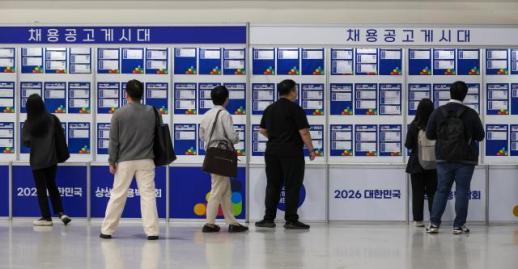 The young are not resting, but unfound: Job fair in Seoul SEOUL, April 28 (AJP)-The so-called "resting" young people under 30 numbered 402,000, and the unemployment rate of the young cohort hit 7.4 percent as of March even as the overall employment rate neared 70 percent in South Korea. The spring has failed to arrive for the young jobseekers. The government and business groups opened the 2026 Korea Win-Win Job Fair at aT Center in southern Seoul on Tuesday, hoping to provide some reprieve. The two-day event is hosted Ministry of Employment and Labor and business organizations including the Korea Enterprises Federation, the fair was organized as a follow-up measure to the Youth Jobs First Step Initiative announced in December last year. About 700 companies are taking part online and offline, including major conglomerates such as Samsung Electronics, SK Group, Hyundai Motor Group and LG Group, as well as mid-sized firms, small businesses, startups and foreign companies. More than 2,200 jobs are being offered. Candidates move booth to booth, repeating the same introduction, adjusting tone, refining answers — in real time. The effort is constant. The outcome uncertain. “Resting” suggests choice. What fills this hall suggests persistence. They are not outside the labor market. They are circling its edges. If the doorway narrows, the queue lengthens. If the queue lengthens, the pause grows. Folders go back into bags. Phones come out — checking, refreshing, waiting. They will apply again. They will return again. Spring, for them, is not here yet. 2026-04-28 15:11:11
 -
 Jipyeong, Criminal Procedure Law Society Hold Seminar on Attorney-Client Privilege and Corporate Legal Strategy Jipyeong Law Firm and the Korean Association of Criminal Procedure Law said April 28 they held an online and in-person seminar the previous day on corporate legal strategy in the “ACP era,” covering responses to investigations and global best practices. On Jan. 29, 2026, a revision to the Attorney-at-Law Act aimed at institutionally protecting confidential communications between lawyers and clients passed the National Assembly plenary session. It is set to take effect Feb. 20, 2027. The change is expected to codify attorney-client privilege, or ACP (Attorney-Client Privilege), which had previously been recognized only in limited circumstances through lower-court rulings. The organizers said the seminar was designed to review legal and practical issues tied to ACP’s introduction and to consider corporate response strategies. The program opened with remarks by Lim Seong-taek, managing partner at Jipyeong, and a congratulatory address by Lee Geun-woo, president of the association, followed by three presentations and a panel discussion. In the first session, Jang Pum, a partner at Jipyeong, spoke on preparations for ACP, reviewing shifts reflected in recent court decisions and outlining key requirements for privilege to be recognized. In the second, Park Seung-dae, also a Jipyeong partner, discussed response strategies for investigative and oversight agencies, offering approaches for handling disputes over whether materials qualify for ACP protection. In the third, Kim Jin-hee, a senior foreign attorney at Jipyeong, presented on overseas examples and best practices, stressing the need for Korean companies to build global-standard practices for documents, investigations and the use of AI on the premise that ACP applies. The panel discussion was moderated by Lee Sang-won, professor emeritus at Seoul National University, with participants including Lee Geun-woo, a professor at Gachon University; Park Jun-yeon, an attorney at Herbert Smith Freehills Kramer; and Kim Ga-yeon, an executive at X (formerly Twitter) Korea. “An important task is to use ACP as an opportunity to advance corporate compliance management and risk-control systems and, through that, strengthen competitiveness,” Lim said. He added that Jipyeong will continue providing practical advice so companies can respond proactively to ACP legislation, including by refining internal standards and building systems to respond to investigations and probes. * This article has been translated by AI. 2026-04-28 15:07:17
 -
 South Korea Assembly Passes Election Law to Add 3 Incheon District Council Seats Ruling and opposition parties on the 28th approved revisions to the Public Official Election Act to adjust the number of basic local council members in Incheon ahead of an administrative system overhaul. Under the bill, Incheon’s total will increase by three seats, to 128 from 125. The National Assembly passed the measure at an afternoon plenary session, revising the number of basic local council seats for the June 3 local elections. Of 246 lawmakers present, 234 voted in favor and 12 abstained. Rep. Bae Jun-young of the People Power Party, explaining the proposal, said the administrative overhaul set to take effect in July revealed that some districts would lose seats under current constituency lines. He said the outcome failed to reflect population growth and changes from the reorganization. Bae said the Assembly’s special committee on political reform concluded additional seats were needed to ensure resident representation and equal voting value. He said the plan would also raise the nationwide total number of district and county council members from 3,003 to 3,006. The bill is a follow-up to a version introduced and processed at a plenary session on the 18th, after lawmakers argued the earlier draft did not fully reflect the administrative overhaul that adds Yeongjong-gu in Incheon and that the council-seat count needed adjustment. Also at the plenary session, the People Power Party delivered a floor statement on a motion recommending the dismissal of Unification Minister Jeong Dong-young, after controversy over his remarks mentioning a uranium enrichment facility in North Korea’s Kangsong city. Rep. Kim Geon said Jeong, since those remarks, had continued to make what he called uncoordinated, unilateral statements on diplomacy and security policy, creating discord with the president, the Foreign Ministry and the Defense Ministry and causing friction with ally the United States. Kim criticized Jeong for not issuing an official apology or presenting steps to prevent a recurrence despite what he described as diplomatic risks between South Korea and the United States. Kim said Jeong had publicly referred in the Assembly to a South Korea-U.S. intelligence matter, creating diplomatic and security risks, and that afterward even information sharing on North Korea had been halted, raising concerns about alliance trust and security coordination. He said Jeong was shifting blame outward rather than offering an apology and prevention measures. Kim urged that the dismissal motion not be treated lightly and called for a plenary session vote, saying, “There is no ruling or opposition party when it comes to national security.”* This article has been translated by AI. 2026-04-28 15:06:07
 -
 Korea Financial Investment Association Launches Mandatory Online Course for Single-Stock Leveraged, Inverse Products The Korea Financial Investment Association has created a mandatory pre-trade education course for investors seeking to trade single-stock leveraged and inverse exchange-listed products, strengthening investor protections for high-risk instruments. The association’s Financial Investment Education Institute said on the 28th that it opened an online course titled “Pre-Trade Education for Single-Stock Leveraged and Inverse Exchange-Listed Product Trading.” The requirement was introduced ahead of the May 22 launch of single-stock leveraged (±2x) products based on leading South Korean shares. Completion is required for anyone who wants to invest in single-stock leveraged or inverse products. Investors must register the completion number issued after finishing the course in their brokerage system before they can place trades. The curriculum focuses on how leveraged products work and the risks involved, including concepts such as negative compounding effects and leverage. It also includes quizzes and a pre-investment checklist to test understanding. Investors must choose the appropriate course depending on what they plan to trade. A combined program covering single-stock leveraged and inverse products totals two hours (one hour basic plus one hour advanced). Those investing only in single-stock products can take a separate one-hour advanced course. Existing investors in leveraged ETFs and ETNs are also subject to the same pre-trade education requirement. The association said the training will help investors better understand the products and improve their ability to make rational investment decisions. The course has been available since 10 a.m. that day and can be accessed by applying through the Financial Investment Education Institute’s website. * This article has been translated by AI. 2026-04-28 15:05:17
 -
 Deputy Prime Minister Koo Yun-cheol Meets AMCHAM Chief to Discuss Korea’s Global Finance Hub Push Koo Yun-cheol, deputy prime minister and minister of finance and economy, met Monday with James Kim, chairman of the American Chamber of Commerce in Korea, to discuss policy directions for South Korea’s push to become a global financial hub. The meeting at the Government Complex Seoul included Koo and the ministry’s international economic affairs chief. AMCHAM attendees included Jeffrey Jones, chairman of the Future of Korea Partnership Foundation, among others. Kim said that as Singapore and Hong Kong strengthen their competitiveness as financial centers, South Korea also needs to bolster the competitiveness of its financial industry to further expand the foundation for attracting global investment. He said he hopes to work closely with the ministry to strengthen market competitiveness and improve the investment environment. Kim also presented Koo with AMCHAM’s recently published report, “Strategy for Advancing Korea as a Financial Hub.” The report includes recommendations for South Korea’s bid to become a global financial hub, including creating a regulatory environment aligned with global standards and building a predictable supervisory system to help expand investment by global companies. Koo said the report contains a range of policy recommendations to strengthen the competitiveness of South Korea’s financial industry and would be a useful reference. He said the government is continuing efforts to advance capital markets, improve the structure of the foreign exchange market and innovate financial regulation. “The Korean government is making an all-out effort to position the capital market as a core platform for economic growth and to modernize it in line with global standards,” Koo said. He added that the government will steadily carry out tasks in the previously announced MSCI roadmap so South Korea’s capital market can be recognized with a fair “Korea premium.” Koo said the government will closely consult with relevant agencies on views raised during the meeting and actively reflect needed items in future institutional improvements. * This article has been translated by AI. 2026-04-28 15:04:28
 -
 South Korea, Singapore Launch Talks to Upgrade FTA, Focus on Supply Chains The Ministry of Trade, Industry and Energy said April 28 that South Korea and Singapore have launched negotiations to upgrade their free trade agreement, prompted by Trade Minister Yeo Han-ku’s visit to Singapore. The ministry said the two countries’ chief negotiators signed negotiating rules in the presence of Singapore Deputy Prime Minister and Minister for Trade and Industry Gan Kim Yong and Yeo. The signing followed a March summit agreement to begin talks on improving the FTA. After the signing, South Korea held the first round of negotiations with relevant ministries including the Ministry of Economy and Finance and the Ministry of Land, Infrastructure and Transport. Talks were conducted in four working groups: supply chains, the green economy, aircraft maintenance, repair and overhaul, and trade facilitation. Yeo also held a series of meetings with Gan; Tan See Leng, minister in charge of digital, supply chain and energy; and Grace Fu, minister in charge of World Trade Organization and multilateral trade issues. The ministry said they discussed ways to speed up upgrade talks on the Korea-ASEAN FTA and the Korea-Singapore FTA, strengthen the foundation for economic cooperation with New Southern Policy countries, and bolster minilateral cooperation. Separately, Yeo met in relay talks with energy trading firms and commodity information and analysis organizations alongside Rep. Lee Eon-ju, chair of the Korea-Singapore parliamentary friendship association and a lawmaker from the Democratic Party. The ministry said meetings with Vitol, Trafigura and S&P Global were used to share outlooks for global energy markets and explore response options. Yeo also held a meeting with South Korea’s four refiners operating locally to review crude oil and naphtha supply and demand conditions and hear difficulties faced by companies. The ministry said Yeo carried out outreach to expand Singapore investment in South Korea’s advanced industries and broaden exports of Korean consumer goods. He visited Singapore’s sovereign wealth fund Temasek and stressed the need for sustained investment cooperation. He also met with Shopee, Southeast Asia’s largest e-commerce company, to discuss a dedicated section for Korean products, as well as cooperation on certification and logistics to help South Korean small and medium-sized companies expand in Southeast Asia. Yeo visited the Hyundai Motor Group Singapore Global Innovation Center, described as Singapore’s advanced manufacturing innovation hub, and PSA, a global port operator, to review on-site artificial intelligence for next-generation manufacturing and the status of logistics automation technology. “Following up on the March summit, we launched FTA upgrade talks and discussed key economic cooperation issues including supply chain stabilization, investment attraction and boosting cross-border online shopping,” Yeo said. “We will work to ensure this visit leads to tangible outcomes that help our companies.”* This article has been translated by AI. 2026-04-28 15:03:21