
Journalist

Seo Hye Seung
-
 Samsung Heavy Industries Becomes First Shipbuilder to Earn Zero Waste to Landfill Certification Samsung Heavy Industries said it has strengthened its environmental, social and governance efforts by raising the recycling rate of waste generated at its shipyard. The company said it held a ceremony on the 28th at its Geoje shipyard after receiving UL Solutions’ “Zero Waste to Landfill (ZWTL)” certification. Attendees included Namgung Geum-seong, vice president and head of the shipyard, and Yoon Hye-jin, executive director of UL Solutions Korea, the company said. ZWTL is an environmental certification awarded based on the share of a site’s waste that is recycled rather than sent to landfill, and is used globally to gauge corporate efforts in resource circulation. Samsung Heavy Industries said shipbuilding has faced challenges in resource circulation because it generates a wide range of waste that can be difficult to process. It said it earned the certification after continuing to improve its waste-management system to increase recycling. The company said it overhauled its sorting system by classifying all waste by type and characteristics under its own procedures. It also linked manual sorting to mechanical sorting to raise recovery rates for recyclable materials. It said it further upgraded management by working with the environment office and the Korea Environment Corporation on technical cooperation and professional consulting, and by building a real-time monitoring system. In March, Samsung Heavy Industries said it also became the first in the industry to receive “circular resource recognition” from the Nakdong River Basin Environmental Office for four types of nationally managed waste: slag, dust, waste wood and waste expanded synthetic resin (Styrofoam). The recognition is a government system that allows waste to be treated and, if it is not harmful to health or the environment and can be traded for a fee, to be recognized as a circular resource. “ZWTL and circular resource recognition show the results of Samsung Heavy Industries’ efforts to recycle waste,” Namgung said. “We will further strengthen our resource-circulation system.”* This article has been translated by AI. 2026-04-28 14:30:50
 -
 Seoul to Add Bus, Subway Service; Expands Off-Peak Commute Fare Refunds The government will increase bus and rail service during rush hours to ease crowding and expand fare refunds for commuters who travel earlier or later than usual under staggered work hours. Public agencies will be urged to have at least 30% of employees participate in staggered commuting, and the government will encourage private companies to adopt flexible work arrangements. The Ministry of Land, Infrastructure and Transport said it announced a joint plan with nine related ministries on the 28th at the Government Complex Sejong to reduce congestion on public transportation during commuting hours. The plan includes 32 tasks in four areas: expanding transit supply, spreading out commuting demand, discouraging car use and running a public campaign. Service will be expanded on heavily crowded routes in the Seoul metropolitan area. On weekdays, Seoul will add four more runs on 196 city bus routes and on the Shinbundang Line section between Jeongja and Sinsa. Subway service will also increase by 18 runs on parts of Lines 2 and 7, including the Sadang-Bangbae and Cheolsan-Gasan Digital Complex sections. Five stations with concentrated demand for Gyeongin Line express trains — Daebang, Singil, Gaebong, Dongam and Jemulpo — will get 15 additional daily stops. If the national oil alert is raised to the highest level, “severe,” the government will also pursue intensive dispatching of urban rail and buses comparable to measures taken during a city bus strike. By 2029, the government will provide 40.9 billion won to the crowded Gimpo Goldline and Seoul subway Lines 4, 7 and 9, and will push to shorten headways by introducing domestically developed communications-based train control, or CBTC. In September, the government will cut by 50% the spending threshold used to calculate refunds under the public transit reimbursement service “Moduui Card” (flat-rate K-Pass). For riders who use public transportation during designated off-peak windows around rush hour, the refund rate will rise by 30 percentage points. Flexible work in the public sector — including staggered hours and telework — will be strengthened in stages. The plan recommends applying staggered commuting to at least 30% of public-sector workers. If the oil alert level rises, it recommends 50% participation and actively encourages working from home. The government will also urge flexible work in the private sector by offering guidelines, incentives and consulting. It plans to encourage voluntary efforts to ease commuting congestion by reducing traffic-inducing charges for companies that cut vehicle use. A public-sector odd-even driving restriction that began on the 8th will be expanded step by step to the private sector if the oil alert level is raised. The government also plans to launch, next month, an auto insurance rider that discounts premiums for vehicles participating in the program. Land Minister Kim Yun-deok said the government will implement the added rail and bus service and expanded Moduui Card benefits without disruption, and that ministries and local governments will jointly inspect conditions and take immediate steps as needed to minimize commuting inconvenience. He also urged public cooperation to help overcome what he called an energy crisis, even if it causes some inconvenience. * This article has been translated by AI. 2026-04-28 14:29:33
 -
 South Korea Sets 30 Million Won Reward for Itaewon Disaster Truth-Finding, Extends Healing Leave to 1 Year The Ministry of the Interior and Safety said Tuesday that a partial revision to the enforcement decree of the special law on protecting victims’ rights, determining the truth and preventing a recurrence of the Oct. 29 Itaewon disaster was approved at a Cabinet meeting and will take effect May 11. The revision sets detailed standards for paying rewards to people who contribute to truth-finding and clarifies requirements for victims seeking to extend healing leave. Under the decree, a total of 30 million won will be paid in rewards to those who provide direct and decisive information that had not been made public through the media or other channels. The reward applies when, without the information, truth-finding would have been impossible or significantly difficult. Payment will be decided through review and a resolution by the special investigation committee. Any reward obtained through improper means will be recovered, the ministry said. The decree also spells out conditions for extending healing leave for victims recovering from physical and psychological harm. Previously, healing leave was available for up to six months. With the revision, workers can extend leave by an additional six months — up to one year total — if they submit a doctor’s diagnosis or medical opinion written within 30 days of the submission date. Workers seeking an extension must apply to their employer seven days before their leave ends. Even if a leave period ended before May 11, an application can be filed seven days before the date the worker wants the leave to begin. Separately, an amendment to the special law taking effect May 11 will extend the deadline to apply for victim recognition to within six months after the special investigation committee ends its work. It will also extend the deadline to apply for healing leave to within one year after the committee’s activities conclude. Interior and Safety Minister Yoon Ho-jung said, “The government will do its utmost to support victims of the Itaewon disaster to focus on recovery and fully regain their daily lives.”* This article has been translated by AI. 2026-04-28 14:22:03
 -
 SEMAS Wins Top Grade in 2025 Public Agency Shared Growth Evaluation The Small Enterprise and Market Service said on April 28 it received the highest rating, “Top,” in the Ministry of SMEs and Startups’ 2025 public agency shared growth evaluation. It was the first time SEMAS earned the top grade in the assessment. Over the past five years, its results were: 2020 (Needs Improvement), 2021 (Average), 2022 (Good), 2023 (Excellent) and 2024 (Excellent). The evaluation reflects public agencies’ shared-growth performance and surveys of how partner small and midsize companies perceive cooperation. Results are divided into five grades: Top, Excellent, Good, Average and Needs Improvement. SEMAS said the rating recognized its sustained, agencywide efforts to grow alongside small businesses and small merchants. SEMAS received strong marks for pushing institutional changes to make job placement links for closed businesses and career-transition incentive payments tax-exempt, expanding purchases of products made by small and midsize firms to boost public procurement, and diversifying shared sales channels for partner companies. The agency also said it identified shared-growth tasks tied to its core programs and expanded cooperation initiatives that partner firms and local communities can feel, while working to meet public agencies’ social responsibilities. SEMAS Chairman In Tae-yeon said, “Earning the top grade reflects the combined efforts of all employees to support the sustainable growth of small and midsize companies and small merchants.”* This article has been translated by AI. 2026-04-28 14:21:16
 -
 Lotte Energy Materials to Invest 50 Billion Won to Expand Iksan Circuit Foil Plant Lotte Energy Materials said Monday it will invest about 50 billion won to expand its Iksan plant, the country’s only production base for circuit foil, as it seeks to complete its materials value chain (Elecfoil-CCL-PCB-Module). The company said it decided on the investment to secure future competitiveness even as the electric-vehicle market, including the copper-foil sector, faces headwinds due to a demand slowdown. It cited rapid growth in artificial intelligence data centers as driving a surge in customer demand for HVLP (hyper-very-low-profile) copper foil used for high-speed signal transmission. Through the Iksan plant, Lotte Energy Materials said it is providing materials solutions that meet customer requirements for performance, reliability, mass-production capability and stable supply. The company said the expansion will support customers’ efforts to build more stable supply chains. Chief Executive Officer Kim Yeon-seop said the company made the decision “carefully” to pursue two goals: securing future competitiveness and restoring performance. “We will further strengthen customer trust by securing core materials technologies for the AI and network era and by stabilizing quality and supply through expanded production capacity,” he said.* This article has been translated by AI. 2026-04-28 14:18:45
 -
 OpenAI Renegotiates Microsoft Deal, Opening Path to AWS and Google Cloud OpenAI and Microsoft have revised their partnership, loosening a structure that had effectively given Microsoft exclusive rights to sell OpenAI’s AI models. Reuters reported on 27일(현지시간) that the companies renegotiated key terms, allowing OpenAI to offer its products through rival cloud providers such as Amazon Web Services and Google Cloud under certain conditions. Under the amended agreement the companies released, Microsoft remains OpenAI’s primary cloud partner, and OpenAI products will generally launch first on Microsoft Azure. But if Microsoft cannot, or chooses not to, support needed features, OpenAI may provide those products on other clouds. A central change is that Microsoft’s intellectual property license to OpenAI models and products, which runs through 2032, is no longer exclusive. The U.S. technology outlet The Verge said the shift to a nonexclusive license could widen access to OpenAI technology for other companies. The revenue-sharing structure also changes. Microsoft will no longer share with OpenAI a portion of the revenue it earns from offering OpenAI models on Azure. OpenAI’s revenue-sharing payments to Microsoft will continue through 2030, but with a cap on the total amount. Reuters reported that Microsoft will receive 20% of OpenAI revenue through 2030, subject to an undisclosed overall limit. The adjustment comes as OpenAI seeks to expand its corporate customer base. Under the previous deal, AWS and Google Cloud customers faced constraints in adopting OpenAI products directly. Amazon responded quickly. CEO Andy Jassy said, “We will offer OpenAI models directly on AWS’s AI platform within weeks.” The revised agreement also removes an artificial general intelligence, or AGI, clause. The earlier contract included a provision that could have changed revenue-sharing and rights if OpenAI reached AGI. The new deal keeps revenue-sharing in place through 2030 regardless of whether AGI is achieved. The Verge said the AGI clause, long seen as pivotal to the partnership’s future, was deleted. The changes do not end the relationship. Microsoft remains a major shareholder with a 26.79% stake in OpenAI. OpenAI’s commitment to use at least $250 billion (about 36.8 trillion won) in Azure services through 2032 also remains in effect. 2026-04-28 14:17:58
 -
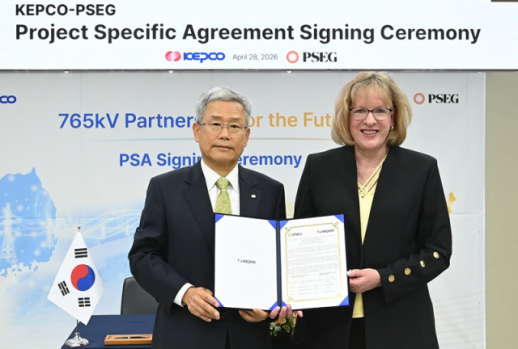 KEPCO Signs 765kV Transmission Technology Cooperation Deal With PSEG Korea Electric Power Corp. said it has partnered with U.S. energy company Public Service Enterprise Group, or PSEG, as it moves to expand into the U.S. extra-high-voltage transmission market. KEPCO said it signed the agreement on April 28 at its Art Center in Seoul’s Yangjae-dong to cooperate on 765-kilovolt transmission projects. The utility said the deal is significant because it represents formal recognition overseas of KEPCO’s capabilities in engineering, procurement and construction, or EPC, for 765kV-class transmission networks, as well as its ability to operate power systems reliably. KEPCO said its long-distance, large-capacity transmission technology and operating experience have helped demonstrate its competitiveness in the U.S. market. KEPCO said it plans to go beyond technical consulting and take a more active role across project development and execution. It said it aims to enter the U.S. power market in earnest by participating directly through equity investment and the establishment of special-purpose companies, or SPCs. KEPCO also said it will work with South Korean equipment makers under a “Team Korea” framework to pursue entry into the U.S. 765kV transmission market. It said the effort is expected to broaden overseas opportunities for South Korea’s power equipment industry and strengthen competitiveness in the global power infrastructure market. KEPCO said it plans to use the extra-high-voltage transmission business as a foothold to gradually expand cooperation in new U.S. energy ventures, including an intelligent digital power plant, or IDPP, and an advanced distribution management system, or ADMS. KEPCO President Kim Dong-cheol said the agreement “served as an opportunity for KEPCO’s 765kV EPC and operational capabilities to be validated in the global market.” He added, “As a responsible public enterprise, we will continue to expand our entry into the U.S. power market in various ways, including equity investment, in cooperation with domestic companies.”* This article has been translated by AI. 2026-04-28 14:17:12
 -
 TY Life, Hyundai Marine & Fire and My Financial Partner sign MOU to expand insurance-linked lifecare TY Life (Taeyang Life), Hyundai Marine & Fire Insurance and My Financial Partner have signed a memorandum of understanding aimed at expanding insurance-linked lifecare services, the companies said. They described the deal as a structural cooperation model that goes beyond a simple partnership, seeking to combine each firm’s customer touchpoints and product strengths into an integrated service system spanning a customer’s life cycle. The companies said the agreement centers on expanding product portfolios and diversifying sales channels. TY Life, which has broadened beyond funeral-ceremony services into health care, welfare and leisure, is expected to strengthen a “total lifecare” structure by pairing its services with insurance products. The companies said insurance focuses on protection against risks such as accidents and illness, while mutual-aid and lifecare services extend from daily life and old age through funerals, allowing a longer customer relationship when combined. For My Financial Partner and Hyundai Marine & Fire, the companies said the cooperation could help attract new customers and widen distribution. My Financial Partner, a corporate insurance agency organization, said it specializes in tailored insurance planning; adding lifecare services could shift it beyond straightforward policy sales toward a more consultative model. Hyundai Marine & Fire would also gain access to a new customer base in the mutual-aid and lifecare market, the companies said. The companies linked the deal to a broader push across finance and services to build “lifecare platforms” that move beyond single-product sales and address a range of needs over a customer’s lifetime. They cited demographic changes such as population aging, growth in one-person households and rising demand for health management as factors increasing demand for combined insurance and lifecare offerings. They also pointed to the potential for data-driven expansion. By combining insurance usage data with lifecare service data, the companies said they could more precisely analyze customer patterns and risk factors, enabling more customized product design and service recommendations and supporting more personalized services tied to digital transformation. TY Life said it has built a stable customer management system based on 22 years of experience operating mutual-aid services and has recently pursued a platform shift by expanding across lifecare. My Financial Partner is a Hyundai Marine & Fire subsidiary with face-to-face sales strength through a professional planner organization, while Hyundai Marine & Fire brings product development and risk management capabilities built in South Korea’s non-life insurance market, the companies said. The three companies said they may expand cooperation in stages, including joint product development, integrated service packages and joint marketing. Industry observers said that if the model takes hold, it could become an example of broader convergence across insurance, mutual-aid services and health care. The companies said the MOU is intended not only to boost near-term sales but also to build an integrated service structure connecting customers across their life cycle and to lower barriers between industries, signaling potential growth in similar partnerships.* This article has been translated by AI. 2026-04-28 14:16:23
 -
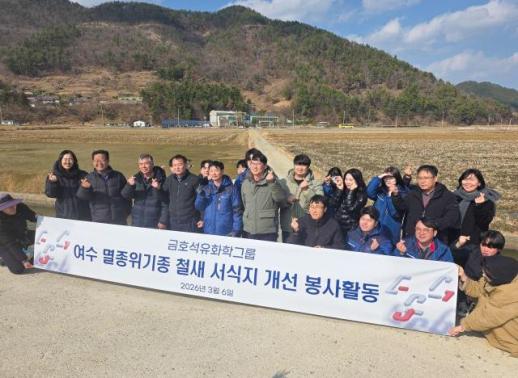 Kumho Petrochemical to Restore Migratory Bird Habitat in Yeosu Wetland Project Kumho Petrochemical Group said it is launching a habitat restoration project in Yeosu, South Jeolla Province, aimed at protecting biodiversity and supporting climate response efforts. The group said April 28 it will begin a project to improve habitat for endangered migratory birds. Five affiliates will participate: Kumho Petrochemical, Kumho P&B Chemicals, Kumho Mitsui Chemicals, Kumho Polychem and Kumho T&L. Working with Thanks Carbon, the group will invest a total of 260 million won over the next three years to create wetlands by flooding farmland near the Gasari Eco Park. The area will expand in phases, from about 1,200 pyeong in the first year to 2,400 pyeong in the second and 3,400 pyeong in the third. The Yeosu area, near the Suncheon Bay wetland, has served as a key stopover and wintering site for migratory birds. The group said industrialization and development have reduced farmland and worsened habitat conditions. Its plan is to restore winter habitat by creating flooded rice paddies on farmland during the off-season. Flooded paddies can support a range of species and are also known for storing carbon in soil, the group said. It plans to monitor bird numbers and environmental changes using unmanned sensor cameras and to develop management strategies based on the data. Local farmers will take part as operators. The group said nearby farms are supplying feed such as rice seed and sweet potatoes once a week during winter. In March, Kumho Petrochemical employees joined on-site activities, it said. Baek Jong-hoon, CEO of Kumho Petrochemical, said, “Preserving Yeosu’s ecological value and protecting biodiversity is a responsibility for a company that has grown with the local community.” He added, “We will continue sincere efforts to deepen our ESG management.” Separately, the company said employees raised 210 plants of the Jeju native species ‘pachoil-yeop,’ a Class II endangered wild plant, for nine months and planted them near their natural habitat at the Kumho Jeju Resort. 2026-04-28 14:15:18
 -
 Iran Nears Oil Storage Limit Under U.S. Pressure, May Face More Output Cuts Iran is rapidly running out of crude oil storage capacity under U.S. economic pressure, raising the likelihood of additional production cuts, analysts said. Bloomberg reported on April 27, citing commodities analytics firm Kpler, that Iran has only about 12 to 22 days of usable crude storage remaining. Kpler said shrinking storage could push Iran to cut output by as much as 1.5 million barrels a day by mid-May. Goldman Sachs has previously assessed that Iran has already reduced crude production by up to 2.5 million barrels per day. Iran’s crude exports have fallen sharply since a U.S. maritime blockade, Kpler said. Recent exports were about 567,000 barrels a day, down from a March average of about 1.85 million barrels a day. Crude loadings have also dropped about 70% since the blockade, it said. Even with lower production, the fiscal hit is expected to arrive with a lag. It takes about two months for Iranian crude to reach Chinese ports, its main destination, and payments take additional time, meaning the impact of reduced revenue is expected to become more pronounced in about three to four months. Iran is expanding stopgap measures to keep production going, The Wall Street Journal reported. With crude piling up at home, Iran has restarted disused storage tanks in poor condition and is using temporary facilities such as containers. The steps are seen as aimed at easing infrastructure strain and reducing U.S. pressure amid tensions around the Strait of Hormuz. Sanam Vakil, director of the Middle East and North Africa program at the U.K. think tank Chatham House, said Iran is trying to avoid shutting in production and deepening revenue losses. “A production shutdown would increase pressure and encourage negotiations,” she said. Iran is also turning to rail transport, a method typically avoided because it is less profitable and efficient. A spokesperson for the Iran Petroleum Exporters Association said Iran is pursuing a plan to ship crude to China by rail. Erica Downs, an energy policy expert at Columbia University, said it is unclear whether small Chinese refineries will absorb higher rail costs, calling it “a measure born of desperation.”* This article has been translated by AI. 2026-04-28 14:12:05