
Journalist

Tom Stacey
-
 Record 34 listed firms post over 1 trillion won in operating profit last year, report finds SEOUL, April 15 (AJP) - South Korea's top 1,000 listed companies saw their operating profits increase sharply last year, reaching the highest level since 2000, according to a report released by the Korea CXO Institute on Wednesday. Their combined operating profit stood at 189.23 trillion Korean won (about US$126.15 billion), up more than 40 trillion won or 27.7 percent, from 148.28 trillion won a year earlier, as the number of companies posting over 1 trillion won in operating profit hit a record 34. Some nine firms including Hanwha Ocean, HD Hyundai Heavy Industries, KT and SK Innovation, were newly added, while four companies including POSCO Holdings and SK Telecom dropped off the list. In particular, seven companies saw operating profit grow by more than 100 percent, with SK Innovation posting a 453.5 percent rise and Hanwha Ocean climbing 447.5 percent. The overall increase was largely led by improved results at SK hynix and Samsung Electronics. Excluding these two semiconductor giants, operating profits for the rest also rose 6.6 percent from a year earlier. Buoyed by both revenue and operating profit hitting record highs, their average operating margin came in at around 9 percent, marking only the third time it has reached that level, after 2004 and 2018. By company, SK hynix kept the No. 1 spot in operating profit for a second straight year, posting 44 trillion won, up from 21.33 trillion won a year earlier. The memory chip maker also ranked first in net profit for the first time with 42.69 trillion won, surpassing rival Samsung Electronics' 33.69 trillion won. "The combined operating profit of the top 1,000 listed companies is expected to exceed 200 trillion won this year as Samsung Electronics and SK hynix are projected to post 'record-high' operating profits," said Oh Il-seon, head of the corporate tracker. The figures were compiled based on their annual revenues from 2000 to 2025 and other financial data. 2026-04-15 16:41:39
 -
 Actress Moon Chae-won to Marry in June, Agency Says Actress Moon Chae-won has announced plans to marry. On 15일, her agency, Blitzway Entertainment, said Moon will hold her wedding in June and that her fiance is not a celebrity. The agency said the ceremony will be private, attended only by family and close relatives, and asked for warm congratulations as Moon begins a new chapter. Moon has discussed her ideal partner in past interviews. She said she dislikes people who lie and added that she would prefer someone who does not use social media. She also said she feels more comfortable with an introverted person than an outgoing one. In an interview after the January release of her starring film, "Heartman," Moon responded to a question about marriage by saying it is not something she can plan and that it would likely require a certain amount of fate. Moon debuted in 2007 in the SBS series "Run! Mackerel" and has played leading roles in dramas and films including "Painter of the Wind," "Shining Inheritance," "Good Doctor," "Flower of Evil," "Payback," "War of the Arrows," and "Feng Shui."* This article has been translated by AI. 2026-04-15 16:24:18
 -
 March COFIX for New Loans Slips to 2.81%, Easing Some Variable Mortgage Rates The COFIX (Cost of Funds Index), a key benchmark for variable-rate mortgage loans at South Korean banks, fell back into decline after a one-month rise. The Korea Federation of Banks said Tuesday that the March COFIX based on new loan issuance came to 2.81%, down 0.01 percentage point from the previous month. The index had dropped in January for the first time in five months, falling 0.12 percentage point, then turned higher in February before easing again in March. Over the same period, the COFIX based on outstanding balances held steady at 2.85%, while the “new outstanding balance” COFIX slipped 0.02 percentage point to 2.45%. COFIX is the weighted average interest rate of funds raised by eight domestic banks. It moves up or down as rates on major funding products such as deposits and bank bonds rise or fall. The federation said the new-loan COFIX reflects market-rate changes more quickly because it is calculated using funds newly raised during the month. It advised borrowers seeking COFIX-linked loans to fully understand how market-rate shifts affect the index before choosing a loan product. Commercial banks are set to apply the newly announced COFIX to variable rates on new mortgage loans starting Wednesday. At KB Kookmin Bank, the six-month variable mortgage rate tied to the new-loan COFIX will fall 0.01 percentage point to 3.98% to 5.38% from 3.99% to 5.39%. Under the same benchmark, the rate on jeonse deposit loans backed by the Korea Housing Finance Corp. will also edge down to 3.74% to 5.14% from 3.75% to 5.15%. At Woori Bank, the six-month variable mortgage rate tied to the new-loan COFIX will drop to 3.79% to 5.39% from 3.80% to 5.40%.* This article has been translated by AI. 2026-04-15 15:51:29
 -
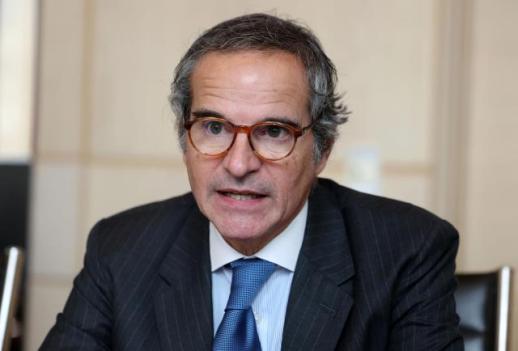 IAEA urges safeguard on Korea's nuclear submarine plan, verification on Iran SEOUL, April 15 (AJP) - South Korea must enter into a special safeguards arrangement with the International Atomic Energy Agency (IAEA) if it proceeds with nuclear-powered submarines to ensure that nuclear material is not diverted from propulsion use, its director general said Wednesday. “The use of nuclear technology to power submarines has a number of very important technical implications,” IAEA Director General Rafael Grossi said at a press briefing in Seoul, describing the visit as a “kickoff” for discussions with Seoul on its naval nuclear propulsion plans. As a signatory to the Nuclear Non-Proliferation Treaty (NPT), South Korea is subject to IAEA safeguards. However, Grossi noted that nuclear-powered submarines pose a unique challenge because fuel loaded into vessels on long missions falls outside routine inspections. “Because of the nature of these vessels, the nuclear material is not continuously accessible to inspectors,” he said, warning that large quantities of enriched uranium — potentially even highly enriched uranium — could remain outside direct oversight for extended periods. To address this, Grossi stressed the need for a tailored verification system between the IAEA and South Korea to ensure that nuclear material is not diverted for military purposes beyond propulsion. “We need technically sound arrangements so we can verify that the material remains where it is and is used only for propulsion,” he said, adding that such frameworks are being developed with countries including Australia and Brazil. He emphasized that “ironclad guarantees” are essential to ensure the program does not contribute to nuclear proliferation, noting that the process would involve coordination across government, military and shipbuilding sectors. Grossi also cautioned that developing nuclear-powered submarines is a long-term undertaking, likely to take many years, involving extensive research, construction and testing phases. On Iran, Grossi said the country has already mastered uranium enrichment technology and currently possesses roughly 440 kilograms of uranium enriched up to 60 percent, with most of the stockpile located at known sites such as Isfahan. He described any potential suspension of enrichment as a “political decision,” noting that the duration of a moratorium — whether five, 10 or 20 years — carries little technical difference but reflects levels of political trust. More importantly, he stressed that any nuclear agreement must include rigorous verification. “Without verification, any agreement is just a piece of paper,” Grossi said. “We must be able to check every gram of nuclear material and how it is used.” Turning to North Korea, Grossi said the IAEA has observed a continued expansion of nuclear activities, including operations at Nyongbyon and other facilities, despite the absence of inspectors since 2009. Recent assessments indicate a “significant increase” in Pyongyang’s nuclear capabilities, with estimates suggesting the country may have material sufficient for dozens of nuclear warheads. While there is no clear evidence of Russian military nuclear assistance, he said current cooperation between Moscow and Pyongyang appears limited to civilian nuclear projects. Grossi reiterated that pursuing nuclear weapons does not enhance national security, warning instead that it risks triggering a broader arms race. “Moving toward nuclear weapons would not give any country greater security,” he said. “It would encourage others to follow, leading to dangerous escalation.” Grossi also addressed his candidacy for the next United Nations secretary-general, highlighting what he described as a deepening crisis of confidence in the global body. “The world is going through a very difficult period marked by polarization and multiple conflicts,” he said, calling the upcoming leadership transition a critical moment to restore trust in multilateral institutions 2026-04-15 15:44:43
 -
 South Korea secures additional crude oil, naphtha through alternative routes SEOUL, April 15 (AJP) - South Korea has secured 273 million barrels of crude oil by the end of this year, presidential chief of staff Kang Hoon-sik said on Wednesday. At a press briefing at Cheong Wa Dae in Seoul, Kang, who just returned from a weeklong trip to Kazakhstan, Oman, Qatar and Saudi Arabia, said the country has reached a deal to secure additional crude oil, including up to 2.1 million tons of naphtha, by the end of this year. "Compared to consumption levels last year, the 273 million barrels of crude oil are sufficient to sustain more than three months without any additional emergency measures, and 2.1 million tons of naphtha are equivalent to about one month's supply," Kang said. "The procurement of additional crude oil and naphtha will be imported through alternative routes that would not be affected by whether the Strait of Hormuz is closed or reopened," he said, adding, "We expect this to help stabilize domestic supply and prevent supply disruptions." He also revealed that there were discussions about a plan to establish oil storage facilities outside the strait, a critical chokepoint for roughly one-fifth of the world's oil supply, to ensure a more secure supply chain. 2026-04-15 15:26:35
 -
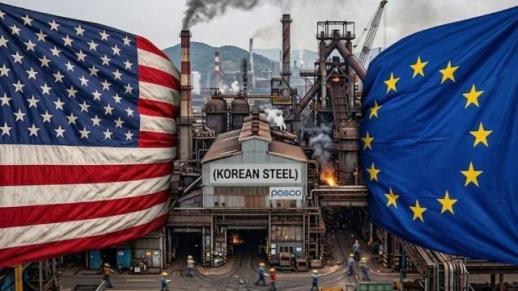 Double tariff whammy hits Korean steel as EU barriers pile on top of U.S. tariffs SEOUL, April 15 (AJP) - When it rains, it pours for South Korean steelmakers as they face collateral damage from higher trade tariffs in Europe on top of U.S. duties aimed at curbing cheap Chinese imports. The European Parliament and the Council of the EU hammered out a deal on Monday (local time) after late-night negotiations, setting tariff-free quotas at 18.3 million tons per year — nearly halved from about 35 million tons permitted under the current safeguard regime. Imports exceeding the cap will face a 50 percent duty, up from 25 percent. The measures, pending formal endorsement and a plenary vote expected in May, are set to take effect on July 1. The agreement also introduces a "melt and pour" traceability rule requiring importers to prove where raw steel was first smelted and cast — a provision targeting steel from overcapacity countries, chiefly China, routed through third-party processing. "We cannot afford to turn a blind eye to global overcapacity reaching critical levels," said EU Trade Commissioner Maros Sefcovic. Global steel overcapacity is projected to reach 721 million tons by 2027, more than five times the EU's annual consumption. Whether the target is primarily China, the blow nevertheless falls hard on South Korea. The EU bought $3.71 billion worth of South Korean steel in 2025, making it the country's largest export market — down from $4.48 billion in 2024, according to the Korea International Trade Association. South Korea shipped about 3.31 million tons to the bloc last year, of which about 2.58 million tons entered duty-free under country-specific quotas. EU posed as relief to the U.S. that has been imposing 50 percent levies on steel and aluminum imports from June last year. The new EU framework resets baseline quotas to 2013 import levels — well before the global oversupply cycle intensified — meaning Seoul's allocation is expected to shrink significantly. Korean steelmakers are still reeling from the U.S. blow. POSCO and Hyundai Steel, the country's two dominant producers, are estimated to have paid a combined $281 million in U.S. tariffs between March and December 2025. Korean steel exports to the United States have since plummeted after tariffs were doubled to 50 percent in June, with demand described by industry sources as "nearly depleted." The pressure compounds a longer-running squeeze from cheap Chinese steel flooding global markets. At home, Hyundai Steel ran two rounds of early retirement programs in 2025 and permanently closed half of its rebar capacity at its Incheon plant in January, shuttering a 90-ton electric furnace as the domestic construction slump deepened. In November 2025, the National Assembly passed the K-Steel Act, a 570 billion won support package to fund industry restructuring and bolster exports. But with the EU now confirming the tariff overhaul that had been under discussion since last October, pressure on Seoul to secure favorable quota terms has intensified. "Korean steel exports to the EU were already constrained within existing quotas, with limited room to expand," said Lee Jae-yoon, senior research associate at the Korea Institute for Industrial Economics and Trade. "With the U.S. market effectively shut and domestic demand still weak, the EU should have been a growth outlet — but these new protective measures, combined with the EU Carbon Border Adjustment Mechanism, are closing that window." The double tariff squeeze has nonetheless forced a strategic pivot toward the United States. POSCO acquired a 20 percent stake worth $582 million in Hyundai Steel's planned $5.8 billion electric arc furnace mill in Louisiana, with commercial production expected in 2029. POSCO has also signed a strategic partnership memorandum with Cleveland-Cliffs, the second-largest U.S. crude steel producer, though the company said in a March regulatory filing that no final decision on equity participation or investment size has been reached. The EU's move is driven by a broader structural strain. European steel capacity has shrunk by 65 million tons since 2007, with about half of that loss since 2018. The sector operates at around 67 percent capacity — well below the 80 percent considered healthy — while import penetration hit a record 29 percent in the third quarter of 2025. Lee said Korean steelmakers will ultimately need to pivot toward green steel to navigate the tightening trade environment. Building production facilities in Europe — unlike in the United States — holds little commercial appeal, given the continent's own supply glut. "The U.S. offers higher prices, high energy costs that keep out cheap imports, and insufficient domestic capacity — making it attractive for investment," Lee said. "Europe is the opposite. It already has overcapacity, so there is little merit in setting up local production just to avoid tariffs." The Korean government is also moving to cushion the blow. Seoul has been in continuous contact with Brussels since the European Commission first unveiled the proposal in October, and has maintained those channels since Monday's agreement. "We have been in constant dialogue with the EU since the initial proposal, and remain in close contact regarding the steel tariff and quota framework. No tangible agreement on Korea's specific allocation has been reached yet," a spokesperson for the Ministry of Trade, Industry and Energy said. 2026-04-15 14:36:45
 -
 American YouTuber gets 6 months in prison over multiple bizarre offenses SEOUL, April 15 (AJP) - American YouTuber Johnny Somali, who stirred controversy with a series of bizarre behaviors including insulting a statue in central Seoul symbolizing victims of Japan's wartime sexual slavery, was sentenced to a prison term on Tuesday. The Seoul Western District Court handed down a six-month prison term along with 20 days of detention to Somali, whose real name is Ramsey Khalid Ismael, on charges including obstruction of business and the distribution of false information through graphic photos and provocative images. The court also banned him from being hired by institutions related to children, adolescents, and people with disabilities for five years. Wednesday's ruling came after prosecutors in February sought a three-year prison sentence for his offenses including kissing the statue, causing disturbances on public buses and subways, and streaming obscene videos online in 2024, among others. "He was found guilty of all charges," the court said, adding that he repeatedly committed crimes for personal profit through online platforms, calling them as a "serious disregard for South Korean law and order." The court, however, exercised some leniency in its sentencing, taking into consideration that he had been unable to return to his home country for an extended period under a travel ban. Somali told the court that he regretted his actions and wanted to apologize to the South Korean public. 2026-04-15 14:28:32
 -
 International Symposium to Reassess Video Art Pioneer Nam June Paik Marks 20th Anniversary of Death Korea Arts Council (ARKO) and the Nam June Paik Art Center will jointly host an international academic symposium, “Paik After Paik,” on April 23 at the ARKO Arts Theater Grand Theater in Seoul, ARKO said Tuesday. The event marks the 20th anniversary of the death of video art pioneer Nam June Paik (1932-2006). Nine leading researchers from South Korea and abroad will review the state of Paik scholarship built over the past 60 years and discuss how his legacy can be reinterpreted within contemporary debates on art, technology and culture. Organizers said the symposium approaches Paik not as a closed historical subject but as a field of inquiry that continues to be reshaped within today’s technological environment and systems of knowledge. The program includes a keynote address, two sessions and a panel discussion. The keynote will be delivered by Hannah Higgins, a professor at the University of Illinois Chicago, who will revisit Paik’s experiments in the 1960s by linking them to conditions of learning and knowledge production in the age of artificial intelligence. Session 1, “The Structural Terrain of Paik Studies,” will examine research methods and institutional foundations with a focus on curatorial practice, media theory and archives. Participants are Lee Sook-Kyung, director of the Whitworth at the University of Manchester in the U.K.; Lev Manovich, distinguished professor at the CUNY Graduate Center; Hannah Fajersztajn, collection coordinator for the Nam June Paik Archive at the Smithsonian American Art Museum; and art historian Son Boo-kyung. Session 2 will broaden discussion by connecting Paik to 21st-century themes including data science, machines and labor, posthumanism and transnational cultural practice. Participants are Woo Jung-a, a professor at Pohang University of Science and Technology; Douglas Barrett, an assistant professor at Syracuse University; Lee Hyun-ae, an academic research professor at Chung-Ang University; and Jun Okada, an associate professor at Emerson College. ARKO and the Nam June Paik Art Center said the symposium aims to build an international research network linking scholars, arts institutions and archives. It is their first joint academic project under a memorandum of understanding signed in December 2025, and organizers said it will serve as a starting point for cooperation including archival research, journal publication and international researcher exchanges. ARKO Chairman Chung Byung-kuk said he hopes the symposium, through cooperation with the Nam June Paik Art Center, will help expand Paik research. “ARKO will continue to support efforts to invigorate discourse in the visual arts,” he said. Park Nam-hee, director of the Nam June Paik Art Center, said the symposium will review accumulated scholarship and rethink it in light of contemporary technological environments and conditions of knowledge. She said she hopes it will encourage audiences to see Paik not only as a historical figure but as an open subject of research shaping the present and future. The symposium is free and open to the public, with advance reservations recommended. More information is available on the ARKO and Nam June Paik Art Center websites. * This article has been translated by AI. 2026-04-15 14:27:25
 -
 Korean Films ‘Hope,’ ‘Colony’ and ‘Dora’ Invited to Cannes as Park Chan-wook Named Jury President Despite the box-office success of the film 'The Man Who Lives With the King,' the broader Korean film industry remains under strain. Against that backdrop, three Korean films — 'Hope,' 'Colony' and 'Dora' — were invited to the 79th Cannes Film Festival, and director Park Chan-wook was appointed president of the competition jury. The most prominent selection is director Na Hong-jin’s 'Hope.' Cannes included the film in its competition lineup, announced April 9 as part of the festival’s official selection. The competition section is Cannes’ centerpiece, bringing together the year’s most closely watched films. It is Na’s first time in Cannes’ main competition. Since his debut with 'The Chaser,' he has maintained ties with the festival through films including 'The Yellow Sea' and 'The Wailing.' The new film also marks his first release in 10 years since 'The Wailing,' adding weight to its competition berth. Director Yeon Sang-ho’s 'Colony' was also invited, landing in the Midnight Screenings section. That program spotlights genre films — including action, thriller, horror, noir and fantasy — that combine craft with broad appeal. Yeon has been selected by Cannes again following 'The King of Pigs,' 'Train to Busan' and 'Peninsula.' Another Korean entry is director Jung Joo-ri’s 'Dora,' invited to the Directors’ Fortnight. The Fortnight’s organizing committee announced the selection on April 14. The noncompetitive section, founded by the French Directors Guild, is known for highlighting distinctive new voices. Artistic director Julien Rejl described 'Dora' as a free and original film inspired by Freud’s early 20th-century “Dora” case, exploring a young woman’s desire — and the passion and confusion that follow — within the context of Korean cinema. Jung’s debut feature 'A Girl at My Door' was invited to Cannes’ Un Certain Regard in 2014, and 'Next Sohee' was selected as the 2022 Critics’ Week closing film. With 'Dora,' all three of her feature films have been invited to Cannes. 'Dora' follows two wounded characters as they are swept into a complex emotional spiral. The film has drawn attention for pairing singer-actor Kim Do-yeon with Japanese actor Sakura Ando. It is an international co-production that received investment and production support from France, Luxembourg and Japan. Park’s appointment further underscores Korea’s presence at this year’s festival. Cannes named Park president of the 79th competition jury, saying it is the first time a Korean has held the post. Park has long been associated with Cannes through films including 'Oldboy,' 'Thirst' and 'Decision to Leave.' Having attended Cannes as an award winner, a competition director and a juror, he will now lead the panel that decides the top prizes. The Cannes invitations alone are unlikely to resolve the industry’s difficulties. Still, as the downturn continues, the festival’s renewed attention to Korean films is being welcomed, and this year’s lineup is expected to prompt a fresh look at where Korean cinema stands now.* This article has been translated by AI. 2026-04-15 14:21:27
 -
 Seo Dong-ju Shares Feelings After Missed Miscarriage Surgery Broadcaster Seo Dong-ju has spoken publicly about how she has been coping after a missed miscarriage. On April 14, Seo posted a video titled “How Seo Dong-ju Heals Grief Through Drawing” on her YouTube channel, “Seo Dong-ju’s Tto.Do.Dong.” In the video, Seo said it had been four days since she underwent a curettage procedure and that she was doing well. “After a few days, I feel a lot better,” she said, adding that she cried less than she expected and has been improving as each day passes. Seo said she is now in a stable condition. “After going through it, it wasn’t a big deal,” she said. “If anyone is in a similar situation, I hope you don’t worry too much. With time, you can endure it, and you’ll be OK.” She said she did not want to spend too long crying or holding on to negative energy. Seo said she had spent the past two months eating well and trying to keep positive thoughts, and she did not want that effort to go to waste. With her next cycle approaching, Seo said she worried that sinking into sadness could harm both her physical and mental health. “So I tried, no matter what, to keep myself enjoying life,” she said, adding that she has been trying to eat even healthier, take walks and get plenty of rest. Her husband said Seo is “mentally very strong,” and that watching her get through it gave him strength. He added that the period had been harder for him than for her. Seo, the daughter of late comedian Seo Se-won and broadcaster Seo Jeong-hee, married a Korean American man in 2010 and divorced in 2014. She remarried in June last year to a non-celebrity man four years younger than her.* This article has been translated by AI. 2026-04-15 14:09:25