

[Yonhap Photo]
SEOUL -- South Korea's jailed ex-president Lee Myung-bak was sentenced to 15 years in prison corruption, embezzlement and other charges, becoming the country's fourth national leader to take a humiliating path.
Lee, who served as president from 2008 to early 2013, was also slapped with a fine of 13 billion won ($11.6 million) and a forfeit of 8.2 billion won. He boycotted Friday's session after a criminal court in Seoul allowed live TV coverage.
Lee has asserted his innocence, arguing prosecutors brought charges based on unreliable evidence, but he was found guilty of embezzling a company fund of 24.6 billion won and taking bribes from Samsung Electronics and others.
"Serious punishment is inevitable," the court said, scolding Lee for shifting his responsibility to others and denying all of the crimes he has committed, even if there are credible statements from people concerned and objective evidence.
Lee has insisted he has never received bribes during his five-year tenure or used his position to pursue private interests, describing himself as the victim of political retaliation for the death of his predecessor, Roh Moo-hyun, who threw himself off a mountain cliff in 2009 following a humiliating probe into alleged corruption involving his family.
At the center of debate has been DAS, an auto parts supplier for Hyundai Motor. The court sided with prosecutors, saying Lee is the real owner of DAS and used it to create a slush fund. The ex-president has insisted the company was owned and managed by his brother.
The court ruled that Lee took bribes in return for favors that included $5.2 million from Samsung as well an illegal payment from South Korea's spy agency.
Lee's successor, Park Geun-hye, should stay in prison for a total of 33 years for her role in a massive corruption scandal that revealed deep-rooted collusive ties between businessmen and politicians.

Copyright ⓒ Aju Press All rights reserved.
Related News
-
 Unification Minister Jeong Dong-young Calls UN Command's Restrictions on DMZ Access Serious Issue
Unification Minister Jeong Dong-young announced on October 27 that he would push for the normalization of access to the Gyeongui Line North-South Access Office's exhibition hall. He criticized the United Nations Command for strictly limiting access to the Demilitarized Zone (DMZ) not only for military matters but also for non-military areas such as forest, ecological, and cultural heritage investigations, calling it a "serious issue." During a comprehensive audit at the National Assembly's Foreign Affairs and Unification Committee, Jeong stated that the Ministry of Unification is not participating in discussions between the Ministry of National Defense and the UN Command regarding the military demarcation line (MDL) baseline. However, the ministry is involved in a separate intergovernmental task force that discusses various issues within the DMZ. In response to a question from Lee Jae-gang, a member of the Democratic Party, about whether he would pursue the normalization of access to the exhibition hall, Jeong replied, "The UN Command and the Ministry of National Defense will closely coordinate, and the Ministry of Unification will also participate." Earlier, the UN Command requested that access to the exhibition hall operated by the Ministry of Unification be granted only after prior approval in March. In April, it demanded restrictions on the number of visitors and the installation of closed-circuit television and fencing, citing that part of the parking lot on the exhibition hall site is located north of the southern limit line, thus falling within the DMZ. Jeong explained, "When the Gyeongui Line Access Office and the entry gate were constructed in 2003, the exhibition hall was built separately. The UN Command raised concerns about the parking lot area being north of the southern limit line, and we are currently in close discussions." He emphasized that the exhibition hall is a facility for the 4,000 to 5,000 policy visitors who annually visit the Gyeongui Line Access Office to view the exhibits, describing it as a "non-military purpose facility." Lee criticized the UN Command for not approving visits to the DMZ by journalists and religious figures while responding passively to North Korea's installation of barbed wire and landmines around the MDL, calling it a "double standard." Jeong noted that investigations by the Korea Forest Service into forest conditions, the Ministry of Environment's climate and ecological studies, the Cultural Heritage Administration's cultural heritage investigations, and the Ministry of Unification's research on disappeared villages have been strictly limited since 2024. He added that the Korea Forest Service's request for an investigation this year was also denied. He stated, "Applying strict jurisdiction over the DMZ to forestry, environmental, cultural, and academic fields is a serious issue," and expressed that he believes the UN Command's previous flexible approach to investigations into forests, climate, and cultural heritage was appropriate. Regarding the transfer of wartime operational control, Jeong argued that the focus should be on establishing a timeline rather than meeting conditions. In response to a question from Park Sung-jun of the Democratic Party, he said, "The transfer of operational control was initially prepared with a specific timeline, but the Lee Myung-bak administration extended the timeline, and the Park Geun-hye administration changed it to a conditional basis. Military capabilities and readiness against nuclear and missile threats, as well as the security environment, are conditions that are perpetually difficult to meet." He emphasized the need to seriously reconsider the approach taken during the Roh Moo-hyun administration, which specified a timeline. Jeong also expressed support for the need to expand the Ministry of Unification's overseas representatives. In response to a suggestion from Kim Young-ho of the Democratic Party to dispatch officials to countries like Sweden, Vietnam, and Cuba that have connections with North Korea, he stated, "It is necessary for the Ministry of Unification to have representatives in Southeast Asian countries that can serve as points of contact with North Korea, such as Sweden, which operates a special envoy to North Korea." On the issue of damage compensation lawsuits regarding South Korean facilities, such as the Mount Kumgang fire station that North Korea demolished in 2024, Jeong maintained a cautious stance. During the audit, Kim Gun of the People Power Party pointed out that a legal review received by the Ministry of Unification indicated that "preservation measures for the right to claim damages should be taken before the statute of limitations expires, and the most certain method is to file a lawsuit," urging a review of existing policies. In response, Jeong stated, "From a practical standpoint, extending the statute of limitations is more important than filing a lawsuit," adding that securing the statute through measures such as payment notices, publication in the official gazette, and public notification is a priority. He concluded by stating, "Ultimately, we must resolve the issue through dialogue." * This article has been translated by AI.
-
 OP-Ed: A Century of archaeological friendship
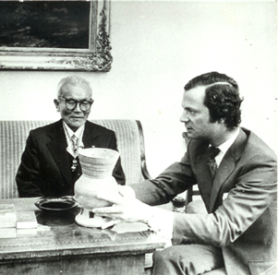
Choe Chong-pil, professor of archaeology at Sejong University and son of Choe Nam-ju, explains to King Carl XVI Gustaf of Sweden the history of the late King Gustaf VI Adolf’s excavation at the ancient Seobong Tomb in Gyeongju on November 17, 1994. Courtesy of Choe Chong-dae Editor's Note: The following opinion article is contributed by Choe Chong-dae, a longstanding member of the Royal Asiatic Society Korea and an enthusiast of international cultural and historical affairs. October 10, 2026, marks the centennial of a truly historic event: the excavation of the Seobongchong (Seobong Tomb) golden crown in Gyeongju. In October 1926, a remarkable encounter between European royalty and East Asian antiquity unfolded in the ancient city of Gyeongju. Swedish Crown Prince Gustaf Adolf — who would later become King Gustaf VI Adolf — visited Korea with his wife, Princess Louise, as part of an extensive tour of East Asian archaeological sites. His journey was far more than a diplomatic formality. He took a direct interest in the excavation of an ancient Silla tomb and witnessed the discovery of one of Korea’s most remarkable golden crowns. The Crown Prince participated in the excavation of the Silla-era tomb, where a spectacular golden crown was unearthed. He reportedly remarked that the thrill of such a discovery “surpasses becoming king.” Choe Nam-ju explains Silla pottery to King Carl XVI Gustaf of Sweden at the Royal Palace in Stockholm in April 1975. Courtesy of Choe Chong-dae. The excavation involved Korean figures including Choe Nam-ju, then a young aspiring archaeologist who witnessed the historic discovery. The tomb was subsequently named Seobongchong (瑞鳳塚). The first character, Seo (瑞), was associated with Sweden, while Bong (鳳) referred to the phoenix ornament on the golden crown and chong (塚) mean tomb. A century later, Gustaf VI Adolf is remembered not merely as a visiting royal, but as a dedicated scholar whose passion for archaeology helped create a remarkable bridge between Sweden and Korea through their shared appreciation of cultural heritage. The Silla golden crowns have since become icons of Korean cultural identity, while the 1926 excavation remains a lasting reminder that the study and preservation of human history can transcend borders, titles and time. As we commemorate this centennial, we remember Gustaf VI Adolf — grandfather of Sweden’s current monarch, King Carl XVI Gustaf — not simply as a royal visitor, but as a scholar with a genuine passion for archaeology. His experience in Gyeongju led to a lifelong connection with Choe Nam-ju and, through him, with the Choe family. Remarkably, this was not a fleeting encounter. For decades, King Gustaf VI Adolf and his daughter, Princess Ingrid — who later became Queen of Denmark and the mother of Queen Margrethe II — maintained a lasting friendship with Choe Nam-ju and his family through personal correspondence. This enduring relationship, rooted in their shared experience of the 1926 excavation, illustrates how cultural and intellectual ties can develop into friendships that transcend borders, social standing and generations. Queen Margrethe II of Denmark made a state visit to Korea from October 8 to 12, 2007. During the visit, she had planned to visit the Seobong Tomb in Gyeongju under the guidance of Choe Nam-ju’s son, but the visit could not take place because of scheduling constraints. On October 9, however, I had the privilege of meeting Queen Margrethe II at a banquet in Seoul hosted by the Danish Ambassador, Poul O. G. Hoiness. The Korea–Sweden connection also acquired a humanitarian dimension after the outbreak of the Korean War in 1950. Sweden, Denmark and Norway demonstrated their solidarity with Korea by providing vital medical assistance. Sweden dispatched medical personnel and established the Swedish Red Cross Field Hospital in Busan, the first non-American and non-Korean medical unit to operate during the war. Together with Norway’s Mobile Army Surgical Hospital and Denmark’s hospital ship Jutlandia, the Scandinavian medical missions treated tens of thousands of wounded civilians and soldiers. Their assistance continued after the war through medical expertise and financial support, contributing to the development of medical institutions in Korea, including the hospital that later became the Korean National Medical Center. King Carl XVI Gustaf of Sweden, third from left, and Queen Silvia, second from left, pose with Choe Chong-dae, left, columnist, and Choe Chong-pil, professor of archaeology at Sejong University, during the reopening ceremony of the Museum of Far Eastern Antiquities in Stockholm on September 2, 2004. Courtesy of Choe Chong-dae Following the Korean War Armistice Agreement in 1953, the Military Armistice Commission and the Neutral Nations Supervisory Commission (NNSC) were established under the United Nations Command to help supervise implementation of the agreement. Against this backdrop, the personal connection between Sweden and my father continued. Swedish doctors who had served at the Swedish Red Cross Field Hospital in Busan conveyed the warm regards of King Gustaf VI Adolf to Choe Nam-ju. In the mid-1950s, Swedish members of the NNSC delegation stationed at Panmunjom also paid a courtesy visit to my father’s home in Gyeongju and conveyed the King’s greetings. A Swiss NNSC delegation subsequently visited him as well. Remarkably, Choe Nam-ju forged a profound professional and personal bond with King Gustaf VI Adolf despite their vastly different social backgrounds, and long before official diplomatic relations were established between Korea and Sweden. Whenever a Korean ambassador presented his credentials in Stockholm, the King reportedly recalled his excavation experience in Gyeongju with Choe Nam-ju. This relatioship became so well known that incoming Korean ambassadors would customarily pay a courtesy call on Choe in Gyeongju. In 1973, King Gustaf VI Adolf extended an invitation to Choe Nam-ju to visit Sweden, recalling their remarkable experience at the Seobong Tomb excavation in Gyeongju. Tragically, the invitation came only months before the King’s death later that year. Following his death, his grandson, Carl XVI Gustaf, succeeded him as King of Sweden. The relationship between the Swedish royal family and the Choe family, however, did not end with the passing of Gustaf VI Adolf. In 1975, Choe Nam-ju accepted an invitation to visit Sweden from King Carl XVI Gustaf. During the visit, he had the honor of meeting the new King at the Royal Palace in Stockholm, as well as Swedish government officials and members of the public. The visit further strengthened the people-to-people diplomacy that had begun with the 1926 excavation. While in Sweden, Choe Nam-ju also paid his respects at the tomb of the late King Gustaf VI Adolf, accompanied by Jang Sang-moon, the Korean ambassador to Sweden. Throughout the remainder of his life, my father remained wholeheartedly committed to promoting cultural exchange between Korea and Sweden. He continued this work until his passing in 1980. At the welcoming dinner for the King and Queen of Sweden, hosted by the President of Korea at the Blue House on the evening of May 30, 2012, Choe Chong-dae greets President Lee Myung-bak, while his brother, Choe Chong-pil, converses with Swedish King Carl XVI Gustaf, courtesy of Choe Chong-dae The relationship continued into the next generation. In 1994, King Carl XVI Gustaf visited the Seobong Tomb site in Gyeongju and planted a commemorative tree. During the visit, he was accompanied by my brother, Choe Chong-pil, then a professor of archaeology at Sejong University, who explained to the King the history of the excavation and its significance. Together, they also observed the evergreen fir tree that had been planted by King Gustaf VI Adolf in the courtyard of the former National Museum of Gyeongju. Another significant milestone came in 2010, when my brother Choe Chong-pil and I were awarded the prestigious Royal Swedish Order of the Polar Star. The honors were presented by Swedish Ambassador to Korea Dr. Lars Vargö at the ambassador’s residence in Seoul on July 23, 2010, on behalf of King Carl XVI Gustaf, in recognition of our efforts to promote Swedish culture and strengthen friendship between Sweden and Korea. This honor came nearly four decades after our father, Choe Nam-ju, received the Royal Swedish Order of Vasa, “Knighthood,” First Class, in 1971. According to Swedish royal records, he was the first person from East Asia to receive this distinction. Thus, three Swedish royal decorations have been bestowed upon members of the Choe family across two generations. These honors represent not merely personal achievements, but recognition of a family’s multigenerational dedication to cultural exchange and friendship between Korea and Sweden, reflecting an honor shared by our entire nation. The family’s connection with Sweden also extended to the Museum of Far Eastern Antiquities in Stockholm. On September 2, 2004, my brother and I attended the reopening ceremony of the museum and had the privilege of an audience with King Carl XVI Gustaf and Queen Silvia. In February 2012, Their Majesties King Carl XVI Gustaf and Queen Silvia attended the inauguration of a new Korean Gallery at the Museum of Far Eastern Antiquities, further underscoring the importance of Korea–Sweden cultural exchange. The Choe family played a role in the establishment of the Korean Gallery and worked closely with the Korean government in support of this important cultural initiative. King Carl XVI Gustaf and Queen Silvia subsequently paid a state visit to Korea at the invitation of President Lee Myung-bak in May 2012. My brother, Dr. Choe Chong-pil, professor of archaeology, and I were honored to attend the welcoming dinner hosted by the President at the Blue House on May 30, 2012. From the excavation of a Silla tomb in Gyeongju in 1926 to royal meetings in Stockholm and Seoul nearly a century later, the story of the Choe family and Sweden is one of enduring cultural friendship. The golden crown of Seobongchong stands at the center of this remarkable history. What began as an archaeological discovery involving a Swedish Crown Prince and a Korean scholar developed into a lasting relationship between two countries and, more personally, between two families. The Choe family has nurtured this unique relationship with Sweden across generations and remains committed to carrying the legacy forward. The story of Seobongchong reminds us that cultural diplomacy does not always begin in government offices. Sometimes, it begins in the soil of an ancient tomb, through a shared fascination with the past, and grows through friendship, scholarship and mutual respect. One hundred years after the golden crown emerged from the earth of Gyeongju, its significance extends far beyond archaeology. It remains a symbol of how the preservation of cultural heritage can build bridges between people and nations — bridges that can endure for generations. -
-
Former Japanese Prime Minister Yasuo Fukuda Dies at 90
Yasuo Fukuda, the former Prime Minister of Japan known for his efforts to improve relations with Asian countries including South Korea and China, has died at the age of 90.According to Japanese media, including Kyodo News, Fukuda passed away on October 22 from heart failure. The ruling Liberal Democratic Party officially announced his death on the same day.Fukuda served as Prime Minister from September 2007 to September 2008. He was the son of former Prime Minister Takeo Fukuda, making them the first father-son duo in Japan's history to both hold the office.Regarded as a prominent member of the 'dove' faction within the Liberal Democratic Party, Fukuda focused on improving relations with neighboring countries during his tenure. He emphasized dialogue and cooperation with Asian nations, particularly in addressing historical issues that had caused tensions. When asked about visiting the Yasukuni Shrine shortly after taking office, he responded, "Is there a need to do something that the other side dislikes?" indicating his cautious stance on the matter.Fukuda was also proactive in enhancing relations with South Korea. In 2008, he held a summit with then-President Lee Myung-bak, agreeing to establish a future-oriented Japan-South Korea relationship beyond historical grievances. That same year, he reached an agreement to develop a 'strategic reciprocal relationship' during a visit by then-Chinese President Hu Jintao to Japan.Even after retiring from politics, Fukuda continued to work towards improving Japan-China relations. In 2014, he visited China and met with President Xi Jinping, and he was credited with facilitating a subsequent summit between Xi and then-Prime Minister Shinzo Abe.Born in 1936, Fukuda graduated from Waseda University with a degree in economics and worked for an oil company for about 20 years before entering politics as a secretary to his father, Takeo Fukuda.He was first elected to the House of Representatives at the age of 53 in 1990 and was re-elected seven times, solidifying his political base. He was appointed Chief Cabinet Secretary in the cabinet of Prime Minister Yoshirō Mori in 2000 and continued to play a significant role in Japanese politics, serving in the same position under Prime Minister Junichiro Koizumi.Fukuda became Prime Minister after Shinzo Abe resigned in 2007. However, he faced challenges in advancing key policies due to a divided parliament and stepped down in September 2008.After choosing not to run in the 2012 House of Representatives election, Fukuda remained active in promoting better relations with Asian countries, maintaining influence in Japan's diplomatic circles.* This article has been translated by AI.