

[Courtesy of Korea Aerospace Industries ]
Solar-powered UAVs have been researched for their ability to fly in high altitudes more than 12 kilometers (7.4 miles) above sea level while charging batteries. They can stay up in the air for many hours to monitor the weather and geological or natural phenomena such as a wildfire. Many countries also develop solar-powered UAVs for military purposes.
KAI said in a statement on August 26 that its high-altitude solar-powered UAV took off at an aviation center some 320 km south of Seoul at 5:35 a.m. (2035 GMT) on August 16 and returned to its base at 10:41 a.m. on August 18 after staying up to 18 km above sea level for 16 hours.
The aircraft maker started the development of solar-powered UAVs in 2016 by sending an unmanned aircraft into an altitude of 18 km above sea level for 90 minutes. KAI has used high-performance battery packs as well as lightweight and durable structures. KAI's UAV can send live high-definition video feed to a station within a 50-kilometer radius.
KAI said it would develop a solar-powered UAV capable of staying up in the air for months to collect aerial and weather data as well as air samples.

Park Sae-jin
Experienced journalist and editor at AJU PRESS specializing in multilingual news. I cover international diplomacy, geolpolitics, and policy, consistently delivering highly accurate, compelling reporting for a worldwide audience.
Copyright ⓒ Aju Press All rights reserved.
Related News
-
 International Drone Standards Conference to be Held in Seoul
An international conference discussing standards for unmanned aerial vehicles (UAVs) will take place in South Korea. The Ministry of Trade, Industry and Energy's Advanced Military Cooperation Division announced that the 22nd ISO/TC 20/SC 16 and SC 17 plenary meeting will be held from November 17 to 20 at the Daeyang AI Center of Sejong University in Seoul.ISO/TC 20 is the technical committee of the International Organization for Standardization (ISO) focused on aerospace. Its subcommittee SC 16 is responsible for the international standardization of unmanned aerial systems (UAS), while the meeting will also address airport infrastructure under SC 17.This conference follows similar international meetings on UAVs held in the United States and China. Approximately 100 experts from 13 countries, including the U.S., will attend to share updates on the development of international standards in the UAV sector and discuss future standardization directions.Workgroup meetings will focus on various topics, including hydrogen propulsion systems, cybersecurity, and traffic management. Discussions on international standards related to airport infrastructure will also take place.The opening plenary session on November 17 will feature reports from the secretariat, presentations from the U.S. Federal Aviation Administration (FAA), and country-specific updates, along with preliminary reports from workgroups. From November 18 to 19, workgroup meetings will cover general requirements, manufacturing and maintenance, operational procedures, traffic management, testing and evaluation, subsystems, noise measurement, hydrogen propulsion systems, cybersecurity, and artificial intelligence (AI).The closing plenary session on November 20 will include reports on cooperation with relevant committees and workgroup results, culminating in the approval of resolutions. Jang Hyun-young, president of Korea Electric Power Technology, will chair discussions on hydrogen propulsion systems (WG 9) and advanced air mobility (AG 7), while Jeong Dong-hyuk, a professor at Sejong University, will lead discussions on cybersecurity (WG 10).This event is hosted by the National Institute of Technology and Standards, with the Advanced Military Industry Association and Sejong University among six co-organizers. Domestic companies and institutional representatives can attend for free as observers. The next SC 16 plenary meeting is scheduled for July 2027 in Montreal, Canada.Jeong Jong-taek, president of the Advanced Military Industry Association, stated, "This is an opportunity to witness the discussions on international standards for unmanned aerial vehicles firsthand. We will strive to lay the groundwork for nurturing first movers in the global UAV market."Meanwhile, the global UAV market continues to grow. According to market research firm MarketsandMarkets, the worldwide UAV market is projected to grow from $26.12 billion last year to $40.56 billion by 2030, with an average annual growth rate of 9.2%.* This article has been translated by AI.
-
Drones Transforming Agriculture and Logistics in Vietnam
The landscape of rural Vietnam is rapidly changing with the rise of drones. In the Mekong Delta region of southwestern Vietnam, approximately 10,000 drones are already being used for pesticide and fertilizer spraying, while in the northern mountainous area of Dien Bien, trials have been completed for transporting harvested coffee down the mountainside. Vietnam is moving beyond field applications to establish national testing grounds and research facilities, aiming to develop a 'low-altitude economy' as a new industry.According to local media reports on October 7, citing data from VNPT UAV Lab, around 10,000 drones are deployed in the Mekong Delta for pesticide and fertilizer spraying and precision agriculture. In the southern city of Can Tho, the area of rice cultivation using drones for pesticide spraying is expected to exceed 4,000 hectares this year.The rapid adoption of drones in agriculture is driven by increased production efficiency. Pham Duc Bao, head of VNPT UAV Lab, explained that using drones can reduce seed usage by 45%, fertilizer by 30%, and irrigation water by 20%. Productivity can increase by about 12%, while overall production costs may decrease by up to 40%, potentially raising farmers' profits by approximately 6 million dong (about $250) per hectare per crop cycle.Drones are expanding their role beyond pesticide spraying to precision agriculture. Drones equipped with multispectral sensors can capture images of crop health, utilizing big data and artificial intelligence (AI) to identify areas lacking water and fertilizer or showing signs of pests and diseases. This allows for targeted application of water, fertilizer, and pesticides only where needed.Bao described pesticide and fertilizer spraying as the "initial stage" of drone utilization, emphasizing that precision agriculture, which combines data collection and analysis, represents the "future of UAV use in agriculture." "Beyond Pesticide Spraying to Data Collection... The Growing Role of Drones in Rural Areas"The use of drones is spreading beyond the flatlands of the Mekong Delta into mountainous regions. Bui The Duy, president of Hanoi National University, noted that UAVs are being widely utilized in Dien Bien and the Central Highlands. Some durian farms are purchasing UAVs and training personnel to operate them. Duy remarked that the pace of low-altitude economy expansion in rural areas is "faster than in urban areas," attributing this to UAVs being the most suitable and efficient technological products for rural settings.In the mountainous Dien Bien region, drones have also entered the logistics sector. In September, in the Muong Ang coffee-growing area, UAVs completed 118 flights, transporting about 6 tons of harvested coffee from the production site to processing areas. Each flight had a payload capacity of 50 kilograms. Additionally, trials for pesticide spraying are ongoing in Muong Ang. While manual work on a sloped 1-hectare field takes 3 to 4 hours, UAVs can complete the task in just 7 to 10 minutes.This initiative is part of a UAV regulatory trial program approved by Dien Bien Province in June. Nguyen Ba Anh, deputy director of the Dien Bien Science and Technology Department, described the results so far as "initial successes," noting that the basic requirements for flight paths, distances, payloads, and transport purposes have been met.Dien Bien Province sees potential for expanding UAV applications beyond agricultural and production material transport to include medical logistics, essential goods delivery, digital surveying, forest and land management, disaster response, and search and rescue operations. One company has requested to review three projects: a UAV flight testing and training center, a production facility, and a technology exhibition and education center, with an estimated total investment of nearly 200 billion dong (about $8.5 million). The ongoing regulatory trials in Dien Bien are set to continue until the end of May 2027, with a target of approximately 6,000 flights.From Rural Trials to National Industry... Three Testing Grounds Planned by 2030The Vietnamese government has also proposed developing UAVs as a national industry rather than just individual agricultural technologies. The Politburo of Vietnam defined low-altitude airspace as a national resource and a new growth area on September 28, aiming to enhance self-sufficiency in technology, infrastructure, and data. Vietnam plans to increase the domestic production rate of major UAV models used in agriculture to over 30-40% by 2030 and over 85% by 2045. By 2030, the government aims to establish three national UAV flight testing grounds and at least one national research and testing center.In the long term, the goal is to develop the low-altitude economy to contribute approximately 1.5% to the national GDP by 2045. To achieve this, the government plans to delineate flight zones, establish management systems covering registration, identification, permits, operations, and oversight.Nguyen Van Thuat, deputy director of the Digital Economy and Digital Society Department at the Ministry of Science and Technology, stated that Vietnam is currently in the "initial stage" of developing its low-altitude economy. He emphasized the need to quickly establish regulations, standards, frequencies, and policies for skilled personnel, while also stressing that practical applications should not be delayed until the legal framework is fully completed.Meanwhile, Vietnam's UAV industry is expanding its practical applications through the 10,000 agricultural drones in the Mekong Delta and the logistics trials in Dien Bien. However, challenges remain, including legal frameworks, inter-agency collaboration, complex terrain and weather conditions, and a lack of infrastructure and skilled personnel. Connecting field trials to a national industry will require establishing operational standards, management systems, and a skilled workforce.* This article has been translated by AI.
-
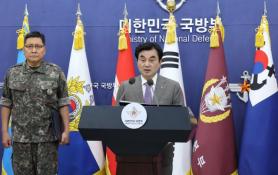 South Korea to Deploy Long-Range Kamikaze Drones, Establish Drone Command
Defense Minister An Gyu-baek announces military facility regulation improvements on June 17 in Seoul. The South Korean government is moving to enhance its drone and anti-drone capabilities by deploying the K-Low-cost Uncrewed Combat Attack System (K-LUCAS), a long-range kamikaze drone.The Drone Operations Command, established under the Yoon Suk Yeol administration, will be restructured into the Defense Drone Headquarters, which will focus on policy development for drone and anti-drone operations, rather than operational command.On June 26, Defense Minister An Gyu-baek held a briefing at the Ministry of National Defense in Seoul to announce the drone and anti-drone development policy.The ministry stated that it will expedite the deployment of K-LUCAS to counter strategic threats and neutralize enemy air defense systems, with plans to deploy the drones before the previously scheduled mid-2030s timeline.Additionally, the government aims to acquire over 20,000 low-cost, expendable drones, including short-range reconnaissance drones and small kamikaze drones, by 2030. It will also work on securing next-generation drones, such as swarm drones utilizing artificial intelligence (AI), to prepare for future battlefields.Long-term plans include deploying anti-drone systems in frontline areas and small unmanned aerial vehicle (UAV) response systems, with a commitment to immediately field proven commercial equipment next year.Specifically, the ministry plans to establish a differentiated rapid acquisition system for drones, allowing for the swift introduction of civilian technology into military applications and linking certification systems for commercial drones to military use.The Drone Operations Command was created in December 2022 as a response to North Korea's incursion of unmanned aerial vehicles into South Korean airspace.The ministry plans to transfer operational functions from the Drone Operations Command to the respective military branches, while the Defense Drone Headquarters will specialize in concept development, requirement identification, acquisition support in collaboration with the military, and partnerships with industry and various organizations.As the Drone Operations Command is disbanded, personnel from its subordinate units will return to their respective military branches, and the unmanned aerial systems previously held by the command will be redistributed based on mission requirements.The newly established Defense Drone Headquarters will be organized as a direct unit under the Ministry of National Defense, led by a general officer.Furthermore, the ministry reaffirmed its commitment to train 500,000 drone operators, enabling all service members to utilize drones as a "second personal weapon." The military plans to procure around 60,000 domestically produced training drones.The ministry stated, "We will improve the current system where some drone capabilities are operated by specific units, allowing each military branch to conduct integrated surveillance, reconnaissance, and strike operations. We will also develop drone operation concepts and tactics tailored to the unique characteristics and missions of the Army, Navy, Air Force, and Marine Corps."* This article has been translated by AI.