

[Courtesy of Hanwha Defense]
SEOUL -- South Korea will localize the German diesel engine of its K-9 self-propelled howitzer, which is one of the country's best-selling ground weapons, as part of a state project to acquire original technologies for key imported parts. Research and development will begin in 2021.
K-9, produced by Hanwha Defense, boasts a high localization rate, but its engine has been provided by MTU Friedrichshafen of Germany. The Defense Acquisition Program Administration (DAPA), a state body controlled by the Defense Ministry, said that the government would develop replacements for key imported parts in consideration of "technological ripple effects and high export potential."
"We are confident that the localization of K-9 self-propelled howitzer's engine under consideration will pave the way for self-defense in the field of firepower and help expand exports," DAPA head Wang Jung-hong said in a statement.
K-9, which entered service in 1999, is compatible with standard NATO 155-mm ammunition and operates with K-10 armored vehicles for ammunition resupply. The $3.9 million weapon with a maximum firing range of 40 km can move at a maximum speed of 67 km per hour.
Some 1,700 K-9s are in service, including 650 shipped to Turkey, India, Poland, Norway, Finland and Estonia. In early September, Hanwha Defense was picked as the sole preferred bidder for an Australian artillery gun procurement project to supply 30 K-9s and 15 K-10s.
Copyright ⓒ Aju Press All rights reserved.
Related News
-
 Hanwha invests $1 bn in U.S. defense, shipbuilding expansion
Courtesy of Hanwha Group SEOUL, November 16 (AJP) - South Korea's Hanwha Group has committed more than 1.5 trillion won (about $1 billion) to its U.S. subsidiaries this year, accelerating its expansion into the American defense and shipbuilding markets. According to industry data released Sunday, Hanwha's three major defense affiliates — Hanwha Aerospace, Hanwha Ocean and Hanwha Systems — have invested or approved a combined 1.506 trillion won in their U.S. operations so far this year. Hanwha Aerospace accounted for the largest share, committing more than 1 trillion won to its American subsidiaries. Of that amount, 508.5 billion won was allocated to Hanwha Defense USA through four capital injections, including 168.4 billion won approved in September to acquire Hanwha Systems' 60 percent stake in Hanwha Philly Shipyard. The move is expected to consolidate the group's U.S. defense and shipbuilding operations under Hanwha Defense USA. Hanwha Aerospace also committed 280.2 billion won to its U.S. strategic investment subsidiary, Hanwha Futureproof, and 220.2 billion won to Hanwha Aerospace USA, which specializes in aircraft engine components. Meanwhile, Hanwha Ocean pledged 325 billion won to its U.S. holding company, Hanwha Ocean USA Holdings, while Hanwha Systems invested 172.1 billion won in its American subsidiaries. The investments come as Hanwha expands its presence in the U.S. defense market through new contracts and manufacturing facilities. In August, Hanwha secured a U.S. Army contract to supply a prototype of its wheeled K9 self-propelled howitzer, known as the K9MH, for the Mobile Tactical Cannon program. The company is establishing an assembly, integration and testing facility in Opelika, Alabama, to support the project. Hanwha is also developing an ammunition production base in Arkansas, with plans to invest $2.2 billion over seven years in facilities producing 155mm artillery shell components and propellant charges. In the naval sector, Hanwha secured a $269 million contract last month to build a medium landing ship for the U.S. Navy and Marine Corps, marking its first U.S. naval newbuild contract since acquiring Philly Shipyard in 2024. The group is also pursuing the acquisition of Austal USA, a U.S. shipbuilder involved in naval vessel construction and nuclear-powered submarine module production. Hanwha Defense USA submitted a nonbinding proposal in August and began commercial negotiations in mid-October. The group has also expanded its naval defense activities, conducting a maritime firing test of its Chunmoo multiple rocket launcher off the southern U.S. coast this month. The investments underscore Hanwha's efforts to establish a stronger manufacturing presence in the United States as it seeks to secure more contracts across the U.S. Army and Navy.
-
 K-Defense Industry Faces Decline Amid U.S. Midterm Election Outcomes
The recent U.S. midterm elections have resulted in a significant victory for the Democratic Party, raising expectations for the expansion of K-defense contracts in the European market. This is particularly relevant if the Democrats decide to increase military support for Ukraine.As of the end of the third quarter, the combined order backlog of four major South Korean defense companies—Hanwha Aerospace, Hyundai Rotem, LIG D&A, and Korea Aerospace Industries (KAI)—was approximately 95.3 trillion won. This marks a decline from over 100 trillion won at the end of last year, dropping to the 98 trillion won range in the second quarter and further down to 95 trillion won in the third quarter. Notably, all three companies, excluding KAI, saw their order backlogs decrease in the third quarter.The intensified competition among global defense firms has made it increasingly difficult to secure new contracts in key export markets such as Europe and the Middle East.In this context, the outcome of the U.S. midterm elections has emerged as a new variable for the domestic defense industry. With the Democrats securing majorities in both the House and Senate, changes in former President Donald Trump's foreign security policies are anticipated.Market analysts are hopeful for an increase in arms exports, particularly to Europe. According to reports from the Financial Times, the Democratic Party is considering an additional military aid package for Ukraine worth up to $15 billion (approximately 21 trillion won). The U.S. has not allocated new support funds for Ukraine since April 2024.If the U.S. expands military support for Ukraine, it could lead to replenishment of weapon stockpiles and military buildup in various European countries, potentially opening up global defense contract opportunities.According to the Stockholm International Peace Research Institute (SIPRI), Europe accounted for 33% of major global arms imports from 2021 to 2025, surpassing Asia-Oceania (31%) and the Middle East (26%). During the same period, Poland represented 58% of South Korea's major arms exports.The South Korean defense industry is also broadening its export base in the European market. Hanwha Aerospace entered the Western European market in late August by signing an export contract for K9 self-propelled howitzers with Spanish defense firm Indra. In September, it secured a supply contract for the Chunmoo multiple rocket launcher worth approximately 640 billion won with Croatia. Hyundai Rotem is also pursuing additional contracts in overseas tank projects in Peru and Romania, building on its K2 tank exports to Poland.Lee Jun-gon, an adjunct professor at Konkuk University’s Defense Acquisition Department, stated, "While the overall framework of U.S. defense and security policy is unlikely to change, the pressure from the Democratic Party could influence defense budget allocations."* This article has been translated by AI.
-
 Korean firms eligible to supply EU satellite network
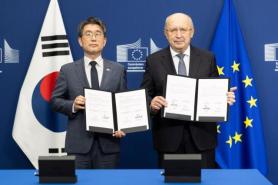
EU Defense and Space Commissioner Andrius Kubilius, right, and Jeoung Giyoung, deputy minister for the advanced capabilities program at South Korea’s Defense Acquisition Program Administration (DAPA), at a signing ceremony on satellite cooperation in Brussels on September 17, 2026. (Photo: © European Union) ZURICH, November 09 (AJP) -South Korean companies can supply non-sensitive parts and services for the European Union’s planned secure satellite network, a European Commission official said Monday, pointing to a potential new market for Korea’s space and defense industries. Korean firms are already eligible to join the IRIS² project as suppliers or subcontractors, the official told South Korean newspaper E-Today. Eligibility does not guarantee contracts, however, and any work would be subject to the program’s legal and technical requirements. Formal participation by the South Korean government would require a separate international agreement, the official said. The distinction gives Korean companies a potential commercial opening while Seoul and Brussels explore a broader partnership in secure satellite communications. IRIS², short for Infrastructure for Resilience, Interconnectivity and Security by Satellite, is intended to provide secure communications for governments and armed forces as well as commercial connectivity. Often described as Europe’s answer to SpaceX’s Starlink, the network is part of an EU effort to reduce dependence on foreign providers. The war in Ukraine has underscored the importance of reliable satellite links on the battlefield, adding urgency to Europe’s push for its own capabilities. “Security also depends on space,” European Commission spokesperson Thomas Regnier said, explaining that IRIS² would serve both civilian and military users. The first satellites are scheduled for launch by the end of 2029. Talks over the project’s operation and financing concluded in August, and its main suppliers have been selected. The comments follow a series of exchanges between Seoul and Brussels this autumn. On September 17, EU Defense and Space Commissioner Andrius Kubilius and a senior official from South Korea’s Defense Acquisition Program Administration (DAPA) signed an arrangement in Brussels to cooperate on secure satellite communications. The arrangement opened the way for discussions on a possible Korean link to IRIS². A joint working group held its first meeting in October, bringing together the European Commission, the European Space Agency, DAPA and South Korea’s Agency for Defense Development. The cooperation could give South Korea access to aspects of the program’s design while allowing European space companies to draw on Korean industrial expertise. Norway and Iceland are the only countries to have signed formal cooperation treaties with the EU on the program so far. South Korea is among the first countries outside Europe to enter discussions. Two Korean defense electronics companies see scope to contribute, although neither has established that its products meet the project’s requirements. Hanwha Systems cited its experience developing satellites, ground stations and terminals for low-orbit networks. It said it had not begun supplier talks. LIG D&A pointed to its satellite repeaters and advanced antennas developed for South Korea’s military satellite programs. Both companies said further checks would be needed to assess compatibility with IRIS² requirements. The potential opening would extend Korea’s growing defense business in Europe into space communications. Korean manufacturers have already secured major contracts in Poland for K2 tanks, K9 self-propelled howitzers and combat aircraft. Winning satellite work would depend on meeting a separate set of technical and security requirements. - Tags: IRIS², European Union, European Commission, European Space Agency, South Korea, Andrius Kubilius, Thomas Regnier, Defense Acquisition Program Administration, Agency for Defense Development, Hanwha Systems, LIG D&A, E-Today, Starlink, SpaceX, satellites, defense industry