

[Aju News DB]
SEOUL -- 40 years have passed since "Daseok" (to only eat dinner instead of having three meals a day) Ryu Young-mo (1980~1981) passed away on February 3, 1981. The philosopher had lived an honest and noble life based on the idea of "Eolna" (Spiritual Self) in Korea during the 20th Century that was full of pain and dynamic historical events. This is an obituary that is 40 years late.
Ryu lived through South Korea's Christian history that rooted into the Korean peninsula about one hundred years ago, following the teachings of Jesus. The philosopher nicknamed the "Spiritual leader of Bukhansan" had called himself an "illegitimate Christian," throwing questions to those who gathered in groups to call upon God. He pursued a life of Eolna, an idea that pursues being one with the Holy Spirit that nests in the hearts of people.
His teachings convey a message to all Christians living in the current pandemic era. The reason why churches violate the government's quarantine guidelines to hold masses and religious events are not based on a devout attitude towards Christianity. It is because churches became a commercialized power group. It is because they cannot change the way of their foundation of survival. COVID-19 has revealed the bare face of religion and its twisted shape.
Ryu has said that such tragedy was born due to religions that fail to play their true roles. It is not a problem caused by a coronavirus pandemic. A religious problem that stayed hidden for a long time was revealed. Ryu was a pioneer.
The philosophy of Daseok is based on Christianity and it does not deviate from the religion's line. Eolna is the key idea of Daseok. It is a bridge that connects people to the Holy Spirit, Ryu preached. The philosopher had warned about religions that communicated with God on behalf of the people. He claimed that religion is an autonomous communication act that takes place between an individual and God.
Daseok's philosophy focuses on recovering the true connection between churches and God. The connection was lost during the process of secularization. The philosopher claimed the connection must be established not through a church but by people themselves. Ryu also preached that people should live their life in desperation. It is the key aspect of life management that will help people to live their lives to the full.
Park Sae-jin
Experienced journalist and editor at AJU PRESS specializing in multilingual news. I cover international diplomacy, geolpolitics, and policy, consistently delivering highly accurate, compelling reporting for a worldwide audience.
Copyright ⓒ Aju Press All rights reserved.
Related News
-
 OPINION: When a revolution revolves around one man
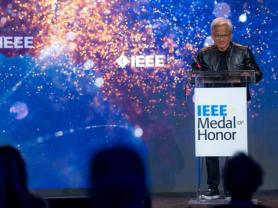
Nvidia CEO Jensen Huang, recipient of the 2026 IEEE Medal of Honor. Courtesy of IEEE "When in doubt, throw doubt out and have a little faith," wrote E. A. Bucchianeri. Investors left astray in the AI transition were ready to set aside their doubt when their shepherd returned. Huang's return was as dramatic as his exit. His reinstatement as Nvidia's chief executive sent the company's shares up 31.48 percent, adding $952 billion dollars in market value in a single session on Monday. It was Nvidia's biggest percentage gain since 2003 and the largest one-day increase in market capitalization on record for a U.S. company. The euphoria spilled over to Seoul. The KOSPI jumped over 7 percent and reclaimed 5,000 mark, led by Samsung Electronics and SK hynix as foreign buying was turbocharged with the reassurance on AI drive. Little about Nvidia's business changed during Huang's 11-day absence. Its engineers kept working. Its factories and suppliers kept producing. Its customers still needed computing power. What changed was investors' willingness to finance that future, and it swung on a single variable: the identity of the man at the top. It would be easy to call this founder worship. It would also be too easy. Huang's importance is real. He spent decades assembling the technology, the relationships and the commercial ambition that placed Nvidia at the center of the AI industry. Replacing such a figure is not a matter of changing the name on an office door. His reach extends well beyond the chips Nvidia sells. As Yale economist Natasha Sarin noted in a New York Times commentary, the company helps finance parts of the very ecosystem that buys its products. Its investments and commercial commitments bind together chip supply, computing capacity and the ambitions of AI developers. The concentration has bulldozed AI investment but also stoked risk. When a supplier helps fund its customers' expansion, strong demand and easy financing feed each other. When confidence falters, the same links can carry doubt across businesses that looked like separate bets. Huang's return restored faith in those links. It did not prove that the projects they support will pay off. President Donald Trump grasped the stakes at once. He told CNBC that he had spoken to Nvidia's board and persuaded the directors to bring Huang back. The company, for its part, acknowledged receiving input from senior U.S. officials that left it confident his reinstatement posed no national security risk. For a president whose economic agenda leans heavily on the AI boom, the motive to step in was obvious. A prolonged collapse in confidence would not have stopped at shareholders. It would have reached investment plans, suppliers and jobs. Preventing that damage is a legitimate concern. The means still deserve scrutiny. A board is entitled to reverse itself when new evidence emerges. Government officials may hold information relevant to a security assessment. Huang deserves a fair process, and allegations are not proof of wrongdoing. But shareholders deserve to know what changed. Bloomberg reported that senior executives were not consulted before the directors decided to reinstate him. Nvidia's independent investigation into reports of foreign intelligence targeting is still under way. The U.S. administration habitually invoked national security to justify sweeping restrictions on trade and technology. If the standard is to mean anything, it must hold steady when an economically indispensable individual seeks reassurance from the same government. There is a longer-term cost, too. Investors who come to believe the White House will shield strategically important companies will begin to price that protection in. Capital will then chase the promise of political support alongside commercial merit. And each successful rescue makes the next one look more necessary. A suspected AI-generated image posted without comment on U.S. President Donald Trump’s Truth Social account on Nov. 23, 2026, shortly after Jensen Huang’s return as Nvidia CEO was announced. The image parodies the scene following the assassination attempt on Trump during the 2024 presidential campaign. Courtesy of Truth Social For South Korea, however, any criticism must come with an uncomfortable relief. The AI boom has handed an economy weary of sluggish growth a powerful new engine. After expanding 1.1 percent last year, Korea is now projected by the International Monetary Fund to grow 3.9 percent this year and 3.3 percent next year. Exports have crossed the $1 trillion mark. Semiconductors accounted for 42.7 percent of shipments in the first 10 months, and roughly half in recent months. The gains are spilling into factory equipment, power infrastructure and construction, holding out the prospect of stronger incomes and spending well beyond the chip industry. These gains are the product of years of Korean investment, engineering and manufacturing discipline. They deserve celebration. They also explain why a boardroom decision in Santa Clara can rattle confidence in Seoul. Even monetary policy feels the tremor. A sustained market rout would complicate the Bank of Korea's effort to contain inflation by sapping confidence and tightening financial conditions. A recovery, if it holds, gives policymakers more room to read domestic demand and prices. Korea's task is to turn the chip windfall into a broader capacity for growth. That means spreading productivity gains to smaller manufacturers and service businesses, building the skills to put AI to productive use, and making sure infrastructure spending serves more than the next burst of data center demand. Export strength should leave the domestic economy better prepared for the downturn that will eventually come. Nvidia faces a parallel test of institutions. A credible succession plan, independent oversight and fuller disclosure of its financial commitments across the ecosystem would give investors firmer grounds for confidence. The board's new security and export-control committee and its planned chief compliance officer will matter only to the extent that they can exercise authority when doing so is inconvenient. Huang’s return — minus the signature black leather jacket that had been parodied during his absence — was greeted with a roar from shareholders around the world, Nvidia staff and partner companies. Thanking the board and employees “for a second chance,” he vowed to be a better chief executive. The pledge is welcome. It should also be heard with humility, by him as much as by those cheering him on. Being a better CEO and laying the foundation of the AI age are not the same task. The first is measured in quarters, share prices and execution. The second is measured by whether what he leaves behind can stand without him. His charisma and insight were needed to usher humanity into the AI era, and history will likely credit him for it. But a founder is judged not only by what he builds while he is indispensable. He is also judged by whether he recognizes the moment he no longer is. When his role is done, he must be willing to walk away, humbly and of his own accord. There is every reason to welcome his return and the breathing room it has bought. That room should be used, not merely enjoyed. An industry that promises to transform the world needs institutions strong enough to carry its ambitions beyond the fortunes of its most gifted individual. A revolution proves its durability when it can outgrow its revolutionary. *The author is the managing editor of AJP. **The views expressed are the author's own.
-
 Public Opinion Favors Government Oversight Over Support Ahead of 2028 Elections
A public opinion poll released on the 20th indicates that the sentiment ahead of the 2028 National Assembly elections favors the notion of government oversight over the idea of supporting the government. Conducted by Korea Gallup from November 17 to 19, the survey of 1,001 men and women aged 18 and older found that 37% agreed with the idea of supporting the government, while 47% supported the idea of overseeing the government. Among supporters of the Democratic Party, 78% expressed the view that the ruling party should win, while 89% of People Power Party supporters and 76% of conservatives stated that the opposition party should win. In terms of party support, the Democratic Party and People Power Party recorded 36% and 28%, respectively. The Rebuilding Korea Party garnered 3%, and the Reform Party received 2%. By political inclination, 70% of progressives supported the Democratic Party, while 60% of conservatives backed the People Power Party. Among moderates, 37% supported the Democratic Party, 17% supported the People Power Party, and 39% were undecided. Korea Gallup also conducted a survey regarding the outlook for the economy over the next year. The results showed that 26% were optimistic about the economy, while 38% were pessimistic. Meanwhile, 30% believed the economy would remain the same. Korea Gallup explained that economic optimism was more prevalent among respondents who generally agreed with and trusted government policy directions. However, this month, optimism among progressives dropped to 42%, marking the lowest level since the current administration took office. This survey was conducted using randomly selected virtual phone numbers through telephone interviews. The margin of error is ±3.1 percentage points at a 95% confidence level, with a contact rate of 40.8% and a response rate of 10.1%. For more details, please refer to the website of the Central Election Polling Review Committee.* This article has been translated by AI.
-
 OPINION: Suneung has gone haywire, and stickers will not fix it
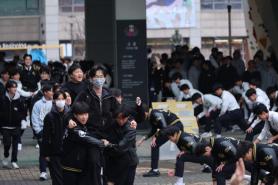
High school seniors leave Joongdong High School in Gangnam District, Seoul, to cheers from younger students on the morning of Nov. 18, 2026, a day before the College Scholastic Ability Test (CSAT). AJP Han Jun-gu The eve of the suneung – the Korean for the once-a-year Collage Scholastic Ability Test (CSAT) - is supposed to be quiet. Students check the route to their test site, pack their bags and try to sleep early. This year, every feed is dizzy. More than 550,000 candidates, and far more people once their families are counted, spent Wednesday working out which pens they can no longer carry, which shirt has too many buttons and whether their glasses will pass inspection. The mood has turned intimidating after President Lee Jae Myung floated the idea of putting up bounty money for those who report cheats, stirring the police to immediate rummage through the internet. The reward would be at least 100 million won (about $75,000) per case for high-tech cheating, with lighter punishment for accomplices who come forward, and students on online forums warn that the money could invite excessive reports and indiscriminate suspicion. A task force led by the National Police Agency’s investigation chief began a crackdown on Monday, and eight of the 14 reported cases of AI-assisted exam cheating are under investigation. Officers are also checking the authenticity of 13 online items, from cheating confessions and threats to ads for equipment, and have deleted or blocked 40 posts they deemed baseless or conspiratorial. One author had vowed to smuggle miniature gear into the exam to expose its weaknesses. Yet the nominee for police chief said Wednesday that no investigation into specific cheating on the suneung is under way. Nothing has been proven against this exam. Education Minister Choi Kyo-jin inspects a College Scholastic Ability Test (CSAT) site at Yeongdeungpo Girls’ High School in Yeongdeungpo District, Seoul, on the afternoon of Nov. 16, AJP Yoo Na-hyun Even so, trust, the only currency it runs on, is already draining away. Suspicion now reaches everywhere. A high school senior has asked the Constitutional Court to suspend the exam date, arguing that candidates are being made to bear the risk of inadequate safeguards. The first person ever to earn a perfect score on the law school admission test, doubted online, has promised to solve Thursday’s Korean-language section live. On Telegram, a group of about 22,700 members advertises button cameras and camera glasses, the latter for about 800,000 won ($600), though reporters found no proof that any kit was delivered, and it may be a scam. The fuss has a clear origin. The top scorer in this year’s state tax accountant exam missed just one of 160 first-round questions, including a perfect mark in a tax law paper where the average was 30.18. On Nov. 15, that candidate confessed on YouTube to cheating with electronic devices and generative AI, photographing questions with a tiny camera, sending them to AI and reading the answers on a smartphone. The candidate is now a police suspect. The details are damning for the system. The candidate sat in the center of the second row for the first round and the front row for the second, with two invigilators in the room. Phones were not collected, there was no CCTV, and the specialist monitors hired to spot cheating devices were not deployed at the exam. The exam agency failed to find signs of cheating even after suspicions surfaced. It took a confession to expose what a national testing system could not see. A commercially available miniature camera is seen in front of a notice on penalties for cheating with smart devices at a test site in Yeongdeungpo Girls’ High School in Seoul on the afternoon of Nov. 16, 2026, three days before the College Scholastic Ability Test (CSAT). AJP Yoo Na-hyun The alarm had been ringing for months. Smart-glasses cheating was first caught in national qualification exams in May. The state skills agency has since logged 12 such cases this year. Last month, candidates wearing AI glasses were caught at essay exams for the University of Seoul and Yonsei University. Yet the government focused on glasses and left other methods unprepared, and the tax exam was beaten by a camera. What followed was improvisation. Education Minister Choi Kyo-jin told lawmakers he did not think AI cheating could be caught perfectly, and officials stumbled over whether to block signals at test sites. Then, within days, came the black-pencil rule, the button stickers, 8,400 extra personnel and an alert set to blare from every phone in the country. Oversight was lax until it became frantic. Cheating with devices is hardly new. In 2004, police traced CSAT answers sent as numeric text messages and booked more than 100 people. The hardware has long existed. What has changed is the software. A hidden camera could once only carry a question out of the room, and someone outside still had to solve it. Generative AI removes that someone. Cheating has become smarter, cheaper and closer to the perfect crime – unless the cheat confesses. Here lies the bitter irony. South Korea is enjoying a chip bumper year on the back of AI. The country is expected to cross the $1 trillion export milestone this week, and it owes more than 40 percent to semiconductors. Tax revenue is forecast at a record 478.6 trillion won ($358 billion), 63.2 trillion won above the government’s estimate in March, with surging profits at Samsung Electronics and SK hynix doing much of the work. Seoul has been racing to become a top-three AI power, and yet it has neglected the side effects along the way. Family members of test-takers, pray at Jogyesa Temple in Jongno District, Seoul, on the afternoon of Nov. 9, 2026, 10 days before the College Scholastic Ability Test (CSAT). AJP Han Jun-gu Every coin has two sides, and an intoxicated country forgot to turn this one over. The government’s budget for next year set aside no dedicated money for detection gear or extra monitors at the state skills agency, and radio detectors for test sites will arrive next year at the earliest, leaving invigilators to rely on their eyes. Only after the confession did the government and lawmakers move to add 18.2 billion won ($13.6 million) for national qualification exams. That is about 0.03 percent of this year’s revenue windfall. China, meanwhile, has already used signal blockers and had AI services suspend problem-solving functions during exams. At home, convicted exam cheats have usually received fines or suspended sentences. The nation that supplies the memory for the AI age left its own exam halls guarded by the naked eye. Thursday’s measures may well deter some. They cannot win the race. AI glasses now weigh about 50 grams and are nearly impossible to tell from ordinary frames by eye, and smart contact lenses are in development. A sticker covers yesterday’s camera. Meanwhile, every candidate will sit a life-shaping test under the gaze reserved for a potential cheat. Authorities can casually call all this a transition, an experiment, something to learn from as we go. That language suits a software release. It does not suit a day for which students have studied morning and night for years, with their careers, future jobs and dreams at stake. Those who stumble on Thursday cannot simply patch the error. They wait a year. That is the deeper flaw. Because so much rides on one sitting, a single stolen answer is worth a fortune, a single rumor can unnerve a nation and a single bad morning can redirect a life. The single-day suneung must be overhauled. This will not be simple, and South Korea has been here before. The first CSAT was held twice, in August and November 1993, but was cut to once a year after matching the difficulty of the two tests proved too hard. That was a real obstacle, but it belonged to another era. The American SAT is offered several times a year. Three decades on, the question deserves a fresh answer. A teacher of senior students at Eunpyeong High School in Eunpyeong District, Seoul, receives an urgent notice on the Education Ministry’s change to the items candidates may bring into exam rooms on Nov. 18, 2026, a day before the College Scholastic Ability Test (CSAT). Pool photo The question-and-answer format needs the same scrutiny. A multiple-choice item is exactly what a hidden camera and a chatbot handle best. The National Education Commission is reviewing essay-style questions and absolute grading for the CSAT, with a final plan due next March. Essays alone are no cure. The tax exam cheat says AI was also used in the second round, which is essay-based. They also bring their own worries over private tutoring and fair grading. So the country needs what it has lacked this week: time to think. Past governments that pushed absolute grading were repeatedly defeated by public backlash, and a reform drafted in panic will meet the same fate. Once the last bell rings, South Korea should audit what worked, ask what the exam is really for and rebuild it with students at the table. A sliver of the chip windfall would pay for it. At 8:40 a.m. Thursday, 551,864 registered candidates are due to begin with black pencils and years of work behind them. They have kept their side of the bargain. The adults who run this exam now have to keep theirs. *The writer is the managing editor of AJP. **The views expressed are those of the author and do not necessarily reflect the editorial position of AJP.