
According to the report, the population aged 15 to 64, totaling 36.57 million in 2023, is projected to decline to 27.17 million by 2044. The total population will fall to 39.69 million in 2065 from 51.71 million in 2023.
KPPIF forecasts that Korea's low birth rate has far-reaching implications across various sectors of Korean society. For example, the number of students entering elementary school is expected to decrease to 220,000 in 2033 from 430,000 in 2023. Military manpower will also plunge to 190,000 in 2038 from 260,000 in 2023. Korea had a record-low fertility rate of 0.72 in 2023, as previously revealed by Statistics Korea.
Meanwhile, the elderly population aged 60 and over will continue to increase, reaching 18.91 million, representing 40 percent of the total population, by 2050. It is estimated that the number of single-person households aged 65 and older is projected to account for 20 percent of the total households by 2049.
"The looming demographic disaster caused by population decline is a matter of existential concern to Korea," said Lee In-sil, president of KPPIF. "If we fail to address this issue promptly, it would incur significant costs for Korean society to remedy."
Copyright ⓒ Aju Press All rights reserved.
Related News
-
 Birth Rate Increases for Second Consecutive Year as Total Fertility Rate Reaches 0.8
The number of births has increased for the second consecutive year, with the total fertility rate rising to 0.8. Notably, the birth rate of firstborns has surged, driving the overall increase in births. Changes in birth patterns, including a rise in births outside of marriage and multiple births, have also been observed.According to the '2025 Birth Statistics' released by the National Data Agency on August 26, 2026, the number of births last year reached 254,300, an increase of 16,000 (6.7%) from the previous year. This marks two consecutive years of growth following 2024.In terms of birth order, firstborns saw the largest increase, with 12,600 more births (8.6%). Secondborns increased by 3,300 (4.4%), while births of third or higher-order children rose by 100 (0.5%). Firstborns accounted for 62.4% of all births, up 1.1 percentage points from the previous year. In contrast, the proportions of secondborns and third or higher-order children decreased to 31.2% and 6.4%, respectively, down 0.7 and 0.4 percentage points.The trend of increasing births outside of marriage continued, with 14,000 such births last year, representing 5.5% of all births. The proportion of births outside of marriage remained stable at 1.9-2.0% from 2014 to 2017 but has steadily risen since reaching 2.2% in 2018.The time taken to have a firstborn after marriage has slightly decreased. Among firstborns, 53.2% were born within two years of marriage, an increase of 0.5 percentage points from the previous year. The proportion of all births occurring within two years of marriage also rose to 36.1%, up 1.1 percentage points.Multiple births have also increased, accounting for 6.1% (15,500) of all births, up 0.4 percentage points from the previous year. The average age of women giving birth to multiples is 35.3 years, 1.7 years older than those giving birth to singletons.Park Hyun-jung, head of the Population Trends Division at the National Data Agency, stated, "Since 2023, the increase in marriages and the recovery of the average age for marriage and childbirth in the early 30s have significantly contributed to the recovery in birth rates. We expect the increase in births to continue."She added, "The rise in marriages since the transition to endemic status in May 2023 and the increase in the population of women in their 30s have played a role, along with positive changes in perceptions about childbirth as seen in social surveys."Amid rising birth ages and an increase in multiple births, the proportion of preterm births has also grown. Preterm births, defined as those occurring before 37 weeks of gestation, accounted for 10.8% of all births, an increase of 0.6 percentage points from the previous year, and have expanded by about 1.6 times compared to a decade ago. Notably, 73.7% of multiple births were preterm.The total fertility rate, which represents the average number of children a woman is expected to have in her lifetime, is now 0.80, an increase of 0.05 from the previous year. Like the number of births, the total fertility rate has also risen for two consecutive years.By age group, the birth rate is highest among women in their early 30s, at 73.1 births per 1,000 women, followed by 52.1 for women in their late 30s and 21.2 for women in their late 20s. Compared to the previous year, the birth rate for women in their late 30s saw the largest increase of 6.0 births, followed by increases of 2.8 for women in their early 30s, 0.8 for women in their early 40s, and 0.5 for women in their late 20s.The average age of mothers at childbirth has risen to 33.8 years, an increase of 0.2 years from the previous year. The average age for firstborns is 33.2 years, for secondborns is 34.7 years, and for thirdborns is 35.8 years. The average age of fathers remains at 36.1 years, the same as the previous year, but is 1.3 years higher than a decade ago.By region, the total fertility rate is highest in Jeonnam at 1.09, followed by Sejong at 1.06. In contrast, Seoul has the lowest rate at 0.63, with Busan at 0.74. The gap between the highest and lowest regions is 0.46, primarily attributed to differences in birth rates among women in their late 20s and early 30s.* This article has been translated by AI.
-
 Korea Medical Tourism Expands Beyond Beauty to Cancer and Fertility Care
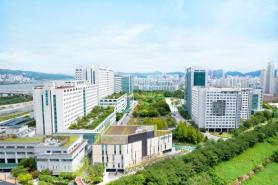
Asan Medical Center in Seoul (photo provided by the hospital) As South Korea enters the era of 1 million foreign patients, its medical tourism industry is rapidly moving beyond skin care and cosmetic procedures into specialized treatment such as cancer care and infertility services. With demand rising for longer courses of care that run from diagnosis and surgery through recovery, hospitals say overall patient management — including language support, logistics and follow-up — is becoming a key measure of competitiveness. The government had set a goal of attracting 700,000 foreign patients by 2027, but the total already topped 1 million last year. Industry officials said on the 16th that Korea’s medical tourism has long been driven by K-beauty, but more patients are now traveling to Korea for complex treatment, including cancer and infertility care. Asan Medical Center said more than 19,000 foreign patients visited in 2024. Patients from the United States as well as the United Arab Emirates and Mongolia often request consultations in advance by email or messaging apps and send medical opinions from local doctors along with CT and MRI materials to prepare for care, a hospital official said. The hospital’s International Healthcare Center has built an integrated online platform that links registration, uploading test materials, pre-consultations and telemedicine, allowing management to begin before patients arrive. “More patients with serious illnesses are coming to Korea after setting treatment plans through remote care before entering the country,” an Asan Medical Center official said. Over the past five years, the hospital conducted more than 800 remote consultations for patients from 57 countries, many involving severe cases such as liver and pancreatic cancer, the official said. Analysts say the shift toward serious disease treatment also reflects conditions overseas. In the United States, treatment costs are high, and many procedures are known to cost about 50% to 90% more than in Korea. In the United Kingdom, patients can wait months to see specialists. By contrast, Korea is viewed as combining relatively lower costs with strong outcomes. In 2023, Korea’s treatable mortality rate — early deaths that could be avoided with timely, effective care — was 45 per 100,000 people, well below the OECD average of 77. Satisfaction with medical technology and facilities is also reflected in repeat demand: A Korea Health Industry Development Institute survey found 59.8% of foreign patients said they were willing to return. Magok CHA Hospital (photo provided by the hospital) Hospitals are also strengthening tailored services to attract overseas patients. With about 70% of foreign patients coming from nearby countries such as Japan, China and Taiwan, Magok CHA Hospital’s fertility center is cited as an example of improving convenience by leveraging its location near Gimpo Airport. For infertility patients who must return repeatedly to match treatment schedules, the “10-minute drive from the airport” is described as a key advantage. The center has also set up a separate treatment area, Building B, for foreign patients, separating their routes from those of Korean patients. The hospital said it redesigned the care environment to reflect longer interpretation and consultation times. “We chose the location with accessibility in mind, and we operate specialized interpreters and a one-on-one consultation system,” a fertility center official said. Seoul, where 85% of foreign patients are concentrated, is expanding policy support. The city plans to increase its pool of interpreter coordinators from 100 to 1,000 this year, broadening coverage beyond English, Chinese and Japanese to include less common languages such as Russian and Arabic. “Not only medical care but also interpretation and guidance can shape the patient experience,” a Seoul Tourism Organization official said, adding that trust built through those services can influence perceptions of Korea’s health care overall. Seoul is also pushing to introduce “medical-friendly accommodations.” A city official said medical tourism is currently centered on hospitals and clinics, with related services such as patient recruitment agencies, travel firms and transportation operating alongside them. The city is reviewing support systems tailored to long-stay patients, the official said.* This article has been translated by AI.
-
 South Korea welcomes first babies of 2026 amid signs of fragile fertility recovery
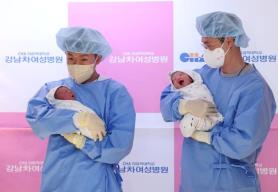
The first two babies born at the stroke of midnight on Jan. 1, 2026 at CHA University Gangnam Medical Center held by their fathers. (Yonhap) SEOUL, January 01 (AJP) - South Korea marked the start of the Year of the Red Horse with the birth of its first newborns at the stroke of midnight on Jan. 1, 2026, as two baby girls were delivered simultaneously at a maternity hospital in Seoul. According to CHA University Gangnam Medical Center, the two girls were born at exactly 12:00 a.m. to mothers aged 37, both in stable condition. One baby, weighing 2.88 kilograms, was delivered by cesarean section, while the other, weighing 3.42 kilograms, was born naturally. Both newborns and their mothers were reported to be healthy. One of the babies, nicknamed “Jjaem,” is the first child of a couple married for four years. Her father, Yoon Sung-min, 38, said he felt especially joyful that his daughter arrived at the very beginning of the new year. “I hope she grows up happy and enjoys life, just like her nickname suggests,” he said with a smile. The other newborn, nicknamed “Dori,” is the second child of her parents. Her father, Jung Dong-gyu, 36, said he had expected a late-December birth but was grateful that both mother and child held on until the new year. “It feels meaningful that she became one of the first babies of 2026,” he said, adding that he hopes more children will be born around her so she can grow up with many friends. Separately, another baby girl was born under dramatic circumstances later that day aboard a fire-service helicopter in the skies over Jeju Island. According to the Jeju Fire Safety Headquarters, emergency services received a request at 11:30 a.m. from an obstetrics clinic in Jeju City to transport a woman in her 30s who was experiencing premature rupture of membranes at 30 weeks of pregnancy. A rescue helicopter was dispatched, but during the flight to a mainland hospital, the woman went into labor and delivered the baby at 1:17 p.m. Both the mother and newborn were reported to be in stable condition. Officials described the airborne delivery as a rare case, made possible by the swift response of emergency personnel. A nurse tends to newborns at Ilsan CHA Hospital in Goyang, Gyeonggi Province/ Yonhap The symbolic New Year births come as South Korea shows tentative signs of a rebound in childbirth after years of record-low fertility. The country’s total fertility rate — the average number of children a woman is expected to have in her lifetime — stood at about 0.80 for the January–October period last year. If the trend holds through year-end, it would mark the first return to the 0.8 range in four years. Korea’s fertility rate fell to 0.81 in 2021, dropped further to 0.78 in 2022 and hit a record low of 0.72 in 2023, before edging up to 0.75 in 2024 — the first rebound in nine years. Government and research projections suggest the recent uptick may continue. The National Assembly Budget Office estimates the fertility rate at 0.80 last year and 0.90 this year, with a gradual rise to 0.92 by 2045. It attributes the improvement to a rebound in marriages delayed during the COVID-19 pandemic, an increase in the population of women in their 30s, and gradually improving perceptions toward marriage and childbirth. Official population projections also point to a recovery trend. Under the medium scenario, the fertility rate is expected to bottom out at 0.65 before rising to 0.68 this year, 0.71 in 2027 and 0.75 in 2028. A more optimistic scenario sees the figure climbing from 0.75 to 0.80 this year and 0.84 by 2027. Public attitudes appear to be shifting as well. A survey by the Presidential Committee on Ageing Society and Population Policy showed that the share of people expressing willingness to marry rose from 61.0 percent in March 2024 to 65.2 percent a year later. The proportion saying they believe children are necessary increased from 61.1 percent to 70.9 percent over the same period. Still, the country's fertility rate remains well below the OECD average of 1.43 in 2023 and far under the replacement level of 2.1 needed to sustain the population.