
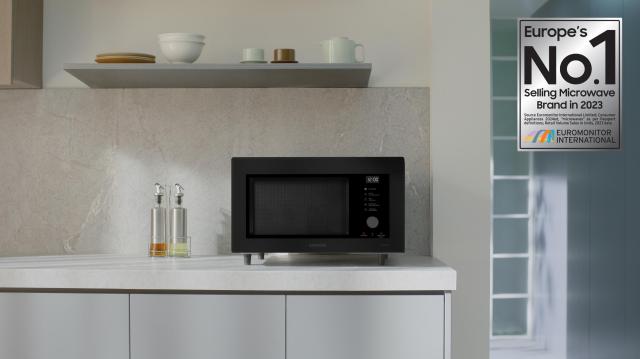
Samsung captured a 15.3 percent market share, continuing its leadership since 2015, the Korean company said Sunday, citing market research firm Euromonitor’s data based on a survey of 19 European markets.
The company attributed the success to its strategic approach in catering to European customers’ interest in kitchen interior design through differentiated materials and premium designs.
"Samsung Electronics has achieved the number one market share by providing products that align with European consumers' expectations for design and ease of use," said Choi Ik-soo, vice president of digital appliance division.
"Moving forward, we will solidify our leading position in the European market through our strengths in smart connectivity and premium designs."
Since 2019, Samsung has rolled out the BESPOKE line of microwaves in seven color options in the European markets. In April, Samsung launched a new model linked to its Internet of Things platform.

Candice Kim
Candice Kim is a dedicated business and technology reporter specializing in the intersection of high-tech innovation and fast-paced consumer trends. Her core beats span the semiconductor, IT, cosmetics, and retail sectors, where she provides in-depth coverage of industry titans including Samsung Electronics, SK hynix, and LG Electronics, alongside leading consumer brands like Olive Young and Musinsa. Whether analyzing complex silicon supply chains or tracking the latest shifts in beauty and fashion retail, Candice is committed to delivering sharp, accurate reporting that keeps readers informed on the forces shaping today's most dynamic markets.
Copyright ⓒ Aju Press All rights reserved.
Related News
-
 Memory Semiconductor Boom Expected to Shift in 2028 as Samsung and SK Keep Watch
The boom in memory semiconductors driven by artificial intelligence (AI) demand is expected to reach a turning point around 2028. Samsung Electronics and SK Hynix are anticipated to continue their strong performance in high-bandwidth memory (HBM) and general-purpose DRAM until next year. However, analysts suggest that the combination of new global factory operations and aggressive expansions in China may lead to a decline in price strength due to reduced supply shortages.At the TrendForce Roadshow Korea 2026 held on November 18 at the Oakwood Premier Coex Center in Gangnam, Seoul, Ellie Wang, a senior analyst at TrendForce, presented on the topic of "Balancing Performance and Cost: Next-Generation Growth Drivers for DRAM and HBM," indicating that a turning point for memory prices could occur in mid-2028.Wang stated, "Since mid-2023, we have projected that a turning point for memory prices could appear in mid-2028. While investment plans for data centers are largely confirmed until 2027, we expect risk factors to emerge after 2028."In the immediate term, memory price strength is expected to persist until next year. TrendForce forecasts that the contract price for general-purpose DRAM will rise by 5-10% in the first quarter of 2027 compared to the previous quarter. In the second quarter, it is projected to increase by 3-8%, and by 0-5% in the third and fourth quarters. Although the rate of price increase may slow, supply shortages in memory are expected to continue.The expansion of AI infrastructure investment is supporting demand. TrendForce anticipates that the capital expenditures of major global cloud service providers (CSPs) will increase by 104% this year, followed by a further 60% increase next year. The investment scale for next year is expected to reach approximately 15.158 trillion won.The expansion of HBM production is also constraining the supply of general-purpose DRAM. Next year, HBM supply bits are expected to increase by 65.7% year-on-year, while DRAM for PCs is projected to decrease by 7.9%. It is estimated that server-related products will account for 67% of the total DRAM supply bits.Wang explained, "Producing HBM4 requires 3-4 times more wafers than general-purpose DRAM. Therefore, it seems unlikely that DRAM prices will turn downward even in 2027."However, the supply environment may change starting in 2028. New production facilities being pursued by Samsung Electronics, SK Hynix, and Micron are expected to come online between 2028 and 2030, leading to increased production capacity. If the growth rate of AI investment slows, there is a possibility that the increased supply may not be fully absorbed by demand.In particular, China's aggressive expansion has emerged as a variable. TrendForce projects that the DRAM production capacity of China's CXMT will increase by 20% from 300,000 wafers per month at the end of this year to 360,000 wafers per month by the end of next year. During the same period, Samsung is expected to expand from 750,000 to 845,000 wafers per month, while SK Hynix is projected to grow from 615,000 to 695,000 wafers per month, marking a 13% increase for both. China's expansion rate is outpacing that of domestic companies.Additionally, changes in the growth rate of the HBM market are anticipated. Ellie Wang raised the possibility that the HBM shipment growth rate could slow from approximately 50% in 2027 to around 10% in 2028. However, she noted that the 2028 figure is still under review. As the growth rate of HBM adoption in AI semiconductors moderates, the supply and demand environment may change with the continued expansion of production capacity among major memory companies.Wang concluded, "Until 2027, the robust demand for memory driven by increased AI investment and HBM production will continue. However, with new factories from major semiconductor companies coming online starting in 2028, the subsequent balance of demand growth and supply expansion will determine the direction of the memory market."* This article has been translated by AI.
-
Investors React to Samsung Electronics Stock Drop Below 200,000 Won
A investor recently purchased two additional shares of Samsung Electronics after its stock price fell below 200,000 won. Despite seeing a loss in his account, he opted for additional buying. He stated, "To reduce the 20% loss rate even slightly, I need to buy more shares now to lower the purchase price," adding, "I aim to reduce it by at least 3 percentage points."Following the sudden resignation of Jensen Huang, the former CEO of Nvidia, negative news spread across the semiconductor sector. As Samsung Electronics' stock price dipped below 200,000 won, individual investors began to engage in bargain buying. In contrast, individual investors who initially bought shares of SK Hynix on the first day of the drop turned to net selling the following day.According to the Korea Exchange on the 18th, individual investors net purchased approximately 3.76 million shares of Samsung Electronics from the 16th to the 17th. In terms of trading volume, they bought about 734.1 billion won over the two days. Previously, individual investors net sold about 5.91 million shares of Samsung Electronics over four days from the 9th to the 12th, but they returned to a buying position starting on the 13th. They continued this trend with net purchases on the 16th and 17th, maintaining the bargain buying momentum. Samsung Electronics finished trading at 190,300 won after a 4.47% drop on the 16th and a further 3.30% decline on the 17th.The trading patterns for SK Hynix were different. Individual investors net purchased about 500,000 shares of SK Hynix on the 16th, amounting to approximately 584.2 billion won. However, on the following day, the 17th, they net sold 75,456 shares, recording a net selling position of about 86.7 billion won in trading volume. Although they engaged in bargain buying on the first day of the drop, the continued decline seemed to dampen their buying enthusiasm.There was a noticeable difference in trading volumes between the two stocks. After Samsung Electronics fell below the 200,000 won mark, it experienced two consecutive days of decline, yet trading volume increased from about 16.16 million shares on the 16th to approximately 16.77 million shares on the 17th. This suggests that individual buying activity continued actively despite the falling stock price. In contrast, SK Hynix's trading volume decreased from about 4.19 million shares to 3.74 million shares during the same period, indicating a reduction in buying momentum.The differing responses of individual investors to the two stocks may be attributed to variations in stock price levels and investor sentiment. The perception that Samsung Electronics became relatively cheaper after breaking the symbolic price of 200,000 won may have stimulated individual investors' bargain buying sentiment. On the other hand, the higher stock price of SK Hynix, around 1 million won, was seen as a burden for buying. Additionally, ongoing concerns about the peak of the memory market may have led individual investors to adopt a cautious approach to further purchases.However, some analysts argue that the differences in supply and demand for the two stocks should not be interpreted as a structural change in investor sentiment. Choi Hyeon-jae, head of the research center at Yuanta Securities, stated, "When viewed on a weekly basis, both stocks show a tendency to move somewhat similarly," adding, "The recent differences in supply and demand can also be seen as short-term movements."* This article has been translated by AI.
-
Samsung Electro-Mechanics Shares Surge on Strengthened Partnership with NVIDIA
Samsung Electro-Mechanics is showing strong gains in early trading following news of an enhanced supply collaboration for advanced package substrates with NVIDIA.According to the Korea Exchange, as of 9:34 a.m. on November 18, Samsung Electro-Mechanics shares were trading at 790,000 won (KRW), up 36,000 won (4.77%) from the previous trading day. The stock opened with a 5.17% increase and briefly rose to 817,000 won (KRW), reaching an intraday gain of 8.36%.The improved investor sentiment is attributed to Samsung Electro-Mechanics' decision to increase the supply of advanced package substrates in line with NVIDIA's expansion of its next-generation accelerated computing platform production.On this day, Samsung Electro-Mechanics announced that it would further strengthen its supply collaboration for advanced package substrates to support NVIDIA's next-generation accelerated computing platform production.This move concretizes the strategic partnership related to semiconductor package substrate supply that both companies unveiled last month. The expansion of supply for advanced package substrates used in NVIDIA's next-generation graphics processing units (GPUs) is central to this collaboration. To achieve this, Samsung Electro-Mechanics will leverage the operational capabilities of its key production sites in Sejong and Busan.Previously, Colette Kress, NVIDIA's interim CEO and CFO, stated during a conference call on November 17 (local time) that "new contracts related to package substrates have been signed with companies including Samsung Electro-Mechanics."* This article has been translated by AI.