
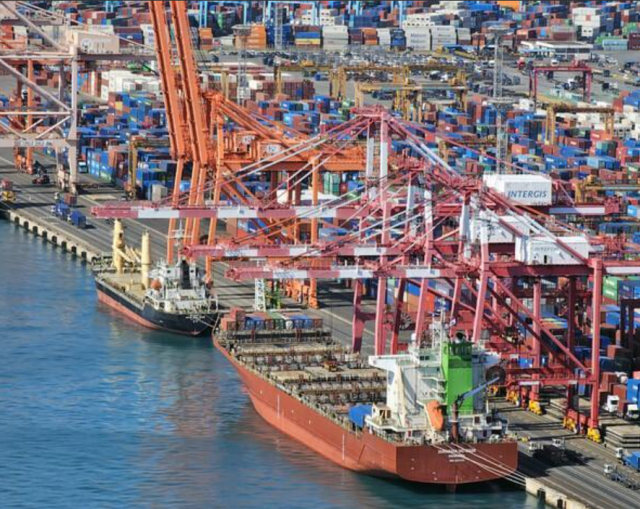
SEOUL, August 7 (AJU PRESS) - South Korea posted the largest current account surplus in six years and nine months in June, driven by strong semiconductor exports, the Bank of Korea said Wednesday.
The current account balance recorded a surplus of $12.26 billion in the month, the largest since the $12.34 billion surplus in September 2017.
The cumulative surplus for the first half of 2024 was $37.73 billion, up from $1.15 billion in the same period last year.
Exports totaled $58.82 billion, up 8.7 percent from $54.13 billion a year earlier. Exports have risen for nine consecutive months since October, when overseas shipments rebounded after 14 months of decline.
The increase was led by semiconductors, which grew 50.4 percent, followed by IT equipment at 26 percent, petroleum products at 8.5 percent and passenger cars at 0.5 percent.
Exports to Southeast Asia increased 27.9 percent, to the United States 14.8 percent, and to China 1.8 percent. Imports fell 5.7 percent to $47.35 billion from $50.22 billion a year ago.
Copyright ⓒ Aju Press All rights reserved.
Related News
-
 Korea's record export streak continues past $1 trillion
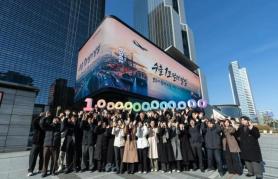
Staff of Korea International Trade Association (KITA) celebrates Korea's export milestone of $1 trillion on Nov. 19, 2026. (Courtesy of KITA) SEOUL, November 23 (AJP) -South Korea’s exports topped $1 trillion as of Nov. 20 as record chip shipments helped more than double overseas sales in the first 20 days of November from a year earlier, preliminary customs data showed Monday. Semiconductor exports nearly quadrupled to account for almost half of shipments during the 20-day period, the Korea Customs Service said. Cumulative exports reached $1.0076 trillion through Nov. 20, up 63.2 percent from a year earlier. The country crossed the $1 trillion threshold for the first time on Nov. 19. Exports for Nov. 1–20 totaled $77.4 billion, up 101.5 percent from a year earlier and the highest ever recorded for the first 20 days of any month. The previous record was $71.6 billion set in September this year. South Korea's export trend. Source: Korea Customs Service. November preliminary. Compiled and edited by AJP, Graphics AI assisted Daily average exports rose 95.2 percent to $4.84 billion. The period had 16 working days, half a day more than a year earlier. Chip shipments surged 294.4 percent to $38.5 billion, also a record for a 20-day reporting period. Semiconductors accounted for 49.7 percent of exports, up 24.3 percentage points from a year earlier. The figures underscore the growing weight of chips in Korea’s export performance, with a single product category now generating nearly as much overseas revenue as all other goods combined. Petroleum product exports rose 91.9 percent to $4.13 billion, while shipments of computers and peripherals jumped 330.6 percent to $3.67 billion. Passenger car exports fell 5.6 percent to $3.59 billion. Ship exports increased 85.1 percent and steel shipments rose 27.0 percent. Car shipments in contrast fell 5.6 percent to $3.59 billion during the period. Exports expanded across all five leading destinations. Shipments to China jumped 145.6 percent to $20.05 billion, while those to the United States rose 142.7 percent to $16.44 billion. Korea's record exports streak as of November 2026. The November figure preliminary. Source: Korea Customs Service. Compiled and edited by AJP. Graphics AI assisted Exports to Vietnam increased 85.8 percent, Taiwan 149.7 percent and the European Union 25.7 percent. China, the United States and Vietnam together accounted for 55.5 percent of total shipments. Imports rose 39.4 percent to $50.3 billion during the period, leaving a trade surplus of $27.1 billion — a record for the first 20 days of a month. Semiconductor imports increased 103.4 percent, crude oil 83.4 percent, gas 93.9 percent and machinery 13.8 percent. Combined imports of crude oil, gas and coal rose 78.5 percent. Imports from China climbed 52.5 percent, while purchases from the United States increased 45.2 percent. Imports from the EU, Taiwan and Japan rose 17.0 percent, 81.5 percent and 27.0 percent, respectively. For the year through Nov. 20, imports totaled $685.5 billion, up 22.6 percent, bringing the cumulative trade surplus to $322.1 billion. Tags: South Korea exports, Korea trade, $1 trillion exports, semiconductor exports, chip boom, falling car exports, automobile exports, November trade data, Korea Customs Service, trade surplus
-
 Government Aims to Spread $1 Trillion Export Achievement to SMEs
The government is preparing policies to spread the achievement of the first-ever annual export of $1 trillion to small and medium enterprises (SMEs) and the overall industrial ecosystem. The plan aims to expand SME participation in national large-scale projects and strengthen cooperative growth between large corporations and SMEs to alleviate the growth gap between industries and companies.The Ministry of Trade, Industry and Energy and the Ministry of Small and Medium Enterprises and Startups will hold the first meeting of the 'Task Force for Addressing Polarization: Industry and Enterprise Gap Mitigation' on the 23rd, co-chaired by Deputy Minister Park Dong-il and First Deputy Minister Noh Yong-seok. This meeting is a follow-up to the 'Directions for Addressing Polarization' announced jointly by relevant ministries on the 11th.At that time, the government activated a comprehensive task force to alleviate polarization in five areas: the labor market, industry and enterprises, regions, generations, and society, and began to identify policy tasks by sector. The government's motivation to address polarization stems from the concern that the growth achievements centered on exports and large corporations have not sufficiently spread to SMEs and vulnerable groups.In particular, the boom in certain industries, such as semiconductors, has not led to balanced growth across the economy, making it a policy task to resolve productivity gaps between industries and company sizes. On the 19th, South Korea became the fourth country in the world to achieve annual goods exports of $1 trillion, following the United States, China, and Germany, thanks to the semiconductor boom. From January to October of this year, SME exports also reached $107.6 billion, a 9.9% increase compared to the same period last year, marking the highest ever. During the same period, the number of exporting SMEs increased to 94,000 companies.The government plans to focus on reviewing ways for SMEs to participate in national large-scale projects to spread this export growth trend across the industry. In particular, it will focus on strengthening joint technology development and cooperative growth between large corporations and SMEs in advanced industries such as semiconductors and artificial intelligence (AI), and building a growth ladder that connects small, medium, and large enterprises.The Industry and Enterprise Gap Mitigation Task Force will hold regular meetings weekly to gather opinions from relevant ministries, national research institutions, and private experts to refine policy tasks. The identified tasks will be categorized into immediately actionable tasks, institutional improvement and promotion tasks for next year, and tasks requiring social discussion and public discourse. Core tasks confirmed through inter-ministerial consultations will be reflected in the '2027 Economic Growth Strategy.'Deputy Minister Park Dong-il stated, "Recently, our country has achieved remarkable results, surpassing $1 trillion in exports for the first time in history," and added, "We will strengthen the growth ladder connecting small, medium, and large enterprises while ensuring that the fruits of growth are evenly distributed across the entire industrial ecosystem through technology development and cooperative growth led by anchor companies."First Deputy Minister Noh Yong-seok emphasized, "It is important to create a policy environment that allows the achievements of growing industries to spread not just to a few large corporations but to all SMEs," and stated, "We will identify policy tasks that match the growth stages and conditions of companies."* This article has been translated by AI.
-
South Korea Enters $1 Trillion Export Era, Preparing for the Next Chapter
South Korea has finally entered the $1 trillion export era, becoming the fourth country in the world after the United States, Germany, and China. This achievement surpasses even Japan, a nation that has not reached this milestone. A country that once lacked resources and capital has risen to become a global manufacturing powerhouse. This historic accomplishment is the result of the challenges faced by entrepreneurs, the hard work of laborers, the dedication of engineers, and the nation's industrial policies. However, while celebrating this achievement, we must ask: How much has the $1 trillion in exports enriched the lives of the people? And how sustainable is this boom? The record exports this year were driven by semiconductors, which accounted for 42.7% of total exports from January to October. The explosive growth of the artificial intelligence (AI) industry and global investments in data centers have provided significant opportunities for the South Korean economy. However, as reliance on specific industries increases, the impact on the national economy grows when those industries face challenges. The U.S. Federal Reserve recently pointed out in its financial stability report that there has been a surge in debt issuance related to advanced computing infrastructure, including AI data centers. By October of this year, the amount of related debt issuance exceeded $680 billion, nearly five times that of 2023. If massive capital investments do not translate into sufficient returns, both businesses and financial markets could face difficulties. This situation brings to mind the dot-com bubble around the year 2000. The internet did not disappear; rather, it transformed the global economy. However, many companies that rode the wave of excessive expectations collapsed. Technological revolutions and investment successes are not synonymous, and the same applies to AI. What South Korea needs to be wary of is not AI itself but rather reckless investments and excessive optimism regarding the semiconductor boom. If semiconductor prices fall and global AI investments undergo adjustments, exports, corporate profits, capital investments, and tax revenues could all be adversely affected. When the tide of prosperity recedes, the underlying strength of our economy will be revealed. So, how should South Korea prepare for the future? The answer lies in the history of past industrialization. The success of South Korean manufacturing was a result of adapting to changes in the global order. During the Cold War, the country leveraged the international political environment to lay the groundwork for industrialization. After China joined the World Trade Organization (WTO), South Korea expanded its exports of intermediate goods such as semiconductors, steel, and petrochemicals, leading to growth. In shipbuilding, automobiles, and electronics, South Korea accumulated technology and entered the global market. However, yesterday's formula for success does not guarantee tomorrow's achievements. China is no longer just a factory assembling South Korean intermediate goods. It has become a formidable competitor threatening South Korea in electric vehicles, batteries, solar energy, and advanced manufacturing. The United States is also strengthening protectionism and domestic-centered industrial policies. The order of global trade is changing. We are moving from an era where competition was based solely on price and production capacity to one where technology, supply chains, economic security, and trust all determine competitiveness. This change presents both a crisis and an opportunity for South Korea. The country is unique in possessing a diverse manufacturing base that includes semiconductors, automobiles, shipbuilding, steel, batteries, and electronics. This industrial diversity is a strong strategic asset in the new international order. South Korea must evolve from being merely an exporter of products to a nation that exports technology, production systems, and industrial ecosystems. It should expand its industrial cooperation networks connecting Europe, ASEAN, India, the Middle East, and Latin America. Economic diplomacy must also be restructured to focus on joint investments, technological cooperation, and supply chain building. Domestic industrial policies must also change. Investments in AI and semiconductors should continue. However, we must move away from competing solely on investment scale. Market viability, profitability, technological differentiation, and employment effects must be rigorously verified. In particular, combining AI with manufacturing sectors where South Korea has global competitiveness—known as physical AI—represents an important strategic choice. Integrating AI into robotics, automobiles, shipbuilding, logistics, agriculture, and healthcare can enhance the competitiveness of existing manufacturing while creating new industries. We must also foster industries such as biotechnology, aerospace, advanced materials, and energy. While focused investments in specific industries are necessary, the national economy must not become dependent on a single industrial competition. We need to innovate systems for entrepreneurship, investment, research and development, and talent cultivation to allow new global companies to emerge. Above all, it is crucial to connect the success of exports to the lives of the people. Just because semiconductor companies are performing well does not mean that job opportunities for young people will automatically increase. Similarly, an increase in stock indices does not guarantee a rise in sales for small business owners. AI can enhance productivity while simultaneously displacing some jobs. If the benefits of technological innovation concentrate in a few companies and capital, a larger gap will emerge between the achievements of an export powerhouse and the lives of its citizens. The government must not treat industrial policy and livelihood policy as separate tasks. It should create a structure where large and small businesses grow together, productivity improvements lead to better wages and job quality, and the benefits of technological innovation spread to local economies and the lives of the people. What is the ultimate purpose of the economy? Eastern classics have long sought the answer in human life. Laozi warned in the "Tao Te Ching" that the hunger of the people is linked to the excessive taxation by rulers. Confucius emphasized the importance of teaching after enriching the people in the "Analects." The concept of Zhongyong (中庸) in the "Doctrine of the Mean" represents a spirit of achieving harmonious order beyond extremes. This can be interpreted as a teaching that the prosperity of the state cannot be separated from the lives of its people. We also have the ideal of Hongik Ingan (弘益人間), which means to benefit humanity widely. The phrase Injung Cheonji Il (人中天地一) from the "Cheonbu Gyeong" can be interpreted to mean that heaven and earth meet as one within humanity. This insight suggests that humans, nature, and the universe are not separate. It resonates with the spirit of Hongik Ingan. The national philosophy in the age of AI must be rooted in this understanding. Technology exists for humanity, and industries must develop for the lives of the people. Sharing the fruits of growth and achieving harmony between humanity, culture, and nature is the path to practicing the spirit of Injung Cheonji in today's economic policy and realizing the ideal of Hongik Ingan. South Korea has prospered through manufacturing. It must now advance to become a nation where technology, industry, and human life develop together. The $1 trillion in exports is not an endpoint but a new starting point. The record of exports remains in numbers. The success of a nation is proven through the lives of its people.* This article has been translated by AI.