
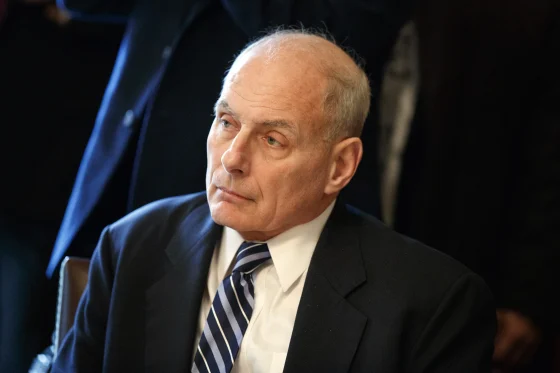
The retired Marine general who served as chief of staff from 2017 to 2019 told the British newspaper The Times, "Certainly the former president is in the far-right area, he's certainly an authoritarian, admires people who are dictators - he has said that. So he certainly falls into the general definition of fascist, for sure."
In another interview with The New York Times, Kelly further said that Trump "certainly prefers a dictator-style approach to governing."
Kelly's remarks came just two weeks before next month's presidential election, adding to the growing list of warnings from Trump's former aides about his approach to the presidency and how he might exercise power if re-elected.
Kelly recounted instances where Trump praised the loyalty of Adolf Hitler's Nazi generals and expressed a desire for similar obedience from U.S. military leaders in interviews with American dailies like The New York Times and The Atlantic.
Vice President Kamala Harris quickly used his comments to alert voters to the potential threats Trump could pose to democratic values.
When asked whether she believed Trump is a fascist, Harris responded that he would be "a president who admires dictators" if elected again.
Copyright ⓒ Aju Press All rights reserved.
Related News
-
 OPINION: Why more men and fewer white women say they will vote for Trump in US election
Republican presidential nominee former President Donald Trump speaks at a campaign rally in Duluth, Georgia on Oct. 23, 2024. AP-Yonhap SEOUL, October 24 (AJP) - Donald Trump is leading Kamala Harris by 11 percentage points with male voters, according to a recent New York Times poll. Trump is carving out a definitive advantage with U.S. men. While Trump's core support comes from white men, he has also made notable gains with Hispanic-American and African-American men. Though Trump has repeatedly denigrated Hispanics and regularly uses anti-immigrant rhetoric, this has not been a deal breaker for the Latino community. Surveys have shown that around 50 percent of Hispanic men think that Trump is "tough" enough to be president. Trump helped ramp up disinformation around Barack Obama's qualification to run as president by claiming that he had concerns about Obama's birth certificate. Trump also defended white supremacists marching in Charlottesville, Virginia, but these moves have not deterred some young African American men from supporting him. About one in four African American men under the age of 50 plan to vote for Trump, polls suggest. Why young men like Trump A lot of Trump's support comes from young men, in particular. Pollsters noted that when President Joe Biden was still in the race, he had lost one particular category of Democrats – people who liked podcaster Joe Rogan – a demographic that is mostly young men aged 18-29. Harris is underperforming compared with Joe Biden in 2020, and this is almost entirely due to losing support with young men. The same New York Times poll showed that Trump leads Harris among young men by 58 percent to 37 percent, more or less the same as Biden before he dropped out of the race. One of the reasons why some men are flocking to Trump is that young American men have moved more to the right in general. In 2024, young men are more likely to be Republican and more likely to see themselves as conservative than in the past, while the most progressive group in U.S. history are young women. In fact, the gap between young men and young women and the politics they believe in has almost doubled in the past 25 years. Young men may be drawn to Trump because he pushes against societal pressure that men need to be apologetic for being themselves. Almost two-thirds of American men believe that men should be represented and valued more in society, according to a YouGov study. Another issue may be that some men face tremendous pressure to live up to certain expectations. Past research argued that most men who found Trump appealing were finding it difficult to live up to social standards of masculinity, referred to as a fragile masculinity hypothesis. This connection was not associated with male support for Mitt Romney in 2012 or support for John McCain in 2008, but did correlate with support for Trump in 2016 and for Republicans in the midterm elections. Trump has bolstered his macho image by increasingly acting on the campaign trail as if he is speaking to a bunch of guys in a locker room. He has become more profane and vulgar, even talking about the size of pro golfer Arnold Palmer's penis in a bizarre campaign moment. Trump also makes no attempt to be politically correct in the post-MeToo era, even complaining that noted sexual offender Harvey Weinstein got a raw deal . Though many women were repelled by Trump's running mate J.D. Vance's past videos where he claimed Washington was run by childless cat ladies, it did little to turn off Trump's supporters. For some men, these ideas play into their fears about women becoming too powerful, and that men are facing a major threat to their social status. Some of these men that Vance has been trying to appeal to are Christian extremists who would like to overturn the 19th amendment (which gave U.S. women the right to vote), and see women return to roles as homemakers. Trump also taps into the fears that some men may have about the threats posed to them by women's advancement. One-third of men who support Trump believe that women have made gains at men's expense, rising to 40 percent for men under 50 who support Trump, according to Pew Research from 2024. A survey from the Survey Center on American Life demonstrated that 19 percent of men say that women have it easier than men do, but it is men aged 18-29 who are twice as likely as men over the age of 64 to believe that this is the case. Indeed, some of the struggles young American men face are not just imagined. A Pew Research survey from 2023 found that young men in the U.S. were less likely than in years gone by to be financially independent or have a full-time job by the age of 25. Young men are also less likely than young women to be enrolled in university, and have higher rates of suicide. Why do most women not like Trump? While Trump is doing well with some men, he has been hemorrhaging support from women. In particular, women have been mobilised by Trump and Vance's misogynistic rhetoric, and by the Supreme Court's 2022 decision to overturn Roe v Wade, which had given American women the right to an abortion. Support for reproductive rights does not differ much by gender with about 61 percent of men in support, compared to 64 percent of women, but the issue is more salient for women than men. Sensing the issue of abortion could be a problem for Trump with female voters, he tried to connect with women claiming that he would be their "protector" and that he was the "father of IVF." But so far these strange statements, and Trump's boorish comments may be turning off female voters – even white women – who were a core part of Trump's support in 2016 and 2020. Trump only leads with white women by one percentage point in 2024, compared to seven points in 2020. In a historic election that has been defined by a notable gender gap, the two candidates' communication styles could not be more different. However, it remains to be seen which candidate's gender advantage will propel them to victory. ------------------------------------------------------------------------------------------------------------------------- Natasha Lindstaedt is a professor, Department of Government at the University of Essex in England. This article was republished under a Creative Commons license with The Conversation. The views and opinions in this article are solely those of the author. https://theconversation.com/us-election-why-more-men-and-fewer-white-women-say-they-will-vote-for-trump-241721
-
 OPINION: 'The Apprentice' released so close to polls, this Trump biopic is inevitably political
This image released by Briarcliff Entertainment shows Jeremy Strong (left) and Sebastian Stan in a scene from the film "The Apprentice." AP-Yonhap SEOUL, October 18 (AJP) - "The Apprentice" – a new film dramatizing Donald Trump's business career during the 1970s and 80s – is the latest in a presidential election full of controversy. The movie charts Trump's (Sebastian Stan) professional rise from an awkward nobody to hotshot real-estate tycoon. Trump's Pygmalion-like transformation is credited to his friendship with Roy Cohn (Jeremy Strong). Cohn was an infamous prosecutor who worked with Senator Joseph McCarthy during the Communist and Lavender (homosexual) scares, and as a political fixer for Richard Nixon. The key storyline is that Trump becomes Cohn's apprentice, learning underhanded ways of business and Machiavellian deal-making. Other figures said to have influenced Trump's career, such as political adviser Roger Stone, get only cameos at best. Trump does not look good. He is portrayed as vain, using amphetamines as diet pills and getting plastic surgery including liposuction and a scalp reduction. Trump rejects his alcoholic brother and later Cohn, who dies from AIDS in social disgrace. Trump is also shown to rape his then-wife, Ivana (Maria Bakalova) – a scene which made headlines after the movie's Cannes Film Festival premiere earlier this year. The rape claim was made during the couple's divorce proceedings, although Ivana said afterwards that she did not consider the incident "rape" in a criminal sense. Director Ali Abbasi says this depiction isn't a take-down of the former president but a more nuanced exploration of Trump's character. Indeed, there is sympathy for Trump – for example, by detailing the emotional pressure from his father. The film explores how this experience fueled Trump's obsession with winning, which is cultivated by Cohn and his three rules of success: "attack, attack, attack," "deny everything" and "never admit defeat." The film seeks to get inside Trump's mindset, not only as a businessperson, but unpicking what drove him in the White House, as well as the election he's now fighting. Some have criticized this approach for being too soft on Trump. A review in The Guardian called the film "obtuse and irrelevant." A further concern is that presenting Trump as a "winner" could actually be seen to legitimize amoral business practices as successful, especially given that Trump's later six bankruptcies are not clearly mentioned. The Apprentice is also a deeper commentary on America. Another character comments that Cohn's three rules also describe U.S. foreign policy. The film raises big questions about the U.S., not least where Cohn repeatedly highlights what he identifies as the country's virtues, and justifies his (sometimes illegal) actions as upholding these. The audience is left to consider what shapes America and its foreign policy – and what may be toxic about this. Will the film influence the upcoming election? The film's screenwriter, Gabriel Sherman, insists the movie is not designed "to influence people's minds." Yet the film's release so close to the polls means it is inevitably political. The Apprentice is unlikely to radically shift the electoral needle. Trump's negative portrayal may make some voters on the fence question his suitability for high office. But beyond this, the film will reinforce what people already thought. Pro-Trumpers won't like the movie, but this upset will likely just give oxygen to their support. Those against Trump will also be able to feel their opinion has been affirmed, even by those who would have wanted the film to take a harder line. Although it's perhaps uncertain whether anyone who dislikes Trump will want to spend two hours watching even more of him than they already have in this election. While the film likely won't influence the final outcome, it is still a major marker in this election thanks to the huge controversy around it. Concern over its divisive portrait of Trump meant the movie took five years to reach production. Clint Eastwood turned down the option to direct due to the perceived business risk involved. Distribution also took time to secure – a situation Abbasi describes as a "boycott or censorship." Distribution problems were also exacerbated by legal threats. After Cannes (where the film received an eight-minute ovation), Trump's legal team issued a cease-and-desist letter. Communications Director for the Trump election campaign, Steven Cheung, said the film was "garbage" and "pure fiction," constituting election interference. Strong resistance also came from billionaire and close Trump associate, Dan Snyder, who was involved in the film's financing, thinking it would paint a positive picture of the presidential hopeful. Snyder later sought to block the film's release after seeing a preview. Controversy has only raised the movie's profile. And while people will watch it for very different political reasons, some will buy a ticket purely because this film is now a standout event in one of the most contentious U.S. elections in history. ------------------------------------------------------------------------------------------------------------------------- Michelle Bentley is a professor of international relations at the Royal Holloway University of London. This article was republished under a Creative Commons license with The Conversation. The views and opinions in this article are solely those of the author. https://theconversation.com/the-apprentice-released-so-close-to-the-polls-this-trump-biopic-is-inevitably-political-241077
-
 OPINION: How Middle East conflict could influence US election – and why Arab Americans in swing states might vote for Trump
Republican presidential nominee former President Donald Trump speaks at a campaign event at the Ryder Center at Saginaw Valley State University in Michigan on Oct. 3, 2024. AP-Yonhap SEOUL, October 4 (AJP) - As we near the first anniversary of the Oct. 7 attack on Israel, the conflict in the Middle East has escalated significantly. Iran just launched nearly 200 missiles on Israel, and Israel has continued its fight against Hezbollah in Lebanon, and Hamas in Gaza. In addition to the assassination of top Hezbollah commanders, including its leader Hassan Nasrallah, Israel has struck hundreds of targets in southern Lebanon, the Bekaa and the suburbs of Beirut in the past few days. It has also expanded the conflict to include a limited ground invasion into Lebanon. Meanwhile, despite ongoing efforts by the U.S., the possibility of some kind of ceasefire in Gaza and the wider region seems ever more remote. After the Iranian missile strikes, a U.S. state department spokesman said: "We are not going to give up on reaching a ceasefire in Gaza because we believe it is the best way to free the hostages." But he later added, referring to Hamas, "you need both parties to engage and right now we have a refusal to engage by one of those parties." It looks more and more likely that there will be no political win for President Joe Biden in the Middle East before the Nov. 5 election, as his team had clearly been hoping. Some argue that this is partly because Israeli prime minister Benjamin Netanyahu is hoping that Donald Trump wins in November, and that he could then draw the U.S. into a confrontation with Iran. Ceasefire blocked The U.S. seemed to be making some headway on a ceasefire in July. But then came the assassination of Hamas political leader, Ismail Haniyeh, in Tehran (which Israel has not admitted to). Some have argued that this was not only an attempt to draw Iran into the conflict, but a clear blow to the chances of a ceasefire. The more pragmatic Haniyeh was soon replaced by the more extremist Hamas commander, Yahya Sinwar. The U.S. was again hopeful of a peace deal in September, but Netanyahu torpedoed the deal with last-minute demands. These included for armed men be barred from returning to northern Gaza during an eventual ceasefire, and that Israel retain control of the Philadelphi Corridor, a narrow band along Gaza's border with Egypt. Reports suggested that Netanyahu was deliberately undermining negotiations and using delay tactics over the summer. But what is the political purpose of delaying peace? Netanyahu is banking on Trump winning the election, and having a U.S. partner that is easier to manipulate than Biden. Netanyahu has boasted that he was able to convince Trump to exit the Iran nuclear deal, a historic deal engineered by the Obama administration in 2015 to lift economic sanctions on Iran in exchange for curbs on its nuclear programme. It was considered by many to be a step towards global peace. Trump's controversial decision to move the U.S. embassy from Tel Aviv to Jerusalem — which Palestinians also claim as their capital – was also a symbolic win for Netanyahu and the Israeli right. Arab-American voting patterns Despite Trump's unconditional support for Israel, many Arab Americans are more likely to vote for Trump (or at least vote against Kamala Harris) in November. Jewish American voters have traditionally tended to vote for the Democratic ticket, with about 70 percent of Jewish citizens identifying as Democrats. This is important as there are sizeable Jewish communities in swing states such as Pennsylvania (with 433,000), Florida (with 672,000), and Georgia (with 141,000). Recent polls show that 72 percent of Jewish voters back Harris against Trump. And while 75 percent of American Jews claimed that Israel is important to them, it ranked only 9th on a list of 11 issues in terms of importance to shaping their vote. The same can't be said for the Arab-American communities, who have been devastated by the conflict in Gaza (and now Lebanon) and are angered by Biden's response to Israel. While the U.S. has used diplomatic pressure to agitate for a ceasefire, it also recently sold Israel another US$20 billion (£15.08 billion) in fighter jets and other weapons. This is one of the largest military packages since the beginning of the Gaza war. Given a list of ten issues and asked to choose the three most important, 60 percent of Arab Americans polled chose Gaza, and 57 percent said the war in Gaza would influence their vote. This may explain why nearly 80 percent of Arab American voters have an unfavorable view of Biden (based on a poll taken in May). Only 55 percent have an unfavorable view of Trump. Though Arab-Americans don't necessarily like Trump, they cannot stomach supporting an administration that failed to prevent the humanitarian catastrophe in Gaza. They may either not vote or vote for a third-party candidate. And Netanyahu is banking on this issue affecting the election in Trump's favor. Arab Americans constitute a critical voting bloc in swing states, such as Pennsylvania (126,000 Arab Americans) and Michigan (392,000 Arab Americans). It's likely that the Jewish American vote from 2020 to 2024 won't change, but Arab Americans supported Biden nationally with 64-percent support in 2020, and in the key state of Michigan provided Biden with almost 70-percent support. This could tip the balance against Harris in a state that Biden won with only 154,000 votes. Many Arab American voters are not convinced that Harris represents a departure from Biden — and in a poll conducted by the Council on American-Islamic Relations in Michigan in August, only 12 percent of Muslim American voters in that state support Harris. These voters are demanding a ceasefire. But we won't see a ceasefire anytime soon. Prior to the Oct. 7 attacks on Israel, Netanyahu was fighting for his own political survival. Netanyahu, who is still on trial for criminal charges for fraud, bribery and breach of trust, has repeatedly discredited democratic institutions and was resisting public pressure to step down. After the attacks in Lebanon, Netanyahu is now rebounding in the polls in Israel. Netanyahu is facing less internal pressure for a ceasefire in Gaza, and is gaining more confidence that aggression will pay off. In our view, the more aggressive Netanyahu's government is (both in Lebanon and in Gaza), the greater the likelihood that Trump will be elected. This all works perfectly for Netanyahu as it could allow him to look beyond Lebanon and target his biggest obsession: Iran. ------------------------------------------------------------------------------------------------------------------------- Natasha Lindstaedt is a professor at the University of Essex in England. Faten Ghosn is a professor at the University of Essex in England. This article was republished under a Creative Commons license with The Conversation. The views and opinions in this article are solely those of the authors. https://theconversation.com/how-the-middle-east-conflict-could-influence-the-us-election-and-why-arab-americans-in-swing-states-might-vote-for-trump-240065