
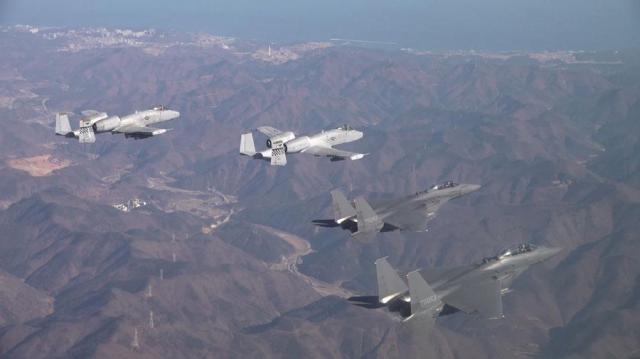
The show of force came just a day after North Korea fired multiple short-range missiles into the East Sea, ahead of the inauguration of incoming U.S. President Donald Trump.
According to the Defense Ministry here, the trilateral drill, which also involved the deployment of the country's F-15K fighter jets and Japan's F-2 fighters, was the first of its kind this year, after a similar exercise in November last year.
"The three countries will continue to expand trilateral drills and strengthen cooperation in response to North Korea's threats," a ministry official said.
The B-1B bombers are the largest and fastest aircraft in the U.S. fleet, and North Korea has reacted nervously whenever they fly around the peninsula. It takes them just about two hours to reach here from the U.S. military base in Guam.

Copyright ⓒ Aju Press All rights reserved.
Related News
-
 US Intelligence Estimates Iran Has Up to 2,500 Missiles, Contradicting Trump's Claims
US intelligence agencies estimate that Iran possesses between 1,500 and 2,500 missiles, according to reports. This assessment contradicts President Donald Trump's assertion that Iran's military capabilities have been effectively decimated.On November 14, the Wall Street Journal reported that US intelligence agencies believe Iran retains significant military capabilities to strike the US and its allies in the Middle East if a full-scale war resumes. The Israeli military also assesses Iran's missile stockpile to be over 1,500.Earlier this year, the US and Israel destroyed many of Iran's missile production facilities during airstrikes following the outbreak of conflict in February. However, US intelligence indicates that Iran is gradually replenishing its arsenal using previously stockpiled components, albeit at a slower pace than before the war.Simon Liddin, who served as the Deputy Assistant Secretary of Defense for the Middle East during the Trump administration, noted that even the lower estimate of 1,500 missiles suggests Iran has recovered more than half of its pre-war stockpile.Iran Resumes Attacks on US Bases in the Middle East After Two MonthsAs US-Iran ceasefire negotiations stall, Iran has resumed attacks on US military facilities in the Middle East after a two-month hiatus, targeting commercial vessels in the Strait of Hormuz.On November 15, the Islamic Revolutionary Guard Corps (IRGC) announced it had attacked a US military base in Bahrain using drones to target its air defense radar system.The IRGC claimed in a statement posted on Telegram that six drones from its aerospace division struck the US air defense radar system at the Al Udeid helicopter base in Bahrain.Threats are also emerging at sea. The Iranian state news agency IRNA reported on November 14 that three oil tankers in the Strait of Hormuz caught fire after hitting naval mines, according to the IRGC Navy. The IRGC stated that these vessels were using unauthorized routes without navigation systems and claimed they exploded after inadvertently passing through a prohibited area.However, Reuters reported that it could not independently verify the IRGC's claims.Minister Kim Jeong-gwan Calls Extension of Oil Price Cap InevitableThe government has extended the oil price cap for another four weeks, with Minister of Industry and Trade Kim Jeong-gwan explaining that it was an unavoidable measure considering the burden on consumers.On November 15, Minister Kim shared his views on social media regarding the extension of the oil price cap, which was decided on November 13, outlining its background, limitations, and future policy direction.Initially implemented in March due to instability in the Middle East, the oil price cap has now been in place for nine months. Kim stated that the decision to extend was not easy, emphasizing that the government is limiting market pricing while bearing financial burdens. He noted that this system cannot continue indefinitely.He identified the ongoing instability in the Middle East as a key reason for not lifting the cap. While he acknowledged some expectations of stabilization due to recent declines in international oil prices, he cautioned that it is too early to feel secure and that the potential for further deterioration remains.Kim expressed concern about the economic impact of abruptly ending the cap, stating, "Above all, I worry about the burden that citizens would have to bear if we end the price cap now. Rising fuel prices do not stop at gas stations; they lead to increased logistics and production costs, which could burden ordinary citizens, small businesses, and companies alike."New National Safety Secretary Appointed from Police AgencyKim Sung-jae, the spokesperson for the National Police Agency, has been appointed as the new National Safety Secretary under the Blue House.On November 15, political sources reported that the Blue House has selected Kim to succeed Lee Jong-won, the inaugural National Safety Secretary.Kim is expected to start working at the Blue House as early as November 16.Having been promoted to police chief in September, Kim is transitioning to this new role just two months after taking on the spokesperson duties.Lee Jong-won, the former National Safety Secretary, is anticipated to return to the police organization after being promoted to the rank of police commissioner.Zelensky: US Asked If Ukraine Would Withdraw from Donbas for NATO MembershipIn ongoing US-mediated ceasefire negotiations between Russia and Ukraine, a proposal has emerged to exchange Ukraine's NATO membership for a withdrawal from the eastern Donbas region. Ukraine, which has maintained a firm stance against territorial concessions, indicated it might consider this option if it receives solid security guarantees.On November 14, Ukrainian President Volodymyr Zelensky told reporters that he was asked by US representatives during recent negotiations whether Ukraine would withdraw from Donbas if it joined NATO.Zelensky stated, "This is the first time such a question has been raised by the US." He reaffirmed that Ukraine has no intention of withdrawing its military from the Donbas region and will not recognize Russian-occupied Ukrainian territory as part of Russia. However, he expressed willingness to consult the public on this matter if comprehensive security guarantees, a strong military presence, and post-war reconstruction funding are assured by NATO and the European Union.* This article has been translated by AI.
-
Prospects for South Korea-China Summit Rise Amid North Korea-Russia Ties
As the Asia-Pacific Economic Cooperation (APEC) summit approaches, the likelihood of a South Korea-China summit is increasing, while North Korea continues to strengthen its ties with Russia. With the U.S.-China-Russia summit set for November 19, there are concerns that South Korea may be excluded from discussions regarding the Korean Peninsula. The prospects for both South Korea-U.S. and North Korea-U.S. summits remain uncertain.On November 15, the Korean Central News Agency reported that a North Korean delegation led by Jo Yong-won, a secretary of the Workers' Party of Korea, visited Russia the previous day. This visit was made at the invitation of the ruling United Russia party.In contrast, discussions are underway for a summit between South Korean President Lee Jae-myung and Chinese President Xi Jinping. South Korean Foreign Minister Park Jin stated during a press briefing at the South Korean embassy in China that "the Chinese side fundamentally focuses on economic cooperation rather than political relations with North Korea," adding that he had in-depth discussions with Chinese Foreign Minister Wang Yi regarding the potential for a North Korea-U.S. summit.He emphasized the importance of preparing for changes that the citizens of both countries can feel, especially as they approach the 35th anniversary of diplomatic relations next year, during the APEC summit.However, it is unlikely that the South Korea-U.S. and North Korea-U.S. summits will take place during this APEC meeting. A foreign ministry official refrained from commenting on the possibility of a South Korea-U.S. summit. Speculation has also arisen that U.S. President Donald Trump will not meet with North Korean leader Kim Jong-un during his trip to Asia.Amid these developments, there are concerns that the Korean Peninsula issue may be addressed at the U.S.-China-Russia summit without the involvement of South Korea and North Korea. A senior official from the South Korean foreign ministry conveyed to the U.S. and China that the upcoming summit should not resemble a second Yalta Conference, referring to the 1945 meeting where the leaders of the U.S., the U.K., and the Soviet Union discussed post-war arrangements and the reorganization of international order.Kang Jun-young, a professor at the Graduate School of International and Area Studies at Hankuk University of Foreign Studies, stated in a conversation with Aju Economy that it is crucial for South Korea not to be excluded if the Korean Peninsula issue is discussed at the U.S.-China-Russia summit. He also noted that the South Korea-China summit should focus on practical issues such as supply chain cooperation between the two countries.* This article has been translated by AI.
-
Military Compensation of 150 Billion Won Unpaid, 4,637 Individuals Await Payments
The amount of military compensation that the Ministry of National Defense is required to pay has surged, yet the related budget falls significantly short of actual needs. A total of 4,637 individuals have not received compensation despite court rulings, with unpaid amounts exceeding 150 billion won. According to data submitted by Yoo Yong-won, a member of the National Defense Committee from the People Power Party, as of September 30 this year, the unpaid military compensation totaled 150.6 billion won. There have been cases where individuals have not received payments for about seven months after filing claims in February. Military compensation is a program that provides damages to citizens harmed during the execution of duties by the Ministry of National Defense or the military. It primarily includes compensation for historical incidents such as the Samcheong Education Center and the Jeju 4.3 Incident. While the scale of compensation payments is rapidly increasing, the budget allocations have not kept pace. The amount disbursed for military compensation rose from 87.9 billion won in 2023 to 135.7 billion won in 2024 and 179.4 billion won in 2025, marking an approximate 104% increase over two years. In contrast, the budget allocations decreased from 27.7 billion won in 2023 to about 17.7 billion won in both 2024 and 2025, a reduction of approximately 36%. This year, the allocated amount was only 20.0 billion won, yet by the end of August, 89.6 billion won had already been disbursed. The expected total disbursement by the end of the year is projected to reach 202.3 billion won. The Ministry of National Defense has been covering the shortfall in compensation budgets by reallocating funds from other projects. The amounts secured through this method were 118.0 billion won in 2024 and 171.9 billion won in 2025. This year, it was confirmed that a total of 70.0 billion won from budgets related to non-commissioned officer salaries was utilized for military compensation. The burden of interest due to delayed payments is also increasing. Delayed interest rose from 2.6 billion won in 2023 to 8.1 billion won in 2024, with 6.2 billion won expected in 2025. The estimated amount for delayed interest payments this year is projected to be 10.2 billion won. Complaints regarding payment delays submitted to the National Complaint Center increased from two in 2023 and one in 2024 to eleven in 2025, with 36 cases reported by the end of September this year. Concerns are growing that budget shortages may recur next year. The government has proposed a military compensation budget of 50.3 billion won for 2027, which is only about 29% of the Ministry of National Defense's estimated needs of 172.5 billion won for the upcoming year. Yoo stated, "The delay in compensation payments after the state’s liability rulings can undermine public trust in the government," and emphasized the need for substantial measures from the Ministry of National Defense and budget authorities to prevent ongoing situations where citizens must wait indefinitely for compensation payments. He added, "Even considering limited financial conditions, the issues of insufficient military compensation budgets and payment delays have been recurring for years. The government must closely analyze future needs to enhance the appropriateness of budget allocations and develop measures to minimize delays in compensation payments."* This article has been translated by AI.