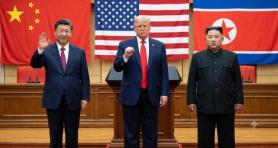
When South Korea’s new Democratic Party president took office in June, his administration moved quickly to explore the possibility of a summit between North Korea and the United States. During his first meeting with the U.S. president, President Lee Jae Myung described himself as a “pace maker” and the American president as a “peace maker,” signaling his intention to shepherd the two sides toward dialogue. His approach echoes the Moon Jae-in government’s diplomacy in 2018, when Seoul sought to revive inter-Korean engagement.
But the track record since then is sobering. Pyongyang demolished the inter-Korean liaison office, scrapped the Sept. 19 military agreement and formally labeled South Korea an enemy state. Those actions severely eroded trust, yet the Democratic Party continues to favor engagement—a stance that many critics argue risks repeating the mistakes of the past.
Given today’s geopolitical landscape, a North Korea–U.S. summit remains unlikely, at least until the war in Ukraine reaches some resolution. Former President Donald Trump recently suggested a Ukraine peace deal might be possible “with adjustments,” but the realities are far more complicated: territorial claims, security guarantees and an international order tested by revisionist powers.
Meanwhile, Seoul is reportedly considering a shift from confronting North Korea’s “hostile two-state theory” to embracing a “peaceful two-state theory” centered on coexistence. This would align with President Lee’s three guiding principles: acknowledge the North Korean regime, avoid hostile acts and reject any notion of absorption unification.
The Unification Minister has gone further, advocating recognition of “two states” and the institutionalization of a peace regime—ideas that could eventually require constitutional reinterpretation. He argues that South Korea must adjust its legal and political frameworks to reflect the long-term reality of division on the Korean Peninsula.
Still, the administration remains hopeful it can help facilitate a North Korea–U.S. dialogue. But the memory of 2018—when Seoul found itself sidelined even after brokering the initial breakthrough—serves as a warning against excessive optimism.
Some of the recent attempts underscore the challenge. Efforts to deliver a letter from Mr. Trump to Pyongyang reportedly went nowhere. Though U.S. and North Korean officials have held quiet, working-level conversations in recent weeks, North Korea’s demands were seen as unrealistic by Washington.
Kim Jong-un has since declared that denuclearization is no longer on the agenda and that future talks should instead focus on peaceful coexistence and recognition as a sovereign nuclear state. He has also claimed that sanctions relief is no longer a priority, an assertion likely rooted in Pyongyang’s strengthened ties with China and Russia.
Under these conditions, the prospect of a North Korea–U.S. summit during Mr. Trump’s planned visit to China next April appears remote. The U.S. ambassador to Seoul has noted that a second Trump administration may try unconventional approaches, but only if Washington sees clear strategic value.
A turning point could come with the end of the Ukraine war. A shift in the global balance—particularly if it weakens the North Korea–China–Russia alignment—might create new space for diplomacy. Until then, Seoul would be wise to avoid making concessions on territorial claims and to maintain a pragmatic, clear-eyed approach toward Pyongyang.
About the Author
Joo Jae-woo is a professor at Kyung Hee University. He studied political science at Wesleyan University and international politics at Peking University. He has served as a visiting scholar at the Brookings Institution and a visiting associate professor at the Sam Nunn School of International Affairs at Georgia Tech.
* This article, published by Aju Business Daily, was translated by AI and edited by AJP.
Copyright ⓒ Aju Press All rights reserved.