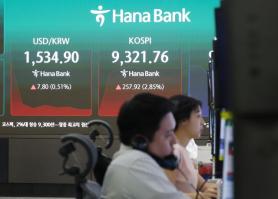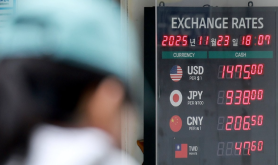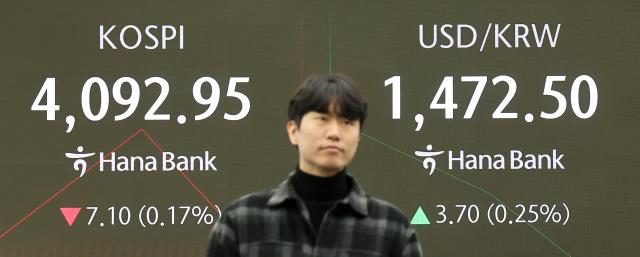
With the local currency stuck in the band of 1,470 won per dollar for nearly a month and inflation pressures reawakening, economists say the country can no longer rely on ad-hoc tools, verbal interventions, or temporary tax cuts to stabilize forex.
Instead, the entrenched weakness of the won is exposing the need for a fundamental, long-term overhaul of the nation’s macroeconomic, energy-import, and capital-flow policies.
The won slipped below 1,470 won on Monday, presumably through interventionist hands. The currency has risen for five straight months—from an average of 1,366.95 won in June to 1,469.48 won in December, a 7.5 percent jump—enough to unsettle inflation that had only recently begun to stabilize.
Already, the import price index spiked 1.9 percent in October, the fastest pace since January, pushing domestic supply prices up 0.9 percent.
Consumer inflation, at 2.4 percent, risks drifting higher as companies face steeper dollar-denominated input costs and begin passing them on. The Bank of Korea and global investment banks now expect inflation to hover near or slightly above 2 percent next year.
When a Weak Won Stops Being a “Phase”
The deeper concern is that the weak-won environment may no longer be a passing cycle but the country’s new structural baseline. A Bank of Korea study estimates that if a 10 percentage-point depreciation persists for more than three months, annual inflation rises 1.61 percentage points—a hit that could dull any nascent recovery in private consumption.
That emerging pattern is already visible at the small-business level. Even after government-backed spending coupons lifted third-quarter sales by 5.3 percent year-on-year, profits still fell 4.63 percent from the previous quarter because of elevated costs, according to KB Securities.
“Domestic demand is improving, but inflation pressure is strengthening in parallel, weakening the elasticity of the recovery,” said economist Ryu Jin-i. She expects consumer prices to peak in the third quarter of next year, pushing the central bank into a difficult trade-off between growth and inflation.
Policy Ambiguity Is Becoming Its Own Risk
Markets say they cannot tell whether the government sees the won’s weakness as structural or temporary—and that uncertainty is beginning to carry its own costs. Standard verbal warnings about “excessive one-sided moves” have had virtually no effect, largely because foreign inflows remain tepid and dollar demand remains firm.
A brief episode involving the National Pension Service’s (NPS) hedging strategy fueled further confusion. Officials suggested higher hedging ratios could stabilize the won by increasing demand for the currency, only to backtrack after public pushback over using pension assets for currency management.
Deputy Prime Minister Koo Yun-cheol later stressed that the government had no intention of “mobilizing the pension fund as a temporary tool”—a clarification that left markets questioning the strategic coherence of the policy framework.
Other inflation-containment tools—fuel tax cuts, emergency tariffs, and public-fee restraint—have been stretched to their limits. The country’s longest-standing fuel-tax reduction is still in effect. Tariff relief for grains and raw materials has been repeated so often its impact is fading. And public-utility price controls are hard to sustain if the weak-won trend continues.
At a recent policy briefing, Presidential Policy Chief Kim Yong-beom outlined three priorities: encouraging the repatriation of Korean companies’ overseas profits, examining retail investors’ overseas investment risks, and reassessing the NPS’s hedging framework. Yet each carries structural tension—tax architecture, capital-market liberalization principles, and pension-fund fiduciary duty—that makes them difficult to execute swiftly.
Structural Pressures Mount Behind the Scenes
Economists warn that the country’s 40-month run of Korea–U.S. interest-rate inversion continues to siphon funds into higher-yielding foreign assets. “Intervening with ten billion dollars stabilizes the market for a day or two at most,” said Hansung University’s Kim Sang-bong. “These are not fundamental solutions.”
Corporate hedging behavior also reflects the shift: currency-risk insurance purchases fell 32.7 percent in the first 11 months of the year, and plunged 45.8 percent in October alone—evidence that companies now see the high exchange rate as the new normal.
Meanwhile, Korea’s heavy dependence on imported energy and food magnifies its exposure. A government plan to import 100 billion dollars of U.S. energy over four years diversifies away from the Middle East but raises transportation and logistics costs. Japan and China have aggressively pursued food-supply diversification; Korea’s efforts remain tentative by comparison.
Even raw-material reserves are feeling the squeeze. The Public Procurement Service raised its nonferrous metal stockpiling budget to 80 billion won, but the same money now buys less because of rising global prices and the weaker currency.
A Moment to Rebuild Fundamentals
Although Korea’s current-account surplus—bolstered by a rebound in semiconductor exports—helps cushion capital outflows, economists emphasize that a long-term remedy lies not in patchwork interventions but in reinforcing macroeconomic fundamentals and improving the domestic investment environment.
“Instead of relying on short-lived measures, it is time to redesign the policy framework from the ground up,” said Seoul National University economist Ahn Dong-hyun. “Korean companies are investing more abroad than they are reshoring. Regulatory improvements and a stronger domestic base are essential to reversing that trend.”
For now, the won remains pinned near 1,470 won per dollar—an indicator not just of currency markets but of a broader strategic question: whether Korea’s policymakers can shift from crisis response to a durable, forward-looking policy architecture that prevents the weak-won, high-inflation cycle from becoming a structural feature of the economy.
* This article, published by Aju Business Daily, was translated by AI and edited by AJP.
Copyright ⓒ Aju Press All rights reserved.