

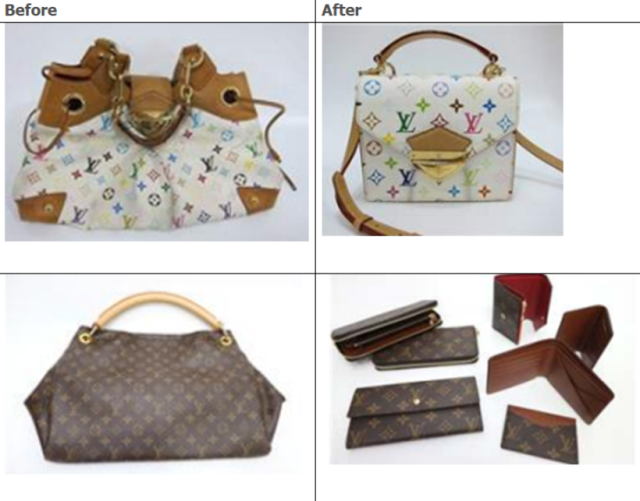
SEOUL, December 18 (AJP) -South Korea’s Supreme Court will hold a public hearing later this month to decide whether remodeling luxury handbags into entirely new products constitutes trademark infringement, a case expected to set the court’s first clear benchmark on the legal limits of the so-called “reform” or upcycling business.
According to the Supreme Court on Thursday, its Second Division, presided over by Justice Kwon Young-joon, will hear public arguments at 2 p.m. on Dec. 26 in Courtroom No. 1 in a lawsuit seeking an injunction for trademark infringement.
The case pits French luxury brand Louis Vuitton against a bag remodeling operator, with the central question being whether extensive alteration of branded goods amounts to unauthorized trademark use.
The dispute arose after the operator, at the request of customers, dismantled and remade Louis Vuitton handbags into different items — including other bags and wallets — while keeping the original Louis Vuitton logos intact. The operator charged fees for the service.
Louis Vuitton argues that the practice is indistinguishable from unauthorized manufacturing and distribution of trademarked goods. It claims that retaining the logo on substantially altered products risks misleading consumers about the product’s origin and quality, thereby infringing trademark rights.
The operator counters that consumers who lawfully purchased the bags have the right to alter their own property, including by outsourcing the work to a professional technician, and that such conduct does not constitute trademark infringement.
At issue is whether the remodeling qualifies as “trademark use” that serves a source-identifying function, whether the remodeled items should be treated as new “products” under trademark law, and whether their circulation is likely to cause consumer confusion.
Both the trial court and the appellate court ruled in favor of Louis Vuitton, finding that the remodeling exceeded permissible repair and amounted to trademark infringement. The operator appealed, sending the case to the Supreme Court.
In a key appellate ruling, the Patent Court held that refurbished luxury bags qualify as independent “goods” in the marketplace due to their substantial resale value, particularly in the active secondary luxury market. The court ordered the operator to pay 15 million won ($11,500) in damages to Louis Vuitton and issued an injunction barring further use of the brand’s trademark.
“Refurbished products hold significant value on the secondary market, just as the original items do, giving them independent value as products,” the court said.
It added that because the Louis Vuitton mark remained visible without any indication that the items had been reworked or recycled, average consumers could be misled into believing the products were original Louis Vuitton items — constituting unauthorized trademark use.
The court distinguished minimal repairs, which do not create new products, from substantial changes in size, design or structure. In this case, it found that dismantling handbags and reassembling them into wallets or differently shaped bags resulted in entirely new products, beyond the scope of trademark exhaustion.
Between 2017 and 2021, the operator used Louis Vuitton materials provided by clients to create custom bags and wallets in various sizes and designs, charging between 100,000 and 700,000 won per item. Louis Vuitton filed suit in February 2022, seeking a ban and 30 million won in damages, arguing that the practice diluted brand identity and quality guarantees.
The case will mark the sixth time the Supreme Court has convened a public hearing in a matter handled by a small panel rather than the full bench, highlighting the court’s growing use of public hearings in cases with broad social and economic implications.
Copyright ⓒ Aju Press All rights reserved.
