SEOUL, December 23 (AJP) - Researchers have developed a new technology to grow human intestinal stem cells without using animal-derived materials, resolving a major safety hurdle for regenerative medicine. The method significantly improves the ability of these cells to move and repair damaged tissues, potentially accelerating treatments for intractable gastrointestinal diseases.
The Korea Advanced Institute of Science and Technology (KAIST) announced on December 23 that a joint research team led by Professor Im Sung-gap of the Department of Chemical and Biomolecular Engineering has created a polymer-based culture platform called PLUS (Polymer-coated Ultra-stable Surface). The project included researchers from the Korea Research Institute of Standards and Science (KRISS) and the Korea Research Institute of Bioscience and Biotechnology (KRIBB).
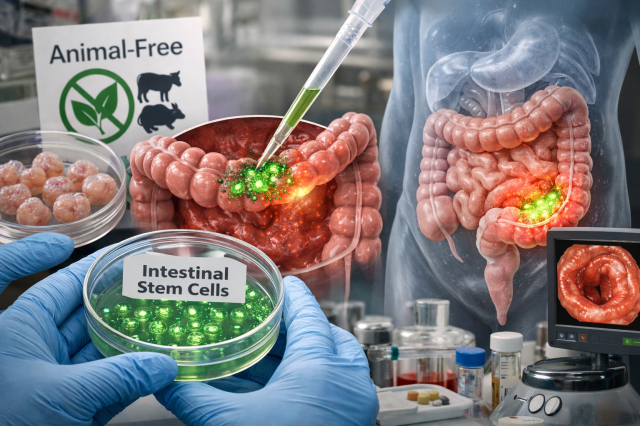
Current methods for growing intestinal stem cells often rely on "Matrigel" or mouse-derived cells to provide a foundation for growth. Because these materials come from animals, they carry risks of viral contamination and trigger strict regulatory hurdles for human use. The newly developed PLUS platform uses a synthetic polymer coating applied via gas-phase deposition, creating a completely "xenogeneic-free" or animal-free environment that remains stable at room temperature for three years.
To understand why the cells grew so well on this synthetic surface, the team used proteomics, a method of analyzing all proteins within a cell simultaneously. They discovered that the PLUS platform triggers "cytoskeletal remodeling." This process essentially reorganizes the internal structural framework of the stem cells, specifically increasing proteins that bind to actin, which the cells use as a motor to move.
Live imaging showed that stem cells grown on this platform moved nearly twice as fast as those grown on conventional surfaces. In laboratory models of damaged tissue, these cells repaired nearly half of the injured area within one week. This increased mobility is critical for cell therapy, as the injected stem cells must be able to migrate to and integrate with the patient's damaged intestinal lining to be effective.
The researchers confirmed that the platform supports the mass production of stem cells derived from human pluripotent stem cells. The cells maintained their essential characteristics for over 210 days and successfully repaired intestinal inflammation in animal models, suggesting a high potential for clinical application in humans.
"This research provides a synthetic culture platform that eliminates the dependence on animal-derived components, which has been a major barrier to the clinical application of stem cell therapies," Professor Im Sung-gap said. He noted that the technology could lead to a paradigm shift in how regenerative medicine is produced and distributed.
The study involved Park Seong-hyun and Sun Sang-yu of KAIST, and Son Jin-kyeong of KRISS as lead authors. The research was supported by the Ministry of Science and ICT and the Ministry of SMEs and Startups.
(Paper information)
Journal: Advanced Materials Title: Tailored Xenogeneic-Free Polymer Surface Promotes Dynamic Migration of Intestinal Stem Cells DOI: https://doi.org/10.1002/adma.202513371
Copyright ⓒ Aju Press All rights reserved.