A Christmas story from Seoul: in many shapes – and beyond
by Lee Jung-woo and Yoo Na-hyunPosted : December 24, 2025, 11:02Updated : December 24, 2025, 19:39
Share
facebook
twitter
URL
Text size
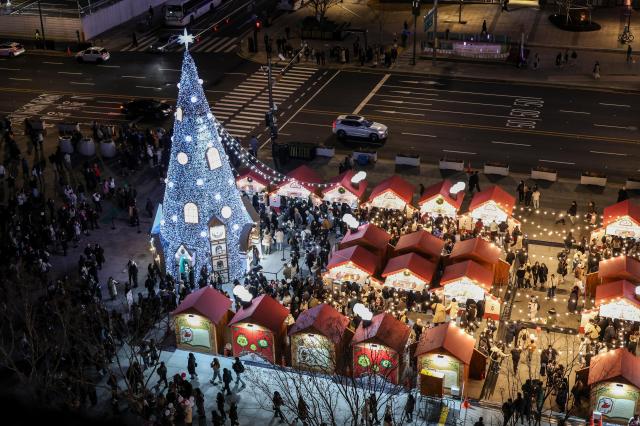
The 2025 Seoul Winter Festa/ AJP Yoo Na-hyun
SEOUL, December 24 (AJP) - In Seoul, Christmas does not arrive in a single shape.
It appears instead in layers — some rooted in history, others carried forward by habit, and still others projected in light. The city’s winter traditions do not replace one another. They accumulate.
The season often begins, quietly, with a tree.
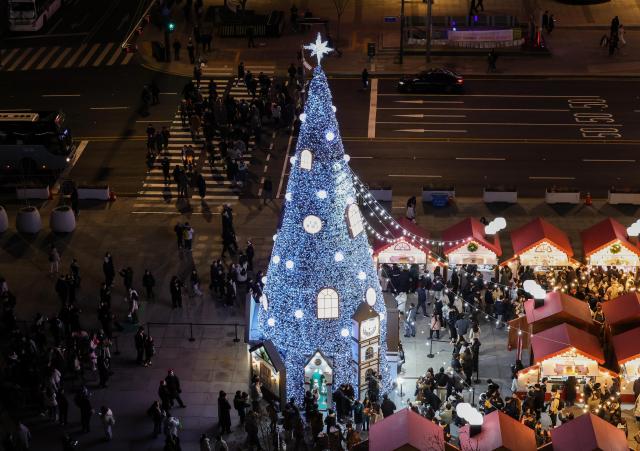
The 2025 Seoul Winter Festa/ AJP Yoo Na-hyun
Few people realize that the Christmas tree itself, as celebrated across Western societies, traces its botanical origin to Korea. The Korean fir, native to the southern regions of the Korean Peninsula and growing naturally on Hallasan Mountain in Jeju, became the most popular species used for Christmas trees worldwide. In 1920, British botanist E. H. Wilson identified the species and introduced it to the academic community. Through cultivation and commercialization, it would become one of the world’s most beloved Christmas tree varieties.
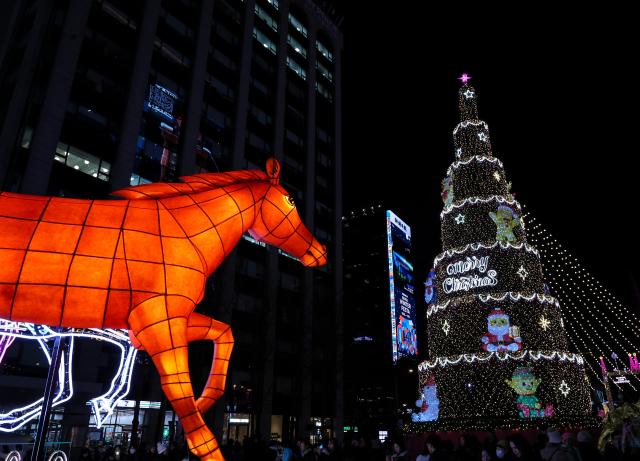
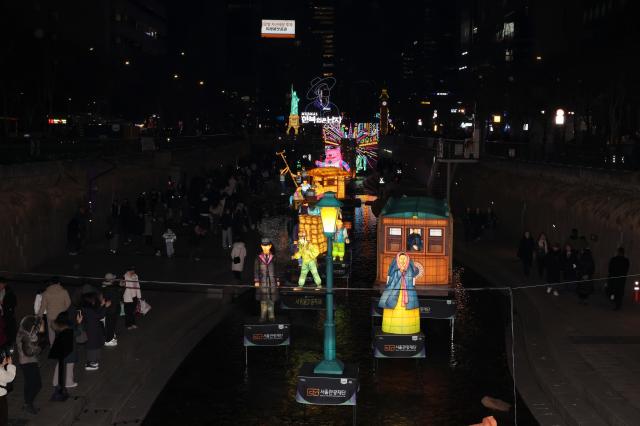
A horse-shaped lantern and a Christmas Tree along the Cheonggye Stream in central Seoul on Dec. 12, 2025. AJP Yoo Na-hyun
Korea encountered the Christmas tree early, though not without myth. Legend holds that the first person in Korea to see a Christmas tree was an empress, but no historical record confirms the story.
What is documented is that in 1897, American missionaries set up a decorated tree in Jeong-dong, where many of them lived. In letters sent to American churches, they described Korean students gathering around the tree, astonished by a sight they had never seen before.
That sense of wonder still surfaces each winter — but it is no longer confined to trees.
Another tradition appears closer to the ground, at street level.
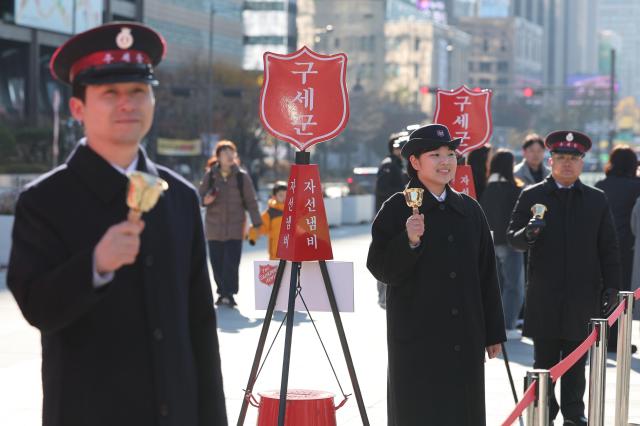
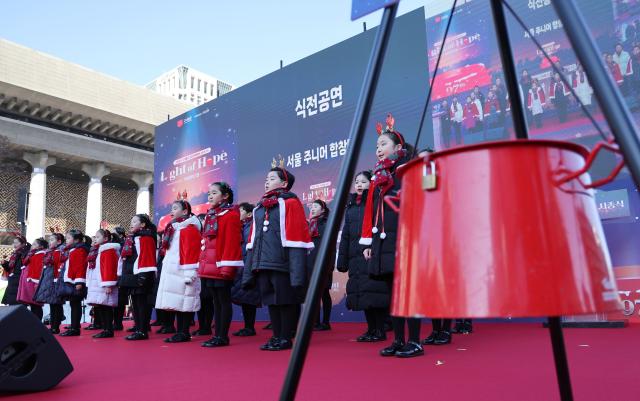
The Salvation Army Korea holds an event to mark the start of its fundraising season at Gwanghwamun Square, Nov. 28, 2025/ Yonhap
The Salvation Army’s red kettle first appeared on the streets of Myeong-dong on Dec. 15, 1928.
It was introduced by Joseph Baugh, a Swedish missionary and commander of the Salvation Army in Korea, who was moved by the plight of those driven to theft and homelessness by famine and drought. That year, around 20 kettles were placed across central Seoul, including in Myeong-dong and Jongno, collecting 812 won in the currency of the time.
The kettles remain a fixture of the season, though their sound has grown softer. Fundraising peaked at 7.74 billion won ($5.3 million) in 2016, fell sharply to 2.1 billion won in 2021 during the pandemic, and stood at 2.16 billion won last year — reflecting tighter household budgets, changing habits and the city’s shift away from cash.
The Salvation Army Korea holds an event to mark the start of its fundraising season at Gwanghwamun Square, Nov. 28, 2025/ Yonhap
Between the tree and the kettle, Seoul’s Christmas has long balanced celebration and restraint.
In recent decades, the city has added movement.
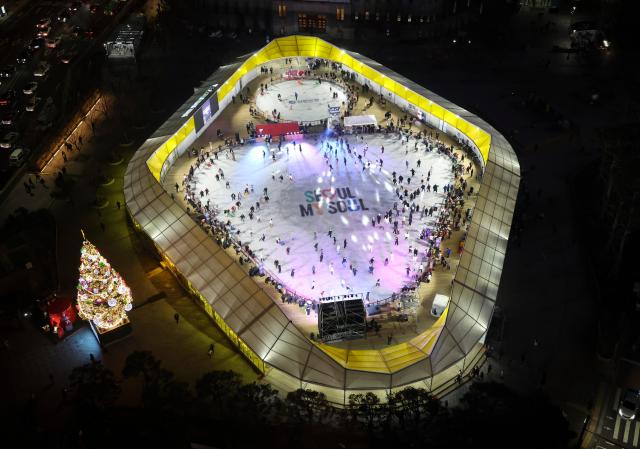
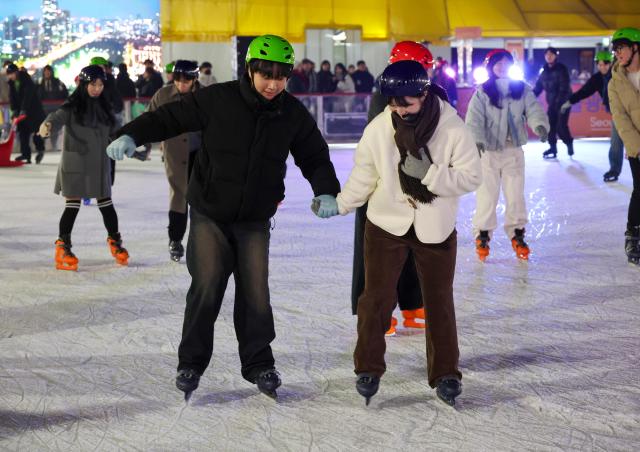
The Seoul Plaza Ice Rink, Dec. 19, 2025/ AJP Yoo Na-hyun
At Seoul Plaza, an ice rink opens beneath the winter sky. First launched in 2004, the Seoul Plaza Ice Rink has operated every year except in 2016 — when the plaza was cleared for candlelight demonstrations calling for the resignation of former President Park Geun-hye — and during the COVID-19 pandemic. Couples skate hand in hand. Children move cautiously beside their parents. This year, the rink runs through Feb. 8, with extended hours on weekends, Christmas Eve and New Year’s Eve.
For visitors, the scale of the city’s winter offerings can be unexpected.
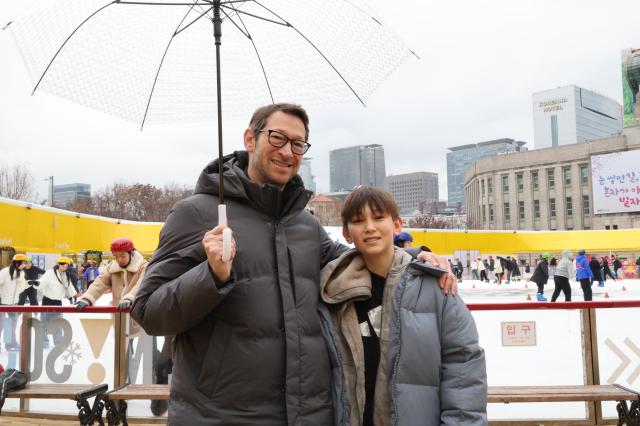
Max and his father Jason at the Seoul Plaza Ice Rink, Dec. 23, 2025/ AJP Yoo Na-hyun
“It’s definitely not as festive as here in Seoul,” said Max Rosenthal, 12, from Georgia, visiting Korea for the first time. “Definitely not,” his father, Jason Rosenthal, agreed.
“I didn’t expect it to be this big — a lot bigger and better than I thought,” Max said. “They definitely play Christmas music everywhere.”
“At all the events,” Jason added. “There’s so much to do and so many places to see the lights and festivals. We’ve spent Christmas in a few countries, like Madrid. It was festive, but only in certain areas. In Seoul, the whole city feels festive.”
When asked about their favorite sights, Max pointed to the river. Jason added another: the light show at Gwanghwamun.
The Seoul Plaza Ice Rink, Dec. 19, 2025/ AJP Yoo Na-hyun
Along the stream, lanterns offer a slower rhythm.
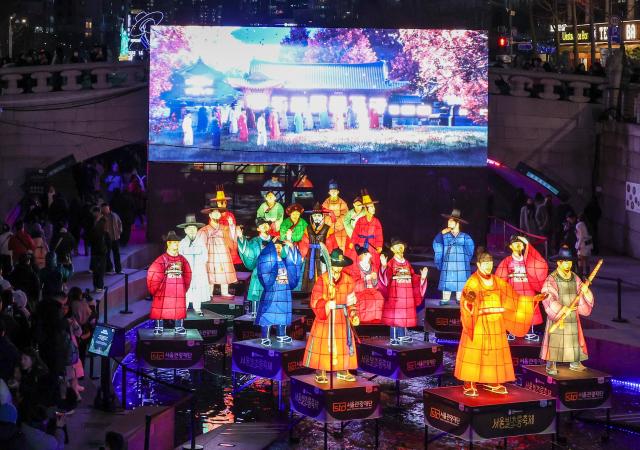
Lanterns and other installations are on display along the Cheonggye Stream in central Seoul on Dec. 12, 2025/ AJP Yoo Na-hyun
The Seoul Lantern Festival, which began in 2009, is being held for the 17th time this year under the theme “My Light, Our Dream, Seoul’s Magic.” A total of 496 works are on display, with the exhibition expanded to Uicheon in Gangbuk-gu, stretching roughly 350 meters from Uigyo Bridge to Ssanghan Bridge. A special sculpture depicting a royal procession is also featured. The lanterns glow nightly from 6 p.m. to 10 p.m. through Jan. 4.
Lanterns and other installations are on display along the Cheonggye Stream in central Seoul on Dec. 12, 2025/ AJP Yoo Na-hyun
Indoors, another tradition is reimagined.
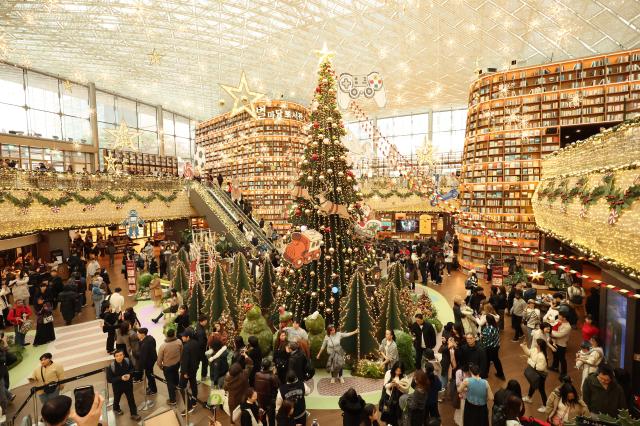
A Christmas tree stands inside Starfield Library at COEX Mall in Seoul’s Gangnam District on Nov. 20/ AJP Han Jun-gu
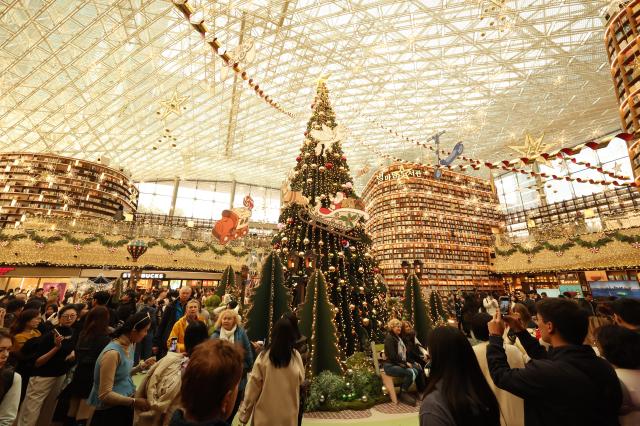
The Starfield Library inside COEX Mall, which opened in May 2017, installed its first Christmas tree that winter. This year’s Christmas festival, titled A Page of Christmas Wonder, centers on a 10-meter-tall tree made entirely of paper. According to Shinsegae Property, all decorations — from the tree to the surrounding installations — were crafted from paper, depicting the imagined journey of a boy who loves books.
A Christmas tree stands inside Starfield Library at COEX Mall in Seoul’s Gangnam District on Nov. 20. AJP Han Jun-gu
Outside, Seoul’s most contemporary expression of Christmas rises in light.
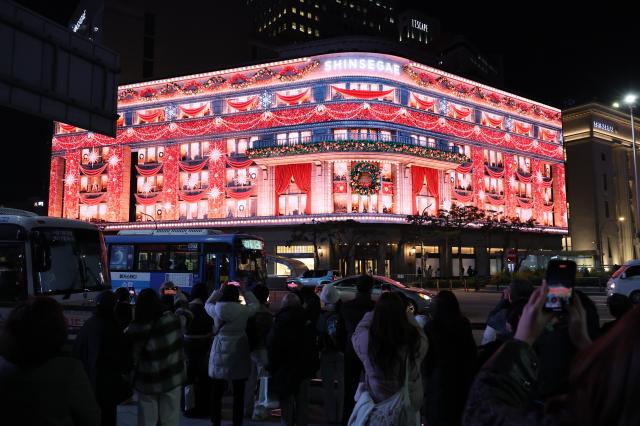
A Christmas display plays on the “Shinsegae Square” digital façade at the main Shinsegae Department Store in central Seoul on Nov. 20/ AJP Yoo Na-hyun
The main branch of Shinsegae Department Store in Myeong-dong — Korea’s oldest department store, nearly a century old and once used as a U.S. military PX during the Korean War — has served as a media façade since 2009. Early Christmas themes included The Wizard of Oz and Cinderella. In 2021, the store removed all exterior advertising, added 400,000 lights and filled the façade entirely with video displays. In 2024, it completed a giant digital signage system that now operates year-round.
All paths eventually lead to Gwanghwamun.
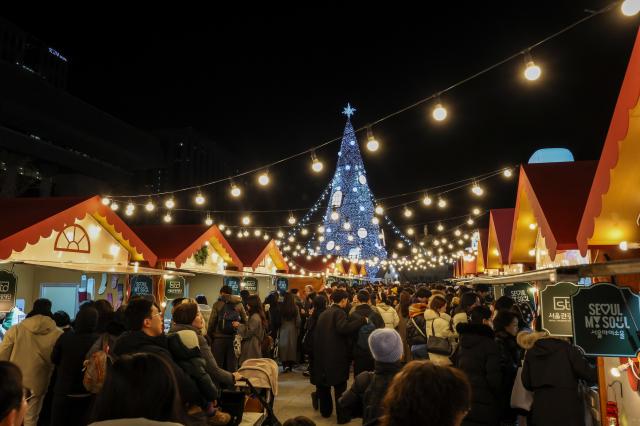
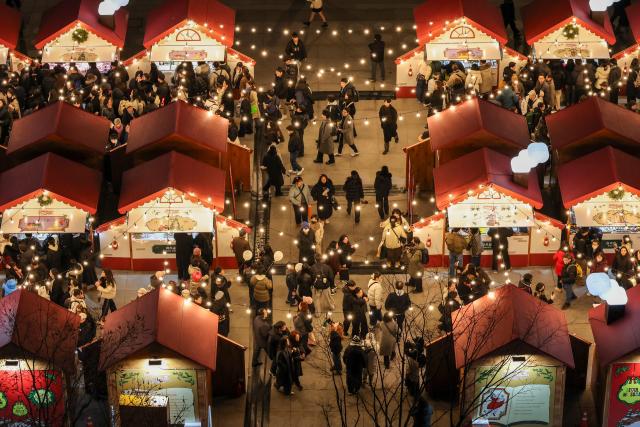
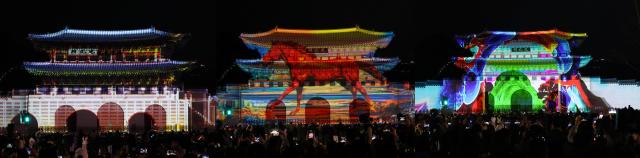
This year’s Seoul Winter Festa runs through Jan. 4 under the theme “FANTASIA SEOUL.” The Gwanghwamun Market recreates a European-style Christmas market as a “Santa Village,” complete with a merry-go-round. Nearby, Seoul Light Gwanghwamun transforms the 630-year-old gate into a massive screen for media art, presented under the theme “Gwanghwa, Breathe with Light.”
In Seoul, Christmas is not defined by a single symbol.
It begins with a tree whose origins predate modern celebration, passes through a kettle that has marked hardship and generosity for nearly a century, and arrives — unmistakably — in light, motion and digital spectacle.
The 2025 Seoul Winter Festa/ AJP Yoo Na-hyun
The 2025 Seoul Winter Festa/ AJP Yoo Na-hyun
Visitors enjoy a media art show projected against the backdrop of Gwanghwamun Gate during the Seoul Winter Festa, Dec. 12, 2025/ AJP Yoo Na-hyun
Different forms, one season.
And a city that chooses to show all of them at once.