

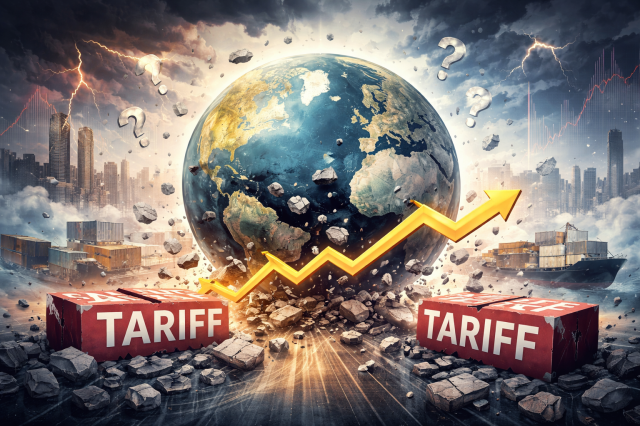
The possible judicial dismantling of Donald Trump’s so-called “reciprocal tariffs” has been greeted by parts of the global market with cautious relief. The assumption is straightforward: fewer tariffs mean less friction, smoother trade flows and a calmer world economy. But that assumption risks mistaking the removal of a symbol for the resolution of a problem. Tariffs were never the core issue. Uncertainty was.
Trump’s tariff policy, controversial as it was, represented only one instrument in a broader political strategy. To frame its collapse as a definitive defeat misunderstands the nature of Trump-style governance. His approach has relied less on any single policy tool than on the creation of leverage through unpredictability. If one legal pathway closes, others may open. What matters most is not whether tariffs survive, but whether economic actors come to believe that U.S. policy itself has become fundamentally unstable.
China’s response illustrates this point. Beijing is unlikely to interpret the weakening of U.S. tariffs as a clear victory. The center of gravity in U.S.–China tensions has already shifted away from trade balances toward technology, finance, supply chains and alliances. For China, the critical question is not whether exports receive a short-term boost, but whether the global policy environment becomes more predictable. In that sense, the end of tariffs may change the terrain, but it does not end the contest.
For South Korea, the dilemma is particularly acute. Commitments to invest in the United States are no longer purely economic calculations; they are embedded in diplomatic and security relationships. Canceling such commitments is not a realistic option. What remains possible is a recalibration of timing and scale. Slowing execution is not a retreat but a rational response to heightened uncertainty. Yet prolonged hesitation carries risks of its own, potentially distorting long-term corporate strategies and investment planning.
Domestic American politics adds another layer of complexity. Legal challenges against Trump may weaken him in the eyes of some voters, but they can also reinforce loyalty among his core supporters. Framed as an institutional conspiracy, judicial scrutiny can deepen polarization rather than resolve it. The result is a political environment in which policy reversals become more likely, not less.
From a global economic perspective, the disappearance of tariffs does not automatically revive investment. Businesses fear volatility more than they fear taxes. When companies suspect that today’s policy relief could be followed by tomorrow’s restrictions, postponement becomes the rational choice. Investment slows, hiring hesitates and growth loses momentum—not because tariffs are high, but because the future is opaque.
The collapse of reciprocal tariffs, then, should not be mistaken for the return of stability. It may instead mark the beginning of a more ambiguous era, one in which the instruments of pressure evolve even as underlying uncertainty intensifies. Markets do not require perfect policies; they require predictable ones. In a world where tariffs fade but volatility persists, the real test for the global economy still lies ahead.
*The author is the President of Global Economic and Financial Research Institute (GEFRI) and AJP columnist.
Copyright ⓒ Aju Press All rights reserved.
