POSCO Future M, the battery materials arm of POSCO Group, said this week it has begun R&D on solid-state battery materials specifically targeting humanoid robots and industrial robotics. Testing of the materials is now under way, with commercialization planned between 2028 and 2030.
Solid-state batteries replace liquid electrolytes with solid materials, improving safety, energy density and charging speed compared with conventional lithium-ion cells. By eliminating risks such as electrolyte leakage, thermal runaway and dendrite penetration, the technology also allows for lighter battery packs — features increasingly critical for mobile robots operating for extended periods.
The global solid-state battery market was valued at $98.96 million in 2024 and is projected to surge to $1.36 billion by 2032, reflecting a compound annual growth rate of 41.6 percent, according to Fortune Business Insights. Asia-Pacific accounted for 43.8 percent of the market last year.
Samsung SDI leads commercialization push
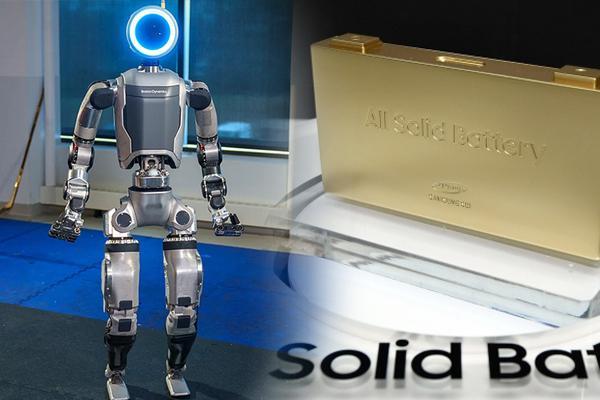
Among sulfide-based solid-state battery developers, Samsung SDI is widely seen as leading the commercialization race. The company aims to bring solid-state cells with energy density of 900 watt-hours per liter (Wh/L) to market by 2027 and is currently supplying samples produced at its Suwon pilot line to customers for performance verification.
"Samsung SDI's earnings appear to be passing through their weakest phase," said Kwon Joon-soo, an analyst at Kiwoom Securities. "Short-term momentum remains intact, supported by expectations for energy storage system orders and solid-state battery investment."
Last October, Samsung SDI signed a tripartite agreement with Germany's BMW and U.S.-based Solid Power to jointly validate automotive solid-state battery technology. The partners plan to install the cells in BMW's next-generation test vehicles as a final verification step.
SK On has set its commercialization target for 2029 — one year ahead of LG Energy Solution's 2030 goal. The company completed a solid-state battery pilot plant at its Daejeon R&D center last year and is now accelerating development. The facility will produce prototype cells for customer supply while evaluating performance and quality.
SK On is developing solid-state batteries with energy density of 800 Wh/L, with a long-term target of reaching 1,000 Wh/L.

The pivot comes as the EV sector — once the industry's primary growth engine — faces mounting headwinds. LG Energy Solution, Samsung SDI and SK On are all projected to post operating losses in the fourth quarter of 2025 as automakers scale back electrification plans and cancel battery orders.
The combined value of terminated contracts in late 2025 alone exceeded 17 trillion won ($11.5 billion). Ford Motor canceled a 9.6 trillion won battery supply agreement with LG Energy Solution in December, followed days later by the termination of a separate 3.9 trillion won deal with Freudenberg Battery Power Systems.
Cathode materials maker L&F disclosed that a 3.83 trillion won high-nickel cathode supply contract signed with Tesla in February 2023 had been reduced to just 9.73 million won — effectively nullifying the deal — amid shifting EV market conditions.
Robots emerge as early solid-state adopters
By contrast, humanoid robotics is rapidly evolving from a speculative concept into a commercial market. At CES 2026 in Las Vegas this month, Chinese firms accounted for 21 of the 38 exhibitors in the humanoid robotics category.
Shanghai-based AgiBot led global shipments with an estimated 5,168 units in 2025, while Unitree Robotics now produces more than 10,000 units per month of its Go2 quadruped robot.
Chinese EV maker XPeng's next-generation IRON humanoid robot is equipped with an all-solid-state battery, while Shenzhen-based Engine AI's T800 model features what the company describes as the industry's first dedicated high-performance solid-state cell, capable of four to five hours of continuous operation.
As both technologies mature, the convergence of solid-state batteries and humanoid robotics is accelerating toward commercial deployment.
Korea joins race via alliance strategy

LG Electronics introduced CLOiD, a home-assistant robot with articulated arms and five-fingered hands, outlining its vision for a "Zero Labor Home." Doosan Group and HL Group also showcased robotics platforms at the event.
Amid surging demand, all three Korean battery makers have joined the K-Humanoid Alliance, a government-backed consortium launched in April to develop high-density, long-life and high-safety batteries tailored for humanoid robots.
The alliance plans to invest 1 trillion won by 2030, with LG Energy Solution, Samsung SDI and SK On leading battery development alongside AI chipmakers Rebellions and DeepX.
For Korea's battery giants, solid-state technology represents both a hedge and a necessity. As China tightens its grip on conventional batteries through scale and cost advantages, the race to commercialize next-generation cells for emerging applications may determine which players remain relevant in the post-EV era.

Copyright ⓒ Aju Press All rights reserved.