SEOUL, January 21 (AJP) - Researchers in South Korea have developed a new structure for catalysts that significantly reduces the amount of expensive precious metals required for hydrogen production and fuel cells.
A team led by Professor Cho Eun-ae from the Department of Materials Science and Engineering at the Korea Advanced Institute of Science and Technology (KAIST) announced on January 21 that they have successfully created ultra-thin nanosheets that outperform traditional particle-based catalysts.
Catalysts are essential for splitting water to create hydrogen and for generating electricity in fuel cells. However, the industry relies heavily on iridium and platinum, rare metals that are prohibitively expensive and prone to degradation over time. Current commercial catalysts use these metals in the form of small particles, which often clump together, reducing their effectiveness and limiting their lifespan.
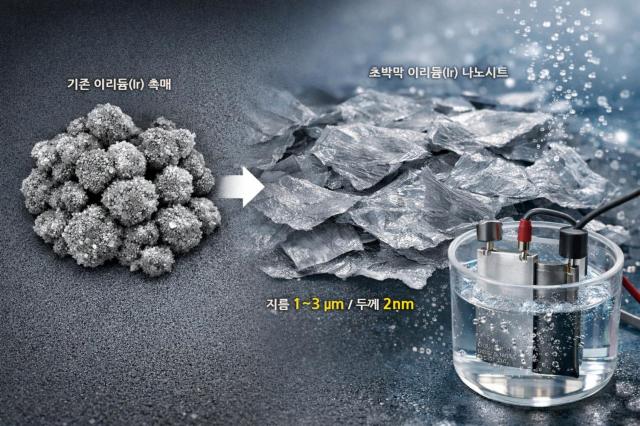
To address this, the research team abandoned the traditional granular form in favor of a sheet-like structure.
By flattening the catalyst material into ultra-thin layers—thousands of times thinner than a human hair—the researchers created a structure that exposes much more surface area to the chemical reaction. This allows the system to generate more hydrogen or electricity using a smaller amount of precious metal.
The new structure also solved a longstanding engineering challenge regarding support materials. Titanium oxide is a durable and inexpensive material, but it is rarely used to support catalysts because it does not conduct electricity well. The researchers found that when the new nanosheets are layered over titanium oxide, the sheets themselves connect to form a conductive path. This allows the stable titanium oxide to support the catalyst without impeding the flow of electricity.
When applied to water electrolysis for hydrogen production, the new iridium nanosheet catalyst improved production speed by 38 percent compared to commercial catalysts. It achieved this performance while reducing the amount of iridium used by 65 percent. The system remained stable for over 1,000 hours under high-load conditions similar to industrial settings.
The team applied the same design strategy to fuel cells using a platinum-copper alloy. The resulting catalyst demonstrated high durability and efficiency.
In fuel cell tests, the platinum-copper nanosheets showed a 13-fold increase in performance per mass of platinum compared to commercial options. The fuel cell performance increased by roughly 2.3 times. Furthermore, the catalyst maintained 65 percent of its initial performance even after a rigorous durability test of 50,000 cycles, proving it to be far more durable than existing alternatives. This was achieved while reducing platinum usage by 60 percent.
"We have presented a new catalyst structure that can simultaneously improve hydrogen production and fuel cell performance while using significantly less expensive precious metals," said Professor Cho Eun-ae. "This research will be a turning point in lowering the cost of hydrogen energy and accelerating commercialization."
The research was supported by the Energy Human Resources Development Program of the Korea Institute of Energy Technology Evaluation and Planning, and the Nano and Material Technology Development Program of the National Research Foundation of Korea.
(Paper information)
Journal: ACS Nano (Impact Factor: 16.0) Title: Ultrathin Iridium Nanosheets on Titanium Oxide for High-Efficiency and Durable Proton Exchange Membrane Water Electrolysis DOI: https://doi.org/10.1021/acsnano.5c15659
(Paper information)
Journal: Nano Letters (Impact Factor: 9.6) Title: Ultrathin PtCu Nanosheets: A New Frontier in Highly Efficient and Durable Catalysts for the Oxygen Reduction Reaction DOI: https://doi.org/10.1021/acs.nanolett.5c04848

Copyright ⓒ Aju Press All rights reserved.