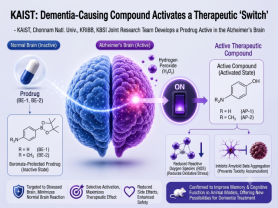
SEOUL, January 22 (AJP) - Researchers in South Korea have discovered that simply rearranging the structure of a potential drug molecule without changing its ingredients can significantly alter its effectiveness against Alzheimer's disease.
A team led by the Korea Advanced Institute of Science and Technology (KAIST) announced on Wednesday that this strategy allows a single compound to simultaneously tackle multiple causes of dementia, offering a potential breakthrough for a disease that has proven difficult to treat with conventional methods.
Alzheimer's disease is a complex condition driven by several interacting factors rather than a single cause. These factors include the accumulation of amyloid beta plaques in the brain, metal ions, and reactive oxygen species. When metal ions interact with amyloid beta, they can increase toxicity and accelerate brain cell damage. Conventional treatment approaches have typically focused on targeting just one of these elements, which limits their overall effectiveness in stopping the disease's progression.
To overcome this limitation, the research team focused on a chemical concept known as "positional isomerism." This involves taking a molecule and, instead of adding new chemical ingredients, simply moving its existing components to different positions on the molecular structure.
The researchers synthesized three variants of a molecule with the exact same chemical composition but slightly different structural arrangements. They found that even these minute changes drastically affected how the molecule interacted with the harmful elements associated with Alzheimer's.
One specific structural arrangement demonstrated the ability to control reactive oxygen species, amyloid beta, and metal-amyloid complexes all at once. By modifying the "placement" of the molecule's components, the team successfully altered its chemical reactivity.
In tests involving mouse models bred with Alzheimer's genes, this optimized compound effectively reduced nerve cell damage in the hippocampus, the region of the brain responsible for memory. It also decreased the accumulation of amyloid plaques. Consequently, the treated mice showed significant improvements in memory and cognitive function that had previously been impaired.
"This study demonstrates that simply adjusting the structural arrangement without changing the molecular composition allows us to simultaneously target multiple causes of Alzheimer's disease," said Professor Lim Mi-hee of the Department of Chemistry at KAIST. "It presents the possibility of a new treatment strategy that can more precisely control diseases with complex, intertwined causes."
The research was conducted in collaboration with Professor Kim Min-keun of Chonnam National University and Dr. Lee Cheol-ho and Dr. Kim Kyung-sim from the Korea Research Institute of Bioscience and Biotechnology (KRIBB). Na Chan-ju and Lee Ji-min, integrated master's and doctoral students at KAIST, served as co-first authors.
The study was supported by the National Research Foundation of South Korea and KRIBB. The findings were published in the January 14 issue of the Journal of the American Chemical Society.
(Paper information)
Journal: Journal of the American Chemical Society (Impact Factor: 15.7) Title: Positional Isomerism Tunes Molecular Reactivities and Mechanisms toward Pathological Targets in Dementia DOI: 10.1021/jacs.5c14323

Copyright ⓒ Aju Press All rights reserved.