

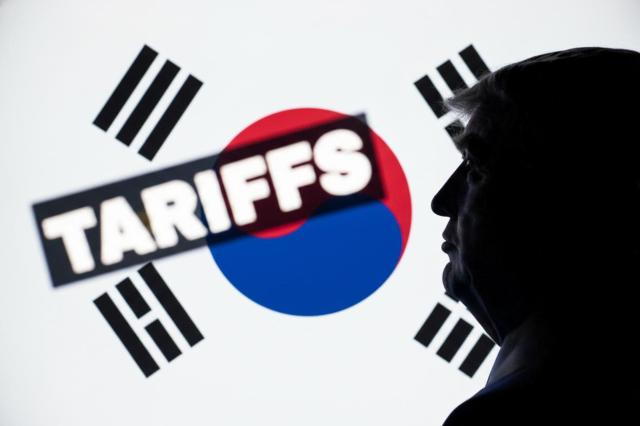
Washington’s displeasure over what it sees as Seoul’s slow follow-through on investment commitments tied to tariff relief had been telegraphed in advance.
According to government sources, the U.S. government sent a letter to Seoul about two weeks ago urging South Korea to fulfill follow-up obligations under the trade-related section of a bilateral “Joint Fact Sheet” agreed last November. The correspondence was reportedly addressed to Foreign Minister Cho Hyun, Industry Minister Kim Jung-kwan and Fair Trade Commission Chair Ju Biung-ghi, and appears to have served as a prelude to Trump’s latest move.
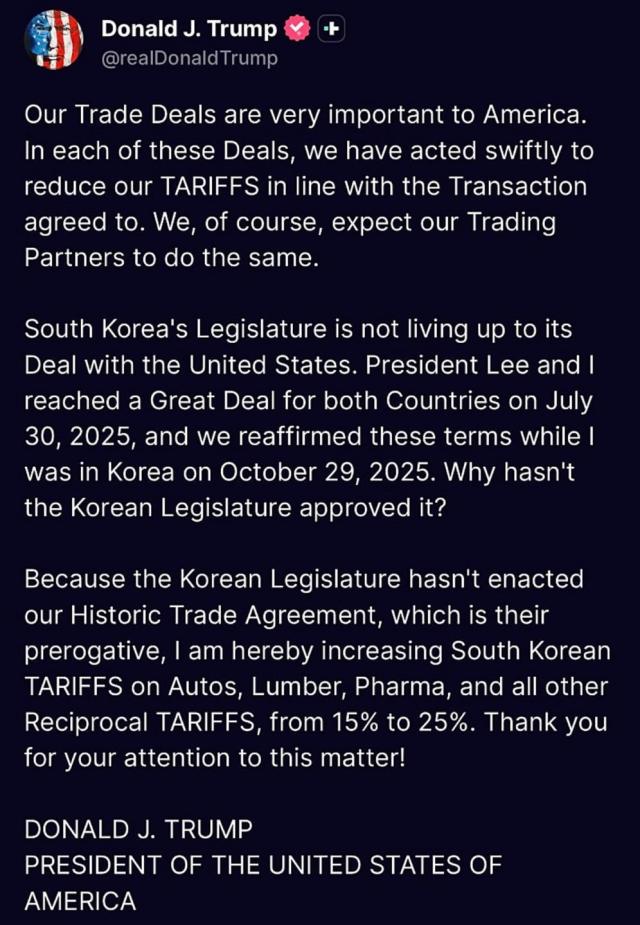
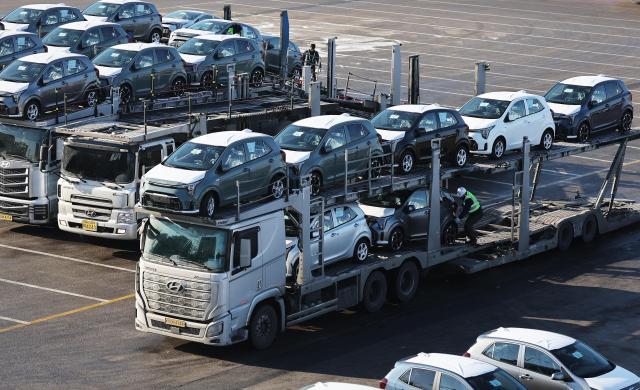
In a post Monday on his social media platform Truth Social, Trump accused South Korea’s National Assembly of failing to complete the legal procedures required to implement the trade commitments. He announced that tariffs on Korean automobiles, timber, pharmaceuticals and “all other reciprocal TARIFFS” would be raised from 15 percent to 25 percent, without specifying an effective date.
Industry Minister Kim, who was in Ottawa to support a Korean consortium bidding for Canada’s submarine procurement project, cut short his schedule and headed to Washington to engage U.S. officials.
U.S. observers noted that Seoul has become the latest target in what they described as a broader Trumpian tariff offensive that has also swept in the European Union and Canada, all accused of foot-dragging on trade or investment pledges.
The overnight threat had an immediate wake-up effect on the political front in Seoul.
President Lee Jae Myung, presiding over a cabinet meeting, criticized the National Assembly for moving “too slowly” on legislation, without explicitly referencing the special bill related to U.S. investment commitments.
“Despite President Trump’s remarks, the National Assembly will proceed calmly according to the planned schedule,” Kim said, adding that tariff-related commitments “are being carried out as agreed.”
Financial markets, however, appeared largely unfazed.
The benchmark KOSPI rose 2.73 percent to close at a record 5,084.85, while the tech-heavy KOSDAQ gained 1.71 percent to 1,082.59. The Korean won weakened only marginally, with the U.S. dollar rising 0.20 won to 1,448.2 won.
“The market rally shows that investors trust the government’s composed response and are not shaken by President Trump’s actions,” the ruling party lawmaker said.
Opposition figures were less sanguine.
Rep. Choi Eun-seok of the main opposition People Power Party argued that the administration had downplayed the need for parliamentary ratification of the trade deal.
“The government’s complacency has given the U.S. an excuse to act unilaterally,” Choi said, calling for a parliamentary hearing with Deputy Prime Minister Koo Yoon-cheol to determine “what went wrong.”
The blame game quickly escalated.
Democratic Party Rep. Cho In-chul countered that opposition lawmakers themselves had slowed legislative progress.
“The agreement clearly states that ratification is not required,” Cho said. “All that’s needed is supporting legislation. The Strategy and Finance Committee is chaired by the opposition, yet they accuse us of inaction.”
Jeffrey Frankel, a professor at Harvard Kennedy School, said Trump was not singling out South Korea.
“He is imposing tariffs that are illegal, illogical and harmful on almost all U.S. trading partners,” Frankel said.
Matthew Bunn, also of Harvard, said Trump’s actions were difficult to explain.
“I have no idea what has caused President Trump to suddenly do this — along with so many other things that undermine the interests of American allies,” Bunn said.
Erik A. Gartzke, a political science professor at the University of California, San Diego, described Trump’s behavior as “bullying.”
“Don’t worry — the Republic of Korea is nothing special,” Gartzke said. “People around the world are learning that Trump is a bully. Accommodate him and he will come back for more. Stand up to him and he usually chickens out.”
John Dunn, professor emeritus at the University of Cambridge, called Trump “a very impatient bully,” arguing that his approach reflects “a minimalist conception of a contract — it binds others but not him unless they have a means to enforce it.”
Trump, Dunn added, “rightly supposes that South Korea is more dependent on the U.S. than the U.S. is on South Korea, and therefore cannot enforce the agreement.”
“This is a completely general pattern of behavior,” Dunn said. “He has only really backed off in the case of China. The South Korean legislative process, meanwhile, is seldom brisk.”
Copyright ⓒ Aju Press All rights reserved.
