

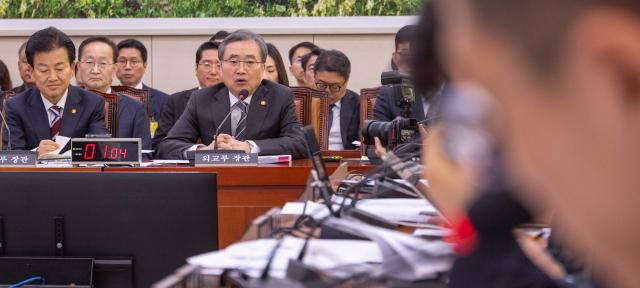
Lawmakers traded blame Wednesday over President Donald Trump’s sudden plan to raise tariffs on South Korea, with the People Power Party arguing the government failed to secure National Assembly approval for follow-up steps in U.S. tariff negotiations after Prime Minister Kim Min Seok’s trip to Washington.
The Democratic Party countered that Trump’s approach to diplomacy and trade is unconventional and said a unified political response is needed to strengthen South Korea’s negotiating position.
People Power Party lawmaker Song Eon Seok told Foreign Minister Cho Hyun at a full meeting of the National Assembly Foreign Affairs and Unification Committee that Kim had promoted his U.S. visit by saying he “promised faithful implementation of follow-up measures” and that communications improved through a “hotline” with Vice President Vance. Song said that “the next day” Trump announced he would raise tariffs to 25%, calling it a betrayal.
Song also cited Trump’s materials as using the word “approve” in asking why South Korea’s legislature had not approved what he called a “special law on investment in the U.S.” He argued it could be read as questioning why the National Assembly had not agreed to ratification, and he urged the government to seek parliamentary consent if there were undisclosed elements.
People Power Party lawmaker Kim Gi Hyeon echoed the criticism, saying it was not a hotline but a “hotbaji line,” using a Korean term implying weakness. He asked why the government was not submitting a ratification motion despite what he said would be a heavy burden on the public. Party lawmaker Kim Tae Ho also pressed Cho, saying the government was blindsided “before the ink was dry” on self-congratulation over a trade deal and asking what it had done to prevent that outcome.
Democratic Party lawmaker Lee Jae Jung said no one denies Trump’s “uniqueness,” but argued the opposition’s continued focus on ratification was effectively holding the government back and reducing agility in South Korea’s diplomatic and economic response.
On the “South Korea-U.S. memorandum of understanding on strategic investment” signed in November last year, Lee said South Korea was not the only country to sign an MOU in that format and that no country was pursuing ratification procedures for it.
Democratic Party lawmaker Hong Ki Won said Trump was taking steps outside established diplomatic practice and warned against treating each move as if South Korea were at fault. “Trump will do more,” Hong said, adding that it was important to respond calmly.
Cho said he believed Trump’s statement about raising tariffs on South Korea was unrelated to the “Coupang situation” or the online platform bill. He said that after the message was issued, the ministry contacted the U.S. State Department and concluded there was no direct link to Coupang or the online platform legislation.
Cho added that it was difficult to identify any specific, reasonable cause and said that may be why Trump issued an additional message.
* This article has been translated by AI.
Copyright ⓒ Aju Press All rights reserved.