

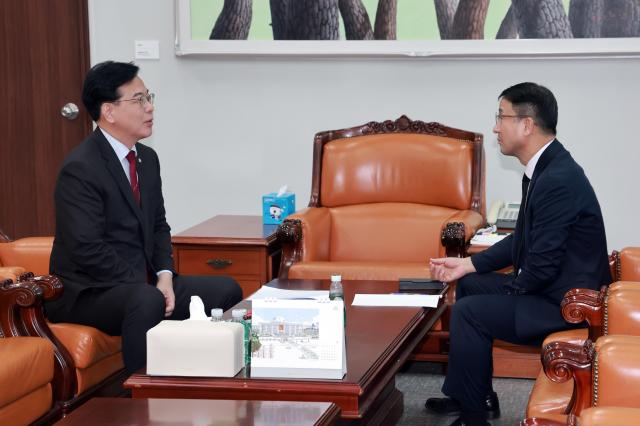
South Korea’s ruling and opposition parties agreed to pass a semiconductor special act and a revision to the National Assembly Act at a plenary session on Jan. 29.
Democratic Party floor leader Han Byung-do and People Power Party floor leader Song Eon-seok reached the deal during a meeting on Jan. 28 in the office of the National Assembly steering committee chair.
The Assembly Act revision would allow the National Assembly speaker to hand off presiding duties if an unlimited debate, or filibuster, drags on, citing the speaker’s fatigue. The parties also agreed to keep the current manual method for voting to end a filibuster, rejecting a switch to electronic voting.
Separately, Democratic Party deputy floor leader for Assembly operations Chun Jun-ho and People Power Party counterpart Yoo Sang-bum agreed later that day to put noncontroversial bills on the plenary agenda.
A total of 90 bills, including the semiconductor special act, were placed on the agenda. The move was seen as an effort to speed up legislation supporting national strategic industries and people’s livelihoods.
An amendment to the espionage law was excluded because the parties remain divided over a provision that would create a new offense for distorting the law.
The February extraordinary session of the National Assembly opens on Feb. 2. Speeches by the leaders of the two parties’ negotiating groups are scheduled for Feb. 3 and 4.
* This article has been translated by AI.
Copyright ⓒ Aju Press All rights reserved.