

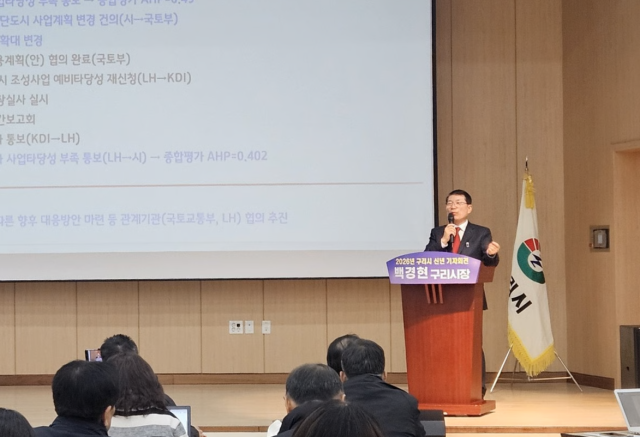
Guri Mayor Baek Kyung Hyun used a New Year news conference on Tuesday to present what he called six operating directions for 2026: welfare, the economy, urban infrastructure, transportation, culture and the environment.
Baek framed the agenda as a question of direction rather than speed, arguing that city policy should focus on where Guri is headed.
On welfare, he emphasized what he described as a tighter safety net, treating support as a system rather than a one-time benefit. He pointed to transportation assistance for older residents and integrated medical and long-term care as administrative responsibilities in a rapidly aging city. On low birthrates, he said the city would approach the issue through housing, caregiving, education and work-life balance rather than relying on cash incentives alone.
On the economy, Baek highlighted traditional markets and neighborhood commercial districts ahead of large-scale development or outside capital, signaling a focus on helping existing merchants endure rather than pursuing short-term stimulus.
On future growth, he cited the Topyeong Hangang Smart Green City plan and a Sano-dong e-commerce advanced city concept, describing them as efforts to change Guri’s role in the greater Seoul area.
On transportation, he pointed to the issue of whether GTX-B trains will stop at Galmae Station, calling it a matter of “citizens’ right to transportation.”
On culture and daily-life infrastructure, he referenced festivals, sports and a new administrative welfare center building, saying city competitiveness should be measured in quality of life.
On the environment, he cited the restoration of the Inchangcheon ecological stream, expansion of Imunan Lake Park and the creation of more walkable streets as steps toward a city focused on management rather than development.
Baek said his guiding phrase for the year is “Nojeokseonghae,” a proverb meaning small accumulations become a sea, underscoring incremental change through repeated execution. He said the six directions are largely already underway, and whether they translate into improvements residents can feel will be determined over time.
* This article has been translated by AI.
Copyright ⓒ Aju Press All rights reserved.