

SEOUL, January 29 (AJP) - South Korea has designated quantum technology as a next-generation national strategic sector and unveiled a broad roadmap to develop technology, infrastructure and talent in parallel.
The country aims to become one of the world’s four leading quantum powers by 2035, leveraging strengths in semiconductors and information and communications technology (ICT) infrastructure.
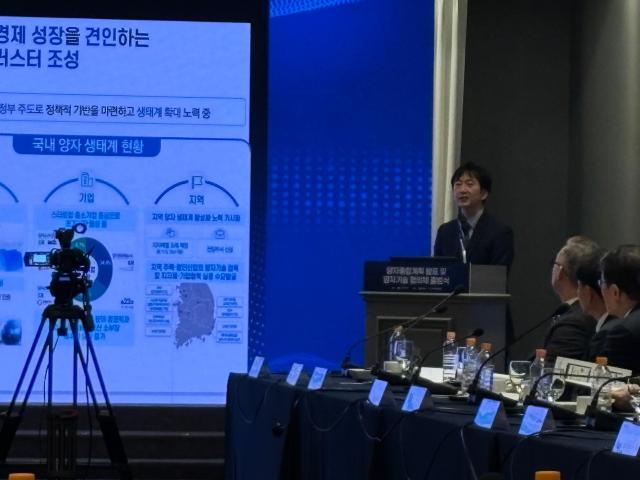
The Ministry of Science and ICT announced the country’s first comprehensive plan on Thursday to foster quantum science, technology and industry, along with an initial master plan to establish a national quantum cluster.
“Quantum technology can break through existing limits across a wide range of fields,” Shim Ju-seop, a ministry official, said at a briefing, adding that the government will pursue becoming an “AI powerhouse and a top-five science and technology power” through the development of quantum AI.
The plan comes as the United States, China, the European Union and Japan treat quantum technology as a core national strategy, with competition accelerating amid tighter export controls and the emergence of technology blocs.
Under the roadmap, the government set near-term technical targets. By 2028, it aims to develop a fully domestically produced quantum computer and expand demonstrations of quantum-secure communications for defense and public-sector use. By 2030, it plans to build a navigation system that can operate independently of the global positioning system (GPS).
To achieve those goals, the ministry said it will support development of a full-stack quantum system, from quantum processing unit (QPU) semiconductors to software, while focusing on identifying practical applications of quantum AI alongside hardware development.
As a focal point for growth, the government proposed creating a quantum cluster, dubbed a Korean-style "Quantum Valley,” to consolidate research and industrial capabilities that are currently dispersed nationwide. The ministry said it will draft guidelines in February, conduct planning and a public call for proposals from March through June, and select a final site in July.
In the selected region, the government plans to build dedicated infrastructure, including a quantum foundry and testbeds, and make them available for open use by companies and research institutions. It also aims to spur industrial transformation and startup growth by combining quantum technology with key local industries through demonstration projects.
On governance, the ministry proposed a new model in the form of a virtual organization — tentatively named the National Quantum Research Institute — rather than a single physical facility, to flexibly link capabilities across universities, research institutes and companies.
The plan also places heavy emphasis on workforce development. The government said it will establish quantum-related graduate and undergraduate programs and, in cooperation with the education and labor ministries, retrain existing ICT workers for quantum-related roles. The goal is to build a comprehensive talent pipeline spanning research-focused master’s and doctoral programs, industry-ready bachelor’s graduates and reskilling opportunities for current workers, Shim said.
The government said it aims to reach its 2035 target of becoming one of the world’s four leading quantum powers and to foster 2,000 companies using quantum technology.
While acknowledging the country entered the field later than rivals, Shim said South Korea would pursue both technological catch-up and early market positioning by drawing on its semiconductor manufacturing capabilities and “world-class” ICT infrastructure, while building an integrated quantum ecosystem of infrastructure, institutions and talent.
* This article, published by Aju Business Daily, was translated by AI and edited by AJP.
Copyright ⓒ Aju Press All rights reserved.
