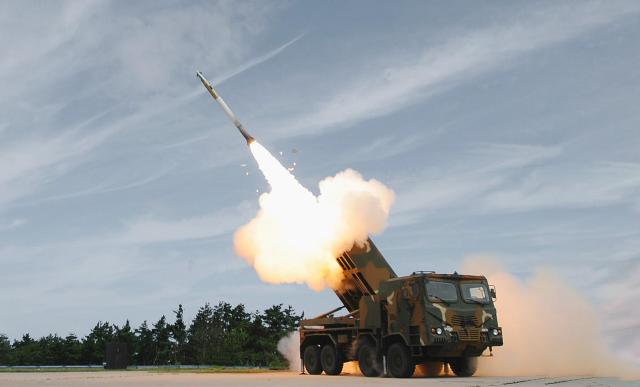
The contract, signed by the Norwegian Defence Materiel Agency with Hanwha Aerospace, covers 16 Chunmoo launchers, precision-guided munitions, training and logistics support, and is valued at roughly 19 billion Norwegian kroner ($2 billion). Deliveries are set to begin in 2028.
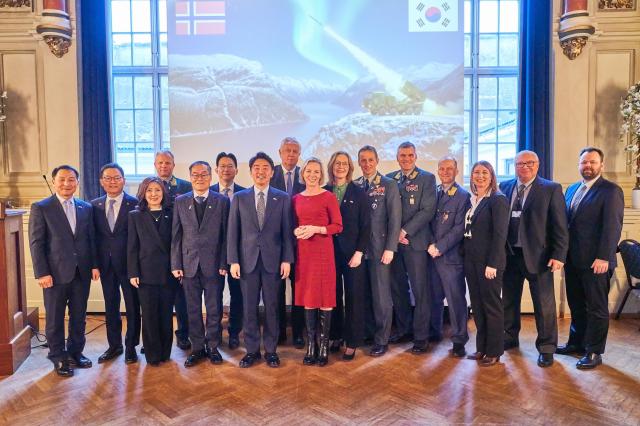
Since Russia’s full-scale invasion of Ukraine, demand for the U.S.-made HIMARS has surged across NATO and allied states, stretching production capacity and pushing delivery schedules years into the future. By contrast, Chunmoo was offered with a clearer delivery timeline and a phased induction plan, allowing Norway to address what it sees as a growing vulnerability in long-range land fires along its northern flank.
“Hanwha’s Chunmoo system was the only offer that met all of the requirements in the competition,” the Norwegian government said in its procurement statement.
A Hanwha Aerospace official, speaking on background, was more direct. “There is a substantial backlog for HIMARS, with deliveries delayed even for priority customers such as Poland,” the official said. “Norway’s assessment came down to delivery certainty and overall affordability relative to capability.”
That calculation extended beyond sticker price. While Norway evaluated proposals from HIMARS and the German-French EURO PULS, Chunmoo was pitched as a turnkey solution — combining multiple rocket types, training, sustainment and future industrial participation under a single framework. Norwegian planners are understood to have placed particular weight on system integration with national command-and-control networks and the possibility of European-based ammunition production.
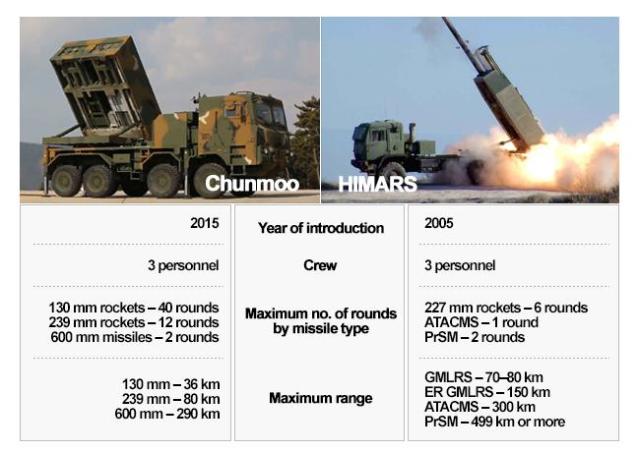
The fundamental distinction between Chunmoo and HIMARS lies in design philosophy.
HIMARS is optimised around the U.S.-standard 227mm MLRS rocket family, along with ATACMS and the newer PrSM-class tactical missiles. Chunmoo, by contrast, was conceived from the outset as a multi-calibre modular launcher. A single K239 platform can fire 239mm unguided rockets, 239mm precision-guided munitions, or 600mm-class tactical ballistic missiles.
In performance terms, the systems are comparable at shorter ranges. HIMARS firing GMLRS munitions reaches about 80 kilometres with a circular error probability (CEP) of under 10 metres. Chunmoo’s CGR-080 guided rockets achieve a similar 80-kilometre reach with a CEP of roughly 15 metres.
Where Chunmoo differentiates itself is payload versatility. The same launcher can be configured for area suppression, precision strikes, or deep fires out to nearly 290 kilometres using CTM-series missiles. In effect, it allows a user to consolidate what would otherwise require multiple weapons systems into a single platform — an approach that appeals to militaries facing both budget constraints and manpower limits.
Relearning the value of long-range fires
Norway’s choice must also be read against its post–Cold War force posture.
For decades, Oslo prioritised expeditionary operations and allied airpower, scaling back heavy land forces and allowing medium- and long-range ground fires to atrophy. That strategy left a conspicuous gap once Russia’s war in Ukraine underscored the enduring value of land-based precision strike — particularly in contested environments where air superiority cannot be assumed.
In the High North, geography compounds the problem. Vast distances, limited infrastructure and extreme weather complicate air operations, making organic long-range fires a central element of deterrence rather than a niche capability. The LRPFS program is designed to restore that capability as a standing feature of Norway’s Army and to reinforce NATO’s ability to secure sea lanes and reinforcement routes in the Arctic.
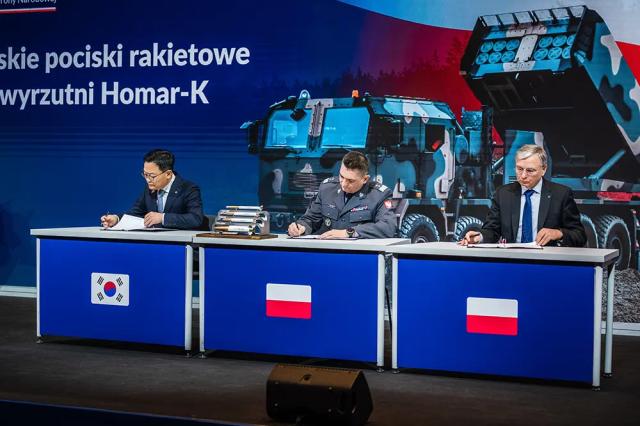
Norway’s decision follows a much larger breakthrough for Chunmoo in Poland, which has effectively served as the system’s European test case.
In October 2022, Warsaw signed a contract for 288 Chunmoo launchers under its Homar-K program, with deployments beginning in 2023. In late 2025, Poland deepened the partnership with a $4 billion deal to locally produce CGR-080 guided rockets.
Those production lines, Polish and Norwegian officials say, will supply not only Poland but other European users, including Norway. The arrangement links Korean system design with Polish manufacturing and Nordic end users — a supply chain that reduces dependence on U.S. production capacity while anchoring key components inside Europe.
The trajectory recalls the earlier spread of South Korea’s K9 Thunder howitzer, now in service across Poland, Norway, Finland and the Baltic states. In much of Northern and Eastern Europe, K9 has become the backbone of tube artillery. Chunmoo is positioning itself as its long-range counterpart — extending that firepower deeper into an adversary’s rear.
While HIMARS remains the benchmark for NATO-standard long-range fires, Chunmoo’s appeal lies in its pragmatism. It offers faster delivery, greater configurability and a clearer path to local industrial participation — attributes increasingly prized by European states confronting a long-term Russian threat, strained defence supply chains and tighter fiscal limits.
The choice also speaks to a broader unease in the High North. Alongside Russia’s militarisation of the Arctic, renewed U.S. attention to Greenland — including Donald Trump’s past and revived suggestions that Washington should assert greater control over the island — has reminded Nordic governments that even allies can become strategic variables.

Copyright ⓒ Aju Press All rights reserved.