

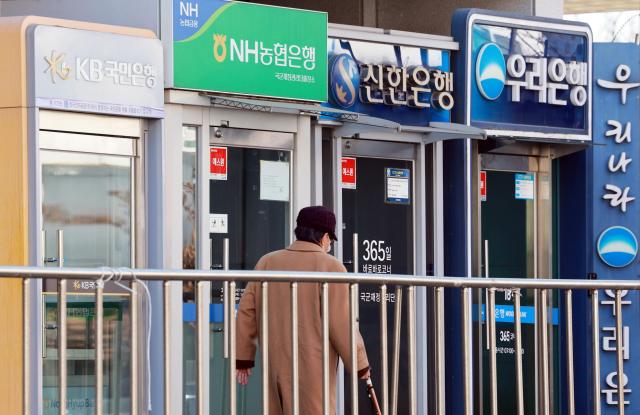
Corporate lending at the start of the year grew at about half the pace of a year earlier, slowing efforts to expand so-called productive finance. Banks and companies are facing what the industry calls a “three-high” environment — higher interest rates, a weaker won and rising delinquencies — while policy incentives have yet to take hold in the market.
As of the end of January, corporate loan balances at South Korea’s five biggest banks — KB Kookmin, Shinhan, Hana, Woori and NH NongHyup — totaled 847.3530 trillion won, according to the financial industry on Monday. That was up 2.6276 trillion won from the previous month’s 844.7254 trillion won, about half the 5.1003 trillion won increase recorded in January last year.
January is typically the busiest month for corporate borrowing as companies set annual business plans and banks reset sales targets, making this year’s slowdown unusual, analysts said. The trend stands out because the Lee Jae Myung government has urged banks to expand lending and investment for businesses, and corporate loans are not subject to the same volume caps applied to household lending.
Banks attribute the slowdown to a mix of worsening macro conditions. With high rates expected to persist, companies have delayed borrowing for new investment or relied on existing credit lines. As of December, the corporate loan interest rate was 4.16% annually, up 0.06 percentage points from a month earlier.
Greater exchange-rate volatility has also made banks more cautious. The industry estimates that for every 10-won rise in the exchange rate, banks’ common equity tier 1 ratio falls by 0.01 to 0.03 percentage points, reducing available capital. The longer the won stays weak and volatile, the more conservatively banks tend to handle corporate lending.
Rising delinquencies have further tightened risk management. As of the end of November, the corporate loan delinquency rate was 0.73%, the highest since November 2018, when it was 0.86%. Delinquencies rose for both large-company loans, from 0.14% to 0.16%, and small- and midsize-business loans, from 0.84% to 0.89%.
Policy support meant to offset these pressures has yet to be fully felt. In September, financial authorities said they would lower the risk weight applied when banks invest in unlisted shares to 250% from 400% to encourage more venture-style capital and expand funding for innovative and growth companies.
But regulators have not finished revising detailed rules needed to implement the plan, delaying banks’ ability to finalize business strategies and adding uncertainty. The Financial Supervisory Service said it plans to complete the revisions in the first quarter.
“A pullback in corporate lending is less about demand collapsing than about uncertainty rising, with both financial firms and companies taking a wait-and-see approach,” a financial industry official said. “If institutional measures that ease risk burdens do not work on time, defensive behavior will not change easily.”
* This article has been translated by AI.
Copyright ⓒ Aju Press All rights reserved.