

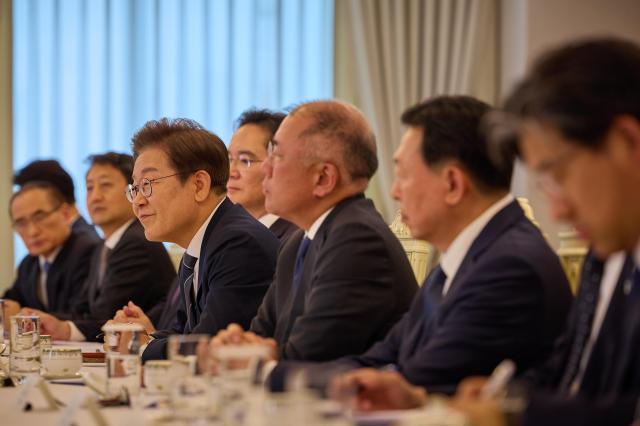
Major South Korean business groups will hold annual general meetings late this month to set business plans and discuss key issues. Attention is on whether Sohn Kyung-shik, chairman of the Korea Employers Federation (KEF), will win a fifth term, and whether the heads of the country’s four largest conglomerates will return to the leadership council of the Federation of Korean Industries (FKI). Also in focus is whether the Korea Chamber of Commerce and Industry (KCCI) will reshuffle executives after a controversy over what it called false information about inheritance tax.
According to the business community on Thursday, FKI, KEF, KCCI and the Korea International Trade Association (KITA) will hold annual meetings from Feb. 24 to 27 to approve business plans and budgets and review last year’s results.
KEF will meet Feb. 24 to decide whether Sohn will serve a fifth term. Sohn, who took office in 2018, has led the group for eight years through four renewals. If approved again, he would lead KEF for 10 years and become its longest-serving chairman. KEF has no separate rule limiting renewals, meaning another term is possible if Sohn agrees.
Sohn, born in 1939, is said to have decided after lengthy deliberation given his age. With major business issues pending — including a revised labor union law set to take effect in March and proposed revisions to the Commercial Act — business leaders have argued he is best positioned to convey management’s views to the government. He has been credited with actively delivering the business community’s positions and concerns about what the article describes as anti-business legislation since the Lee Jae-myung government took office.
A business community official said Sohn has built extensive networks over about 65 years of work and is widely seen as having elevated KEF from a labor-management specialist group to a broader economic organization. The official said Sohn is among the few who can communicate candidly with the government on difficult issues such as labor regulation and Commercial Act revisions, adding that many inside and outside the business community view his working relationship with the Lee government, launched last year, as solid.
FKI will hold a board meeting and annual general meeting Feb. 27. With Chairman Ryu Jin having won another term last year, the meeting is expected to focus on last year’s performance, this year’s plans, and budget and settlement items.
Interest has centered on whether the owners of the four largest conglomerates — Samsung, SK, Hyundai Motor and LG — will return to FKI’s leadership council, though that is seen as unlikely. The four groups rejoined FKI as member companies in 2024, but their owners have not returned to the council.
The leadership council is FKI’s top decision-making body, where major business leaders discuss economic issues and policy direction. Under FKI’s predecessor, the Federation of Korean Industries, about 20 conglomerate chiefs — including Samsung’s Lee Kun-hee, SK’s Chey Tae-won, Hyundai Motor’s Chung Mong-koo and LG’s Koo Bon-moo — met regularly, but the council was dismantled after the 2017 political scandal involving state affairs.
A business community official said Ryu was reported to have tried to persuade the four group owners, but they declined. The official cited heavy corporate agendas and lingering public skepticism about such a top decision-making body as reasons for their reluctance.
KITA will hold its annual meeting Feb. 25 at COEX in Seoul’s Samseong-dong to report 2025 results and approve its 2026 plan and budget, as well as vote on additional appointments of non-standing vice chairmen and directors. Chairman Yoon Jin-sik, who took the post in 2024 under the Yoon Suk Yeol administration, is serving a term through February next year, and there is little discussion of selecting a new chairman.
KCCI will also hold its regular general meeting late this month to report major plans and strategy and last year’s results. After the meeting, discussions are expected to begin in earnest on an executive reshuffle that Chairman Chey Tae-won has signaled. Chey previously announced five reform steps tied to the inheritance-tax false-information controversy, including a review of whether to reappoint executives and a halt to events hosted by the chamber.
A business community official said leaders of major business groups were often replaced when administrations changed, drawing criticism as “parachute appointments,” but this year there are few signs of leadership changes even as terms near expiration. The official said the government and business community appear aligned in wanting practical, working-level leaders amid high uncertainty at home and abroad.
A business community official said leaders of major business groups were often replaced when administrations changed, drawing criticism as “parachute appointments,” but this year there are few signs of leadership changes even as terms near expiration. The official said the government and business community appear aligned in wanting practical, working-level leaders amid high uncertainty at home and abroad.
* This article has been translated by AI.
Copyright ⓒ Aju Press All rights reserved.