

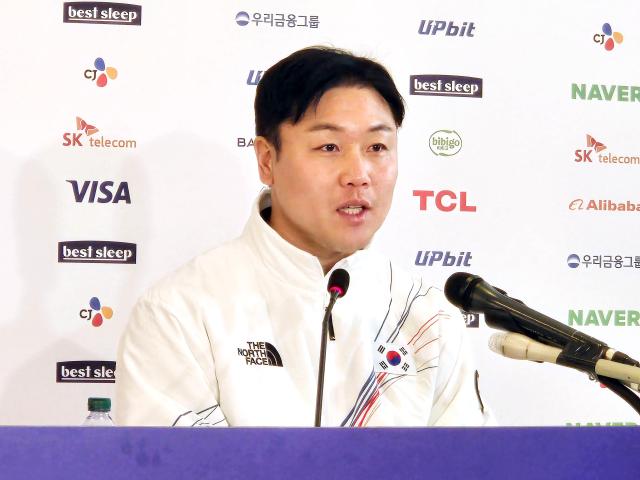
Won Yoon-jong, the first Korean winter-sport athlete elected to the International Olympic Committee (IOC) Athletes’ Commission, pledged to “speak up when needed to protect the rights and interests of all athletes.”
Speaking at a news conference Feb. 20 (local time) at Korea House for the 2026 Milan-Cortina d’Ampezzo Winter Olympics, held at Villa Necchi Campiglio in Milan, Won said, “As an Athletes’ Commission member representing winter sports, I think I can do a good job speaking for them.”
On Feb. 19, Won won the IOC Athletes’ Commission election held during the 2026 Milan-Cortina d’Ampezzo Winter Olympics, finishing first with 1,176 votes. The vote selected the top two finishers out of 11 candidates. He will serve an eight-year term with the same authority as regular IOC members.
Won became South Korea’s third IOC Athletes’ Commission member, following Moon Dae-sung, a taekwondo gold medalist at the 2004 Athens Olympics, and Yoo Seung-min, president of the Korean Sport & Olympic Committee and a men’s singles table tennis gold medalist. Won is the first from a Korean winter sport.
Won described the tension as he awaited the result. “Every minute and second felt incredibly long,” he said. “Because the announcement came in a quiet setting, the tension peaked and I was anxious.”
He credited his win to sincerity. “The one thing I kept in mind while preparing was sincerity,” he said. “I thought the first step was meeting athletes in person, communicating and listening to their voices. I started campaigning with that mindset and kept it to the end, and I think athletes responded positively and voted for me.”
The election is decided by votes from athletes competing at the Olympics. With events spread across northern Italy, Won said the campaign became a physical grind. He recalled saying when he entered the race that he would “run until three pairs of sneakers wear out.”
“With six clusters separated, getting around was especially difficult,” he said. “In places like Livigno, where it snowed or it was cold, it could be dangerous. After standing 14 to 15 hours, it felt like my knees and back wore out more than my shoes.”
Won said he drew on Yoo’s campaign during the Rio de Janeiro Olympics in 2016. “I heard President Yoo walked more than 30,000 steps a day, and I did it with a similar feeling,” Won said. “From morning to night, I communicated with everyone — athletes, volunteers and staff. It’s meaningful that I approached it with sincerity.”
Looking ahead, Won said he wants to broaden support for athletes in countries with limited winter-sports infrastructure. “I’m interested in helping athletes from many countries, including those without snow, understand the value of sport and ultimately support them so they can take part in the Olympics,” he said. “I’ve helped Jamaican sled athletes and supported athletes from Thailand and others who competed at the Youth Olympics as they transition into senior competition, and I want to expand that work.”
Asked about changes to Olympic events, Won said he has heard concerns from athletes about potential cuts. “In the case of Nordic combined or snowboard alpine (parallel giant slalom), I heard athletes say on site, ‘There are lots of spectators and it’s fun — why should it be removed?’” he said. “I think my role is to listen carefully to athletes’ messages and deliver them to the IOC.”
Won said he hopes that after his eight-year term, athletes will say they chose well. “I’d like to hear athletes say, ‘We picked a good representative,’” he said. “I want to do work that repays the trust they placed in me.”
* This article has been translated by AI.
Copyright ⓒ Aju Press All rights reserved.