

According to the industry on Tuesday, the attacks pushed up international crude prices and natural gas prices in Asia and Europe. On ICE Futures, Brent crude for May delivery settled at $77.74 a barrel, up 6.7% from the previous session.
Brent briefly climbed 13% intraday to $82.37, its highest level in more than a year since January last year. On the New York Mercantile Exchange, WTI for April delivery settled at $71.23 a barrel, up 6.3%. WTI also rose as much as 12% intraday to $75.33, the highest since June last year.
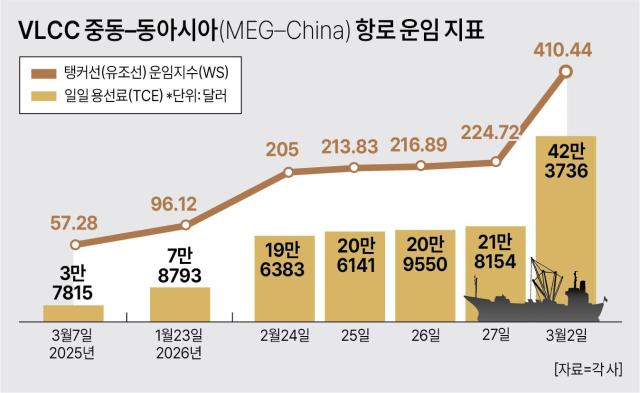
Shipping costs jumped alongside crude. A VLCC (very large crude carrier) rate indicator for the Middle East-to-East Asia (MEG–China) route obtained by Ajou Economy showed the Worldscale (WS) index at 410.44 as of March 2. The corresponding daily time charter equivalent (TCE) was calculated at $423,736.
That was nearly double the level just before the war on Feb. 27 (WS 224.72; TCE $218,154) and more than five times January’s level (WS 96.12; TCE $78,793) in about a month.
Worldscale is the standard benchmark used to settle international tanker freight. A reading below 100 is generally seen as weak and above 100 as strong. Against that yardstick, a move above WS 400 is viewed as an extreme level reflecting war risk, not just a strong market.
The market is increasingly concerned that tanker freight could rise more than tenfold from prewar levels as Iran’s closure of the Strait of Hormuz has effectively become a reality. Marine insurance, a major component of shipping costs, has continued to climb sharply, the report said.
Experts said the fallout for South Korea could be significant because the country depends on the Middle East — where the Strait of Hormuz is located — for about 70% of its imported crude and up to 30% of its natural gas.
If higher crude prices are compounded by rising transport costs, refiners’ import costs would jump, likely feeding into higher prices for petroleum and petrochemical products and higher power-generation costs, squeezing profitability across industries.
The government plans to respond by releasing stockpiled oil and securing alternative supplies. It says it holds about 208 days’ worth of crude reserves, enough to manage short-term disruptions.
But a prolonged closure of the Strait of Hormuz could change the picture. As the war lengthens, releasing reserves alone may not fully ease supply anxiety. The Korea International Trade Association said using detours instead of the strait could lift shipping costs by an additional 50% to 80% from current levels. Transit time and customs procedures could also add up to five days, and in past conflicts in the region, war-risk insurance premiums have been marked up as much as sevenfold.
Oh Hyun-seok, a professor of international trade at Keimyung University, said, “The government says it still has room with its stockpiles, but it is not time to be optimistic.” He added, “If the strait is blocked, South Korea needs to diversify oil imports, and in the short term it needs tax adjustments, such as easing fuel taxes, to reduce the burden on companies and consumers.”
* This article has been translated by AI.
Copyright ⓒ Aju Press All rights reserved.