

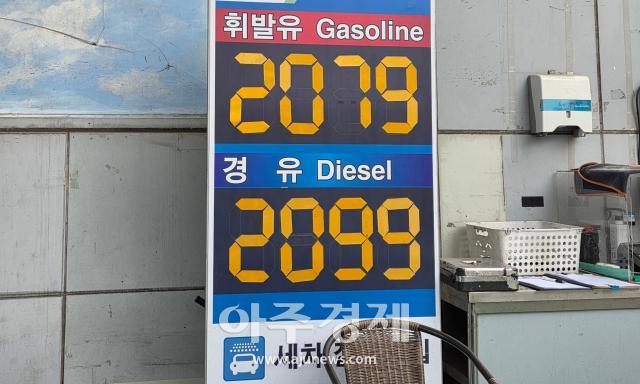
According to the Korea National Oil Corp.’s Opinet price information system, the nationwide average gasoline price stood at 1,894.86 won per liter as of 1 p.m. on March 8, up 5.46 won from the previous day. Diesel averaged 1,917.34 won per liter, up 6.79 won.
Consumers say the increase feels steeper on the ground. While the government has signaled a willingness to intervene strongly — including mentioning a review of setting a maximum price — price gains have only slowed somewhat, and some stations across the country are already posting gasoline and diesel prices in the 2,000-won range. Seoul recorded the highest averages nationwide, with gasoline at 1,945 won per liter and diesel at 1,968 won.
Markets are also bracing for further increases in global crude prices. Goldman Sachs said international oil could top $100 a barrel if tensions in the Middle East do not ease. If disruptions to traffic through the Strait of Hormuz persist, it warned, supply concerns could intensify and add to upward pressure on prices.
Goldman Sachs said that if a blockade of the strait continues, it cannot rule out Brent crude rising above $147 a barrel, as in past spikes in 2008 and 2022. Analysts say if oil moves above $100, South Korea’s gasoline prices would likely break through the 2,000-won threshold.
As cost pressures mount, the industry says it is preparing a response. Three petroleum groups — the Korea Petroleum Association, the Korea Petroleum Distribution Association and the Korea Gas Station Association — said they would actively cooperate so that international oil price increases are not reflected too abruptly at domestic gas stations. Still, the government and consumers appear skeptical of the pledge.
A delivery driver said, “If I make about 30 deliveries a day, I earn around 25,000 won, but after various costs I actually take home only about 10,000 won,” adding, “With fuel prices rising too, it feels like my insides burn every time I fill up.”
Lee Eun-hee, a professor of consumer science at Inha University, said South Korea has sizable crude stockpiles, meaning there is no need to raise domestic fuel prices sharply right away even if global prices rise. “But recently the pace of increases has been excessively fast,” she said, adding that commercial drivers such as delivery workers face an unavoidable burden and that policy support such as energy vouchers should be considered.
* This article has been translated by AI.
Copyright ⓒ Aju Press All rights reserved.