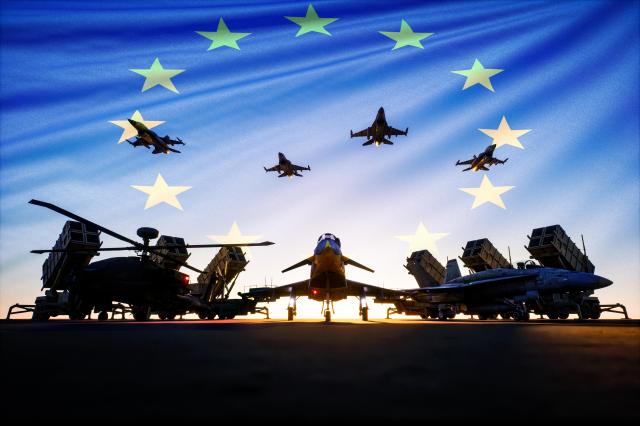
Over the past year, shares of major weapons makers in advanced countries have risen sharply. Some estimates suggest that companies such as Hanwha Aerospace have seen their valuations surge dramatically since early 2024. As the British weekly magazine The Economist observed, defense has become nearly as hot in venture investing as artificial intelligence.
But investors should keep one thing in mind: war does not automatically mean defense stocks will keep rising. Modern history often suggests the opposite. When conflict remains limited, orders for military weapons can increase and earnings may improve. But once war is in full swing, governments often step in to reclaim corporate profits for public purposes — imposing excess-profits taxes, cutting contract prices, restricting dividends and share buybacks, and sometimes capping executives' pay.
History shows it hasn't been simple. During both world wars, the British government imposed high excess-profits taxes to reclaim gains from arms makers. After the U.S. fully entered World War II, it repeatedly renegotiated and lowered prices even on contracts already signed, a practice that continued through the Korean War and the Cold War.
The Economist also cited research showing that from 1938 until the attack on Pearl Harbor, U.S. aircraft manufacturers' shares performed well. But from late 1941 through the end of the war in 1945, returns for the overall U.S. stock market outpaced those of defense stocks. The larger the war became, the less governments tolerated outsized profits.
Today's international environment is reviving that pattern. U.S. President Donald Trump issued an executive order in January barring defense contractors from paying dividends or buying back shares, and he also said CEO pay at defense companies should be capped at about US$5 million a year. Whatever the legal reach, the message is clear: When national security is at stake, governments put public priorities over market logic.
That does not mean long-term demand for defense industries will vanish. In 2025, NATO set a new benchmark targeting 5 percent of GDP, with 3.5 percent for core defense spending and 1.5 percent for security-related investment. Europe's push to rearm amid uncertainty over the U.S. security umbrella is clear. But this does not automatically translate into large-scale orders for tanks, missiles, or self-propelled artillery, since the commitment also covers broader security spending including cybersecurity, protection of energy infrastructure, and upgrades to roads and bridges.
This has implications for South Korean defense companies, which have posted strong results in global markets in recent years. A $13.7 billion contract with Poland in 2022 marked a turning point for South Korea's defense exports, and Hanwha Aerospace has said it aims to double its European sales by 2027. Hyundai Rotem secured a roughly $6.5 billion deal to supply an additional 180 K2 tanks to Poland, while LIG Nex1 won an contract with Iraq worth about 3.71 trillion won for a medium-range surface-to-air missile system.
That success is also cause for caution. The question is not whether defense stocks are worth investing in, but whether they are already priced too high. According to The Economist, Western defense stocks are trading at around 35 times expected earnings, a level not far from Nvidia, which led the boom of artificial intelligence (AI).
A common misconception among South Korean investors is that a major war would automatically boost stocks such as Hanwha Aerospace. The reality is more complex. If a conflict remains limited, expectations of increased weapons demand can lift share prices. But if war drags on and escalates, national finances come under pressure, governments tighten budget controls, and pricing negotiations usually tilt in the state's favor.
Still, the outlook for South Korea's defense industry should not be underestimated. As of 2023, South Korea ranked among the world's top 10 arms exporters, and the government has set a goal of becoming one of the world's four leading defense powers.
Europe's rearmament after Russia's war in Ukraine, growing demand for missiles and other weapons in the Middle East, and security uncertainties in the Indo-Pacific create opportunities for South Korean companies. However, these opportunities will materialize into tangible results only when companies can maintain sufficient production capacity and deliver strong performance in quality, delivery schedules, localization and others.
War pushes up oil prices, higher oil boosts energy stocks, and rising uncertainty lifts defense stocks. History, however, suggests a more complex reality. War can generate orders for defense companies, but it also brings state power that can cap profits. The larger the conflict, the less flexibility companies have; the higher the priority given to national security, the smaller the share left for shareholders.
The right approach to defense stocks is restraint, not euphoria. South Korean defense companies have proven competitive on the global stage. But investors should consider not only whether governments want more weapons, but also how much profit those governments will permit. War can boost revenue, but it does not guarantee a windfall for shareholders. When national security comes first, corporate profits can quickly take a back seat.
* This article, published by Business Daily, was translated by AI and edited by AJP.
Copyright ⓒ Aju Press All rights reserved.