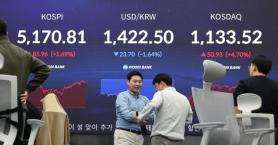
SEOUL, Mar. 11 (AJP) — South Korea’s red-hot equity rally has drawn a flood of money into stock-linked funds, swelling assets at investment managers, but leveraged investment was already showing signs of topping out even before the Middle East crisis jolted markets.
According to data released Wednesday by the Bank of Korea, total deposits at financial institutions reached 93.9 trillion won ($64.05 billion) in February, up 46.4 percent from a year earlier.
The surge was particularly pronounced at asset management firms, driven largely by inflows into equity-linked funds, which attracted 34.1 trillion won during the month.
Following 37 trillion won in January, the two-month inflow represents a more than tenfold increase compared with the same period in 2025, when equity fund inflows totaled just 7.1 trillion won.
The influx came as the benchmark KOSPI surged roughly 50 percent during the first two months of the year, fueled by optimism that South Korea would dominate next-generation memory chips critical for the artificial intelligence boom.

What had looked like an unstoppable rally abruptly stalled after U.S.-led strikes on Iran on Feb. 28 and the subsequent blockade of the Strait of Hormuz rattled global markets.
The KOSPI, which hit an all-time high of 6,307 on Feb. 26, plunged nearly 20 percent between March 3 and March 4, briefly falling below the 5,100 mark.
As of Wednesday, the index had recovered 1.4 percent to 5,609.95, supported by hopes for a ceasefire, discussions among Group of Seven nations on releasing strategic oil reserves and announcements of treasury stock cancellations by conglomerates such as Samsung Electronics and SK Inc. following revisions to the Commercial Act.
Even so, the index remains more than 10 percent below its recent peak.
Leverage nearing its limits
Signs of fatigue had already emerged in credit-driven investment.
Money Market Funds, which serve as liquidity pools for stock trading, recorded inflows of 5.5 trillion won in February — far below the 21.7 trillion won seen a year earlier.
The slowdown suggests the market was hitting record highs even as momentum behind credit-fueled trading began to fade.
Outstanding margin debt reached a record 33.7 trillion won on March 5, before retreating to about 31 trillion won following the sharp market slide.

Similarly, unsettled brokerage accounts fell from 2 trillion won on March 6 to 1.3 trillion won by Monday.
The pullback partly reflected credit limits being exhausted at major brokerages.
Korea Investment & Securities suspended margin purchases and short selling on March 5 after reaching its credit ceiling, with NH Investment & Securities taking similar steps.
The scale of leverage has amplified market volatility.
Forced liquidations accounted for 6.5 percent of unsettled accounts on March 5, the highest level in 31 months since the market slump in October 2023.
“Since credit balances had reached their limit, they became a significant burden on the market,” said Yeom Dong-chan, a researcher at Korea Investment & Securities.
Risk aversion hits KRW and bonds
Meanwhile, flows into fixed-income products weakened as investors reassessed risks.
Bond funds recorded a net outflow of 200 billion won, reflecting heightened volatility in the debt market.
Government bond yields have swung sharply. The three-year treasury yield, which had fallen to 2.95 percent in December, climbed to 3.04 percent in February, while the 10-year yield rose from 3.39 percent to 3.45 percent as markets digested signals from the Federal Reserve under Chair Kevin Warsh.

Following the Hormuz crisis, yields spiked by more than 10 basis points in early March, briefly inverting the spread on March 9 — a signal that heightened concerns about stagflation.
In Wednesday morning trading, the three-year yield slipped 2.7 basis points to 3.256 percent, while the 10-year yield fell 2 basis points to 3.609 percent. Despite the easing, bond prices remain under pressure.
Risk aversion also hit the currency.
The Korean won, which began the year near 1,440 per dollar, briefly plunged toward 1,500 during overnight trading on March 4.
As of 3:30 p.m. Wednesday, the won stood at 1,466 per dollar, down 3 won from the previous day and about 1.6 percent weaker than at the start of the year.

Copyright ⓒ Aju Press All rights reserved.