

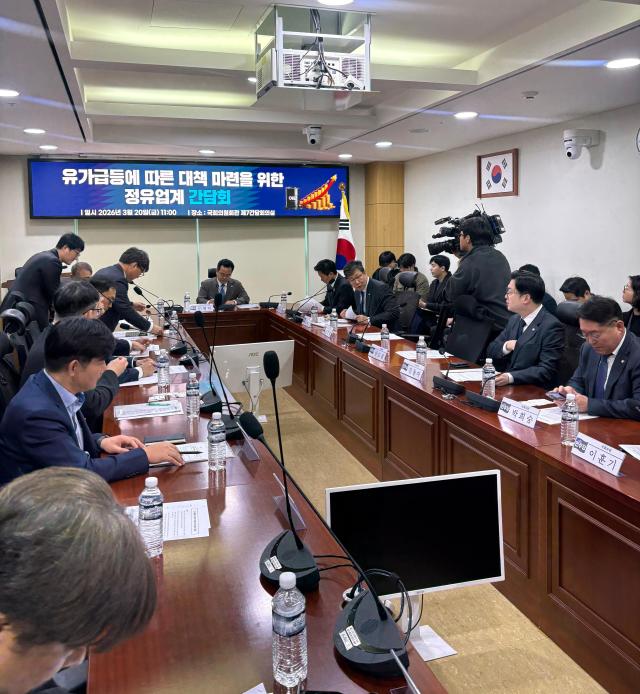
The Democratic Party’s Euljiro Committee held the meeting on March 20 at the National Assembly Members’ Office Building, citing rising household costs as international oil prices jump on Middle East risks. Attendees included the Korea Gas Station Association and representatives from SK Innovation, GS Caltex, HD Hyundai Oilbank and S-Oil.
Gas station operators focused on what they called structural disadvantages in the retail market. Ahn Seung-bae, chairman of the Korea Gas Station Association, said stations do not set prices but sell at prices determined by refiners. When prices rise, he said, stations are blamed for profiteering despite lacking pricing power.
Ahn urged refiners to address practices including all-volume purchasing, after-the-fact settlement, credit card fee burdens and what he described as prices being reflected in advance. He said many stations are effectively tied to buying nearly 100% of their fuel from a single refiner, and that paying before supply prices are finalized — followed by later settlement — increases financing pressure.
Refiners said they shared the need to stabilize supply and ease consumer burdens but were cautious about offering specific solutions on distribution structure, citing limits on what companies can do as crude supply risks intensify.
Lee Sang-yoon, a vice president at SK Innovation, said a blockade of the Strait of Hormuz has become the biggest variable for crude supply, and that any disruption would inevitably have a major impact on the domestic market.
Ahn Young-mo, a managing director at GS Caltex, said the company is using all private inventories to supply petroleum but described the situation as severe. If the Strait of Hormuz blockade is not lifted, he said, “there could be a situation where even naphtha cannot be helped.”
Refiners’ stockpiled volumes could be depleted as early as April, the article said. Additional supplies secured from outside the Middle East and through diplomatic efforts would not be enough to replace existing volumes. The refining industry is asking the government to release strategic reserves.
However, even in a closed-door discussion after opening remarks, participants did not meaningfully address crude supply plans, which refiners consider the top issue. The meeting was seen as confirming the reality of supply uncertainty and the perception gap between refiners and gas stations, rather than producing detailed steps to respond to the price surge.
The Democratic Party’s Euljiro Committee said it plans to form a social dialogue body as early as next week to begin fuller discussions.
* This article has been translated by AI.
Copyright ⓒ Aju Press All rights reserved.