

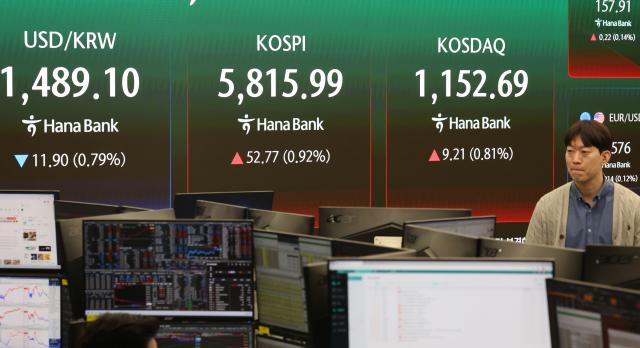
SEOUL, March 22 (AJP) - South Korea’s stock market remains one of the world’s top performers over the past year, backed by heavy retail influx despite rapid foreign pullback due to the economy's heavy exposure to the crippled Strait of Hormuz, causing warnings of bubbly risks.
The benchmark KOSPI hovers around 5,800 despite escalating oil prices and tensions in the Gulf after rising more than 150 percent in less than a year amid heavy swings since the war.
It held tough versus other major markets in the war wake, with the S&P 500 down nearly 4 percent from end-February levels, while Europe’s Stoxx 600 and Germany’s DAX have fallen around 8 percent to 10 percent. Japan’s Nikkei 225 has also retreated more than 9 percent.
By comparison, the KOSPI remains up more than 37 percent from end-2025 levels.
Bank of America (BofA) found the market’s behavior as a “textbook bubble,” pointing to extreme reversals — including a double-digit plunge followed by a near double-digit rebound — that resemble patterns seen during past crises such as 1997 and 2008.
Its proprietary Bubble Risk Indicator, which combines returns, volatility, momentum and fragility, places Korea at near-extreme levels of bubble risk, underscoring the intensity of recent price action.
Valuation metrics add to the caution. The Buffett Indicator has risen above 200 percent, a level widely viewed as significantly overvalued, while the VKOSPI volatility index remains elevated after briefly hitting record highs earlier this month.
The primary force is retail capital returning at scale.
According to Korea Exchange and Koscom data, individual investors have purchased more than 21.8 trillion won ($16 billion) worth of KOSPI shares so far this month, already approaching the record monthly inflows seen during the 2021 pandemic-era rally.
Since January, cumulative net buying by retail investors has reached 34.7 trillion won, and rises to as much as 50 trillion won when exchange-traded funds are included. During the same period, foreign investors sold nearly 50 trillion won worth of Korean equities.
The inflows reflect a broader “money move” across asset classes.
Funds are rotating out of bank deposits, overseas equities and cryptocurrencies, as domestic investors reposition toward Korean equities amid a combination of strong returns and shifting global conditions. Deposits have declined despite rising interest rates, while trading volumes in the crypto market have dropped sharply, signaling waning momentum in alternative assets.
The return of retail investors is not limited to small accounts. High-net-worth individuals are also rotating back into domestic large-cap stocks, while margin borrowing has surged — particularly among younger investors seeking to catch up with the rally.
Data from major brokerages show that margin investors posted average losses of around 19 percent during recent declines, more than double the losses of unleveraged investors. The gap is even wider among younger and smaller investors, where concentrated positions have magnified losses.
Still, many analysts argue the market’s fundamentals remain intact.
On a forward basis, the KOSPI trades at around 9.5 times earnings, below its 10-year average, suggesting that valuations remain relatively attractive after recent corrections.
The rally continues to be anchored by the semiconductor supercycle, with strong earnings momentum in Samsung Electronics and SK hynix supporting broader index gains.
At the same time, external uncertainties — including geopolitical tensions in the Middle East and rising energy prices — continue to inject volatility, with markets reacting sharply to headlines and policy signals. The result is a market increasingly defined by a tension between liquidity and risk.
Copyright ⓒ Aju Press All rights reserved.
