

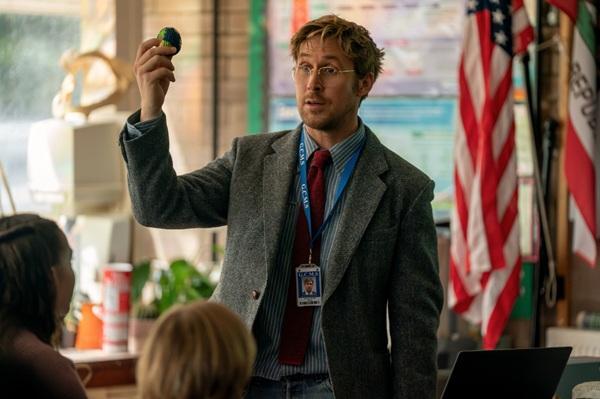
In 'Project Hail Mary,' Ryan Gosling’s character, Grace, can look at first like a familiar genius archetype.
After waking in deep space, he calculates gravity and speed and reasons that he is no longer in the solar system. Instead of collapsing into fear, he observes, forms hypotheses and tests them. He responds to panic with experiments.
The film’s interest, however, is that it does not treat him as a simple hero or a one-note prodigy. Grace is tasked with saving the world, yet he is also an ordinary person with an ordinary routine. He is content teaching children, rides a bicycle to and from work, and lives within his own small comfort. He has no grand ambition to remake society and no outsized hunger for fame. He fits daily life more than sweeping history.
Grace is not cold. He is the kind of person who can offer a brief prayer for someone he never knew. The issue is not indifference but distance: he has goodwill without deep ties, compassion without entanglement. He does not hate people; he is practiced at keeping them at arm’s length.
That is why he cannot immediately step forward for a mission that carries humanity’s fate. Calling it cowardice only partly captures it. He is afraid and does not want to die, and he is not trained to throw himself into a heroic narrative. More fundamentally, “humanity” is too large and abstract for him. He can understand the argument that it must be saved, but that does not automatically translate into a reason to give up his life. He refuses space not because he is uniquely selfish, but because he is recognizably human.

What runs through his psychology is scientific thinking. A scene in which Grace tests falling objects to understand his surroundings underscores science as more than knowledge — it is experiment, failure and repeated challenge. Even in extreme conditions, he does not linger in self-pity. He accepts what is in front of him and looks for the next task. For Grace, science is not only a professional skill but a way to endure fear: he measures instead of breaking down, and he divides problems instead of surrendering to despair.
The film deepens when it shows that even Grace is not completed by science alone. What ultimately changes him is not calculation but relationship — Rocky.
After meeting Rocky, Grace learns for the first time how to survive with someone else. The bond moves beyond the fact that they are different species. They supply what the other lacks: scientist and engineer, thinking and execution, explanation and making, language and sensation. Together they solve problems neither could handle alone, turning friendship into a metaphor for cooperation on a cosmic scale.

The emotional shift matters most. Through Rocky, Grace first feels that he can be essential to someone. He also realizes he cannot endure without Rocky. That is why a celebration scene lands: a laptop filled with human knowledge, a knitted pouch shaped like Earth, the line “Remember me,” and the reply, “You gave me everything.” What is exchanged is not just objects, but time that eased loneliness, a reason to keep living, and the arrival of someone who understands.
From there, Grace’s choices change. If he initially hesitated to risk his life for humanity, later he turns back for Rocky. The shift may seem paradoxical, but it is familiar: people often change more in front of a specific face than for an abstract cause. There are moments when “one friend” becomes a stronger ethical motive than “billions of people.” Through Rocky, Grace learns even how to love humanity — not as a starting point, but as something reached through a single relationship.
That is why Grace differs from a conventional hero. He is not noble from the beginning. He wants to run, hesitates, feels fear and prioritizes his own safety. The character becomes credible not because he is perfect, but because he moves forward while still incomplete.

The name “Grace” is pointed. Read symbolically, he is less a person born with heroic qualities than someone who changes through what he gives and receives in relationships. To Rocky, he is salvation, and Rocky becomes the same for him. Grace is not a figure who saves others in one direction; he is completed within a bond that keeps both alive.
In the end, what sets 'Project Hail Mary' apart is that it places a deeply human question inside the scale of space and science. As critic Lee Dong-jin has said, it is both the story of an exceptional astronaut and an SF projection of problems everyone faces: loneliness, avoidance of responsibility, fear, the need for connection, and the willingness to change for someone else. Grace is a scientist solving problems in space, but also a person becoming larger through meeting another.

* This article has been translated by AI.
Copyright ⓒ Aju Press All rights reserved.