

Newspapers Must Ask ‘Good Questions’ to Create Fresh Perspectives, Korea Newspaper Association Chief Says

by Yoon Juhye Posted : April 7, 2026, 19:54Updated : April 7, 2026, 19:54
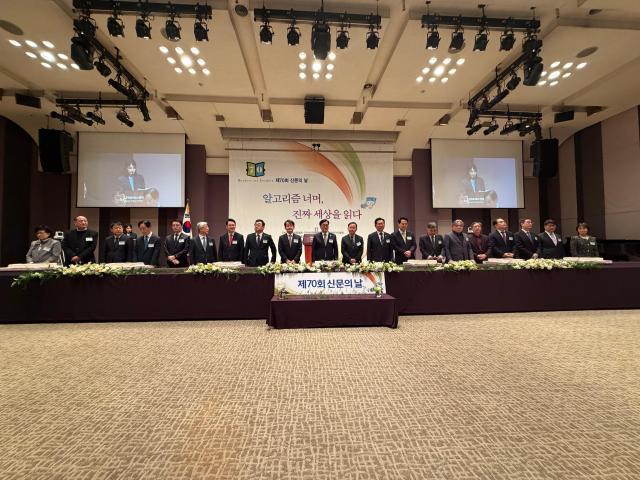
Guests attend a Newspaper Day reception. From left: Heo Myeong, president of the Korean National Council of Women’s Organizations; Kim Hyo-jae, chairman of the Korea Press Foundation; Son Young-shin, vice chairman of the Korea Newspaper Association and publisher of the Busan Ilbo; Kim Yeo-song, vice chairman of the association and publisher of the Gwangju Ilbo; Lee Gyu-yeon, senior presidential secretary for public relations and communication; Lee Byeong-gyu, adviser to the association and honorary chairman of Munhwa Ilbo; Jang Dong-hyeok, People Power Party leader; Park Jong-hyeon, president of the Journalists Association of Korea; Park Jang-hee, chairman of the Korea Newspaper Association and publisher of the JoongAng Ilbo; Woo Won-shik, National Assembly speaker; Lee Tae-gyu, president of the Korea Newspaper and Broadcasting Editors Association; Jeong Cheong-rae, Democratic Party leader; Oh Se-hoon, Seoul mayor; Hong Jun-ho, former chairman of the association and publisher of Chosun Ilbo; Im Chae-cheong, former chairman of the association and publisher of Dong-A Ilbo; Bang Moon-shin, president of the Korea Broadcasters Association; Lee Seong-cheol, vice chairman of the association and publisher of Hankook Ilbo; Jang Seung-jun, vice chairman of the association and publisher of Maeil Business Newspaper; Jeong Seong-eun, president of the Korean Association for Journalism and Communication Studies; and Choi Moon-seon, president of the Korean Women Journalists Association. Photo provided by the Korea Newspaper Association.
Guests attend a Newspaper Day reception. From left: Heo Myeong, president of the Korean National Council of Women’s Organizations; Kim Hyo-jae, chairman of the Korea Press Foundation; Son Young-shin, vice chairman of the Korea Newspaper Association and publisher of the Busan Ilbo; Kim Yeo-song, vice chairman and publisher of the Gwangju Ilbo; Lee Gyu-yeon, senior presidential secretary for public relations and communication; Lee Byeong-gyu, adviser to the association and honorary chairman of Munhwa Ilbo; Jang Dong-hyeok, People Power Party leader; Park Jong-hyeon, president of the Journalists Association of Korea; Park Jang-hee, chairman of the Korea Newspaper Association and publisher of the JoongAng Ilbo; Woo Won-shik, National Assembly speaker; Lee Tae-gyu, president of the Korea Newspaper and Broadcasting Editors Association; Jeong Cheong-rae, Democratic Party leader; Oh Se-hoon, Seoul mayor; Hong Jun-ho, former association chairman and publisher of Chosun Ilbo; Im Chae-cheong, former association chairman and publisher of Dong-A Ilbo; Bang Moon-shin, president of the Korea Broadcasters Association; Lee Seong-cheol, vice chairman and publisher of Hankook Ilbo; Jang Seung-jun, vice chairman and publisher of Maeil Business Newspaper; Jeong Seong-eun, president of the Korean Association for Journalism and Communication Studies; and Choi Moon-seon, president of the Korean Women Journalists Association. (Korea Newspaper Association photo)

"Asking good questions and creating new perspectives through public debate is both the duty and the right of newspapers."

Park Jang-hee, chairman of the Korea Newspaper Association, made the remarks on 7일 at the Korea Press Center during the 70th Newspaper Day ceremony. He said machines cannot raise doubts on their own or empathize with the values of the times and the pain of neighbors.

The ceremony was co-hosted by the Korea Newspaper Association, the Korea Newspaper and Broadcasting Editors Association and the Journalists Association of Korea.

In his address, Park said artificial intelligence can produce answers instantly from vast data, while biased claims spread through algorithms on platforms “as if they were the correct answer.” He called the current moment “an era of answers.”

He said high-quality journalism grounded in facts and balance is “a journey with no final destination.” Citing this year’s Newspaper Day slogan — “Beyond the algorithm, read the real world” — he urged newspapers to dig into truths that cannot be reduced to calculation and to build spaces for unity and public discussion.

Lee Tae-gyu, president of the editors association, stressed responsibility in his opening remarks. “Technology cannot judge and verify what is true, nor does it take responsibility for results,” he said, adding that newspapers exist to put accuracy over speed, trust over sensationalism and responsibility over trends. He said the power to read the real world lies in journalism — in reporters’ on-the-ground verification, editors’ standards and the media’s sense of duty to the community.

Park Jong-hyeon, president of the journalists association, also emphasized rebuilding trust in a message to readers. “AI and algorithms deliver information quickly, but they do not guarantee the truth,” he said. He called on the media to ask more questions, verify more and keep records more responsibly, pledging to choose substance over breaking news and accuracy over speed while staying in the field.

A reception followed the ceremony, drawing about 300 guests including National Assembly Speaker Woo Won-shik; Jeong Cheong-rae, Democratic Party leader; Jang Dong-hyeok, People Power Party leader; Seoul Mayor Oh Se-hoon; and Lee Gyu-yeon, senior presidential secretary for public relations and communication.

In welcoming remarks, Park said that when the world is unsettled, society needs clearer standards of truth, and that newspapers have the strength to push back against falsehoods and extremism. He said that strength comes from trained reporters in the field and rigorous fact-checking. Park added that while the AI era is unlike the past, AI is built on learning, and learning depends on refined accumulations over time — meaning the standing of original journalism and the value of carefully produced works will rise.


* This article has been translated by AI.